
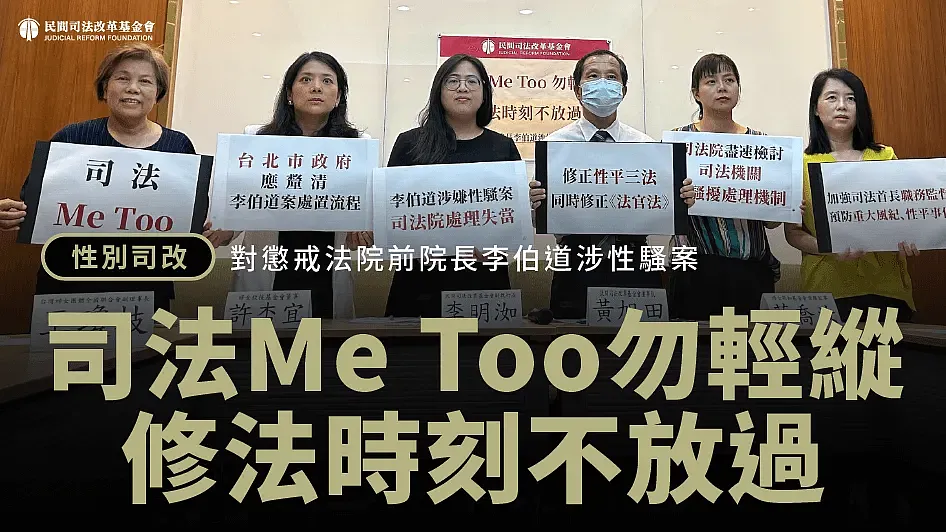
Press Release | No Leniency for Judicial MeToo: A Crucial Moment for Legal Amendments – Press Conference on the Sexual Harassment Allegations Against Former Disciplinary Court President Li Po-tao
Last edited: 2026-07-27
Amidst the recent "MeToo" movement across various sectors, the sexual harassment incident involving Judge Li Po-tao, former President of the Disciplinary Court of the Judicial Yuan, carries profound indicative significance. The Taiwanese public is watching closely: how will the Judicial Yuan, the institution responsible for realizing fairness and justice, handle a sexual harassment incident within its own ranks?
The alleged perpetrator in this case is none other than the President of the Disciplinary Court—the highest-ranking official in charge of the discipline and punishment of civil servants and judges nationwide. If the Judicial Yuan fails to handle and review this properly, it will not only severely undermine public confidence in the judiciary, but also prevent sexual harassment victims nationwide from believing that courts can handle gender equality cases fairly.
To address the Judicial Yuan's mishandling of this sexual harassment incident and to strengthen the prevention of sexual harassment within the judicial system, our organization puts forward the following three demands:
1. Regarding the Judicial Yuan's mishandling of the sexual harassment allegations against Li Po-tao, the Taipei City Government has a responsibility to clarify whether its handling was lawful to be subjected to public scrutiny and legal compliance.
2. The Judicial Yuan should promptly and comprehensively review the regulations, mechanisms, and specific implementation status regarding the handling of sexual harassment incidents by judicial authorities, and make a prompt public explanation to establish public credibility.
3. The Legislative Yuan should amend the Judges Act concurrently during the extraordinary session in July to strengthen administrative supervision over judicial heads and judges, and to prevent sexual harassment and other misconduct.
I. The Taipei City Government has a responsibility to clarify whether the Judicial Yuan's handling of the sexual harassment allegations against Li Po-tao was lawful, in order to be subjected to public scrutiny and legal compliance:
In response to the media reports on June 20 regarding the sexual harassment allegations against Li Po-tao, the Judicial Yuan initially denied any knowledge and publicly conveyed information it knew to be untrue. That same afternoon, the victim published a post confirming the content of the reports, explaining that she requested the Judicial Yuan not to initiate a "Sexual Harassment Grievance Investigation Committee" out of fear that the news would leak and she would face retaliation from Li Po-tao. On June 26, the Judicial Yuan explained that its prior denial of knowledge and failure to launch an investigation were both at the request of the victim; however, the press release acknowledged that the President and the Secretary-General of the Judicial Yuan allowed Li Po-tao to retire while fully aware of the circumstances surrounding the suspected sexual harassment, and considered this act to be "immediate and effective corrective and remedial measures" taken by the employer pursuant to Article 13, Paragraph 2 of the Gender Equality in Employment Act.
In this regard, our organization believes that the statement by the Judicial Yuan is likely to severely mislead public understanding of "immediate and effective corrective and remedial measures."
While protecting sexual harassment victims, the Gender Equality in Employment Act also requires employers to prevent the occurrence of sexual harassment and to actively foster a non-hostile working environment. Article 4 of the "Directions for Prevention, Complaint, and Handling of Sexual Harassment in the Workplace of the Judicial Yuan" and Article 5 of the "Directions for Prevention, Complaint, and Investigation of Sexual Harassment of the Judicial Yuan" also stipulate that once the Judicial Yuan becomes aware of sexual harassment, it shall report it to the Grievance Investigation Committee; when taking "immediate and effective corrective and remedial measures," attention must be paid simultaneously to protecting the victim and disciplining the perpetrator. This is not only to safeguard the safety of the victim, but also to prevent other potential victims in the workplace.
In judicial practice, courts have included "whether the established grievance handling mechanism was initiated for investigation" as a criterion for determining "immediate and effective corrective and remedial measures"1. Yet, the grievance investigation committee mechanism established by the Judicial Yuan was not initiated in this case. We believe that, even when taking into consideration the conflict of obligations faced by the Judicial Yuan between "respecting the victim's wishes" and "reporting and initiating the grievance committee procedure," there remain numerous questionable aspects and mishandling in the treatment of this case, making it difficult to serve as a model for public agencies and private enterprises at all levels nationwide:
1. As a constitutional organ upholding fairness and justice, why is the grievance committee organized by the Judicial Yuan still untrusted by the victim? Did the Judicial Yuan take any measures to enable the victim in this case, and even future complainants, to trust the grievance mechanism?
2. After this incident was reported by the media and identified both the victim and the perpetrator, the Judicial Yuan still publicly conveyed untruthful information under the guise of protecting the victim. Could this measure effectively protect the victim, or did it merely squander the credibility of the Judicial Yuan in vain?
3. Even though the victim was initially unwilling to file a complaint out of fear of retaliation, the Judicial Yuan took no action between May 8 and June 20 after Li Po-tao's retirement. Conversely, had it not been for media exposure, the general public and even the President would have remained completely unaware of this incident; nor did the President and Secretary-General of the Judicial Yuan investigate whether other victims existed or exercise administrative supervision. What must be clarified is whether the Judicial Yuan immediately reported to the grievance committee and initiated relevant mechanisms after Li Po-tao's retirement to avoid leniency? Once Li Po-tao had left the victim's working environment, did the Judicial Yuan make further efforts to gain the victim's understanding so as to initiate the grievance committee? Or did the Judicial Yuan believe that as long as the victim did not proactively file a complaint, the Judicial Yuan should not take any investigative or accountability actions against Li Po-tao?
4. Furthermore, at the handover ceremony for the President of the Disciplinary Court on June 1, the President of the Judicial Yuan publicly thanked and praised Li Po-tao's contributions to the judiciary while knowing full well that he was retiring early due to a sexual harassment incident. In the eyes of the victim and the public, what kind of gender equality values did this convey?
5. Moreover, if allowing Li Po-tao to "legally retire" was the "only" "immediate and effective corrective and remedial measure" at the time, how can the Judicial Yuan explain to the public: if the perpetrator in a future case is not approaching retirement age, will judicial leaders be completely helpless and unable to come up with ways to actively protect victims and hold perpetrators accountable?
The aforementioned issues are not only of vital importance to the clarification of this case, but also affect the handling of gender equality incidents in Taiwan's workplace environments. If the Judicial Yuan's handling method of "ordering the perpetrator to retire" goes unreviewed, this practice risks becoming a "reference template" for public agencies and private enterprises nationwide when handling related incidents, causing profound and adverse impacts.
We call upon the Control Yuan to clarify the aforementioned doubts in its ongoing investigation. Furthermore, to clarify what constitutes "immediate and effective corrective and remedial measures," the Taipei City Government, as the competent authority for gender equality incidents, also bears the responsibility to clarify whether the Judicial Yuan, as Li Po-tao's employer, complied with the requirements of Article 13, Paragraph 2 of the Gender Equality in Employment Act in its handling of this case, so as to facilitate public inspection and compliance.
1 Supreme Administrative Court 2020 Administrative Judgment No. 594 and Taipei High Administrative Court 2021 Administrative Judgment No. 248 refer. Additionally, taking Ministry of Labor Labor Appeal Decision No. 1100025580 as an example, after the hospital in that case received a complaint from the complainant (a nurse) regarding sexual harassment by a patient, although it convened a mediation meeting and transferred the patient to another hospital on the 7th day after receiving the complaint, the appeal committee still upheld the penalty imposed on the hospital for violating Article 13, Paragraph 2 of the Gender Equality in Employment Act because its handling procedure did not comply with regulations and it failed to notify the complainant of the resolution in writing, holding that the sanction was without impropriety.
II. The Judicial Yuan should promptly and comprehensively review the regulations, mechanisms, and specific implementation status of judicial authorities in handling sexual harassment incidents, and publicly explain them to the public to establish credibility:
Furthermore, it is a well-known fact that there is an extreme imbalance of power within the judicial system. Whether it was the 2018 sexual harassment case of Judge Ch'en Hung-pin against a judicial assistant or the 2019 sexual harassment case of Judge Wu Chen-fu against a judicial assistant, the victims who suffered harassment under such power dynamics only surfaced and brought the perpetrators to deserved accountability after enduring tremendous suffering and mental anguish.
However, without fundamentally and systematically improving the friendly workplace environment and perfecting accountability mechanisms, it is feared that such cases will inevitably recur time and again within the judicial system. At a time when society is surging with concern over sexual harassment incidents, cases have emerged not only from the Disciplinary Court but also from the Shilin District Court and Tainan District Court. If the judicial system cannot even set an example internally, how can it be trusted to fulfill its function of protecting vulnerable victims?
In response to this, our organization also calls on the Judicial Yuan to initiate a comprehensive and systematic inventory of the implementation status of sexual harassment and gender equality mechanisms within the Judicial Yuan, and to promptly explain to the public: What will be the standard operating procedures of the Judicial Yuan upon learning of sexual harassment incidents in the future? What are the specific remedial measures? What are the administrative investigation procedures and disciplinary standards for perpetrators? This is to prevent similar incidents from happening again!
III. The Legislative Yuan should amend the Judges Act concurrently during the July extraordinary session to strengthen administrative supervision over judicial heads and judges, and prevent sexual harassment and other misconduct:
Regarding sexual harassment committed by judicial heads abusing their workplace power and resource advantages, aside from post-incident accountability mechanisms for gender equality and discipline, the normative density of the Judges Act concerning the qualifications, selection procedures, performance evaluations, and removal of judicial heads is indeed far too low.
Following the major judicial integrity scandal involving Shih Mu-ch'in in 2020, our organization proposed amendments to the Judges Act concerning administrative supervision (see attachment), stipulating that those serving as court presidents or chief prosecutors must possess standards sufficient to serve as an example for all judges and prosecutors; we also added provisions allowing the Judicial Yuan and the Ministry of Justice to replace court presidents or chief prosecutors when they are "unfit," specifically enumerating that standards of "unfitness" include violating the Code of Judicial Ethics and other circumstances rendering them unfit to serve as presidents. In view of the painful experiences of the Shih Mu-ch'in and Li Po-tao cases, the Judicial Yuan must face this issue squarely.
Meanwhile, in addition to strengthening supervision over judicial heads, the aforementioned draft amendments also reinforce the responsibility of judicial heads—acting as role models—to oversee misconduct by subordinate judges and prosecutors. From the recent sexual harassment allegations involving a presiding judge of the Shilin District Court to the bullying and harassment incident at the Tainan District Court earlier this year, the necessity of reinforcing the supervisory responsibilities of judicial heads is clearly evident. Regrettably, none of the aforementioned amendment proposals were adopted by the Judicial Yuan.
From these incidents, it can be seen that the problem of sexual harassment within the judicial system can no longer be viewed as isolated individual cases. The Judicial Yuan should take this as a warning and immediately initiate systematic reforms. To strengthen internal self-discipline within the judiciary and prevent major judicial integrity and gender equality incidents, our organization calls upon the Legislative Yuan to amend the Judges Act concurrently while amending the "Three Gender Equality Acts" during the July extraordinary session!
Attachment
Attendees
Huang Hsu-t'ien/Chairman, Judicial Reform Foundation
Li Ming-ju/Deputy Executive Director, Judicial Reform Foundation
Hsu Hsing-yi/Director, Awakening Foundation / Taipei Women's Rescue Foundation
Chuang Chiao-ju/Standing Supervisor, Awakening Foundation
Wang Shu-fen/Deputy Executive Director, Garden of Hope Foundation
Wang Chiung-chih/Deputy Chairperson, National Alliance of Taiwan Women's Associations
Wang Wan-yu/Legislator (participating via pre-recorded video)
Fan Yun/Legislator (participating via pre-recorded video)
Press Contacts
Attorney Li Ming-ju, Deputy Executive Director, Judicial Reform Foundation
Phone: 02-2523-1178#22
Email: mj@jrf.org.tw
This article is an AI-generated translation of the original Chinese text. In the event of any discrepancy, the Chinese version shall prevail.