
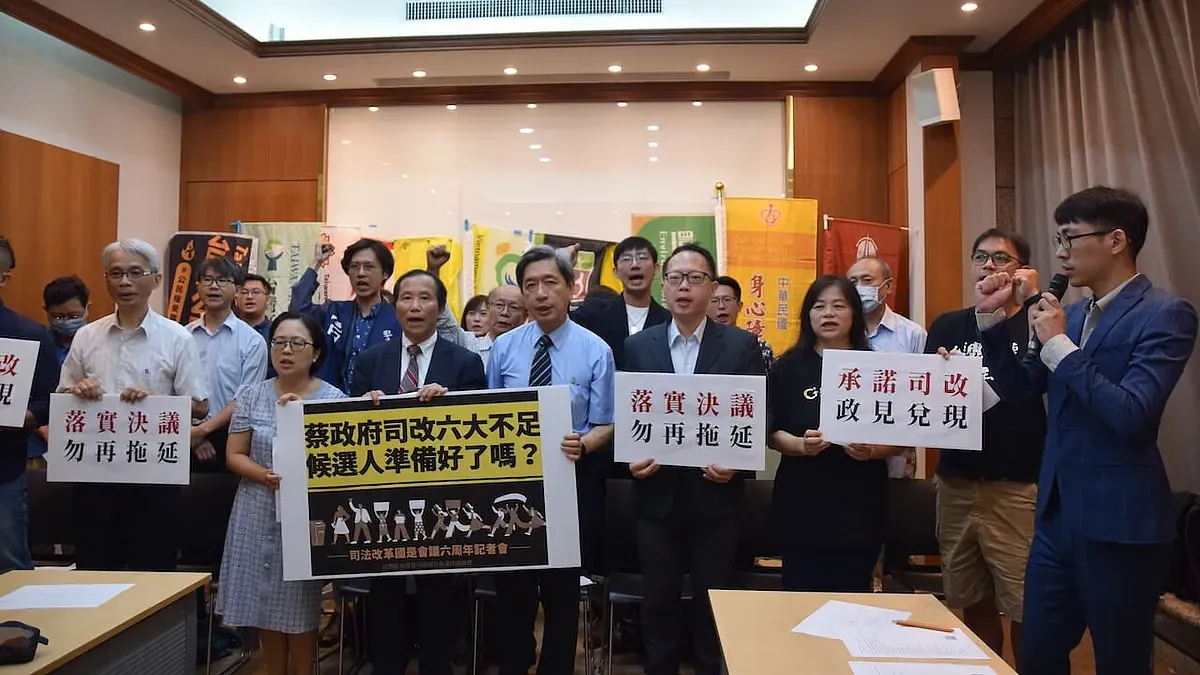
Press Release | "Six Major Deficiencies in the Tsai Administration's Judicial Reform: Are Presidential Candidates Ready?" - 6th Anniversary Press Conference on the National Youth/Judicial Reform Kuo-shih Conference
Last edited: 2026-11-03
- Ministry of Justice Press Release, August 7, 2023
- Judicial Yuan Press Release, August 8, 2023
- Overview of Implementation Status for the 2017 National Judicial Reform Conference Resolutions (Total of 326 items)
This year marks the final year of President Tsai Ing-wen's administration. To evaluate the reform achievements since the conclusion of the 2017 National Judicial Reform Conference, the "Alliance for Monitoring the Implementation of Resolutions of the National Judicial Reform Conference" gathered representatives and members from 21 organizations across various fields to review the implementation status of 326 resolutions item by item.
In terms of substance, although multiple important judicial reform items have seen no progress over the past six years, the scope and items of judicial reform promoted during President Tsai Ing-wen's tenure remain the most extensive of any past president.
However, six major reforms that the government has "deliberated on" for six years without producing any concrete results have severely dragged down the overall pace of judicial reform, casting doubt on the government's determination to advance judicial reform. This Alliance solemnly calls upon the Tsai administration to formally respond, clarify the responsibility for policy delays, and use the remaining time before the election to make amends and swiftly fulfill its reform commitments.
The aforementioned deficiencies and emerging reform issues will also present challenges for future governments. To continuously advance judicial reform, we call upon presidential candidates of all parties to commit to the public on promoting judicial reform, propose policy platforms, and convene conferences upon election to widely incorporate opinions from all sectors of society to drive reform, while utilizing a mechanism of public-private cooperation to monitor implementation. Prior to the election, this Alliance also plans to seek meetings to urge presidential candidates of all parties to attach importance to judicial reform and express our reform demands.
1. Judicial Reform Achievements During President Tsai Ing-wen's Tenure
Regarding the 326 resolutions, this Alliance has reviewed their implementation status item by item as detailed in the explanatory notes. The content of these resolutions is quite complex, and many reform items are difficult for the general public to perceive in their daily lives, yet they are crucial to the quality of "public security," "judicial integrity," "punishment of criminals," and "judgment quality." Accordingly, the following is a summary of the implementation status of the judicial reform conference resolutions by the Tsai administration over the past six years:
(1) Six Major Reforms During the Tsai Administration's Tenure
Reforms introducing new systems such as "国民法官 (Lay Judges)," "Labor Courts," "Crime Victim Protection," and "Constitutional Litigation" have successively completed legislative amendments and officially entered into force in recent years. Compared with the past, these represent significant breakthroughs in institutional content and deserve attention. Regarding the "reform of the prosecutorial system," important measures have been implemented to date, including the "revitalization of personnel assignments in first- and second-instance prosecutors' offices" and "electing chief prosecutors by ballot."
It is also noteworthy that while the judicial reform resolutions overall contained relatively few items on gender equality, laws such as the Stalking and Harassment Prevention Act and measures to "deter crimes involving sexual private images" have been gradually passed in recent years. Together with the recently passed Sexual Harassment Prevention Act, it is expected that judicial authorities and personnel can continuously strengthen their gender equality awareness when handling related cases.
However, the launch of a system is only the first step of reform, and the government must still continuously review the implementation of related policies and systems. Taking prosecutorial reform as an example, a controversy over the selection of chief prosecutors erupted in April this year, and prosecutors' associations concurrently issued appeals, demonstrating that transparency and rationalization both within and outside the prosecutorial system must continue to be promoted. As for the two new systems of "Lay Judges" and "Crime Victim Protection," which just started this year, whether they can actually foster reform in criminal trial culture and methods, reduce the "authority effect" of professional judges on lay judges, or safeguard victims' rights still awaits further review and active promotion by the government.
(2) Six Resolutions with Zero Progress, Dragging Down the Pace of Reform
Although the government has promoted the aforementioned six reform measures, multiple important reform items have seen absolute zero progress.
Regarding resolutions such as "Enacting a Whistleblower Protection Act for the Public Interest," "Consolidating and Enhancing the Quality of First-Instance Trials," "Establishing a Forensic Science Committee and Enhancing Appraisal Quality," "Enacting a Basic Act on Mediation," "Establishing an Independent Special Remedy System for Criminal Miscarriages of Justice," and "Strengthening Reputation Restoration and Social Reintegration for Victims of Miscarriages of Justice," from the past six years up to the present, they remain in the stage of "deliberation." Does no one in the Tsai administration or among the responsible heads need to take responsibility? How much longer must the people wait? And how is the government to make the public believe that these reforms have not been deliberately delayed?
Taking the "Whistleblower Protection Act for the Public Interest" as an example, the draft bill was reviewed and completed by a committee in the previous legislative term (2016–2020), but ultimately failed to pass its third reading. However, after 2020, even though legislators of various parties have proposed 12 versions, because the Executive Yuan has repeatedly failed to submit an official government version, it remains at zero progress to this day.
Taking "Consolidating and Enhancing the Quality of First-Instance Trials" as another example, although the Judicial Yuan proposed appellate court reforms directed primarily at restricting people's right of appeal, it practically failed to propose corresponding countermeasures to "strengthen the quality of civil and criminal first-instance trials," and the review of rules of evidence also came to nothing.
Regarding the reform to "Establish a Forensic Science Committee and Enhance Appraisal Quality," the Judicial Yuan actually proposed complete and viable articles as early as 2019; however, having suffered delays through joint deliberation with the Executive Yuan, it still receives little attention in the Legislative Yuan. If it is not addressed in the next session, it risks rendering the reform efforts a wasted effort. Furthermore, systemic issues in practice such as the lack of uniform standards and methods for scientific appraisals remain stuck in the deliberation stage due to the government's lack of attention.
We believe that the broken promises of these reforms constitute a crisis of governmental credibility. We firmly maintain that the Tsai administration should formally respond, clarify responsibilities, and use the remaining time before the election to make amends and swiftly fulfill its reform commitments.
(3) Most Items Under Implementation Still Require Sustained Effort
Aside from the aforementioned four reform items with zero progress, there are even more policies that require continued tracking and review following adjustments. In these items, official authorities have taken actions to varying degrees, but they still fall short of the reform goals. These include items such as "Rationalizing Police Performance Standards," "Alleviating the Judicial Burden," "Promoting Restorative Justice," "Enforcing Non-disclosure of Investigation," "Strengthening Environmental Protection Legislation," "Prison Administration Reform," "Establishing a Comprehensive Evidence Custody Mechanism," and "Juvenile Treatment Reform." For example:
- "Rationalizing Police Performance Standards": The National Police Agency refused to adopt this, responding instead by including non-governmental experts, scholars, and grassroots representatives in review meetings; however, this still fails to resolve the problems of closed-door policymaking and insufficient integration between police policy and criminal policy. In recent years, adjustments have been made to the performance system, and the approach toward illegal behavior by police personnel has begun to turn toward openness and substantive review, with discussions also arising regarding potential biases in law enforcement. However, related alternative countermeasures clearly have not brought about noticeable improvements to this problem, and major controversial incidents continue to occur.
- "Alleviating the Judicial Burden": The long-term excessive burden on judicial personnel has consistently been one of the bottlenecks hindering judicial reform. The "exodus of prosecutors" frequently reported by the media recently also demonstrates the worsening severity of this problem. However, current policy discussions continue to revolve solely around increasing manpower without fundamentally reviewing how to enhance the efficiency of many links within the judicial system and reduce resource waste without compromising judicial quality.
- "Prison Administration Reform": Amendments to the Prison Act and Detention Act were completed in 2021, introducing the new "External Prison Visitation Committee" system. However, since its implementation, doubts remain regarding the "externality" and "independence" of external visiting members. Secondly, the progressive treatment system remains unchanged, and the examination and recruitment systems for correctional personnel have not been reformed. In addition, the draft amendments to the "Implementation Statute for Juvenile Correction School Treatment" have yet to be completed.
- "Judicial Interpretation": Translations of the main text (holdings) of (non-)prosecution dispositions and judgments are still lacking, and the problem of conversations during courtroom proceedings failing to be adequately interpreted for foreign nationals persists.
- "Enforcing Non-disclosure of Investigation": Although relevant regulations have gradually become complete, situations where information leaks result in the outflow of footage and media stakeouts continue to be witnessed in recent years.
Regarding the reform of the "Training of Legal Professionals," although a comprehensive amendment draft was passed, it has yet to be passed by the Legislative Yuan, causing the reform to stall.
Among the aforementioned reform items, it can also be observed that while the government has taken certain actions, it adopts a rejecting and delaying attitude toward specific reform demands. This overarching problem can hardly be expected to be resolved through internal institutional deliberations. Therefore, six years later today, it is necessary to thoroughly re-examine the implementation status and direction of various resolutions once again while taking stock of emerging judicial reform issues.
2. Clear Reform Commitments, Expressing Determination Through Judicial Reform Platforms
Reviewing the above, it can be seen that whether for items with absolutely no progress or outcomes awaiting further effort, the reason stems from a lack of a mechanism with monitoring power to urge relevant organs to implement judicial reform resolutions.
In response, the 2017 National Judicial Reform Conference actually recommended that it is necessary for the president to design a platform providing continued dialogue for society and relevant government departments, so as to foster joint implementation of resolutions by organs such as the Judicial Yuan and the Ministry of Justice. However, this resolution—intended to "properly implement resolutions"—was itself never implemented.
This Alliance calls upon the future government to draw lessons from the past six years and further advance judicial reform. To this end, this Alliance puts forth the following appeals and plans to visit presidential candidates of all parties:
- Presidential candidates should attach importance to judicial reform and improve the current status of public dissatisfaction with the judiciary.
- Presidential candidates should commit, upon election, to gathering diverse societal opinions and incorporating the voices of the public widely, establishing an open communication platform through conferences to build social consensus in the directions of advancing judicial reform and enhancing human rights protections.
- Regarding the implementation status and progress of judicial reform, the government should cooperate with civil society to jointly establish regular and effective review and monitoring measures.
Appendix
Attendees
Huang Hsu-t'ien / Convenor, Alliance for Monitoring the Implementation of Resolutions of the National Judicial Reform Conference; Member, Fifth Division of the National Judicial Reform Conference; Chairperson, Taiwan Association for Judicial Reform
Lin Yung-sung / Convenor, Alliance for Monitoring Crime Victims' Rights Protection; Standing Board Director, Taiwan Association for Judicial Reform
Lu Ying-chieh / Member, Fifth Division of the Judicial Reform Kuo-shih Conference; Professor, Department of Law, National Chung Cheng University
Li Chun-yi / Member, First Division of the Judicial Reform Kuo-shih Conference; Professor, Department and Graduate Institute of Forensic Medicine, College of Medicine, National Taiwan University
Yapasuyongu'e Akuyana (Ch'en Min-yuan) / Member, First Division of the Judicial Reform Kuo-shih Conference; Chairperson, Taiwan Indigenous Peoples Policy Association
Chiang Jung-hsiang / Chairperson, Judicial Reform Committee, Taiwan Bar Association
Wang Yueh-hao / Executive Director, Garden of Hope Foundation
Shih I-hsiang / Secretary-General, Taiwan Association for Human Rights
Sun Yu-lien / Secretary-General, Taiwan Labour Front
Lo Shih-hsiang / Executive Director, Taiwan Innocence Project
Liu Pei-wei / Executive Director, Taiwan Association of Criminal Defense Lawyers
Ch'en Yen-k'ai / Advisor, Taiwan Police Rights Association
Lü Kuan-hui / Full-time Lawyer, Environmental Jurists Foundation
Nguyễn Văn Hùng / Director, Migrant Workers' and Immigrants' Office, Catholic Diocese of Hsinchu
Huang Sung-li / Director of Policy Center, Covenants Watch
Huang Hui-yu / Deputy Director, Taiwan Forever Association
Chang Che-cheng / R&D Specialist, Taiwan Alliance of Citizens with Disabilities
Lin Ping-feng / Director of Publicity and Campaign Division, Taiwan Civil Human Rights Alliance
Su Hung-hui / Senior Specialist of Advocacy Division, National Alliance of Children and Youth Rights Promotion, Taiwan
Wang Yu-hsiang / Researcher, Taiwan Alliance to End the Death Penalty
Press Contacts
Lü Cheng-yen, Attorney-at-Law, Director of Legal Policy Department, Judicial Reform Foundation
Phone: 02-2523-1178 #37
Email: elvin@jrf.org.tw
This article is an AI-generated translation of the original Chinese text. In the event of any discrepancy, the Chinese version shall prevail.