
Statement|Judicial Reform Achievements: How Do the People View Them and What is the Next Step for Reform?
Last edited: 2026-07-27
2023-08-25 Judicial Yuan Press Release
2023-08-25 Ministry of Justice Press Release
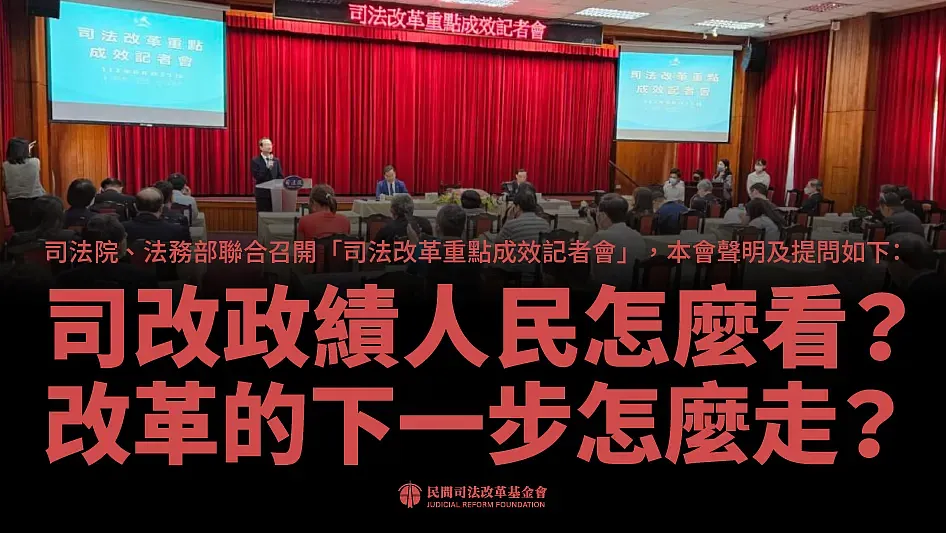
Regarding the "Joint Press Conference on Key Judicial Reform Achievements" held today (the 25th) by the Judicial Yuan and the Ministry of Justice, our Foundation's statements and questions are as follows:
-
Reform Has Just Begun; Achievements Must Be Monitored
Regarding the explanation by the Judicial Yuan and the Ministry of Justice on the achievements of judicial reform over the past six years, our Foundation acknowledges the efforts made by the Ministry of Justice, the Judicial Yuan, and the Legislative Yuan concerning areas where new laws have indeed been revised and passed, such as "crime victim protection," "constitutional litigation," and "labor disputes." However, the passage of new laws does not automatically garner public applause; society expects tangible reform outcomes.
After all, the implementation of these new laws and systems is merely the starting point of reform, not the end. The implementation of new systems does not necessarily elevate the rights and interests of the people. Whether these systems can genuinely fulfill their functions of protecting human rights and promoting fairness and justice must be continuously monitored and addressed.
Take the "Lay Assessor System," which was officially implemented early this year and has recently yielded its first batch of judgments, as an example. With the operation of the system and public attention, it has become apparent that there is still room for review. Whether the adjudication quality of the Lay Assessor System can be recognized and trusted also requires observation. Although implementation has just begun, some problems observed during the simulation phase have gradually surfaced in official cases, making it imperative to review matters such as "reducing the resource gap between prosecutors and defense counsel" and "strengthening the investigation of sentencing evidence and procedures." At the same time, the introduction of new systems such as "expert witnesses (privately commissioned appraisals)" is an urgent priority. Regarding the latter, we deeply hope that the third reading of the draft amendments for "appraisal system reform" can be completed during this final legislative session; regarding the former, how the legal profession responds to the challenges of the new lay assessor system is an issue that cannot be evaded.
-
Where Do Those Stalled Reforms Head?
However, aside from the aforementioned reform items, there are many more items urgently awaiting advancement. Taking the reform achievements listed by the Ministry of Justice as an example, regarding the so-called "intensified crackdown on fraud cases, seizure of illicit criminal proceeds, and restitution of stolen property to compensate victims' losses," how much effectiveness has actually been achieved? Can the results of the "crackdown on fraud" truly be recognized by society? Are case-handling capacities and personnel burdens adequate? Has the judiciary prepared for the massive shift in fraud cases toward the use of "virtual currency and money flows"?
Similarly, although the "promotion of the 'National Institute of Judicial Science'" has been listed as a reform achievement, setting aside the gap between its content and the "resolutions of the National White-Collar/Judicial Reform Conference," from deliberations to the present, completing legislative amendments and initiating reform remains a distant prospect.
In a press conference held on August 7 this year by the "Alliance for Civil Supervision of the Implementation of the National Judicial Reform Conference Resolutions," six major official reform measures were pointed out. More importantly, however, there are many more reforms that the public eagerly anticipates. From the perspective of judges, prosecutors, and judicial personnel, the problem of excessive workloads remains a bottleneck in improving judicial quality.
Among these, six major reforms have seen virtually no progress: "enacting a Whistleblower Protection Act," "consolidating and elevating the quality of first-instance trials," "establishing a Judicial Science Committee to improve appraisal quality," "enacting a Basic Mediation Act," "establishing an independent special extraordinary relief system for criminal wrongful convictions," and "strengthening reputation restoration and social reintegration for victims of wrongful convictions." Taking the "enactment of a Whistleblower Protection Act" as an example, the joint press conference held by the Yuan and the Ministry didn't even mention a single word about it. As for media inquiries, the refrain of "sending it to the Legislative Yuan as soon as possible" has been repeated for years.
We ask the President of the Judicial Yuan and the Minister of Justice: how much longer must the public wait for these stalled reform items? We expect the Judicial Yuan and the Ministry of Justice to continue maintaining an open and proactive attitude to accelerate the pace of reform. We hope Taiwan's rule of law and judicial system can gain international recognition, much like its semiconductor industry.
At the same time, the unfinished business of judicial reform is not solely the responsibility of the Yuan and the Ministry. We expect presidential candidates from all political parties to attach importance to judicial reform, continuously communicate with society, propose a new vision for judicial reform, and strive to realize it upon election.
Press Contact
Lü Cheng-yen, Director of the Legal Policy Department, Judicial Reform Foundation
Phone: 02-2523-1178 #37
Email: elvin@jrf.org.tw
This article is an AI-generated translation of the original Chinese text. In the event of any discrepancy, the Chinese version shall prevail.