
Press Conference | Three Questions and Three Risks Regarding AI-Drafted Judgments: Reducing burdens while managing AI risks
Last edited: 2026-07-27
- 2023-10-06Judicial Yuan Responds to Concerns from All Sectors Regarding the "Smart Judgment Draft System": Currently Formulating Reference Guidelines and Prudently Evaluating the Launch Schedule
- 2023-09-27Press Release on the Judicial Yuan's Response to Suggestions Raised by Civil Organizations at the September 26, 2023 Press Conference on "Three Questions and Three Risks Regarding AI-Drafted Judgments"
- 2023-08-27Judicial Yuan Prudently Develops Generative AI Applications, Debuting with the Drafting of Criminal Judgments; Expecting to Ease Judges' Workloads, with the Core of Adjudication Remaining Decided Solely by Judges
According to a news report on August 27, 2023, the Judicial Yuan, in order to alleviate the judicial burden, is actively building a "Generative Language Model System" (commonly known as the "AI system") based on the TMT5 language model. In the first phase, the Judicial Yuan has applied this to two types of cases: "providing bank accounts" (i.e., aiding and abetting fraud, aiding and abetting money laundering) and "driving under the influence of alcohol or drugs," with acceptance testing and trial implementation scheduled to be completed before the end of September. It will subsequently be applied to matters such as "civil traffic damage compensation" and "debtor relief, rehabilitation, and liquidation."
Regarding the social attention and issues triggered by the AI system, civil organizations make the following appeals:
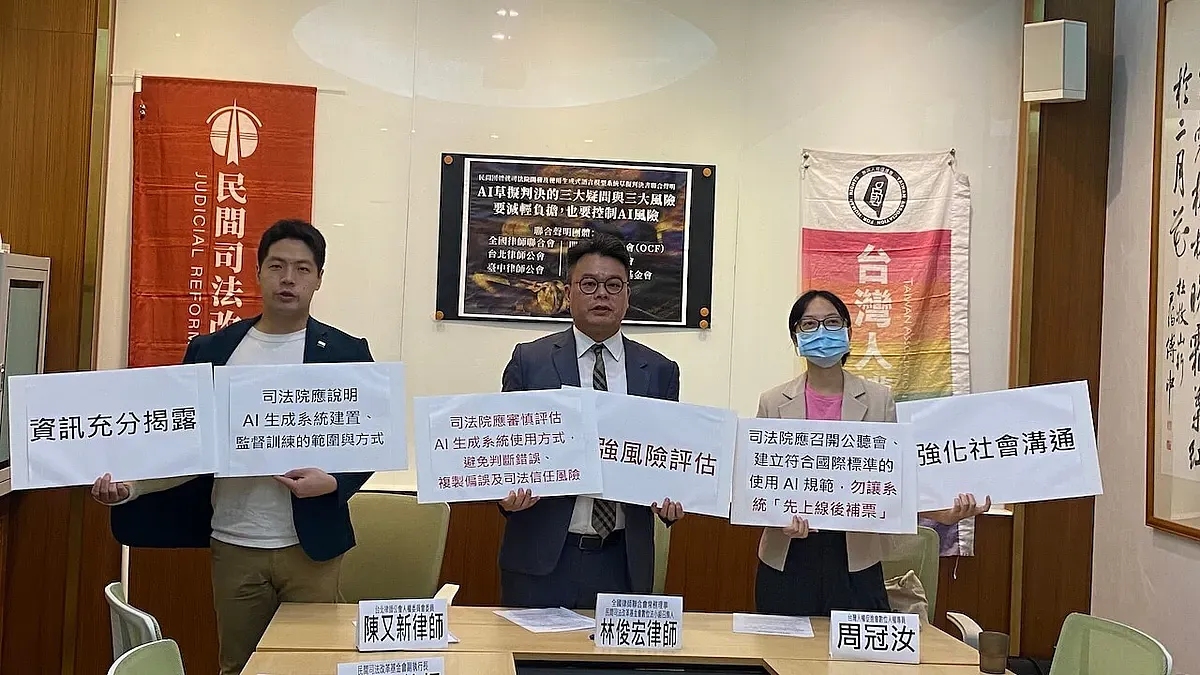
- Full Disclosure of Information: The Judicial Yuan should explain the scope and methods of the AI generation system's construction and supervised training.
- Strengthening Risk Assessment: The Judicial Yuan should prudently evaluate the usage methods of the AI generation system to avoid erroneous judgments, the replication of biases, and risks to judicial trust.
- Enhancing Social Communication: The Judicial Yuan should hold public hearings and establish AI usage norms that comply with international standards before opening the system to judges, rather than letting the system "go live first and issue tickets later."
-
Full Disclosure of Information: The Judicial Yuan should fully explain the methods used to build and train the AI generation system, as well as personal data protection, the generated judgments, and their supervisory mechanisms.
According to the Judicial Yuan's press release, the system has successfully completed development and is about to enter the trial operation phase. This system is built upon the TMT5 language model and has been specifically subjected to supervised training to generate judgment drafts.
Based on this description, the so-called "generative language model" is not a "simple template generator," but an intelligent tool capable of "using corresponding indictments as generation materials to instantly analyze factual data such as criminal facts and evidence." This shows that this system will bring about a major operational transformation in judges' core judicial work of "writing judgments." However, the Judicial Yuan's explanations regarding this major policy still have many deficiencies as follows:
-
According to a Judicial Yuan press interview on September 21, the primary materials during the training phase of this system were a large volume of indictments and corresponding judgment data. What is the time period of the data referred to as a large volume? Regarding the indictments, the Ministry of Justice assisted in providing "de-identified" prosecutorial documents. However, if only judgments and indictments are provided without using the case files, how can the system achieve what the Judicial Yuan claims—that it can "instantly analyze factual data such as criminal facts and evidence" to produce judgment drafts resembling the news screenshots?
-
The construction of this system was outsourced. How was the database for the outsourced vendor's training data built? How is the data stored? Is the data stored with the vendor or managed by the Judicial Yuan? During the process of fine-tuning related parameters, how did the outsourced vendor prevent problems arising from insufficient or biased data? In the contract between the Judicial Yuan and the outsourced vendor, how is the attribution of responsibility handled if related disputes subsequently occur?
-
Even though the Judicial Yuan's press release states that "core matters such as factual determination, legal application, and sentencing decisions remain entirely determined by judges themselves," when a judge uses the system to generate a judgment, can the system record the judge's usage situation? How can it be ensured that "matters of judgment" are still guarded by the judge?
To clarify public doubts, we call on the Judicial Yuan to provide further explanations regarding the above questions, and in particular, to first release the dataset used during training, and simultaneously make it available for joint trial use by stakeholders such as lawyers and prosecutors, so that the public can further examine and evaluate potential data biases and risks.
-
-
Strengthening Risk Assessment: The Judicial Yuan should prudently evaluate the usage methods of the AI generation system to avoid erroneous judgments, the replication of biases, and risks to judicial trust.
The rapid development of artificial intelligence brings the possibility of enhanced work efficiency, but due to its sheer speed of development, looking globally, no one can guarantee that its potential, unknown "risks" have been fully grasped. The draft of the European Union's artificial intelligence act, the "AI Act," has already classified the application of AI in law enforcement and legal interpretation as "high-risk items," requiring rigorous ex-ante and ex-post reviews. Meanwhile, the U.S. National Artificial Intelligence Advisory Committee (NAIAC) also specifically mentioned the particularity of judicial issues in its annual report and recommended conducting specialized policy assessments.
Furthermore, although there are international cases of using AI to assist in litigation (such as the "COMPAS" system used in the United States), judicial institutions abroad using AI are limited to assisting in the stage of "evidence collation" and do not yet extend to drafting judgments and assisting judges in making decisions; moreover, post-hoc auditing mechanisms exist to ensure that cases assisted by AI do not result in inconsistent collated content due to programmatic bias.
However, judging from the Judicial Yuan's press release and the explanatory illustrations used in the news, this system developed and planned for deployment by the Judicial Yuan has transcended the scope of "assisting with collation" and is capable of "assisting judges in decision-making." This will likely generate at least three types of risks:
-
Risk of Erroneous Judgments
According to foreign literature, AI may produce artificial hallucination phenomena, resulting in errors in the generated content. Furthermore, according to research published by Purdue University in the United States, when an AI system's accuracy rate is below 50%, as many as 40% of users are unable to detect errors in the system.
According to the news images, when this system currently generates judgment drafts, it first allows the judge to check options such as "whether pleading guilty" and "which legal provisions to use to handle the case," after which the system automatically generates a draft. The crucial point here is that while the outcome is decided by the judge, the most important reasoning within the judgment is automatically assisted and generated by this system. Consequently, if the content generated by AI contains errors that the user cannot detect, might it directly create the risk of erroneous judgments?
The Judicial Yuan mentioned in a September 21 press interview that this system will not experience "hallucinations" or "confusing identities" like ChatGPT. What are the evaluation standards and processes for this? If the system's risks cannot be completely avoided, how should judges prevent this situation when using it? And how can potential risks during the judges' usage be identified and continuously monitored during the trial phase?
-
Risk of Replicating Systemic Biases
AI still lacks the ability to understand humans and can only answer based on statistically processed results derived from training data; furthermore, AI may also produce biases due to uneven or insufficient raw data. Scholars have warned that in recent years, courts in the United States have widely utilized AI developed by commercial companies to help judges assess defendants' recidivism risks as a sentencing benchmark; however, the operational foundation of this system replicated pre-existing biases and inequalities within the judicial system (such as racial discrimination). The risk of systemic bias requires utmost attention.
According to the Judicial Yuan's press release, this system currently uses existing judgments and indictments as training data, and thus will similarly face this risk. When building this system for use in Taiwan, has the Judicial Yuan evaluated the potential bias risks of the system? What were the evaluation results? What are the strategies projected to monitor and mitigate these risks?
-
Risk to Judicial Trust
Adjudicating cases is not simply a matter of legal interpretation; it also involves cultural differences, immediate contexts, and the genuine thoughts of the parties involved. After all, these complex human considerations, alongside judgments accumulated through individual life experiences, cannot be provided to AI models for training through mere documents and papers. Therefore, for current AI, such determinations remain a major challenge. Taking "providing bank accounts," which the Judicial Yuan plans to prioritize, as an example, determining whether a party intentionally provided an account requires assessing subjective intent that cannot be made based solely on a certain data model. The public can hardly know how judges utilize AI assistance; therefore, we must proceed with extreme caution to avoid damaging public trust in the judiciary.
Moreover, the Executive Yuan's guidelines clearly state that the scope of AI use must be clearly disclosed when utilizing AI. Should the Judicial Yuan's regulations for AI use adopt the same standards as the Executive Yuan's guidelines, how judges can clearly explain AI's participation and role in judgments to ensure the public's right to know and safeguard confidence in the judiciary also warrants thorough discussion.
In summary, civil organizations call on the Judicial Yuan to clearly explain the aforementioned risks to the public; otherwise, it will be difficult to dispel doubts from all sectors of society regarding the Judicial Yuan's use of this system.
-
-
Enhancing Social Communication: The Judicial Yuan should hold public hearings and establish AI usage norms that comply with international standards before opening the system to judges, rather than letting the system "go live first and issue tickets later!"
Admittedly, optimizing the process of judges writing judgments and alleviating the burden of writing judgments can allow judges to reserve their time for important decision-making matters, thereby enhancing the quality of judicial adjudication. The Judicial Reform Foundation has also previously proposed drafts on methods such as "simplifying judgments" or "explicitly stipulating the scope and responsibilities for judicial assistants to draft judgments on behalf of judges." Therefore, utilizing AI systems to assist judges—if it can appropriately reduce unnecessary labor and time costs for judges—is also welcomed by the public and necessary for improving judicial quality. However, the associated risks must also be prudently assessed.
Consequently, civil organizations jointly call upon the Judicial Yuan to hold public hearings when formulating regulations and widely invite stakeholders such as lawyers, prosecutors, and the tech community to participate in order to incorporate diverse opinions. When drafting usage norms, reference should be made to current international standards so that Taiwan's judicial AI applications can align with international regulatory standards before being opened to judges for use. This will reduce or prevent potential systemic risks, ensuring that AI applications serve the protection of the people's fundamental rights and align with the international development trend of "Trustworthy AI."
Joint Statement Organizations
Taiwan Bar Association
Taipei Bar Association
Taichung Bar Association
Open Culture Foundation (OCF)
Taiwan Association for Human Rights
Judicial Reform Foundation
Attending Representatives
Lin Chun-hung, Attorney-at-Law / Executive Director of Taiwan Bar Association, Convener of the Digital Law Group at the Judicial Reform Foundation
Ch'en You-hsin, Attorney-at-Law / Member of the Human Rights Committee of the Taipei Bar Association
Chou Kuan-ju, Specialist / Digital Human Rights Specialist at the Taiwan Association for Human Rights
Li Ming-ju, Attorney-at-Law / Deputy Executive Director of the Judicial Reform Foundation
Press Contact
Ch'iao Cheng-hsiang, Attorney-at-Law / Director of the Case Action Department at the Judicial Reform Foundation
Telephone: 02-2523-1178 #22
This article is an AI-generated translation of the original Chinese text. In the event of any discrepancy, the Chinese version shall prevail.