
JRF Newsletter
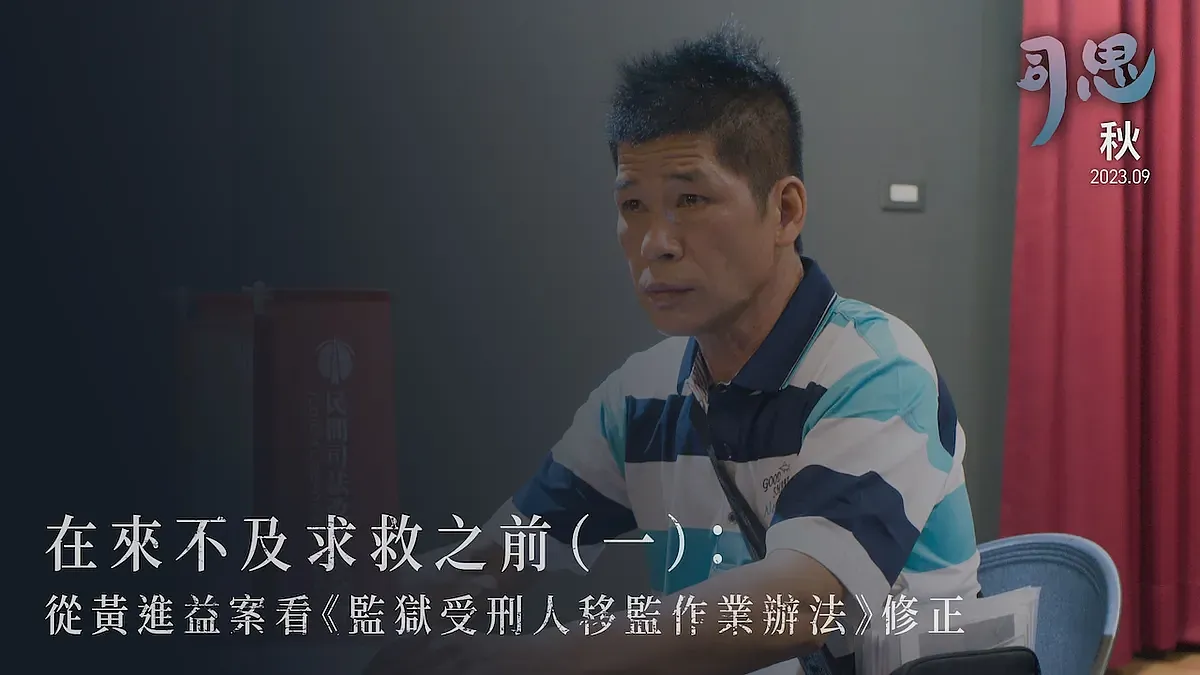
Before Asking for Help in Time| Looking at the Amendment to the Regulations on the Transfer of Prison Inmates through the Case of Huang Chin-yi
Last edited: 2026-07-27
First Meeting, Yet at the End of the Litigation
The Regulations on the Transfer of Prison Inmates were promulgated and implemented in July 2020. Article 3, paragraph 4, subparagraph 5 explicitly stipulates that if an inmate has experienced medical emergencies such as injuries or illnesses within the past month, or has been examined by a physician and ordered to be transferred to a medical institution or prison sickbay for treatment, they shall not be transferred.
At first glance, the provision seems entirely unremarkable. After all, changing prisons requires inmates to readapt to a completely different environment, which is undoubtedly no minor matter. Coupled with the hardships of long-distance travel, if one is injured or ill, it is naturally unsuitable to transfer prisons...... However, one of the reasons this regulation was catalyzed is perhaps because of Mr. Huang Chin-yi.
I first met Huang Chin-yi on the night we learned that the state compensation lawsuit had been dismissed and, after repeated discussions with the pro bono legal team, decided not to appeal. Previously, our understanding of him was limited to the letters he repeatedly sent to the Judicial Reform Foundation (JRF). His writing was always filled with indignation and tenacity, which slightly conflicted with his shy personal image. But that night, Huang Chin-yi perhaps sensed the pro bono legal team's hesitation and the current predicament facing the litigation.
After more than 600 days of awaiting state compensation, Huang Chin-yi ultimately took the initiative to say he was giving up the appeal. Perhaps he was unwilling to let the pro bono lawyers run around for him anymore; when asked about his thoughts, he only repeatedly thanked everyone who had helped him.
The Huang Chin-yi Case: From Minor Offense Parole Revocation to State Compensation Litigation for Prison Medical Care
rHuang Chin-yi is one of the individual cases assisted by the JRF's project on the revocation of parole for minor offenses. During the period when his parole was revoked and he was re-imprisoned to serve his sentence, he frequently visited Peitou Hospital attached to Taichung Prison due to problems such as cervical and lumbar spine degeneration and cervical disc herniation compressing nerves. With the assistance of doctors, he began preparing to undergo surgery to install a cervical spine cage.
However, cervical spine surgery was no small matter for him. Huang Chin-yi recalled, "Surgery requires going through many procedures; it isn't completed just by applying for it and saying this surgery can be done. A single diagnosis takes half a year to determine whether surgery is needed after all. This is very distressing." Coupled with the meager income of at most a few hundred NTD in labor earnings per month during his imprisonment, and burdened with the worry of his elderly mother who needed care at home, the self-funded medical materials and surgical costs were truly a heavy burden for him.
Just as Huang Chin-yi was struggling to raise medical expenses, a sudden move by Taichung Prison completely disrupted Huang Chin-yi's surgical arrangements.
Huang Chin-yi recalled the situation that day: "At that time, it was about two or three in the morning, and it was still very dark, but the lights in the cell suddenly turned on brightly. The central station suddenly called my inmate number, and then gave me about 20 minutes to pack my things, saying they were going to transfer me to Tainan Prison. At that time, I reacted to the central station that I was extremely uncomfortable physically, and also took out the diagnosis certificate showing that I had a surgical plan prepared to proceed. But the central station called the health department to ask, and the health department said it didn't matter—the health department did not know I was going to have surgery. At that time, I did voice my reaction, but they simply couldn't find the record, so I still had to be transferred."
Unlike Taichung Prison, Tainan Prison does not have an attached hospital. For Huang Chin-yi and other fellow inmates, aside from the already exorbitant medical expenses, seeing a doctor also required bearing travel expenses themselves. But in order to complete the original surgical plan and to treat his worsening cervical disc herniation, Huang Chin-yi had no choice but to start from scratch, undergoing examinations anew at a new hospital and discussing the surgical plan with a new doctor.
The Grand Justices once stated in Judicial Yuan Interpretation No. 756 that, "During the period of imprisonment, except for the restriction of personal freedom which incidentally causes other freedoms and rights (such as the freedom of residence and movement) to be restricted as well, an inmate's constitutional rights enjoyed in common with the general public are, in principle, no different."
As ordinary people, we can freely decide when to go to which hospital and which doctor to consult... But for Huang Chin-yi as an inmate, even a surgical plan that had already been arranged could be completely ruined due to the arbitrary administration of the prison.
Huang Chin-yi had previously filed a complaint with the Control Yuan regarding his improper prison transfer. The Control Yuan produced an investigation report stating: "When Taichung Prison handled the transfer, it clearly knew that the complainant (Huang Chin-yi) suffered from the aforementioned diseases, was escorted for medical care to undergo an MRI scan to decide whether to operate, and other facts. Yet, it failed to consult the resident physician Dr. Hsiao and the complainant to understand whether surgery was to be arranged, or whether there were uncompleted referrals or medical tests (examinations) ordered by a physician. It rashly placed the complainant on the roster for transfer to Tainan Prison, and when the complainant handed two diagnostic certificates to the central station on the following day during the transfer, the health department transferred him to Tainan Prison to serve his sentence on the grounds that no surgery had been arranged. This constitutes dereliction of duty." The report rebuked Taichung Prison and sent an official letter requesting the Ministry of Justice, the Ministry of Health and Welfare, and other relevant agencies to review and improve.
Huang Chin-yi's cervical disc herniation deteriorated from the 3rd to 6th vertebrae—which was originally scheduled for surgery at Taichung Prison—to the 3rd to 7th vertebrae, adding the 6th to 7th vertebrae. After being released from prison pursuant to Interpretation No. 796, Huang Chin-yi found the JRF, hoping to file a state compensation lawsuit against Taichung Prison through the assistance of the JRF.
"A very special point in this case is that even before the indictment, there was already an investigation report issued by the Control Yuan," said attorney Wei Kuang-hsuan, one of the pro bono lawyers assisting in this state compensation lawsuit and concurrently a standing executive committee member of the JRF. "Since the Control Yuan had an investigation report directly pointing out that Taichung Prison was negligent, and Huang Chin-yi indeed showed signs that his disc herniation appeared to expand and worsen while he was in Taichung and Tainan prisons, we remained optimistic about applying for state compensation and assisting Huang Chin-yi in seeking damages from Taichung Prison based on the circumstances of tortious damages."
 Photo / Attorney Wei Kuang-hsuan. Photographed by Hsieh Chia-chen
However, even with the investigation report produced by the Control Yuan, the pro bono legal team repeatedly faced the predicament of being unable to shoulder the burden of proof during the litigation process.
"Disc degeneration combined with nerve compression is the result of multiple factors; it is difficult to determine whether, if the patient had promptly received relevant treatment for the cervical disc herniation from the 3rd to 6th vertebrae, the pathology of the 7th vertebra could have been avoided, nor is it possible to determine whether the probability of occurrence could have been reduced." "Surgery for degenerative cervical spine disease is not emergency surgery; some patients can achieve a considerable degree of improvement through conservative treatment (rehabilitation, medication) without surgery. Surgery is recommended only if symptoms persist and affect the quality of life, but this patient did not continuously return for outpatient follow-ups, so the effect of conservative treatment cannot be known." The hospital's reply letter to the court's explanation was ambiguous as usual. Generally speaking, however, the purpose of surgery is to improve medical conditions. If a doctor, when consulting a patient, clearly informs them as the reply to the court did that it is impossible to determine "whether the probability of occurrence can be reduced," how many people, when burdened with huge medical expenses and medical risks, would still make the choice for treatment? But perhaps in medicine, it is indeed difficult to make a definitive judgment of definitely will or definitely will not.
"After all, this case happened inside a prison. When he was transferred initially, he didn't have any proof of physical discomfort either, so it is still very difficult to prove this in actual cases. We kept asking doctors, asking many hospitals, but the answers we got back gave equivocal replies to many questions," said attorney Lin Fu-hao, also a member of the pro bono legal team. "If the burden of proof and the criteria for identifying causation regarding related medical issues in current judicial practice are this stringent, it is still very difficult to actually successfully file a lawsuit (for state compensation) and win a judgment in practice."
"Before Huang Chin-yi filed this state compensation lawsuit, the Control Yuan had already conducted an investigation report and considered that Taichung Prison was negligent. Yet when we actually litigated this state compensation, we found that there were still huge difficulties in the burden of proof. The Control Yuan had already investigated and stated there was negligence, but in reality, seeking compensation still failed," attorney Lin Fu-hao said with a hint of quiet helplessness.
 Photo / Attorney Lin Fu-hao. Photographed by Hsieh Chia-chen
From One Person to Everyone
After the Control Yuan rebuked Taichung Prison and requested the Ministry of Justice, the Ministry of Health and Welfare, and other relevant agencies to review and improve through an official letter, the Ministry of Justice promulgated the Regulations on the Transfer of Prison Inmates. The pro bono legal team all affirmed this amendment. "Because once this regulation comes out, at least all prison personnel have an obligation to review when performing related transfer actions," attorney Wei Kuang-hsuan said. "If inmates know they have this right, once there is another situation of arbitrary transfer, they will have a foundation to file appeals."
Huang Chin-yi's incident may have catalyzed the Regulations on the Transfer of Prison Inmates, bringing further protection to inmates' human rights, but it also indirectly highlights how arduous it is for inmates to fight for their own rights when facing a massive state apparatus.
 Photo / In the middle is Control Yuan Member Kao Feng-hsien; photo sourced from the Control Yuan website
Writing up to this point, Control Yuan Member Kao Feng-hsien, who originally led the investigation of this case, has passed away for two years. When Huang Chin-yi came to the JRF for the first time after being released from prison, he mentioned that he was deeply grateful to the Member for seeing his case and visiting the prison in person, but by the time he was released, he no longer had the opportunity to express his gratitude.
"I simply endured until there was no other way, until the pain was unbearable, before pressing the call light to request being sent to a doctor. If half an hour had passed and no one came, I probably would have died," Huang Chin-yi shared, speaking of the various things he had witnessed inside the prison. "Compared to other fellow inmates whose rights are even more ignored, I am considered fortunate that someone was willing to help me. Actually, since it happened, and the Control Yuan has rebuked them, who is right and who is wrong no longer has any meaning. But if my matter can enable the prison to take administrative matters into consideration in the future, and if this is good for everyone, then it counts as doing a good deed."
References
This article is an AI-generated translation of the original Chinese text. In the event of any discrepancy, the Chinese version shall prevail.