
JRF Newsletter
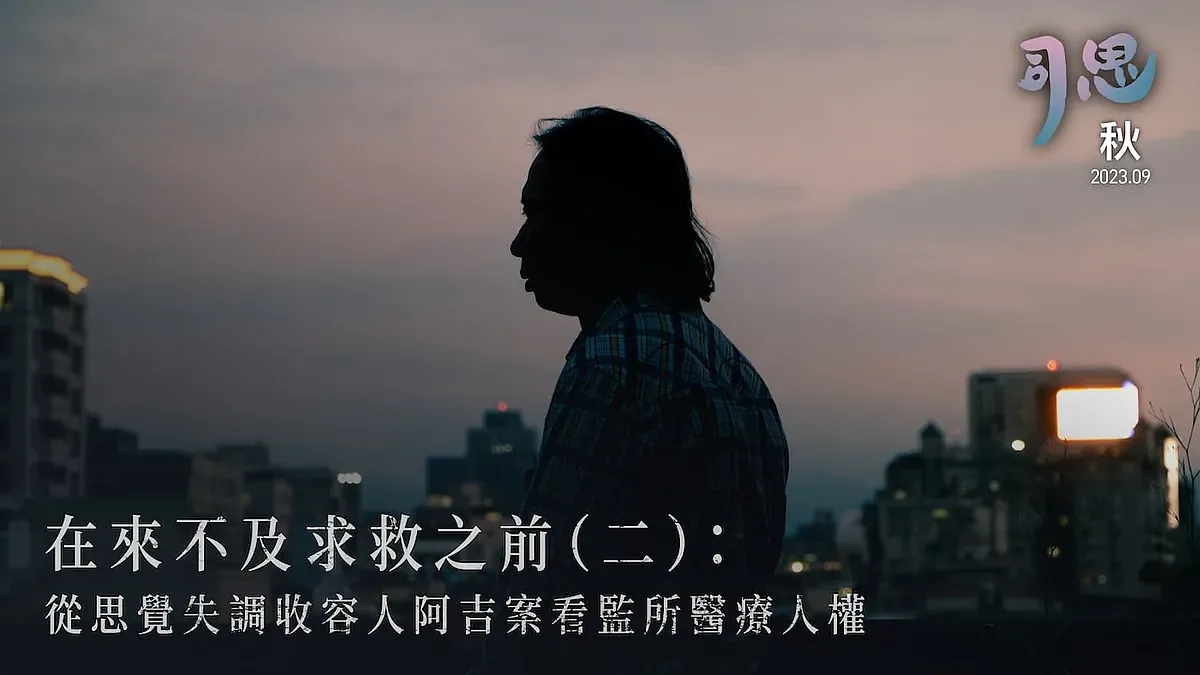
Before Calling for Help Arrives: Medical Human Rights in Correctional Facilities Through the Case of A-Chi, an Inmate with Schizophrenia
Last edited: 2026-07-27
A-Chi (a pseudonym) is an inmate suffering from schizophrenia. Due to a relapse, he committed severe domestic violence and was sentenced to 3 years of custodial treatment prior to the execution of his sentence, followed by 1 year and 8 months of imprisonment. On the very day he was transferred to prison after completing his pre-sentence custodial treatment, he was hospitalized for heatstroke and rhabdomyolysis. Thereafter, his health deteriorated rapidly in prison. Within just 5 months of serving his sentence at the Taipei Prison (August 2018 to January 2019), he had 20 internal clinic visits, was sent outside for medical care 7 times, and was hospitalized 5 times, ultimately being rushed to the hospital after suffering cardiac arrest. He remains out of prison on medical parole to this day.
The Control Yuan also issued the 109 Judicial and Correctional Operations Investigation Report No. 0051 regarding this case, pointing out that the procedures for initiating and reviewing medical parole were unclear, and that there was a lack of coordination and integration mechanisms between various prisons and the Peite Hospital regarding inmates' medical conditions and treatments, reducing severely ill inmates to metaphorical medical ping-pong balls. It proposed corrective measures against the Ministry of Justice, Taipei Prison, and Taichung Prison.
Through interviews with A-Chi's older brother, JRF researcher Lin Wei-T'ing, and attorney Hsueh Wei-Yu of the Legal Aid Foundation, we hope to shed light on the plight of mental illness patients inside correctional facilities.
Deteriorating Condition, Seeking Help Along the Way
A-Chi's older brother originally got to know Attorney Hsueh Wei-Yu when applying for legal aid. Attorney Hsueh assisted the family in handling compensation issues for his younger brother's incidental civil lawsuit. Logically speaking, the connection between Attorney Hsueh and A-Chi's family should have ended when the lawsuit concluded. However, throughout the three years of custodial treatment and the subsequent transfer to serve his sentence at the Taipei Prison, Attorney Hsueh continued to visit A-Chi and maintain close contact with A-Chi's brother, always lending a helping hand whenever the brother had issues to consult about.
 Photo: Attorney Hsueh walked in carrying a thick stack of documents related to A-Chi's case on the day of the interview. Photography by Li Chao-Yen
As for why the brother approached the JRF, it was because during family visitations, he discovered through conversations with A-Chi that his mental and physical condition was going from bad to worse. At the time, someone suggested that relevant human rights organizations could be approached for assistance regarding prison medical issues, so the brother searched for information online, traced and contacted the JRF, and thus began his interactions with Researcher Lin Wei-T'ing.
Attorney Hsueh stated that when A-Chi was still receiving compulsory treatment in the hospital, both his mental state and physical condition were relatively stable. However, the very day he was transferred to the Taipei Prison, he exhibited symptoms such as heatstroke, fever, sepsis, and acute renal failure, and was sent back to the hospital for inpatient treatment just as he arrived at the prison. When Attorney Hsueh went to visit him at the Taipei Prison, although A-Chi still recognized him, in the next second he said to Attorney Hsueh, "Attorney Hsueh! You've been shot!" Attorney Hsueh was startled, and later realized that A-Chi was completely unable to focus in conversation, refused to believe anything he said, and had already begun talking to himself and singing unprompted.
The brother also mentioned that during the three years A-Chi was in the hospital, he visited him regularly. Although his condition always felt relatively normal back then, once he entered the Taipei Prison, he was frequently sent to the hospital within a short period. Consequently, the brother felt deeply puzzled and began to worry about A-Chi's physical and mental state. Once, when A-Chi was sent to a disciplinary cell for a rule violation, the brother went to visit him and found his younger brother incoherent and noticeably different from a normal person. When he asked prison staff why there was a violation, the only answer he got was that A-Chi "refused to stand properly in line when ordered," and no further details could be obtained.
Researcher Lin Wei-T'ing added helplessly that frontline correctional staff do not necessarily understand the symptoms of mental illness. If inmates with mental illness are uniformly treated as rule-breakers and transferred to disciplinary cells or sedation rooms—where the environment is extremely oppressive and can easily cause mental breakdowns even in healthy inmates—the symptoms of mentally ill inmates are even more likely to deteriorate, and A-Chi is a prime example.
The Day the Heartbeat Stopped
Researcher Lin Wei-T'ing said that on the afternoon A-Chi suffered cardiac arrest and was rushed to the hospital, she had just visited him at the correctional facility. At the time, A-Chi "looked emaciated and you had no idea what he was talking about. Although you were talking with him, it felt as though he was talking to someone far away." His speech was fragmented, his mental state was confused, and his body was extremely weak, "giving the feeling of watching a life force gradually fading away."
The brother likewise cannot forget that day. He was working the night shift when the prison kept calling him, asking him to rush to the hospital immediately. When he arrived at the hospital together with A-Chi's wife and daughter, he found that A-Chi had no breathing or heartbeat and was undergoing resuscitation via intubation. The doctors even informed them that due to the prolonged resuscitation time, he might suffer brain damage upon regaining consciousness.
Faced with this situation, although the Taipei Prison wanted the family to take A-Chi home for medical parole as soon as possible, considering the care expenses, the family's burden, and the fear that they might not be able to care for him properly, the brother did not dare to agree rashly at the time. Later, it was precisely out of fear that A-Chi's condition would deteriorate again if he returned to the Taipei Prison that they processed his medical parole and took A-Chi to the hospital for treatment.
Prior to this day, the JRF had assisted the brother in petitioning the Agency of Corrections for medical parole. Why did they have to drag it out until the very last minute—until A-Chi's condition deteriorated to the point where his family had to face massive care burdens and expenses—before allowing him medical parole?

In fact, a month before the cardiac arrest occurred, the hospital doctor had already issued a diagnostic certificate recommending a transfer to the Peite Psychiatric Branch of Taichung Prison for comprehensive treatment. The Taipei Prison twice issued official documents requesting his transfer to the Peite Psychiatric Branch of Taichung Prison for treatment, but Taichung Prison twice made decisions to "refuse admission."
Attorney Hsueh explained in greater detail that during a 17-day period from November 23 to December 10, 2018, A-Chi was hospitalized for septic shock and schizophrenia. The attending hospital issued a diagnostic certificate stating that A-Chi suffered from bipolar affective disorder with prominent psychotic symptoms, and recommended transferring him to the Peite Prison psychiatric branch for comprehensive treatment. After returning to prison, during the period of official correspondence back and forth between Taipei Prison and Taichung Prison, he was hospitalized for another 8 days due to severe sepsis.
Although a diagnostic certificate already deemed that A-Chi needed to be transferred for treatment, his first application was rejected on the grounds that A-Chi "was already discharged on 8/30, indicating that pneumonia and septic shock have improved; outpatient follow-up treatment is recommended." The second application was rejected on the grounds that "the patient's issues are primarily internal medicine, and outpatient psychiatric records are relatively stable."
Attorney Hsueh indignantly stated that even though the attending physician believed A-Chi's physical and mental condition required hospital treatment, and despite him being hospitalized for severe sepsis once again during the period of official correspondence, Taichung Prison nevertheless relied on diagnostic content from months prior to conclude that his symptoms had improved. Materials requisitioned by judges during the litigation process revealed a gap in information during the official correspondence between the two prisons, showing that Taipei Prison failed to attach complete and up-to-date medical records when issuing official documents for Taichung Prison to assess whether to admit him. Furthermore, when Taichung Prison made its assessment, it failed to have specialists from different departments (internal medicine and psychiatry) conduct a joint consultation to evaluate whether A-Chi had a need for admission.
From late December of the same year to early January of the following year, A-Chi was placed in a single-person ward. Only later, when we retrieved dynamic evaluation records from the Control Yuan, did we clearly understand how terrible his living conditions were at the time. These records revealed abnormal behaviors such as "playing with feces, smearing feces on clothing and everywhere, poking feces with tableware," "playing with water in the toilet, singing, not wearing clothes," "talking to oneself, shouting and roaring, cursing with profanity, pacing and muttering at the windows," "throwing quilts into the water room," and "walking around naked, squatting in corners." Taipei Prison guards recorded a summary of A-Chi's behavior every 20 minutes, but took no action whatsoever regarding these abnormal behaviors.
Could the guards never have felt that these symptoms were strange—or suspected they might be precursors to a worsening mental illness—when he was walking naked and playing with water in the freezing winter, throwing his quilts into the water room for days without sleeping at night, cursing and screaming? Yet they simply let these abnormalities continue unchecked.
It was not until January 4, 2019, when A-Chi suffered cardiac arrest and lost consciousness inside the prison, that he was rushed to the hospital for emergency treatment.
Where Does the Problem Lie?
The issue of A-Chi's medical rights being ignored inside the correctional facility actually falls within the scope of the International Covenant on Civil and Political Rights, the International Covenant on Economic, Social and Cultural Rights (collectively known as the Two Covenants), and the Convention on the Rights of Persons with Disabilities (CRPD).
Attorney Hsueh mentioned that provisions such as Article 10, Paragraph 1 of the ICCPR—"All persons deprived of their liberty shall be treated with humanity and with respect for the inherent dignity of the human person"—already point out that the deprivation of an inmate's liberty does not mean their human dignity is likewise stripped away. Attorney Hsueh believes that although prisoners are offenders and convicts, they are also human beings, and minimum standards of physical and mental health must at least be guaranteed. He also remarked with helplessness that although the Enforcement Act of the Two Covenants has been legislated for a long time, judicial authorities and correctional facilities still seem to lack sufficient concepts to respond to persons with disabilities and make reasonable accommodations.
In the concluding observations of last year's second CRPD international review, the international review committee specifically pointed out that severe shortages of personnel and poor management in Taiwan's correctional facilities have resulted in poor health and hygiene standards within prisons, subjecting disabled prisoners to inhumane or degrading treatment.
To make correctional authorities realize that they indeed committed negligence in their medical treatment of A-Chi, Attorney Hsueh and the JRF assisted A-Chi and his older brother in filing a state compensation lawsuit, hoping that through the litigation, correctional facilities would prioritize medical human rights and prevent similar situations from happening again in the future. Unfortunately, the entire case has now concluded, and the state compensation lawsuit was definitively dismissed. When asked about his thoughts on losing the state compensation lawsuit, Attorney Hsueh said solemnly: losing the state compensation and failing to get monetary damages is not the problem; the problem is that losing the lawsuit means "the court has certified that the Taipei Prison, Taichung Prison, and the Agency of Corrections were free of negligence."
Taiwan Taoyuan District Court 111年度國簡上字第3號 Civil Judgment
Main Text: The appeal is dismissed.
Reasoning:
The appellant experienced physical discomfort on the very night of entering the prison and was subsequently treated at the OO hospital and internal prison clinics. From the time of entering prison on August 10, 107 [2018] to being released on medical parole on January 11, 108 [2019], the appellant spent approximately 5 months in prison, totaling 7 escorted external medical visits and 5 hospitalizations amounting to 49 days. It can be seen that the Taipei Prison actively monitored the appellant's health status; upon discovering that the appellant experienced physical discomfort, he was promptly escorted for external medical treatment, duties were performed in accordance with medical advice to provide corresponding medical treatment in a timely manner, and appropriate dispositions were made. […] The Taipei Prison provided appropriate medical care to the appellant and, having weighed the reasons for the appellant's imprisonment and his condition in prison, administered diagnoses and treatments in accordance with the aforementioned regulations and medical advice through internal prison clinics, escorted visits to medical institutions, transfers to psychiatric prison wards, or medical parole. The Taipei Prison bears no negligence.
"I'm Sorry, I Didn't Help Them Overcome Life's Problems"
Returning to A-Chi's current situation, the brother shared with helplessness that A-Chi has received continuous treatment since his illness first manifested in junior high school, but he is also prone to relapses. Over the past few years, whenever A-Chi's physical condition was poorer, his psychiatric medications had to be temporarily stopped for treatment, causing his condition to fluctuate repeatedly. Although his condition has recently been more stable than in the past, ups and downs remain inevitable, causing him to drift haphazardly between multiple hospitals and nursing homes.
The brother and the attorney pointed out coincidentally that a major reason for A-Chi's recurring condition is that he still has 8 months remaining on his sentence. This fact constantly reminds A-Chi while he is undergoing treatment, worrying him about when he will finish serving his sentence and restart work, thereby causing immense psychological anxiety and burden.
Having experienced the previous brush with life and death, everyone inevitably worries: if he returns to the correctional facility to finish serving the remainder of his sentence, will the same situation happen again?
Neither A-Chi nor his brother can endure a second round of torture. The brother even smiled bitterly, saying, "Every time I see a call from the prison, I feel immense pressure. Even if I'm eating noodles and think they taste delicious, the moment I receive that call, I lose my appetite completely."
 Photo: The process has been a torment both for A-Chi inside the prison and for the family outside. Photography by Li Chao-Yen
Attorney Hsueh remarked emotionally that all they actually wanted was an environment that would allow A-Chi to safely complete his sentence and embark on a life of reintegration. However, A-Chi cannot even be called a rehabilitated person right now; his life has simply stagnated for five years, unable to live normally like an ordinary person. Researcher Lin Wei-T'ing also noted that in A-Chi's case, the psychological harm inflicted on the individual by imprisonment and the time spent on treatment have already exceeded the retributive limits of the sentence. Does it still hold any meaning for him? He is a patient; if imprisonment makes his condition worse, does the purpose of special prevention still exist?
Regarding the issue of medical human rights in correctional facilities, Attorney Hsueh said that so-called human rights are nothing extraordinary; human rights are built upon everyone's daily life—that is all there is to it, and that is their life. Therefore, when mentioning the defeat in the state compensation lawsuit, he smiled bitterly and said, "I'm sorry, I didn't help them overcome life's problems."
This article is an AI-generated translation of the original Chinese text. In the event of any discrepancy, the Chinese version shall prevail.