
JRF Newsletter
Our Respective Yet Common Efforts Since That Year: Post-Visit Reflections on Exchanges with the Center for Prisoners' Rights, Japan
Last edited: 2026-07-27
In June this year, the JRF Secretariat visited the Center for Prisoners' Rights in Japan to learn about the center's prison reform campaigns and how it improves prison human rights conditions through individual case assistance and strategic litigation, ultimately driving systemic changes in the prison system.
JRF's Contemporary: NPO Center for Prisoners' Rights
There are significant differences between Taiwan and Japan in the historical contexts of their social movements and even in their contemporary momentum. However, while arranging our visit, we were pleasantly surprised to discover a contemporary organization born the same year as JRF.
The Center for Prisoners' Rights, Japan (hereinafter CPR) was officially established in 1995—the exact same year the Judicial Reform Foundation was founded across the sea in Taiwan. We are particularly grateful to Attorney Huang Hsin-hui for introducing us to the International Exchange Committee of the Japan Federation of Bar Associations (JFBA), which then referred us to Attorney Kim Hee-cho of the Human Rights Protection Committee (Nichibenren). It was through Attorney Kim's recommendation that this exchange with the CPR was made possible. We are also immensely grateful to Professor Hsu Jen-shuo for offering us numerous suggestions regarding our itinerary planning.
Tracing the history of Japan's prison reform movement, it began around 1982, triggered by a government-led prison regulatory draft aimed at restricting the rights of inmates. Japanese lawyer groups blocked the draft and raised dissenting opinions. Although the regulations were ultimately not formulated in the direction the lawyers had hoped, this laid the foundation for the future consultation and cooperation model between the Japanese Ministry of Justice and the Japan Federation of Bar Associations (JFBA). For instance, the Criminal Facilities/Penal Institution Visiting Committees in Japan (similar to Taiwan's independent external prison visiting groups) rely on a verbal commitment between the JFBA and the Minister of Justice to ensure that every prison committee includes representatives recommended by the bar association. Exercising oversight over prison activities through lawyer representatives within facilities tends to be much smoother, and the JFBA holds meetings twice a year to discuss issues concerning external prison visiting and oversight.
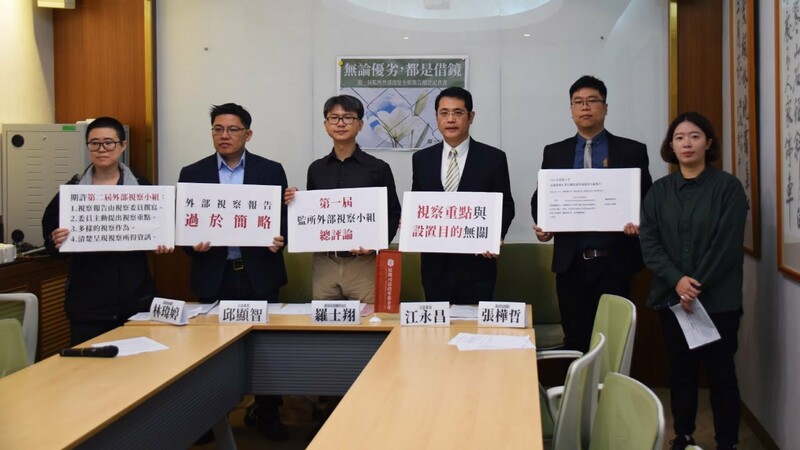 Photo / Taiwan's external prison visiting groups operate independently from individual prisons and detention centers, and are required to submit and publish quarterly visiting reports. Pictured here is a press conference held by JRF presenting the general review of the first term of external prison visiting reports.
In its early days, the CPR primarily filed lawsuits against the improper use of instruments of restraint and lobbied the government to ban leather handcuffs. Between 1994 and 1995, abusive incidents involving leather handcuffs tightening around inmates' abdomens occurred successively across multiple prisons. The CPR formed a legal team to assist with litigation, gathering a wealth of information through these cases. In 1998, they submitted a report to the fourth review of the UN international human rights conventions, which influenced the Ministry of Justice to issue a new notification drastically reducing the use of leather handcuffs in Japanese prisons. Later, following the abuse case in a protection cell at Nagoya Prison, they entered negotiation meetings with the government, successfully abolishing leather handcuffs in 2002.
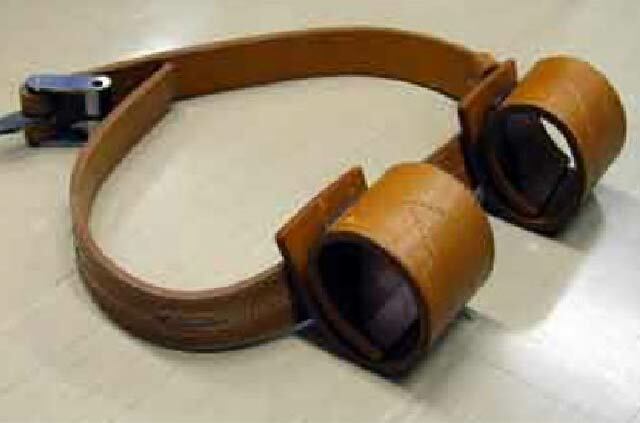 Photo / Pictured here are leather handcuffs, which were long used as instruments of torture in Japan. Photo sourced from the website of the Center for Prisoners' Rights, Japan
Still Inflicting Suffering: Litigation on Prisoners' Right to Medical Care
Aside from cases involving injury or death caused by the improper use of instruments of restraint, the CPR has also assisted in lawsuits concerning prison violence and inadequate medical treatment. On March 1 of last year (2022), a prisoner died at Nagoya Prison due to delayed medical treatment for a myocardial infarction. In mid-February, a 71-year-old inmate cried out for help due to breathing difficulties and cardiac discomfort, and urinated on the tatami mat. The prison merely performed basic temperature and blood pressure checks before repeatedly sending the inmate into a protection cell, where he was allegedly beaten and abused by prison guards. Ten days later, the inmate was finally sent to a medical institution, and passed away at Nagoya Prison just days after. The CPR assisted the family of the deceased inmate in filing a lawsuit. Documents obtained from the prison during the proceedings revealed that half of the inmate's heart had suffered necrosis. Attorneys Kaido and Ono, appointed by the family to represent them, explained to us that during the litigation, they requested the preservation of footage capturing the inmate's cries for help and the interior of the protection cell, but the prison claimed the footage had been accidentally deleted. The prison's response was as unbelievable as it was familiar.
Attorney Kaido is a highly veteran human rights lawyer in Japan [1]. During our limited exchange time, he specifically expressed a desire to talk to us about this Nagoya Prison case. When explaining it, his expression was not only one of helplessness but also of profound pain—an expression we seem to have seen on the faces of many veteran human rights lawyers in Taiwan as well.
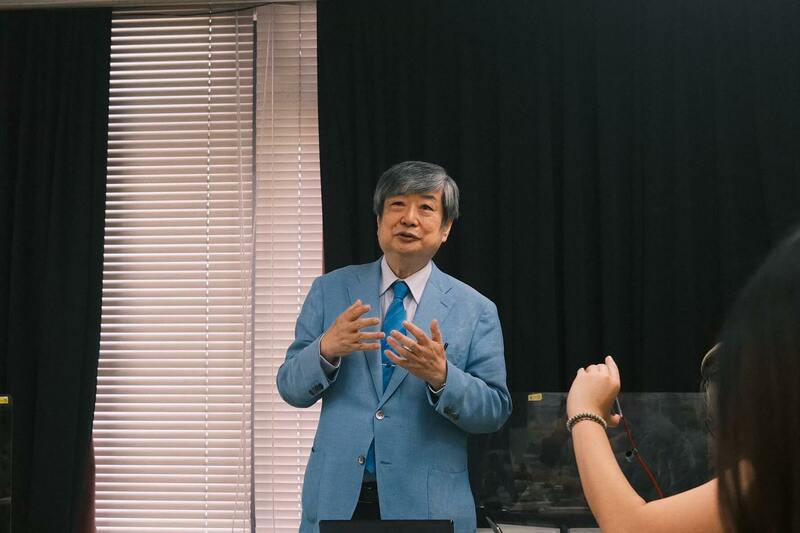 Photo / Pictured here is Attorney Yuichi Kaido (弁護士), Representative Director of the NPO Center for Prisoners' Rights, Japan. Photography by Hsieh Chia-chen
Regarding institutional aspects, Attorney Takatoh of the CPR mentioned that while Japanese prisons have legally mandated quotas for doctors, not all medical specialties are sufficiently covered. In another delayed medical treatment case assisted by the CPR involving an inmate with testicular cancer, the inmate initially consulted a gastroenterologist during internal clinic visits rather than receiving the correct urological examination. Had he received a timely urological checkup, his testicular cancer might have been detected earlier, sparing him from unnecessary gastrointestinal examinations. The CPR's advocacy direction is not merely to upgrade prison medical equipment, but to ensure that inmates receive the same level of proper medical care as ordinary citizens.
Across the Sea: Reflecting on a Corner of Taiwan's Prison Litigation
Returning to Taiwan's own predicament, whether inmates can obtain appropriate medical treatment within prisons has long been a concern for civil society groups. Taking the medical rights case of an inmate with schizophrenia assisted by JRF and lawyers as an example: within five months of being transferred to Taipei Prison after completing his custodial disposition (August 2018–January 2019), the inmate was sent out of prison for medical care 5 times and hospitalized 7 times due to physical and psychiatric symptoms. During this period, Taipei Prison twice wrote to Taichung Prison requesting a transfer to the attached Peite Hospital, but Peite Hospital refused admission each time. It was only during his final transfer to the hospital after suffering cardiac arrest that an application for medical parole was initiated. Despite the Control Yuan proposing corrective measures against Taipei Prison, Taichung Prison, and the Agency of Corrections under the Ministry of Justice regarding this medical "human-ping-pong" situation, the court still ruled in the state compensation lawsuit that Taipei Prison had sufficiently grasped the inmate's health status and provided appropriate medical treatment.
Insufficient medical knowledge among prisons and frontline guards rendering them unable to assess inmates' medical needs, failures by medical personnel to promptly evaluate inmates' health, and prisons restricting the review of medical records are experiences shared by both Japan and Taiwan.
Other issues—such as restrictions on prison correspondence, the presence of third-party monitors during lawyer-client visits, 24-hour surveillance of death row inmates, and prohibitions against inmates receiving visits from their children under 14—are currently being challenged in lawsuits assisted by the CPR through strategic litigation to improve systemic prison issues. Because of its diverse staff composition, which includes not only lawyers but also nurses and former inmates, the CPR is helping inmates reintegrate into society through specialized programs and the compilation of a *Handbook for Social Reintegration*.
Regrettably, due to our large group size, we were unable to visit the CPR's office in person, but we remain deeply grateful for this exchange opportunity. While Taiwan and Japan share both similarities and differences in their paths toward prison reform, strategic litigation frequently serves as a tool for prison rights and systemic reform. By learning from each other's practices and extracting operational experiences for our own organization, we found ourselves nodding in vigorous agreement at many points during the careful explanations given by the CPR's three lawyers and staff members, or offering knowing, bitter smiles when expressing helplessness and anger over the unreasonable aspects of litigation described by the lawyers. As the exchange drew near its end, we still felt a lingering sense of fulfillment.
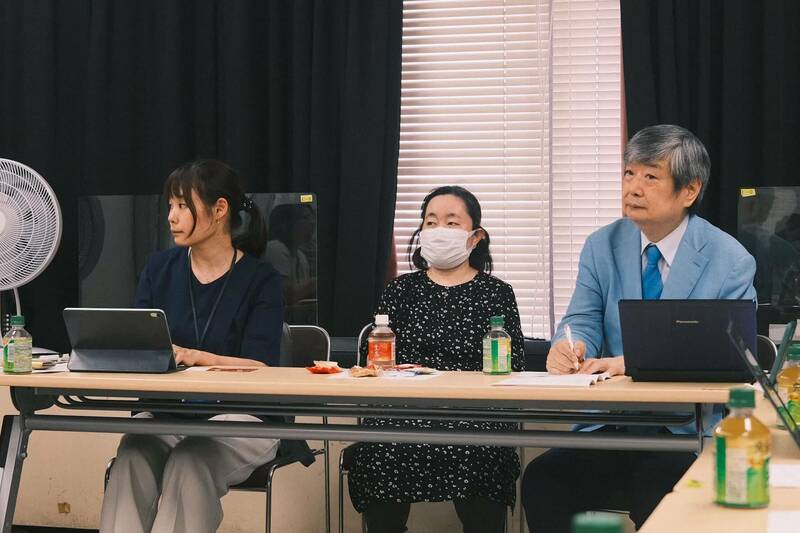 Photo / Pictured on the left is Attorney Ayuko Takatoh (弁護士), Director of the NPO Center for Prisoners' Rights, Japan; in the middle is Yuko Shiota, staff member of the NPO Center for Prisoners' Rights, Japan. Photography by Hsieh Chia-chen
Having worked at JRF for nearly four years and worked on prison affairs alongside our prison researcher Wei-ting, I deeply understand how difficult prison reform is. Even the slightest progress is achieved through the joint cooperation of clients, families, our dedicated project team, and pro bono lawyers as they slowly clarify facts and build strategies. Through our exchange with the CPR, we are even more convinced that, no matter what, we simply hope that prisoners are treated as "human beings" within the high walls of prison—in their living conditions, diet, medical care, and everything else.
To all who care about the human rights of those deprived of liberty in prisons.
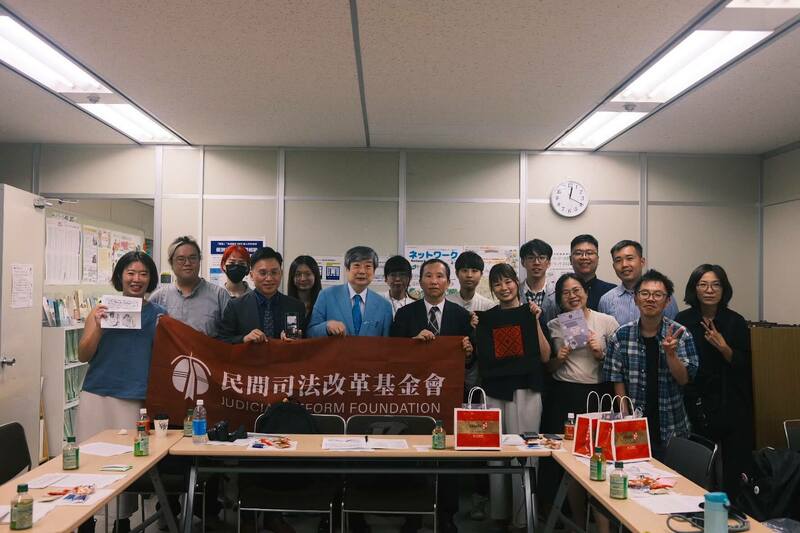 Photo / Group photo taken after the exchange with the Center for Prisoners' Rights, Japan. Second from the right in the front row is Keisuke Ookuma, staff member of the NPO Center for Prisoners' Rights, Japan. Sincere thanks to Attorney Teppei Oono (弁護士), Secretary-General of the NPO Center for Prisoners' Rights, Japan, for participating in the exchange with JRF via online conferencing software. Photography by Hsieh Chia-chen
Notes
[1] Attorney Kaido can also frequently be seen on Japan's strategic litigation crowdfunding website: https://www.call4.jp.
This article is an AI-generated translation of the original Chinese text. In the event of any discrepancy, the Chinese version shall prevail.