
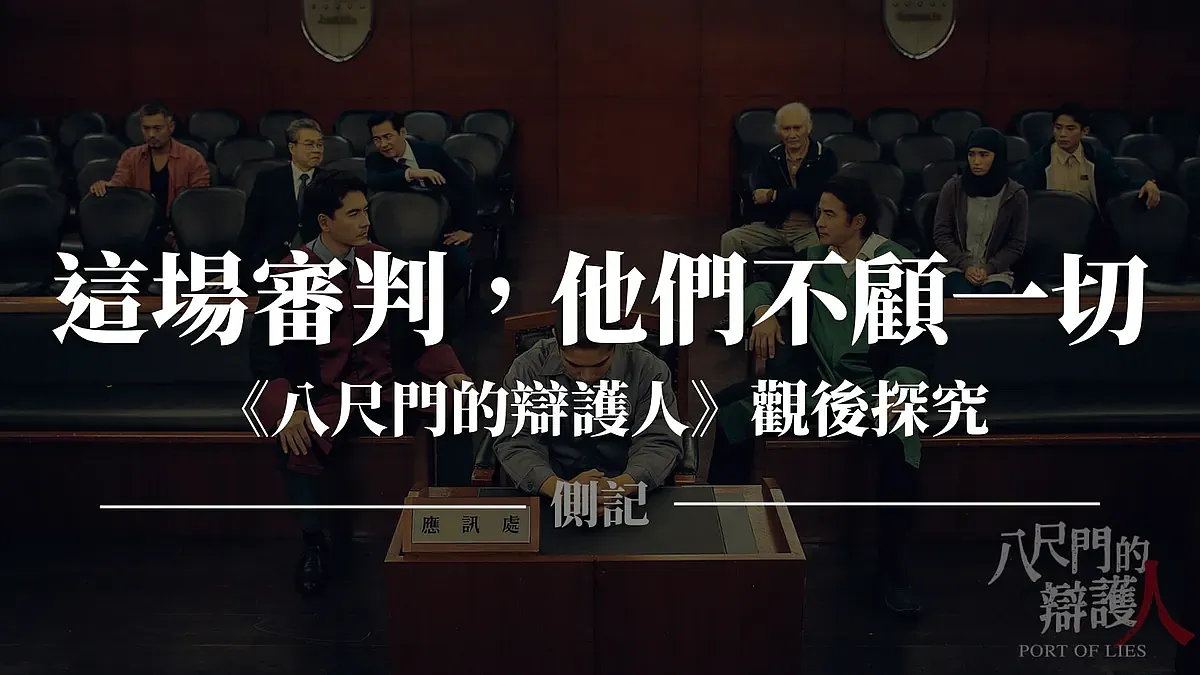
Sidelights|This Trial, At All Costs: Exploring Perspectives After Watching "Port of Lies"
Last edited: 2026-11-04
The Reproduction of the T'ang Ying-shen Case
In 1986, a murder case resulting in three deaths occurred at a laundry shop in Taipei City. The perpetrator was T'ang Ying-shen, an indigenous youth of only 19 years of age who became Taiwan's youngest death row prisoner, sparking immense public concern at the time. T'ang was a Tsou youth who had once studied at the Chiayi Teachers' College before dropping out for various reasons. In 1986, he left his hometown of Chiayi to make a living, coming to Taipei in search of job opportunities. Originally intending to work in a restaurant, he unfortunately fell into a job-hunting trap and was introduced to work at a Taipei laundry shop. Consequently, he incurred a 3,500 NTD introduction fee, had his identity card withheld by his employer, and was forced to work overtime.
Late one night, T'ang was called back to work for no reason, and in a fit of anger, he offered his resignation. However, the employer refused to return his identity card on the grounds that he could not repay his debt, and repeatedly provoked him with the derogatory term "fan-tzu" (aborigine). Conflict erupted instantly. In the end, T'ang killed the employer and his young daughter. The court sentenced him to death for robbery and murder. Refusing anesthesia during his execution by firing squad, believing he got what he deserved, a life of merely 19 years thus came to an abrupt halt.
Returning to the story of "Port of Lies," the migrant worker Abdul is subjected to inhumane treatment by his employer aboard a fishing vessel. When he asks for his passport to be returned, a conflict arises with his employer, ultimately resulting in the deaths of the employer and his young daughter. Just as everyone feels such behavior is devoid of humanity—not even sparing a child—the truth is finally revealed. Abdul did not intend to kill the young child; rather, it stemmed from the abuse he suffered on the boat, where employers would press workers' heads underwater for two minutes to stop them from resisting or to shut them up. It was precisely this humiliation that led Abdul to a fatal misunderstanding, ironically causing the tragedy.
In such cases, the public sees a foreign murderer, an unforgivable and extreme act. But in my eyes, he is at the same time a defenseless illegal migrant worker—even the birthdate on his passport is fake—and a person barely surviving in the shadows of the judicial system. Because of his status as an illegal migrant worker, he has no access to legal assistance; all he can do is rely on himself. How could his employer let him off easily? Such social tragedies are deeply lamentable. Of course he is guilty, even of murder, and bears inescapable responsibility. However, we should not merely view these as isolated crimes, but rather pay attention to the social context and structures behind the cases. These cases highlight the predicaments faced by disadvantaged groups, whether illegal migrant workers or indigenous peoples. They often find themselves in situations lacking legal protection, forced to endure unfair treatment and oppression. One can only hope that when people look at these individuals in society's dark corners, they might spare a glance from the corner of their eye to see their helplessness.
The Rota-Vicious Cycle of Class
The story of "Port of Lies" takes place in an informal settlement, which has become a home for Amis people to put down roots. In the past, these tribesmen participated in fishing operations only to be exploited, harmed, and even humiliated by Han Chinese. Meanwhile, T'ung Pao-chü, the public defender in the story, is himself an Amis and decides to break this vicious cycle. However, he gets pulled into the investigation of a seaside murder case, forcing him back to a hometown where he feels no sense of belonging.
T'ung Pao-chü's father—Old T'ung—was sent to prison for resisting the unfair treatment of Han Chinese. This event feels like history constantly repeating itself, yet this time, the indigenous people have become the very Han Chinese they once hated most, oppressing migrant workers as a daily routine. It is as though classes have rotated, yet it is still the people at the bottom who suffer.
The First Mate, who once despised the "Pailing" (Han Chinese) and viewed Old T'ung—who killed a Pailing—as a tribal hero, grew estranged from T'ung Pao-chü because of it. A dispute broke out instantly over the remark, "You'll end up like those adults in the tribe, amounting to nothing," and from then on they kept their distance. A police officer of the same tribe recalls that their dissatisfaction with Pao-chü actually stems from their fear that what he said might be true.
Today's social class is like a stuck gear unable to turn, while sorrowful life histories become deeply entrenched over time. Indigenous people who were once bullied have begun to tacitly accept past bad habits, oppressing even more vulnerable illegal migrant workers. The cruelty of society may not simply be class reproduction, but the viciousness generated by class multiplying and cycling forward in even more brutal ways.
In the courtroom, the witness failed to appear time and again. When the trial commenced, T'ung Pao-chü bitterly recounted what his father had once said: "On a fishing boat, what gets slaughtered isn't necessarily fish!" The most terrifying thing among disadvantaged groups is the inability to empathize with one another, instead harboring a sense of superiority. This leads down a path of cyclical oppression among different vulnerable groups. Right now it is migrant workers, but who might be next?
The Death Penalty Reduced to a Political Bargaining Chip
In the footage taken before Abdul's execution, we hear Lina loudly calling out for him to state his real birthdate, yet the gunshot still rings out, and the execution does not change. The Minister of Justice, who leans toward abolishing the death penalty, utilized this oversight to achieve her own political objectives. Using the death penalty to divert public attention happens far more often in real society than you might imagine.
Looking back at a 2001 murder case in Foshan, China, which involved five deaths—including two Taiwanese and three mainland Chinese—Taiwanese police arrested Tu Ch'ing-shui (the father) as well as brothers Tu Ming-lang and Tu Ming-hsiung based on information from Chinese public security. Yet the three men consistently maintained their innocence. During the first instance, the Tainan District Court acquitted them due to a lack of direct evidence; however, the second instance changed the verdict to the death penalty. In 2012, the death sentences for Tu Ming-lang and Tu Ming-hsiung were finalized (Tu Ch'ing-shui passed away in prison in 2010). The greatest controversy in this case was that during the trial process in Taiwan, the key witness who could link the three men to the case never appeared in court for cross-examination, and China never sent the relevant physical evidence to Taiwan.
This case underwent a drastic reversal from acquittal to the death penalty during the trial process. Taipei City Councilor Miao Povo once wrote in "The Tu Brothers Case: Two Unsaveable Wrongful Souls": "The Tu father and son merely took a trip to China, and a few days after returning to Taiwan, the police suddenly came knocking to make arrests. They were accused of committing a five-victim robbery-murder case in China. The primary evidence used by the prosecutor in the indictment consisted entirely of interrogation records made by the Chinese Public Security Bureau, unfamiliar witnesses, unseen physical evidence, and unexaminable appraisal reports. The robbery-murder was acquitted in the first instance; going from acquittal to the death penalty, we cannot simply sit by and ignore it."
Furthermore, the Tu brothers' case dragged on for as long as 11 years. Eleven years is not a small number. Yet at what point in time was this judgment executed? Why was this specific time chosen? What was happening at the time? It was precisely when the Sunflower Student Movement was in full swing. The government's violent suppression via water cannons aroused public anger, leading to a drop in public sentiment and posing a tremendous challenge to its approval ratings. These two death row inmates became scapegoats for political accountability, serving to divert public attention away from the government's actions and toward the execution of the death penalty.
When Legislative Yuan Member Wu Yü-sheng was embroiled in a scandal, he shouted loudly in the Legislative Yuan about why death row inmates were not being executed, utilizing such tactics to shift the focus. The lives of all death row inmates were reduced to political bargaining chips. Unverified news was first sensationalized by the media to whip up public indignation, and then the government—acting as the arbiter of "justice"—signed off on executing the shooting, resembling a perfectly coordinated musical, singing in harmony full of cheerful atmosphere. Meanwhile, inside the cells of the death row inmates, the wrongfully accused tossed and turned all night.
Human Rights in Our Eyes
Following the broadcast of the series "Port of Lies," it sparked a massive wave of public opinion, particularly concerning issues of the death penalty's abolition or retention.
First, speaking of the death penalty, its underlying significance is the permanent segregation of criminals. Concurrently, however, the concept of "reformability" has also sparked widespread controversy. Particularly after cases undergo psychiatric evaluations, public trust in the law begins to waver, leading to numerous queries and waves of protest. In this situation, members of the Taiwan Alliance to End the Death Penalty (TAEDP) became prime targets, bearing all the vitriol.
Yet the reality discussed in the series is somewhat ironic: "The Taiwan Alliance to End the Death Penalty once conducted a poll showing that 70% of Taiwanese citizens lack confidence in judicial fairness, 75% believe Taiwanese law only protects those with power and influence, and 80% believe poor people are more likely to be sentenced to death than the rich. However, 85% support the death penalty." One can imagine that the public's understanding and attitude toward this issue are fraught with ignorance and bandwagoning.
In the show, Abdul commits murder following abuse by his employer, and the public is passionately debating whether to support the death penalty. But can human rights issues be subjected to a referendum? Much like the same-sex marriage referendums during the 2018 nine-in-one local elections, it felt like seeing a miniature reflection of that era. The essence of democracy is to protect the rights of the people, and the formulation of laws ensures that these rights are implemented. Under the constitutional interpretation ruling, same-sex marriage rights were protected, yet the referendum results failed due to the overwhelming, brainwashing propaganda of anti-equality groups. The arguments of that time remain vivid in my mind to this day. Within my echo chamber, everyone was feeling despair over the referendum results, at which point some began to say, "The public will is what it is; if those who support same-sex marriage cannot accept it, then what is the point of talking about democracy?"
I once shared a long-form post on my social media, which I suppose only my echo chamber was willing to finish reading. Human rights are important, but they are not as eye-catching as other issues. Nonetheless, it is heartening that the democratic system grants us the freedom to discuss and gives us the opportunity to voice different perspectives. However, some questions are not purely matters of opinion, but matters of right and wrong. If everyone were placed behind a veil of ignorance, could we still hold fast to our ideals?
Returning to the death penalty issue: the fact that I am able to write this article means I am fortunate not to have been convicted for something I did not do. Wrongful conviction exonertee Hsü Tzu-ch'iang received state compensation after being acquitted, but I do not believe that can buy back the life he ought to have had. I support the abolition of the death penalty, and the biggest reason is that I do not wish for such a judicial system to be applied to anyone. The death penalty involves multiple factors such as human rights and social justice; it cannot be dictated solely by emotion and populism. The public lies comfortably on their sofas, watching sensational and unfocused sensationalist social news from the media. Sitting before their screens, they morph into family members of victims, while judges who sentence according to law are labeled "dinosaur judges."
Ultimately, we should ground ourselves in independent thinking and in-depth rule of law education, approaching these issues with a rational and objective attitude while considering how to ensure a balance between justice and human rights within the judicial system. The importance of legal education and the capacity for independent thinking ought to be integrated into our education system to foster students' sensitivity to social issues and critical thinking. Otherwise, whenever elections approach, many inmates in prison will feel anxious and terrified.
This article is an AI-generated translation of the original Chinese text. In the event of any discrepancy, the Chinese version shall prevail.