
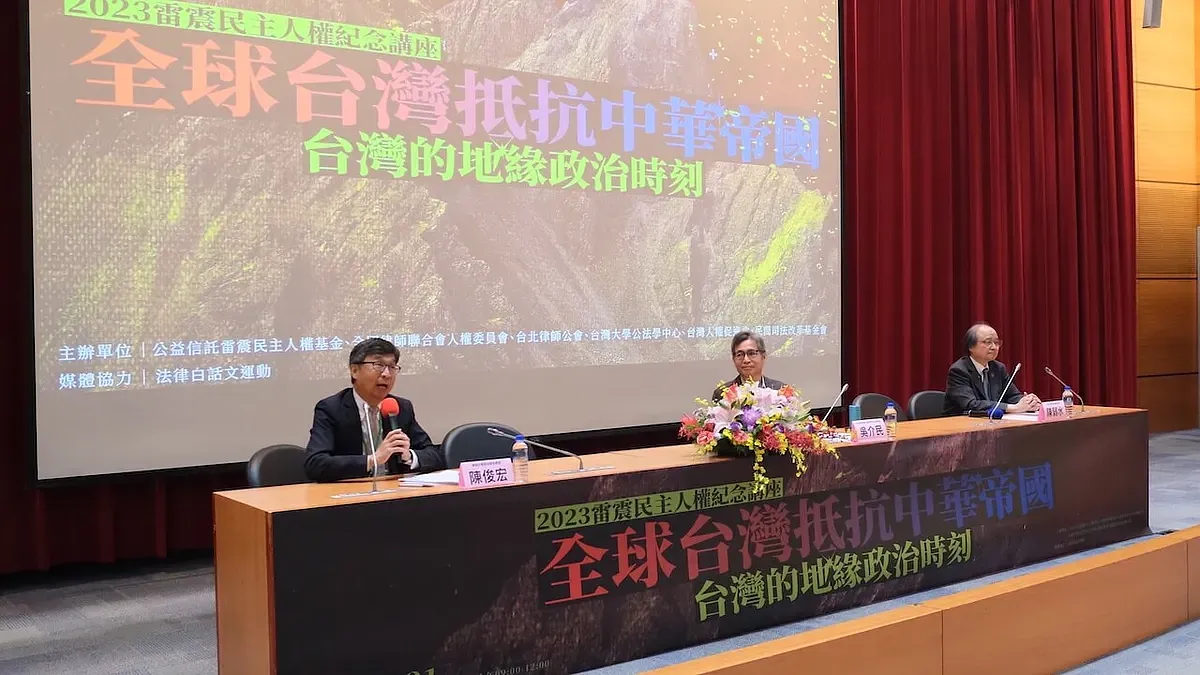
Post-Event Press Release|Global Taiwan Resisting the Chinese Empire: Taiwan's Geopolitical Moment
Last edited: 2026-07-27
The Lei Chen Democracy and Human Rights Memorial Lecture held its second lecture of the year today (October 21) at the Tsai Lecture Hall of the National Taiwan University College of Law. Professor Wu Jieh-min, a research fellow at the Institute of Sociology, Academia Sinica, was invited to deliver the keynote speech on "Global Taiwan Resisting the Chinese Empire: Taiwan's Geopolitical Moment." Professor Ch'en Jo-shui of the Department of History at National Taiwan University served as the discussant, and Professor Ch'en Jui-hung of the Department of Political Science at Soochow University moderated the event. Distinguished guests who delivered opening remarks included Vice President Lai Ching-te, Chairperson of the Democratic Progressive Party; Lo Ping-cheng, Minister without Portfolio of the Executive Yuan; Ko Wen-je, Chairperson of the Taiwan People's Party; and Legislator Wang Wan-yu, Chairperson of the New Power Party. Other prominent guests in attendance included Mr. Chin You-ling, grandson of Mr. Lei Chen, and his wife Mrs. Ts'ao Le-chih; Attorney Hsueh Ch'in-feng, convener of the Lei Chen Charitable Trust; Professor Hsueh Hua-yuan, advisory committee member of the Lei Chen Charitable Trust; Mr. Lin Ch'i-yang (Xiang Yang), advisory committee member; Mr. Huang Wen-hsuan, advisory committee member; Mr. Ch'en Hsin-chieh, advisory committee member; Professor Ku Chung-hua, advisory committee member; and Attorney Hsu Sung-ya of the Taipei Bar Association.
Since 2009, the "Lei Chen Democracy and Human Rights Memorial Lecture" has regularly invited international figures who have made outstanding achievements in knowledge creation or practical action in the fields of human rights, the rule of law, and democracy to deliver a series of lectures in Taiwan. Past intellectual giants invited include legal and political philosopher Ronald Dworkin, global justice theorist Thomas Pogge, former Justice of the Constitutional Court of South Africa Albie Sachs, former United Nations Special Rapporteur on Torture and University of Vienna law professor Manfred Novak, Harvard Law School University Professor Cass Sunstein, and Professor Philipp Van Parijs of the Catholic University of Louvain, a prominent advocate of "unconditional basic income," among other masters in various fields, inviting debaters and exchanges from all sectors of Taiwanese society on human rights and democratic thought. This year, a special lecture series titled "Crises and Prospects of Taiwan's Democracy" was launched. From a geopolitical perspective, scholars were invited to jointly contemplate the future of Taiwan's democracy. The first lecture was held on March 18 of this year, featuring Professor Wu Jui-jen of the Institute of Taiwan History, Academia Sinica, who delivered a lecture titled "Taiwan's Democracy Caught in the Cracks of Empire," analyzing how Taiwan, located in the first island chain, can simultaneously balance defending democracy and consolidating national sovereignty under the pressure of global geopolitical conflicts. The lecture received an overwhelming response. Today's lecture is the second in the series, inviting Professor Wu Jieh-min to analyze Taiwan at a moment of geopolitical upheaval and, under the influence of the China factor, how to respond to challenges, utilize opportunities, and forge itself into a global Taiwan to resist threats from the Chinese Empire.
Through a macro-theoretical perspective and rich empirical data, Professor Wu Jieh-min analyzed the formation of the US-China confrontation structure, ushering in Taiwan's third geopolitical moment since World War II. This moment can be traced back to the end of 2017 when the U.S. Trump administration overturned its engagement policy toward China, implementing high-tech export controls against China. Subsequently, the Biden administration continued and deepened the Indo-Pacific strategy, strengthening military cooperation with allies. Under the US-China confrontation structure, Taiwan's embedding in the global semiconductor production network has increasingly highlighted its importance, but it has also compelled China to escalate its military posturing against Taiwan. Such developments have led Western countries to affirm that "peace and stability across the Taiwan Strait" is a core national interest, prompting the internationalization of the Taiwan Strait issue; however, on the other hand, it has also made the Taiwan Strait the region with the highest global geopolitical risk.
Faced with such an important geopolitical moment, Professor Wu pointed out that this is a challenge for Taiwan, but also a window of opportunity.
He suggested that we seize this window of opportunity and, from the perspective of "Global Taiwan," overturn the traditional cognitive framework of "cross-strait relations," thereby shifting the coordinate axis, starting from Taiwanese subjectivity, and pursuing our own identity in the world. In terms of concrete action, Professor Wu suggested that changes can be sought from three dimensions:
- Strengthening economic security: Facing the global high-tech industry's demand for "de-risking," the government must strengthen economic security measures, step up efforts to plug loopholes in laws, systems, and enforcement, and no longer pursue short-sighted economic policies;
- Enhancing democratic resilience and strengthening national defense: We must clearly recognize the "imperial" nature of China, and the annexation of Taiwan is the final piece of the puzzle for the Chinese Communist Party to rebuild a modern Chinese empire; in other words, for Taiwan, the so-called choice between "war and peace" is fundamentally a false problem. Therefore, facing the crisis of China's expansionist threat, Taiwan must enhance its democratic resilience and strengthen national defense to demonstrate its determination to defend its country, democracy, and sovereignty;
- Pursuing a dignified and reciprocal international status: Although the internationalization of the Taiwan Strait gives Taiwan the opportunity to form deeper connections with democratic countries and gain more security guarantees, as a political entity, Taiwan has long been "de-subjectivized." Therefore, we must not only resist the Chinese threat, but also utilize various opportunities to assert our rights to international allies, pursuing an international status commensurate with Taiwan's economic capabilities, degree of democratization, and geopolitical position, putting into practice the advocacy long ago proposed by our predecessors during the Japanese colonial period: "Make Taiwan the world's Taiwan" (full text of the lecture draft is provided in the appendix)
Discussant Professor Ch'en Jo-shui supplemented the historical context of Taiwan's three geopolitical moments from the perspective of the history of thought, pointing out that due to Taiwan's special democratization process, the current Taiwanese democratic system still retains habits left over by the old system, which is a problem urgently needing to be overcome. Professor Ch'en further deeply analyzed the internal texture of Chinese nationalism using Yang Tu's "theory of gold and ironism," giving the audience a deeper understanding of the imperial nature of the Chinese Empire.
This year's lecture series concluded successfully today. The Lei Chen Democracy and Human Rights Memorial Trust hopes that through this lecture series, rich ideological resources will be provided, using different cognitive frameworks and theoretical perspectives to rethink the crises and challenges of Taiwan's democratic development, and inviting the general public to jointly conceive the democratic future of Taiwan!
Time
Saturday, October 21, 2023, 08:30–11:40
Venue
Tsai Lecture Hall, College of Law, National Taiwan University
Schedule
| Time | Event Agenda | Personnel |
| 08:30 | Guest Registration | |
| 09:00 | Opening Introduction | Master of Ceremonies: Attorney Li Ming-ju / Deputy Executive Director, Judicial Reform Foundation |
| 09:05 | Guest Remarks | 09:05 Professor Hsueh Hua-yuan / Advisory Committee Member, Lei Chen Fund 09:10 Ko Wen-je / Chairperson, Taiwan People's Party 09:20 Legislator Wang Wan-yu / Chairperson, New Power Party 09:30 Lo Ping-cheng / Minister without Portfolio, Executive Yuan 09:40 Vice President Lai Ching-te / Chairperson, Democratic Progressive Party |
| 09:50 | Keynote Speech | Moderator: Professor Ch'en Jui-hung / Department of Political Science, Soochow University Speaker: Research Fellow Wu Jieh-min / Institute of Sociology, Academia Sinica |
| 10:50 | Discussant Comments | Discussant: Professor Ch'en Jo-shui / Department of History, National Taiwan University |
| 11:10 | Q&A and Response | Moderator, Keynote Speaker, Discussant |
| 11:40 | Group Photo and Conclusion | All Participants |
Organizer
Lei Chen Democracy and Human Rights Memorial Trust
Co-organizers
Center for Public Law, National Taiwan University; Human Rights Protection Committee, Taiwan Bar Association; Human Rights Committee, Taipei Bar Association; Taiwan Association for Human Rights; Judicial Reform Foundation
Press Contact
Director Hsiao I-min, Judicial Reform Foundation
This article is an AI-generated translation of the original Chinese text. In the event of any discrepancy, the Chinese version shall prevail.