
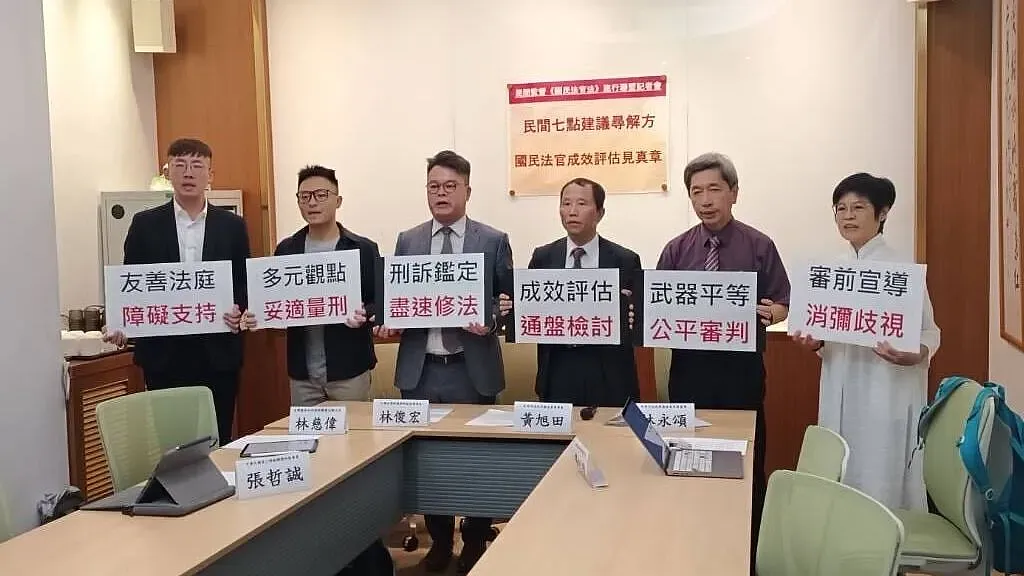
Press Conference | Seven Recommendations for Solutions: Assessing the Effectiveness of the Lay Assessor System – Alliance for Civil Supervision of the Lay Assessor Act
Last edited: 2026-11-03
Since January 1 of this year, the Citizen Judges Act has officially come into effect. This major reform has been hailed by Judicial Yuan President Hsu as a "tectonic shift" in the judiciary, completely overturning how major criminal cases are tried.
Since July, lay assessors have participated in rendering 9 judgments, including 5 cases of fatal drunk or drug driving, 3 murder cases, and 1 case of fatal assault. The murder cases include high-profile societal cases such as a "single mother killing her child" and "killing a husband after suffering domestic violence." As these judgments are successively handed down, issues such as "the severity of sentencing," "defense counsel performance," and "inequality of prosecution and defense resources" have become the focus of heated public debate.
Civil society organizations affirm the participation of "lay judges" in trials out of the expectation that ordinary citizens' common-sense thinking on "fact-finding" will allow the public's legitimate sense of justice to be incorporated into the adjudication of major criminal cases. This not only allows professional judges to better understand the perspectives of ordinary citizens, vitalizing and expanding this experience into the existing judicial system, but also enables the general public to better understand the operation of the judiciary and trials, thereby jointly building a judiciary worthy of public trust.
Upholding the aforementioned philosophy, the "Alliance for Civil Supervision of the Citizen Judges Act" proposes the following 7 recommendations in the hope of bringing continuous improvement to the lay assessor system:
- Bar associations should provide more comprehensive education, training, and resources to member attorneys regarding Citizen Judges Act cases and criminal sentencing defense.
- The Judicial Yuan should help strengthen the functions of the Legal Aid Foundation and enhance the overall defense quality of legal aid attorneys.
- The Judicial Yuan should assess the needs of persons with disabilities serving as lay assessors and issue guidelines reminding courts to provide appropriate assistance.
- The Legislative Yuan should promptly pass the amendments to the Code of Criminal Procedure concerning the "expert testimony chapter" to promote the proper and thorough application of relevant evidence in lay assessor cases.
- Courts should, based on the needs of individual cases, explain human rights conventions, anti-discrimination, and other human rights and rule-of-law concepts to lay assessors during the "pre-trial briefing" phase to construct a fair and non-discriminatory courtroom.
- When drawing "candidate lay assessors," courts should adopt "stratified random sampling" so that the gender ratio of candidates tends to be balanced.
- The Judicial Yuan should use the rights contents of relevant United Nations human rights conventions as a reference framework to list procedural requirements and outcomes for a fair trial, in order to evaluate the effectiveness of the lay assessor system and conduct ongoing reviews.
-
Eliminating the "Prosecution-Defense Imbalance" is an Urgent Priority for Lay Assessor Cases
Most current "lay assessor cases" involve attorneys referred or assigned by the Legal Aid Foundation. However, due to low willingness and limited professional experience among attorneys handling such cases, finding counsel is not easy. Even after finally securing willing counsel, it is often close to the time for the first hearing—the "preparation procedure"—and subsequent trial dates are quite tight. We have also received feedback from attorneys reporting that expert reports were only received on the eve of the "trial date." Such insufficient time arrangements directly and adversely impact the defendant's defense and rights.
In contrast, the defendant faces a fully-resourced prosecution team with extensive experience in lay assessor cases. Such a contest risks making lay assessors witness a "one-sided" situation in the courtroom, something that has already happened in reality.
In addition, we have also found that in practice, situations occur where "the prosecutor has spoken with a police officer by phone before summoning them to testify in court, yet no relevant record is available for disclosure." This also demonstrates the dilemma faced by defendants and attorneys in evidence gathering under the current system. From this, it is also evident that the dilemmas of old criminal cases will be magnified in lay assessor courtrooms. For instance, the current law does not incorporate a system for "privately retained expert witnesses," making it difficult for defendants and defense counsel to challenge the prosecution's expert witnesses (e.g., forensic pathologists, psychiatrists), thereby placing them at a disadvantage. In this regard, the "expert testimony chapter" reform bill currently pending party caucus negotiation in the Legislative Yuan needs to be passed as soon as possible.
To this end, we call on bar associations to provide members with more comprehensive education, training, and resources regarding lay assessor cases and sentencing defense. Courts should allow defense counsel sufficient preparation time when scheduling trial dates to minimize trials starting under conditions of "prosecution-defense inequality." For the Judicial Yuan, strengthening the functions of legal aid and enhancing the overall defense quality of legal aid attorneys—rather than expanding contract-based "public defenders" simply to meet the demand for defense cases—is the urgent priority.
On the other hand, since it is objectively impossible to immediately improve the quality of defense available to defendants, whether a defendant must be tried by "lay assessors"—especially in cases where the defendant has already confessed—certainly leaves room for review.
-
Diverse Composition of Lay Assessors Makes Appropriate Sentencing Key
Beyond insufficient preparation time, the lack of defense resources and tools has also been exposed to the public eye through "lay assessor cases." For example, most current lay assessor cases do not contest the criminal facts, but instead seek lighter sentences; however, "sentencing" has always been a relatively deficient link in Taiwan's criminal litigation system. The length and reasoning methods recorded in past judgments show that courts have placed less emphasis on the application and investigation of sentencing evidence; regarding defense, lawyers are consequently less willing to elaborate on this and receive little training in this regard.
The currently adopted lay assessor system not only allows lay judges to decide "guilt/innocence," but also to jointly determine the defendant's sentence. However, determining the appropriate severity based on the specific circumstances of a case actually departs from the lived experience of ordinary citizens; without a corresponding and rigorous sentencing procedure, the defendant's rights will be severely impacted.
The aforementioned circumstances further highlight systemic issues in sentencing procedures and arguments. Major criminal cases in the first instance that rigorously adopt "pre-sentencing social investigations" or "sentencing evaluations" remain quite rare. When sentencing, judges refer to past sentencing durations across all courts in Taiwan for similar offenses and case facts (i.e., the "Sentencing Trend Suggestion System"), yet there is no stable practical method for properly presenting and debating these statistical data in court.
Unlike professional judges who regularly undergo education and training on conventions and human rights conducted by the Judges Academy, the Judicial Yuan and local courts must also establish supporting measures to ensure lay assessors possess basic human rights concepts regarding gender equality and ethnicity. For example, the New Taipei District Court's cases of a "single mother killing her child" and "killing a husband after suffering domestic violence" both involve issues of gender equality and women's social roles. How to remind and prevent lay assessors from holding "biases" or "biased expectations regarding gender roles" will greatly affect the interpretation of facts and the severity of sentencing.
We believe that in the future, when introducing the basic principles of criminal trials to lay assessors during the "pre-trial briefing" stage, it will also be necessary to provide basic explanations of human rights conventions, anti-discrimination, and other concepts based on the particularity of the case; and to implement the contents of the "Guidelines for Capacity-Building Project of Judicial Personnel on the Convention on the Elimination of All Forms of Discrimination against Women" during trial clarifications and deliberations.
-
Adopt "Stratified Random Sampling" to Balance the Gender Ratio of Candidate Lay Assessors
In the New Taipei lay assessor case of "killing a husband after suffering domestic violence," we also noticed that although the case involved the plight of a battered woman, out of the 6 lay assessors, 5 were male. It is understood that this disproportionate ratio occurred because the gender ratio of the "candidate lay assessors" initially drawn and summoned to court for selection was uneven.
Of course, because the scale of the collegiate panel's composition is small, it is inherently difficult to demand that its composition be "representative." However, since the pervasive influencing factor of "gender" has consistently demonstrated its significant impact across all levels, we recommend that during the "drawing stage" of lay assessors, "stratified random sampling" should be used to prevent members of the public summoned as candidate lay assessors from being excessively skewed toward a single gender.
-
Accessible Courtrooms: Emphasizing the Needs of Persons with Disabilities Serving as Lay Assessors
Beyond the gender ratio, we hope courts are well-prepared so that persons with disabilities can also successfully serve as lay assessors. For persons with disabilities to enter a lay assessor courtroom, in addition to their own willingness, consideration must be given to whether the support services provided in the courtroom are adequate.
Different persons with disabilities sometimes require different support personnel, including sign language interpreters, speech-to-text service providers, personal assistants, visual assistants, etc. While the "Regulations on the Appointment of Special Court Interpreters" stipulate that sign language interpreters and speech-to-text service providers may appear in court in the capacity of "interpreters," other support personnel are not factored into regulations. Furthermore, it remains unclear whether support personnel can provide assistance during the secret deliberation process. We hope the Judicial Yuan will refer to the United Nations' "International Principles and Guidelines on Access to Justice for Persons with Disabilities" to develop operational directives applicable to lay assessor courtrooms, and incorporate necessary support personnel into the courtroom to enable persons with disabilities to successfully serve as lay assessors and demonstrate diverse perspectives.
-
How Should Effectiveness Be Evaluated?
According to the Citizen Judges Act, the lay assessor system must be evaluated. In addition to investigating public perceptions of participating in judicial procedures and trust in the judicial system, the direction of evaluation should, in our view, also assess whether defendants fully enjoy the "right to a fair trial."
The lay assessor system involves numerous reforms in trial practice, including public participation in trials, the non-transfer of case files and evidence (dossier ban), party-adversary proceedings, and centralized trials, all of which create shocks for the three parties of the bench, prosecution, and defense. Amidst these changes in the trial environment, whether defendants' rights to a fair trial are impacted should be comprehensively and carefully evaluated.
We recommend using the United Nations' rights framework as a reference to list procedural requirements and expected outcomes for a fair trial, conduct interviews with the bench, prosecution, and defense (including lay assessors) participating in lay assessor cases; and understand through courtroom observation the gap between actual courtroom activities and ideal conditions, analyze relevant factors between system design and actual operation, and propose effectiveness evaluations and reviews.
Attendees
Lên Yong-sung / Convener, Alliance for Civil Supervision of the Citizen Judges Act; Standing Board Director, Judicial Reform Foundation
Lên Chün-hung / Deputy Convener, Alliance for Civil Supervision of the Citizen Judges Act; President, Taiwan Criminal Defense Lawyers Association
Huang Hsü-t'ien / Chairperson, Judicial Reform Foundation
Huang I-pi / Executive Director, Covenants Watch
Lên Tzu-wei / Legal Affairs Director, Taiwan Association for the Abolition of the Death Penalty
Chang Che-ch'eng / R&D Specialist, The Physically and Mentally Disabled Federation of the Republic of China
Press Contacts
Lü Cheng-yen, Attorney at Law, Director of the Legal Policy Department, Judicial Reform Foundation
Phone: 02-2523-1178 #37
Email: elvin@jrf.org.tw
This article is an AI-generated translation of the original Chinese text. In the event of any discrepancy, the Chinese version shall prevail.