
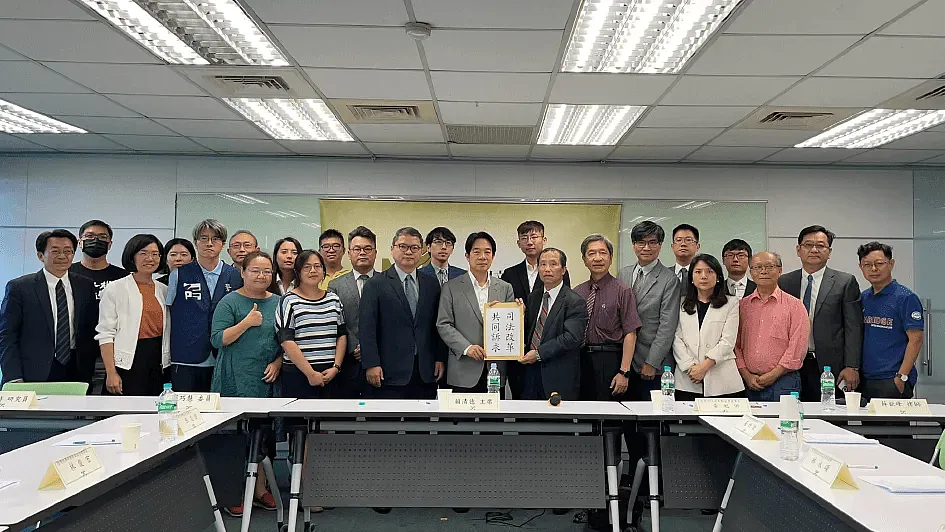
Post-Meeting Press Release | Civil Society Organizations Met with Presidential Candidate Lai Ching-te Regarding Judicial Reform Policies
Last edited: 2026-07-27
On Monday afternoon this week, the Judicial Reform Foundation, Taiwan Bar Association, Taipei Bar Association, and representatives from 18 civil society organizations long dedicated to gender equality, labor rights, indigenous rights, the rights of persons with disabilities, and the environment jointly visited the campaign office of presidential candidate Hou You-yi and put forward the following two common demands.
1. Upon election, the presidential candidate should broadly incorporate the voices of the public, establish an open dialogue mechanism, and build social consensus on judicial reform and human rights protection.
2. Upon election, the presidential candidate should establish a standing "Judicial Reform Committee" with civil society participation to establish stable and effective review and monitoring measures for the implementation of reform initiatives.
Regarding the aforementioned demands, Hou You-yi's campaign office expressed agreement during the visit on October 23, affirming that this direction can be endorsed regardless of election results and across party lines.
Response from Presidential Candidate Lai Ching-te to Civil Society Demands
Today, civil society organizations jointly visited presidential candidate Lai Ching-te, who received them in person. During the meeting, the civil society organizations also put forward the same common demands.
In response, Candidate Lai and his campaign office also agreed on the need to broadly incorporate public opinion and establish an open dialogue mechanism to build consensus. They pointed out that utilizing a standing, task-oriented mechanism to implement judicial reform is a direction worth reviewing and executing; whether established within the Office of the President, the Executive Yuan, or through other means, a mechanism to monitor the implementation of reforms is necessary.
In addition to the aforementioned common demands, group representatives also pointed out various issues within the judicial system that urgently require reform, citing examples such as: "overwork and brain drain among frontline police officers, prosecutors, and judges," "reactivating the Human Rights Advisory Committee of the Office of the President to promote human rights and judicial reform," "promoting a Criminal Review and Exoneration Case Commission (CRECC) as a special miscarriage of justice remedy mechanism," "standardizing scientific consistency in forensic science," "enhancing the protection of victims of sexual violence and domestic violence and introducing expert testimony," "establishing a national 'Gender Human Rights Museum' to deepen gender equality education," "reviewing the accessible judicial environment from judicial personnel to defendants," "gender-friendly justice," "the impact of technological advancement and AI on criminal investigation and judicial adjudication," and "prosecutorial and police reform."
Regarding various traditional and emerging judicial issues, Candidate Lai also expressed his concern and agreement on issues including gender equality, human rights, labor, the environment, and police system reform. If elected in the future, he intends to continue pursuing reforms one by one across various fields and types of issues. Taking gender equality as an example, although international evaluations have affirmed Taiwan's performance, there is still room for improvement by the government in terms of practical implementation and the feelings of the public and frontline workers. Taking environmental rights as another example, facing the goal of 2050 net-zero carbon emissions, the government must also put forth greater efforts.
Candidate Lai also stated that in response to technological advancements, the government must proactively confront the impact of technology and AI on the judiciary; in addition to the advantages and conveniences, it must also be vigilant against the hidden dangers of technological surveillance and digital totalitarianism, and guard against the dangers of democratic regression.
Civil society organizations will also hold a post-meeting press conference after visiting presidential candidate Ko Wen-je on the morning of October 31 (Tuesday).
Press Conference Location
No. 30, Peiping E. Rd., Zhongzheng Dist., Taipei City (1st Floor, Democratic Progressive Party Central Headquarters)
Group Representatives
Huang Hsu-t'ien (Judicial Reform Foundation | Chairperson)
Chang Chih-p'eng (Taipei Bar Association | Chairperson)
Lu Shih-ch'in (Taiwan Bar Association | Vice Chairperson)
Lin Chun-hung (Taiwan Association of Criminal Defense Lawyers | Chairperson)
Lin Yung-sung (Judicial Reform Foundation | Executive Director)
Kuo Li-hsuan (Taiwan Police Working Rights Advocacy Association | Standing Supervisor)
Hsu Hsing-yi (Taipei Women's Rescue Foundation | Board Director)
Tu Yu-wen (Environmental Jurists Association | Executive Director)
Sun Yu-lien (Taiwan Labour Front | Secretary-General)
Shih I-hsiang (Taiwan Association for Human Rights | Secretary-General)
Kuo Hung-yi (Environmental Jurists Association | Secretary-General)
Huang Sung-li (Covenant Watch | Director of Policy Center)
Nguyen Van Hung (Hsinchu Diocese Migrant Workers and Immigrants Service Center, Catholic Church | Director)
Hsu Ching-chien (Garden of Hope Foundation | Advocacy Specialist)
Chang Che-cheng (National Union of the Mentally and Physically Disabled, ROC | R&D Specialist)
Tso Hsin-ping (National Association for the Rights and Welfare of Children and Youths, Taiwan | PR & Advocacy Specialist)
Press Contact
Lü Cheng-yen, Attorney-at-Law, Director of Legal Policy Department, Judicial Reform Foundation
Telephone: 02-2523-1178#37
Email: elvin@jrf.org.tw
This article is an AI-generated translation of the original Chinese text. In the event of any discrepancy, the Chinese version shall prevail.