
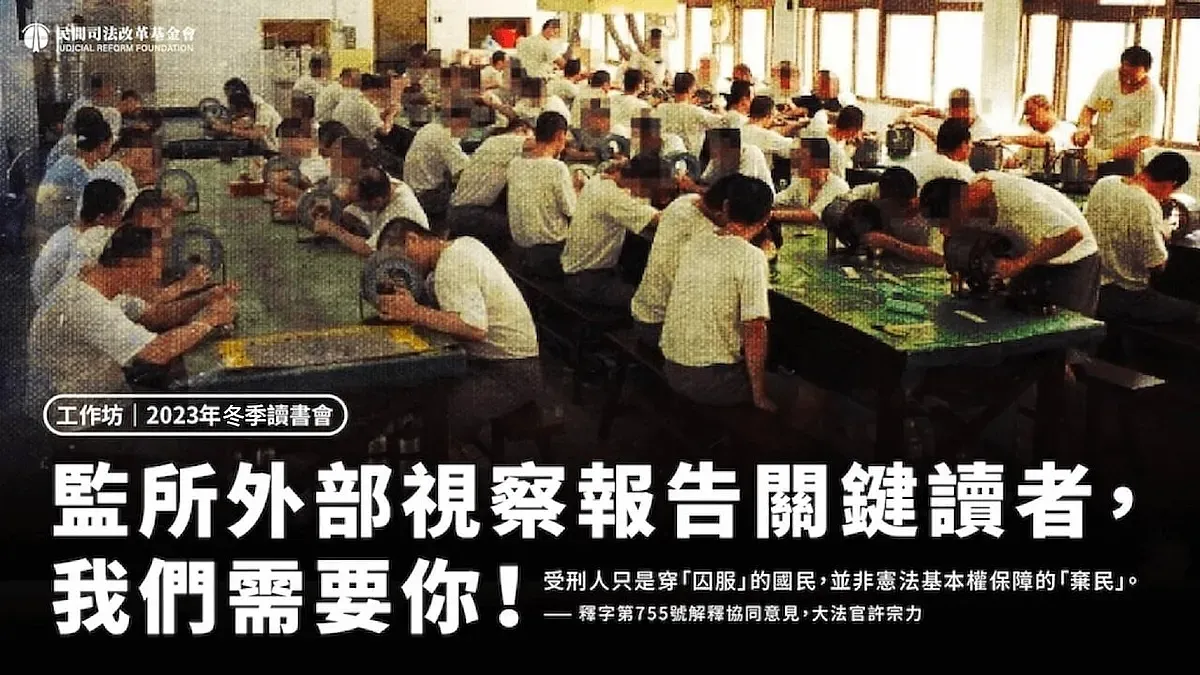
Winter Reading Group|Critical Readers of Prison External Inspection Reports Wanted!
Last edited: 2026-07-27
Inmates are simply citizens wearing "prison uniforms," not "outcasts" devoid of the protection of fundamental constitutional rights.
~ Concurring Opinion to Judicial Yuan Interpretation No. 755, Grand Justice Hsu Tzong-li
The Grand Justices proclaimed that inmates equally enjoy the protection of fundamental constitutional rights, but this should not remain merely a slogan. Inmates are individuals whose liberty has been deprived due to criminal offenses. Following such deprivation, virtually every aspect of an inmate's daily life is controlled by the state, leaving them with little autonomy over their destiny. Furthermore, the high walls of correctional institutions not only physically isolate inmates but also keep those living within them hidden from society, leaving the problems and difficulties occurring inside largely unknown to the outside world. If we wish for the protection of inmates' fundamental rights to be more than just a slogan, we must establish relevant rights protection mechanisms.
The newly amended Prison Act was promulgated and came into effect in 2020. One of its key focuses is the establishment of an independent external inspection panel in each correctional institution. The conception behind this system is to make correctional institutions as transparent as possible, thereby reducing human rights violations on one hand, and helping the outside world better understand whether these institutions are facing any problems or difficulties on the other, thus creating opportunities for improvement by directly confronting these matters. To implement the principle of transparency, the new Prison Act requires prison external inspection panels to submit reports, allowing the public to better understand the actual conditions within prisons and to evaluate the operation of the prison external inspection mechanism.
The Judicial Reform Foundation has consistently monitored the operation of prison external inspections since the new Act took effect. We have read and provided commentary on the external inspection reports submitted by each prison during the first term. In November 2022, the prison external inspection panels underwent a transition, with the second-term panels taking office and subsequently releasing three quarters of inspection reports.
We hope to invite friends from all backgrounds to join us in reading the Q3 2023 prison external inspection reports, reviewing them one by one, sharing insights or questions, and feeding them back to the respective prison external inspection panels. This lets the external inspection members know that someone is earnestly reading their reports and offering reader feedback, thereby giving them greater motivation to participate in external inspection activities and draft reports.
We invite friends who care about prison issues and wish to contribute their efforts to become critical readers of prison external inspection reports. Throughout the reading process, you may raise any insights, questions, or suggestions, while looking forward to the day our ideas bring about change.
Time
- 11/25 (Sat) 10:00-12:00 Orientation (Online)
- Every Saturday from December to January, 10:00 AM - 12:00 PM
Format
Entirely online, no physical attendance
Eligibility
Those who care about prison issues and possess a curious, inquiry-driven mind.
Recruitment Capacity
10 participants (if applications exceed capacity, priority will be given to those who can attend the full sessions and demonstrate higher motivation)
Content
- Read external inspection reports from various prisons. Finally, synthesize everyone's insights or questions and submit them to the respective prison external inspection panels.
- Depending on participants' questions, we may invite formerly incarcerated individuals, practitioners, or external inspection panel members to share their experiences, or arrange prison visits.
※ This reading activity for prison external inspection reports is co-organized by the Judicial Reform Foundation and the "Faint Glimmer: Prison External Inspection Report Reading Project and Death Row Inmate Correspondence Project under the University Social Responsibility Practice Plan" headed by Professor Lu Ying-chieh of National Chung Cheng University.
This article is an AI-generated translation of the original Chinese text. In the event of any discrepancy, the Chinese version shall prevail.