
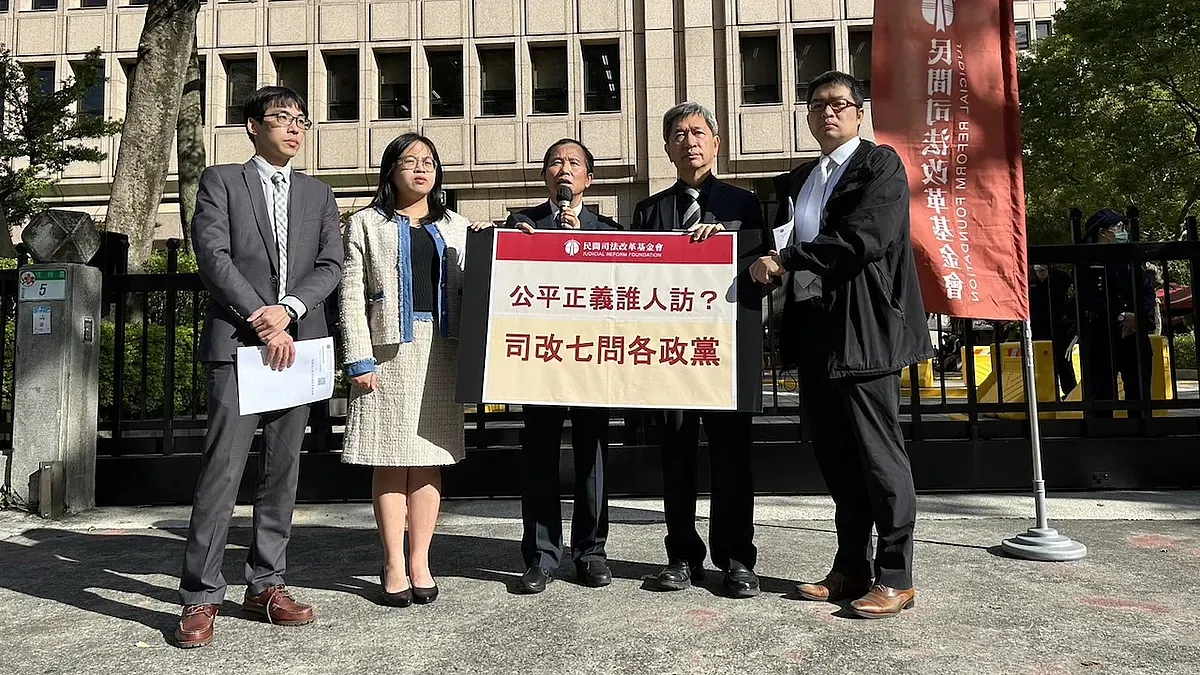
Press Conference | Who Cares About Fairness and Justice? Seven Questions on Judicial Reform for All Political Parties
Last edited: 2026-07-27
The 2024 national at-large legislator election is expected to hold televised political platform presentations for political parties for the first time. Through this, voters can better understand each party's vision for the future of Taiwanese society through the policies they propose.
Competition among different ideas among political parties is an important step in deepening democracy. In response, the JRF calls on all parties to explain to the whole nation what their values of fairness and justice are, rather than simply acting as aggregations of interests, and to promote judicial reform bills from the perspective of human rights protection after securing legislative seats.
To this end, we raise the following seven questions, requesting all political parties to provide concrete responses regarding these specific judicial issues and human rights policies, so that voters can cast their ballots based on the values upheld by each political party:
- To protect the voting rights of inmates, do all political parties support establishing polling stations within correctional institutions and implementing absentee voting so that all inmates can vote inside correctional institutions?
- To eradicate torture and establish a national preventive mechanism against torture, do all political parties commit to supporting the passage of the Enforcement Act of the Convention against Torture in the Legislative Yuan within one year after being elected?
- To prevent personal information in information files collected and managed by the state from being leaked, do all political parties commit to supporting a comprehensive revision of the Personal Data Protection Act within one year after being elected? Regarding the leakage of personal data collected and managed by government agencies, should an independent external investigative unit be established to clarify the facts and build a complete review and prevention mechanism?
- To build a clean government and protect whistleblowers, do all political parties commit to supporting the passage of the Public Interest Whistleblower Protection Act in the Legislative Yuan within one year after being elected? Do they support providing remedial measures for whistleblowers who were unprotected in the past?
- To improve the current lack of unified standards and procedures in forensic science and to prevent wrongful convictions, do all political parties support the prompt establishment of a National Academy of Forensic Sciences?
- To improve the problem of improper law enforcement by police, reform police education, and enhance the effectiveness and quality of law enforcement, do all political parties support the establishment of a "Police Special Project and Performance Management Commission" to establish a reasonable and scientific performance system?
- To systematically prevent and reduce misconduct by judges and prosecutors, do all political parties support amending the Judges Act to strengthen the supervisory responsibility of judicial heads over judges or prosecutors under their jurisdiction?

Explanation of Questions
-
To protect the voting rights of inmates, do all political parties support establishing polling stations within correctional institutions and implementing absentee voting so that all inmates can vote inside correctional institutions?
Explanation:
Inmates in our country's correctional institutions do not have their political participation rights affected unless they are subject to a declaration of deprivation of civil rights. Furthermore, for inmates whose civil rights are deprived, the rights stripped are limited to "the qualification to hold public office" and "the qualification to be a candidate for public office"; they do not include "the qualification to exercise the four rights of election, recall, initiative, and referendum." In other words, no law restricts any inmate's qualification to exercise the right to vote, let alone defendants under detention who have not yet been convicted.
In the concluding observations of the 2022 international review of the Two Covenants, Taiwan was met with strong concern from experts regarding the current situation where inmates cannot vote, which was deemed a violation of the political participation rights guaranteed under Article 25 of the International Covenant on Civil and Political Rights.
Currently, the Taipei High Administrative Court has successfully granted two applications for provisional injunctions, ruling that the Taoyuan City Election Commission and the Hualien City Election Commission should provisionally permit polling stations for the election of the 16th President and Vice President and the 11th Legislators, or adopt other appropriate methods, within the Taipei Prison of the Agency of Corrections, Ministry of Justice where the applicants are located, until the administrative litigation of the case is finalized. However, on November 16, the Supreme Administrative Court overturned the original ruling on the grounds that related matters fall within the "legislative formative discretion."
The Executive Yuan previously proposed the method of absentee voting via transfer voting in the "Draft Act on National Referendum Absentee Voting" proposed in 2021. The party caucuses of the Kuomintang, New Power Party, and Taiwan People's Party all proposed their respective versions, which were reviewed and completed by the Internal Administration Committee of the Legislative Yuan. Unfortunately, caucus consultations in April 2022 failed to reach a consensus, and the Legislative Yuan has not scheduled the bill for deliberation since.
To protect the voting rights of inmates, do all political parties support establishing polling stations within correctional institutions and implementing absentee voting so that all inmates can vote inside correctional institutions?
-
To eradicate torture and establish a national preventive mechanism against torture, do all political parties commit to supporting the passage of the Enforcement Act of the Convention against Torture in the Legislative Yuan within one year after being elected?
Explanation:
Civic groups have called on the government to pass the Enforcement Act of the Convention against Torture for many years without success. Whether it is major capital punishment wrongful cases involving individuals tortured by police such as Chiou Ho-shun, Su Chien-ho, and three others; or the Control Yuan investigation report in September of this year determining that the management of inmates at the Taipei Prison involved illegal abuse and the infliction of torture, torture or other cruel, inhuman, or degrading treatment still occurs from time to time.
The Enforcement Act of the Convention against Torture was submitted to the Legislative Yuan for deliberation in 2018 and 2020 respectively, but has still not been scheduled for committee review and discussion.
In May of last year, the Executive Yuan announced the "National Human Rights Action Plan." Not only did the government promise to list the Enforcement Act of the Convention against Torture as a priority bill to be passed as soon as possible, but it also listed issues such as "deepening public awareness of human dignity, the right to life, anti-torture and the prohibition of inhuman punishment, equality and non-discrimination" as the most important indicator issues for current human rights education. Yet, to this day, the Enforcement Act of the Convention against Torture has not been passed.
To eradicate torture and establish a national preventive mechanism against torture, do all political parties commit to supporting the passage of the Enforcement Act of the Convention against Torture in the Legislative Yuan within one year after being elected?
-
To prevent personal information in information files collected and managed by the state from being leaked, do all political parties commit to completing a comprehensive revision of the Personal Data Protection Act within one year after being elected? Regarding the leakage of personal data collected and managed by government agencies, should an independent external investigative unit be established to clarify the facts and build a complete review and prevention mechanism?
Explanation:
In October 2022, media reported that a total of over 23 million unique ID card numbers leaked to a hacker website, which is virtually the total population of our country, and the leakage time was 2018, which matches the time point when the government claimed household registration data was interconnected that year. However, the Ministry of Interior repeatedly refused to disclose the investigation results on the grounds of "偵查不公開" (non-disclosure of ongoing investigations).
In addition to the leakage of household registration data, according to reports, the database of the Judicial Yuan was also hacked, including access accounts and passwords related to judgments, judgment contents, and raw system data, all of which were published on social software for anyone to download. The above incidents fully demonstrate that the cybersecurity prevention and review mechanisms of our government agencies are severely inadequate.
Regarding data management by public agencies, the government should strengthen information security measures, formulate clear attribution of responsibility and accountability mechanisms to reduce the occurrence of similar incidents in the future.
To prevent personal information in information files collected and managed by the state from being leaked, do all political parties commit to completing a comprehensive revision of the Personal Data Protection Act within one year after being elected? Regarding the leakage of personal data collected and managed by government agencies, should an independent external investigative unit be established to clarify the facts and build a complete review and prevention mechanism?
-
To build a clean government and protect whistleblowers, do all political parties commit to supporting the passage of the Public Interest Whistleblower Protection Act in the Legislative Yuan within one year after being elected? Do they support providing remedial measures for whistleblowers who were unprotected in the past?
Explanation:
Since the initiation of research in 2012, the Public Interest Whistleblower Protection Act has been under deliberation for over 10 years. The 2017 National Customs Conference on Judicial Reform also resolved that the public and private sectors should promptly promote legislation for the protection of whistleblowers and public interest informants. Compared to the late 1990s when countries around the world began enacting related laws, Taiwan's protection of whistleblowers lags behind the world by at least 20 years.
In May 2019, the Executive Yuan sent the "Draft Whistleblower Protection Act" to the Legislative Yuan for deliberation, and various political parties and legislators also proposed counter-proposals, but failed to reach a consensus in caucus consultations. After the turnover of the Legislative Yuan in 2020, the Executive Yuan has not proposed the bill anew. Although the New Power Party proposed three times in 2022 and on November 10 of this year to directly send the proposals of various parties and legislators to the second reading, they were all voted down.
To build a clean government and protect whistleblowers, do all political parties commit to supporting the passage of the Public Interest Whistleblower Protection Act in the Legislative Yuan within one year after being elected? Do they support providing remedial measures for whistleblowers who were unprotected in the past?
-
To improve the current lack of unified standards and procedures in forensic science and to prevent wrongful convictions, do all political parties support the prompt establishment of a "National Academy of Forensic Sciences"?
Explanation:
Taiwan's famous wrongful capital punishment cases such as Chiang Kuo-ch'ing, Hsu Tzu-chiang, Cheng Hsing-tse, Hsieh Chih-hung, and Su Chien-ho all involved major appraisal flaws. Currently, our country's appraisal practice lacks unified scientific standards and methods, as well as a unified laboratory and personnel accreditation system. If there are doubts about the results of testing reports, there is also no re-testing and auditing mechanism or error reporting channel.
Until the end of 2021, serious problems such as the "Kaohsiung Medical University Drug Testing Incident," which involved mass testing errors for new psychoactive substances, still occurred. Through the subsequent investigation of related cases by a special task force, re-testing and re-submission as appropriate, retrial applications, and the labor, time, and financial costs of retrials, the innocence of numerous defendants was finally returned.
To improve the current lack of unified standards and procedures in forensic science and to prevent wrongful convictions, do all political parties support the prompt establishment of a "National Academy of Forensic Sciences"?
-
To improve the problem of improper law enforcement by police, reform police education, and enhance the effectiveness and quality of law enforcement, do all political parties support the establishment of a "Police Special Project and Performance Management Commission" to establish a reasonable and scientific performance system?
Explanation:
In recent years, Taiwan has seen multiple cases of improper police stops and searches and excessive law enforcement, such as: a police officer from the Zhonghe Precinct violently kicking the head of a teenager who refused a police inspection; the Sanchong Precinct randomly stopping, unlawfully handcuffing, and subsequently abandoning a domestic care migrant worker; a Zhongli Precinct police officer subduing and handcuffing a music teacher in the middle of the street using a major throw; and a Zhongli Precinct police station officer subduing a citizen while still attacking them with a baton causing injury.
Following the occurrence of the above incidents, in addition to personal disciplinary punishment and criminal prosecution for the police officers, the police departments of various county and city governments should conduct thorough internal reviews, promptly implement rule-of-law education and training, and review regulations on the use of force by officers in their jurisdictions to eradicate similar incidents from happening again in the future.
The 2017 National Customs Conference on Judicial Reform resolved to establish a "Police Special Project and Performance Management Commission" and a "Police Education and Training Commission" under the Ministry of the Interior, of which half should be composed of external members who are not police personnel (from the National Police Agency), to assist in planning, supervising courses and training, reforming the police education system, reviewing related job responsibilities, enhancing law enforcement effectiveness, and improving the quality of transferred cases.
However, the National Police Agency refused to establish the "Police Special Project and Performance Management Commission," and only held retrospective review meetings, resulting in insufficient legal formalization, rationalization, and supervision of police performance. Although the "Police Education and Training Commission" operates as an internal consultative meeting, because meeting minutes are not made public, it is impossible to evaluate the connection between the meeting content and current police education and training policies or to track them.
To improve the problem of improper law enforcement by police, reform police education, and enhance the effectiveness and quality of law enforcement, do all political parties support the establishment of a "Police Special Project and Performance Management Commission" to establish a reasonable and scientific performance system?
-
To systematically prevent and reduce misconduct by judges and prosecutors, do all political parties support amending the Judges Act to strengthen the supervisory responsibility of judicial heads over judges or prosecutors under their jurisdiction?
Explanation:
In 2020, major disciplinary scandals erupted, such as the improper contact between several judges and prosecutors including Shih Mu-ch'in and wealthy businessman Weng Mao-chung, as well as recent major discipline incidents involving the presiding judge of the Shilin District Court and former president of the Disciplinary Court allegedly involved in sexual harassment, and bullying and harassment at the Tainan District Court. Almost all of these were exposed through the media before the courts and the Judicial Yuan began internal investigations, or before the Control Yuan intervened to investigate.
In fact, bullying, sexual harassment, or disciplinary cases within judicial organs were often rumored within courts or prosecutors' offices for a long time before being exposed by the media without being dealt with, reflecting that the current "Judges Act" has severely insufficient regulatory density regarding the qualifications, selection procedures, evaluation, and dismissal that judicial heads should possess.
To systematically prevent and reduce misconduct by judges and prosecutors, do all political parties support amending the Judges Act to strengthen the supervisory responsibility of judicial heads over judges or prosecutors under their jurisdiction?
Appendices
- New Power Party's Response to the Seven Questions on Judicial Reform
- Taiwan Green Party's Response to the Seven Questions on Judicial Reform
- Taiwan People's Party's Response to the Seven Questions on Judicial Reform
- Chinese Kuomintang's Response to the Seven Questions on Judicial Reform
- Oubasan Alliance for Civil Participation's Response to the Seven Questions on Judicial Reform
Attendees
Huang Hsu-t'ien|Chairperson, Judicial Reform Foundation
Lin Yung-sung|Standing Board Director, Judicial Reform Foundation
Shih Hung-ch'eng|Standing Executive Committee Member, Judicial Reform Foundation
Li Ming-ju|Deputy Executive Director, Judicial Reform Foundation
Press Contact
Lü Cheng-yen, Attorney at Law, Director of the Legal Policy Department, Judicial Reform Foundation
Phone: 02-2523-1178 #37
Email: elvin@jrf.org.tw
This article is an AI-generated translation of the original Chinese text. In the event of any discrepancy, the Chinese version shall prevail.