
JRF Newsletter
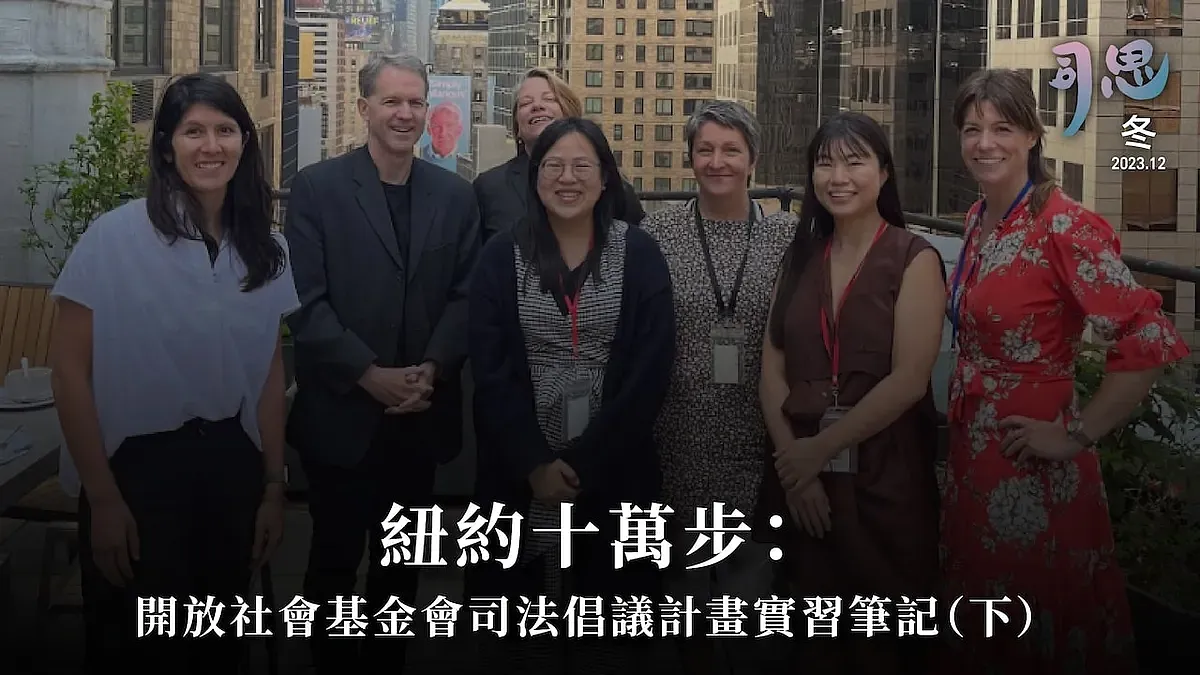
One Hundred Thousand Steps in New York: Internship Notes from the Open Society Justice Initiative (Part 2)
Last edited: 2026-07-27
By this point in the writing, half of my time here has already passed. Although I have roughly grasped the city's rules for survival—such as realizing that seeing a red light does not necessarily mean you have to stop (otherwise, looking like an out-of-towner raises your risk profile, making it more dangerous than getting hit for running a red light), avoiding all sparsely populated times and places, and never pulling out paper currency—I also understand that when colleagues pass my desk and ask "How are you?", I don't need to give a sincere response. Just casually reply with "good" or "fine"; no one actually wants to hear whether you are doing well today, as it is not a genuine question.
Yet there are many more subtle discomforts, which relate to the title of this installment. Whether driven by the urge to mimic colleagues, the pressure to seize short-term opportunities for efficient learning and networking, the natural reaction to adapting within a non-dominant culture, or for whatever reason—discounting the first week of getting welcomed in Washington and dealing with jet lag—this is actually my second week working at OSJI, and I feel significant changes occurring in my personality. Many things I say and actions I take are things I would never do back in Taiwan.
—And to a certain extent, this has become the reason why I am here.
-
The Questions I Want to Ask / Issues That Can Be Addressed Here
Sometimes when entering a field site, we carry our own questions, but for a problem awareness to possess unique value for that field at a given moment, and for it to happen to connect with one's own inquiries, requires a bit of luck. I consider myself relatively fortunate; the problem awareness in the document I wrote before departure was as follows:
- How to evaluate whether the organization's current scale is appropriate?
- How are standards for issue prioritization formed, and how are corresponding resource allocation decisions made?
- What are the evaluation criteria for investing human resources? Do the staffing configurations of organizations at different stages vary?
- How can cross-functional collaboration efficiency be ensured in non-physical work environments?
- How should the social impact of legal issues be viewed, and how can it be achieved?
- How to develop local work outside of New York? What are the strategies for entering legal communities in different regions?
At the time, I did not presuppose what kind of concrete changes I would make as a result of these answers. However, halfway through the journey, I felt that by asking these questions, it was practically impossible not to create an environment of change; it was merely a matter of whether that change would be large or small, fast or slow. Therefore, the premise of all my questions was to understand more deeply: how change happens within an organization.
If other subtle changes were imperceptible to me as an outsider, when everyone within an organization is grappling with shifts in organizational scale, structure, working methods, and personnel, such effects permeate all formal and informal conversations. Through one-on-one interviews, group lunches, and water-cooler chats, I confirmed what was mentioned in the previous newsletter: at this particular space and time, the problem awareness most likely to yield saturated information was: under the immense changes within the organization, how decisions are made; then, how they are communicated, translated, arranged, connected, and synchronized; and finally, how the team forms a consensus on viewing these changes and jointly adapts to the new working style.
On the other hand, they simultaneously face the challenge of physical distance. Out of their 40 employees, only about 10 are in New York, while the rest are scattered across London, Berlin, and other places. They have a core management and decision-making team of 4 (including the Executive Director), and a broader management team of 8 (including the aforementioned 4, possessing no decision-making power but offering policy advice, and composed of the middle managers who actually hold meetings with the staff attorneys below). The former meets weekly, while the latter meets monthly. Supervisors and team members are usually not based in the same regional offices, so they also hold a massive number of meetings to synchronize what everyone is doing. The Executive Director only meets with the core management team and the broader management team. Among the broader management team, the 7 supervisors other than the Executive Director are also in different regions, requiring meetings to fill the communication gap. Yet these meetings are conducted alongside their current policy of maintaining a requirement to be in the office half the time, while the other half can be worked remotely from home. It is truly hard to imagine how work trust can be built and new collaborations adapted to amidst such fragmented communication.
II. Organizational Management Under Change, and the People Within
■ Regarding "Layoffs"
Through interviews, I learned that OSJI had zero influence or participation in the decision regarding layoffs. The decision was made within the Open Society Foundations (OSF), and even OSJI's Executive Director was merely informed of the decision.
I asked the supervisors: since you had no way to participate in the decision, how do you convey it, and subsequently make arrangements and adjustments based on it?
When answering this set of questions, they all looked helpless. The most frequently used word was that they felt it was "difficult." I personally feel that translating this into the Chinese word "困難" (difficult) fails to fully convey the emotion. In short, when accepting a decision "they did not participate in" but being required to execute, arrange, and communicate it, the supervisors felt extremely "conflicted and distressed."
Conversely, the distress they felt due to "non-participation" influenced their decision to let employees "participate" as early as possible when passing down and communicating information. At this point, the most frequently used phrase was "try to be transparent." Note that more than one supervisor added "try to be" before "transparent." It could be said they shared a consistent strategy, yet collectively lacked confidence. When I checked with staff attorneys and administrative personnel—asking, "During the layoff period, how did management help you face this change, and what methods do you think were effective and good?"—they also unanimously mentioned that "transparent" was the reason they still trusted management. This in turn proved that the supervisors were not just giving me, the interviewer, lip service, but were actually putting it into practice.
So how do they "try to be transparent"? Summarizing the supervisors' methods, the methodology was actually quite unpretentious (though certainly extremely difficult to execute in practice). First, regular meetings are mandatory. Their middle managers hold weekly one-on-one meetings with subordinate employees, mostly lasting half an hour. However, one supervisor shared that they found a 30-minute meeting only "deals with business"; the meeting must be kept around 45 minutes (very precisely) to carve out about 5 to 10 minutes to hear genuine questions and concerns. Yet it cannot exceed 50 minutes, or attention wanders. Second, they strive to create opportunities for informal conversations with employees, such as bumping into you at the water cooler, walking into your office to say hello at any time, or having lunch together. Third, regardless of whether it comes naturally to you, you must project an attitude of "please feel free to ask if you have any questions."
■ Regarding "Post-Layoff Organizational Restructuring"
Even though no "upper-level decision-makers" for "layoffs" existed within OSJI, after the layoffs occurred, how the entire OSJI organization re-divided teams, altered division of labor methods, and changed decision-making processes based on current resources provides complete observational material for study within OSJI:
-
Core Decision-Making Team
- Made by the Executive Management Team (EMT), consisting of the Executive Director, Director of Operations, and two Litigation Directors (one managing four secondary supervisors, each of whom oversees 6 to 7 staff attorneys or researchers; the other directly managing 7 staff attorneys—a unique group responsible for communicating with various regional groups within OSF such as Africa and Asia). As for why there are only four people in the EMT, the Executive Director decided this after considering the organization's size. When it previously had 85 people, the EMT had about 7 members. They meet weekly, so as one can imagine, this is not a decision-making group that convenes only for "sufficiently major matters," but rather a "decision-making group for everything." In other words, most of the time the Executive Director does not make decisions alone, but rather reaches decisions with the support of this group.
- Note: The Executive Director and the Director of Operations (actually currently shouldering the roles of Deputy Executive Director, Director of Operations, and Program Director prior to the layoffs) operate separately. Although when I asked, "How do the two of you divide the labor?" they both looked at me in surprise, wondering how I could ask such a question, it is clear from their own descriptions as well as those of other middle managers and secretaries that:
- The Executive Director's most important tasks are external relations and representation, staying synchronized with OSF (ensuring funding sources), major development strategies, and confirming how key issues generate impact;
- The Director of Operations is responsible for human resources (recruitment, personnel appraisal), budgets and execution progress of various programs, staff salaries and workloads, training and staff development, and all office communications and administration ("Making sure this office runs smoothly is my job," "I need to ensure everyone knows what others are doing, is communicating, and is on the same frequency").
- When the layoff decision reached their level, the EMT decided to revamp the original division of labor, shifting staff attorneys away from thematic groupings. Instead, they championed the idea that all staff attorneys are "strategic litigation" experts who can participate in strategic litigation across any theme. This maintains flexibility within the changing organization, ensuring they won't be laid off en masse, nor forced to pivot collectively to a theme that might suddenly become irrelevant (aside from layoffs, OSF is also cutting some themes). This is another organizational structural response strategy alongside maintaining transparency. For other communications, they rely on middle managers (though the Director of Operations remains heavily burdened; whenever she sits in her office, many people continuously walk in to talk to her).
- Tasks of Middle Managers
- There is a group called the Senior Management Team (SMT), which includes the EMT members plus four middle managers (each managing 6 to 7 staff attorneys or researchers; in short, a supervisor cannot oversee more than 7 people, which seems to be a sacred rule in management science). This tier is extremely interesting: they only meet with the four EMT members once a month, but each of the four middle managers holds a 50-minute weekly meeting with the two litigation heads (the two EMT members other than the Executive Director and Director of Operations) to ensure EMT decisions from the week do not fall behind.
- At this middle tier of decision-making, their greatest challenge is that the EMT decided to have subordinate staff attorneys simultaneously pursue litigation on different themes. Middle managers are responsible for managing these cases yet cannot possibly understand everything—how do they manage? When asked what they actually do during these mandatory weekly one-on-one meetings with staff attorneys, synthesizing the opinions of all middle managers, the biggest trick is simply: you ask questions. (The second trick is to read as much CC'd material as possible.)
- Unanimously, the staff attorneys told me that under this framework, they still feel the weekly one-on-one meetings with middle managers are necessary because they get asked questions they hadn't thought of. Supervisors indeed can no longer give substantive argumentative instructions as before, but this also means less interference, which has both pros and cons (some miss the old ways, others prefer the present).
- Furthermore, when launching new cases or proposing new projects, they heavily rely on middle managers to help plan case divisions, navigate the approval process upward, and secure praise from the Executive Director and the broader OSF. Staff attorneys typically rely on middle managers for this upward communication.
- However, their middle managers' ability to intensively "ask good questions" is likely because they are truly exceptionally experienced, currently averaging nearly 10 years of strategic litigation experience in various countries.
- When asking questions, I didn't just ask about work arrangements; I also asked: Do you like yourselves this way? I am curious: for people who enjoy managerial roles, which part do they like? What makes it fun?
- Especially since middle managers are extremely seasoned lawyers who sound enthusiastic about fighting on the front lines, how can they "settle for" doing so much administrative work, querying numerous staff attorneys every day instead of handling cases themselves? The differences here are quite distinct. Some clearly rose to leadership because they wanted to stay in this large organization and were simply too talented (one supervisor speaks five languages...) though they are still adapting; others feel that the managerial role challenges them to engage with a more diverse range of subjects in a concentrated way, and they revel in it.
- Additionally, I asked about their performance evaluation method, which is quite interesting: employees provide a list of five peers, and front-line supervisors have the authority to discuss and modify this list with the employee (to better reflect multi-faceted work conditions, such as cooperation with administrative personnel or collaboration with other researchers). These five people score you. This achieves two things: first, it creates institutional incentives for everyone to engage in cross-functional collaboration; second, you aren't solely graded by a supervisor unfamiliar with your issues, but rather by those you actually collaborate with on issues, which likely better reflects your substantive argumentation skills. This design was coordinated during the organizational restructuring adjustments. In other words, organizational structural design may look administrative and boring, but upon closer inspection, it must be paired with other arrangements like performance evaluations. The Director of Operations told me, "If you just pay lip service asking everyone to connect horizontally, but performance reviews only involve supervisors, what incentive do people have to do so?"
When I asked, "Won't this lead people to only pick their friends for evaluations, increasing the possibility of cliques forming within the organization?" I instantly felt a bit embarrassed—she was talking to me about efficiency, while I was talking to her about interpersonal relationships. Because my English phrasing is difficult to polish on the fly, I just blurted it out like that. However, the Director of Operations simply replied that it relies on front-line supervisors adjusting the list; if the evaluation list is entirely unreasonable, the organization is of a size where methods to observe and correct this naturally exist.
III. But We Are Not Here Merely to Learn
The aforementioned understandings and observations were heavily "learning-oriented." However, due to certain external forces, a different personality emerged in me—
On my first day at OSJI, Executive Director J gave me an informal assignment: "I hope you can tell me before you leave: what reasons do I have to visit Taiwan again?" I took this question to heart like an obedient student, asking my supervisor to help me practice introducing various JRF issues, and asked: "Is telling this to J a good idea? Could this be a reason for him to be interested in Taiwan?" My supervisor was so kind! After I finished, everyone told me, "Yes, go ahead and tell him!"
Yet something felt deeply amiss!
Over the weekend, I had an online discussion with a lawyer in Taiwan about other matters and briefly updated her on my situation in the US. She gave me a wake-up call (a gentle reminder): my seat at the table is important, and if I feel that very few people in this organization know about Taiwan, it becomes even more crucial. Therefore, it wasn't about me submissively letting them choose whichever issues they found interesting, but rather about me strongly asserting: if you fail to consider Taiwan on certain issues, you are missing out on an essential strategic tool. And these "certain issues" cannot be limited to China and Hong Kong affairs. It would be a great pity if you do not understand Taiwan.
Armed with this reminder, I completely stepped into another persona. Putting aside the cautious, learning-oriented posture, starting at the next meeting the following day, I began speaking very directly: I come from JRF. JRF is Taiwan's largest judicial reform organization. We have experience managing a legal team of 400 pro bono lawyers at once, journeying from traditional criminal litigation reform all the way to contemporary concerns over digital governance. I know OSJI currently understands little about Taiwan, and what I want most to know is: from your perspective, at what junctures might there be opportunities for me to advocate for OSJI to keep Taiwan in sight?
Some feedback from colleagues proved helpful; a staff attorney suggested that in the future, if striving for resources, I should think along two directions:
- Aside from serving as a platform for human rights issues regarding China and Hong Kong, does Taiwan do anything else capable of generating regional impact? By positioning ourselves as the optimal platform based on having regional impact in that issue area, opportunities arise.
- Taiwan's judicial system is somewhat more progressive than many East Asian countries (in his impression). If litigation is brought in Taiwan and Taiwan's courts can generate excellent jurisprudence for regional human rights, bringing a case to Taiwan is also a viable proposal.
I began sending numerous emails to find new counterparts within the organization and adjusted my speaking style. In my first week, I never anticipated that the second week would turn out like this—due to a shift in mindset, I transformed from a learner into someone trying to showcase and disrupt.
Gradually, I realized that my colleagues around me speak with this very same confidence. If I had simply come here to politely observe the field, I wouldn't have kept pace with the pressure of efficient learning and networking. Therefore, coming from a dominant culture where I rarely need to explain how capable I am, I had to express my needs more directly and state that I am good at what I do (experiencing a complete personality metamorphosis, I should return to normal once back in Taiwan).
■ Looking Back at Ourselves
As a novice in management, I have heard people say, "JRF isn't even that big of an organization (30 people); what management could it possibly need?" The subtext hidden behind this is the hope that JRF supervisors spend more energy on substantive issues and less on organizational and administrative management. Yet simultaneously, I have heard many people say, "An Executive Director who still handles casework personally is just showing a lack of trust in the staff below." The subtext here is the hope that JRF supervisors spend more energy on resource development, governance, and administrative management. While in New York, I found myself right in the middle of being most perplexed by correct organizational structures and time allocation. Judging by OSJI's scale, it isn't all that much larger than JRF, offering a genuine point of comparison.
Furthermore, anyone who has participated in NGOs probably knows we hold consensus meetings of all sizes. Sometimes people feel internal meetings are inefficient and useless. I struggled intensely with this; I didn't want to become the kind of supervisor who wastes other people's time, yet without meetings, I suffered from anxiety over information failing to transmit.
During several chats with my OSJI supervisor, he mentioned he has been here for six years. As a staff attorney, he also felt meetings interfered with his casework, but to remain in the organization and enjoy the power that organizational machinery can wield, he had to invest time in synchronizing with others. That much he completely understood. Because their work spans different time zones and offices, it is sustained precisely by supervisors holding 30-minute weekly one-on-one check-ins with employees. While this doesn't make me think meetings are inherently necessary or a given, it at least made me feel: Okay, fine, people elsewhere in the world haven't invented a smarter way; they operate pretty much like we do.
IV. On Adaptation
■ My Adaptation
My final one-on-one interview was with R, the Director of Operations, leaving me with many emotions. I wanted to reflect more directly: having written over 20,000 words, what questions was I actually asking? Why did I ask these questions?
As a deputy executive director of less than a year, juggling tasks akin to those of both OSJI's Executive Director and Director of Operations, inquiring about how to arrange management structures, allocate managerial authority, transmit information, ensure synchronization, respond to macro-environmental changes, maintain sustained impact, and assist employee adaptation was indeed my job. Asking these questions and referencing others' answers was only natural. Yet I imagine that even though many people out of politeness wouldn't ask directly, they must still be deeply puzzled: why on earth ask these questions?
My final brief meeting with OSJI Executive Director J lasted only half an hour. About two-thirds of the time was spent sharing recent trends in Taiwan's strategic litigation and explaining why several of our successful cases utilized strategic litigation as a tool (rather than direct legislative lobbying). He was delighted to hear this because back in 2003 when OSJI was established, when he visited East Asian countries to talk about "strategic litigation," people always responded, "That's an American thing; our courts won't buy it." Hearing about Taiwan's progress made him very happy, and he believed and promised that Taiwan would be included in many discussions moving forward.
During the remaining third of the time, I seized the opportunity to ask him one final question: JRF's work mostly involves doing things no one has done before, and I always feel I am handling numerous problems before I am truly ready. Most of the time, I pretend to be ready just to meet the objective standards required by this position, and I just get through it by sheer luck (though I'm not even sure that counts as getting through it). But what I really want to know is: before being chased by tasks handed down by others and the world, how do you ensure you continue to grow and become someone who is ready to take the initiative?
What left me with a whirlwind of emotions was that right after this meeting, I met with Director of Operations R, and I told her I had asked J this question and wanted to ask her the same thing.
Before answering, she first asked what J had said. Then she continued, saying her curiosity about J's answer stemmed from the fact that J is a white male (around 60 years old). Based on her long-term observation of working with him, she felt that—not to say he had never pondered this question—he "was not frequently troubled by it." Although merely her personal observation, related research and discussions support this: the insecurity surrounding promotions and the feeling of never being ready disproportionately plague female workers. No matter how much cultural capital women possess, they are still prone to asking such questions, unlike men with identical job titles, education, and experience. Therefore, rather than offering her own answer, her first request was for me to remember: not excessively doubting oneself is paramount.
—And the reason she could analyze and respond to me in this manner instantaneously was precisely because this was an issue she herself had repeatedly pondered and been troubled by for a long time. She felt that acknowledging her doubts stemmed from her identity as a woman held profound meaning for her. Every management question I raised, she said she found equally challenging. She started at OSJI from a very junior staff position. Her predecessor as Director of Operations was a 60-year-old senior white male supervisor; taking over from him meant suddenly having to speak up in meetings, make decisions, and do so without even being a lawyer—all of which made her feel perpetually unprepared. She had encountered senior employees who set their own work deadlines and goals while distrusting her judgment, and experienced moments when she tried to speak up more in meetings, only to be met with bored or questioning glances from other lawyers that made her feel she looked foolish. She felt she only started feeling slightly more comfortable in the past year.
I am someone who has received a lot of help along the way and possesses ample growth and learning capital, yet even so, I subconsciously asked such a question without realizing that refusing to doubt whether one is ready is precisely what is exceptionally rare under my gender identity.
Asking these questions is part of my adaptation process. Some people might not need to, but I do.
■ Other People's Adaptation
Regarding adaptation: in truth, this is not a particularly easy topic to interview people about. Most employees were eager to share their work achievements and unique highlights, making it harder to hear about the facets of "discomfort." Moreover, this is a highly competitive place, and most staff attorneys come from stellar backgrounds (and from all over the world). I can easily imagine that if someone visiting for just a month ran up to me asking about my discomforts, I would still answer quite diplomatically. In short, they mostly said things like "things are very different now, but we just try to learn and adapt."
For a moment, I wondered if my English wasn't good enough to elicit these answers. Just as I was about to give up, I found a key interviewee: an administrative staff member. During my time at OSJI, he was the one who helped me schedule meetings, secure meeting rooms, and confirm everyone's schedules. He is around 50 years old and has been at OSF for nearly 15 years. Originally responsible for education projects at OSF—handling everything from budgeting and project execution to serving as a sub-team leader—he had done it all. But when the layoff news struck, their entire education team was laid off, and he barely managed to secure this administrative position to stay at OSF.
Yet understanding how he adapted also clarified what other people's adaptation looks like.
I asked him how he adapted to his new work positioning. He said he needs freedom, but also trust. Yet more often, he and R experienced friction; they frequently had to accept that "ultimately, R is the boss." I suppose I heard a fairly honest answer—young and inexperienced managers, no matter how hard they try, may indeed be unprepared. Time cannot be turned back, and no one can be born 20 years early. Even though they cannot and shouldn't be blamed for this, the organization chose her as the boss for other reasons, so she is the boss.
Beyond senior staff, regarding how new employees at OSJI adapt and grow, this week I also interviewed two core department supervisors. Both displayed a high degree of enthusiasm for managerial roles (even though they were themselves exceptional former lawyers, law professors, and even prosecutors). They expressed that the joy of a management role lies in whether one genuinely enjoys supporting others and watching them grow, rather than fighting on the front lines oneself.
One of them used to teach in Colombia (the country, not the university). She said that having been a professor, she naturally loved coaching work. Moreover, her position is unique: she is the head of the litigation practice team. This team handles all legal brief quality control, verifies procedural and jurisdictional issues, handles memos and contracts for cooperation with local groups—in short, ensuring everything the Executive Director sees is roughly ready. Before I even asked, she proactively told me, "I LOVE TO HAVE MOTHERS IN THE TEAM." She loves helping people achieve work-life balance under her management and become the people they want to be (though she specifically said 'mothers' because most of OSJI's colleagues are women, with virtually no fathers...).
Though I couldn't get acquainted with every colleague, I must say that meeting these senior female mentors was perhaps the most important personal takeaway from this trip. (Last week happened to be my period, and the restroom provided sanitary pads and tampons, which was an absolute lifesaver. Thank you very much.)
■ Adaptation Has No End Point
My observations on organizational management end here. Although they may continually evolve, the tools generally boil down to the following. Summarizing a few key points:
- Meetings do not exceed 50 minutes, supplemented by extensive one-on-one coaching and check-ins.
- Executive management team (EMT), senior management team (SMT), litigation practice team, and workflow management group.
- Performance evaluation design is peer-centric rather than supervisor-centric.
- Arrangements for informal conversations.
My supervisor said he originally thought I would want to do some research or a project, but he was glad we found a way for me to genuinely learn things. Coincidentally, these interviews also accompanied them during a moment of profound uncertainty, prompting some soul-searching that allowed them to become aware of themselves and the entire organization amidst the impending changes. I am also deeply grateful to my supervisor that throughout this process, he never felt I was contributing nothing to the project or wasting everyone's time by asking questions everywhere.
To be honest, if placed back in Taiwan, I am obviously far more productive. I can eliminate commuting, safety concerns, and language costs, operating at over 120% efficiency in my most adapted and advantageous cultural environment. Therefore, I think if I were asked to apply for a similar program in the next few years, I wouldn't apply again. But if asked whether I would apply again if I could turn back time, I think I still would. I remain grateful for this period, which allowed me, amidst vulnerability and distance, to realize that after taking one hundred thousand steps in New York, what matters most remains every single small step we take on the soil of Taiwan.
This article is an AI-generated translation of the original Chinese text. In the event of any discrepancy, the Chinese version shall prevail.