
JRF Newsletter
Dialogue between JRF and Taiwan Alliance for Promotion of Civil Rights: When the Journey Ends, the Real Beginning Begins
Last edited: 2026-07-27
As the world truly entered the post-pandemic era, JRF Deputy Executive Director Li Ming-ju and Taiwan Alliance for Promotion of Civil Rights Deputy Executive Director Lin Chün-yen (Lun-lun) traveled to the United States for a six-week visit in May this year through a U.S. Department of State program. Upon returning to Taiwan, they successively visited Japan, Malaysia, Australia, and Thailand, engaging with numerous partners who are similarly striving for human rights movements.
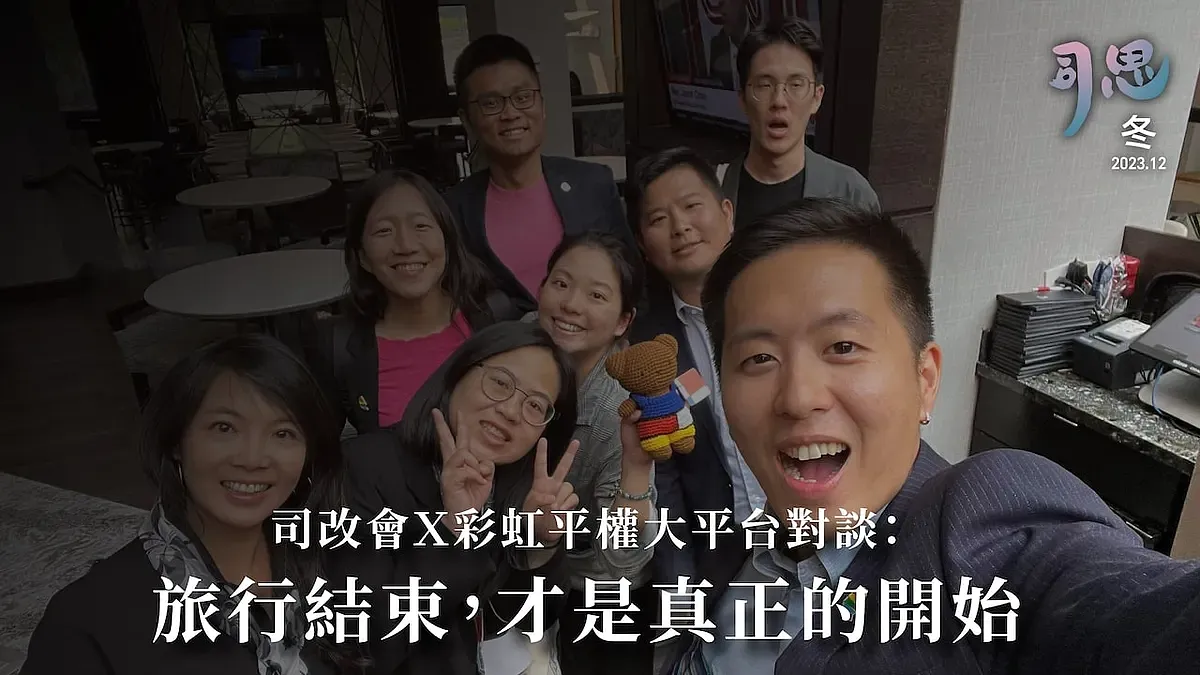
What is the purpose of international exchange work for local NGOs? What are the similarities and differences among gender, judicial reform, and human rights movements across countries? Traveling around the globe and returning to Taichung—the hometown of the two deputy executive directors—on December 15 for the final "Szu-Szu" event of the year at the Taichung Office, we listened to their year-end review. This article is based on the transcript compiled with the assistance of an intern (event photos).
Two Deputy Executive Directors with Social Work Backgrounds
Ming-ju: I am Li Ming-ju, an attorney and Deputy Executive Director of the Judicial Reform Foundation. Sharing the stage with me is Lin Chün-yen (Lun-lun), Deputy Executive Director of the Taiwan Alliance for Promotion of Civil Rights. We previously participated in a U.S. NGO exchange program called the "Professional Fellowship Program" (hereinafter PFP), engaging in six weeks of practical learning and seminars. Through this international mobility, we discovered many shared takeaways and reflections, and we hope to share these experiences with everyone.
Aside from Lun-lun's family, today's attendees include his friends as well as our students. Our sharing might not delve into the specific details of our work, but we hope to showcase the daily content of NGO workers. The environment we inhabit is similar to everyone's, not only in terms of international opportunities and exchanges, but also regarding how we cope within our shared environment. During the pandemic, I had just entered the NGO sector, and this kind of challenge is universal. I hope we can have a relaxed exchange today, and everyone is welcome to ask questions or discuss.
Lun-lun: I am Lin Chün-yen, a graduate of the Department of Social Work with a double major in the Department of Business Administration at National Taipei University. After graduating from high school, I unexpectedly entered the social work department and have been working in the NGO field ever since. I firmly believe that dedicating time and energy to meaningful causes is worthwhile, especially in the field of gender movements, which has become my profession and passion.
Ming-ju: Lun-lun and I share one commonality: our social work backgrounds. I am an attorney and pursued a graduate degree in social work after graduation. Through different explorations, I discovered the appeal of organizational work, especially since social workers tend to play their roles within "organizations," whereas social work "firms" are relatively rare. Historically, this stems from the fact that social workers must simultaneously consider individual cases and broader society; otherwise, they are merely assisting in the implementation of government welfare. For instance, in traditional poverty work, if social work organizations simply provide material goods and welfare, it merely maintains stability, whereas one must also think about how to change the unfair social structure of wealth and poverty. Practicing law indeed consumes a lot of time on individual cases. When I first started working at a law firm, I spent a great deal of time handling family law cases. At 25 years old, I hoped to try work that could bring about more structural change, which prompted me to enter the field of organizational work.
Lun-lun: Milwaukee, Sydney, Bangkok—Exchanging Similarities and Differences
Lacking Past Experience, Accumulating Starting Now
I think international work can be imagined as a ball game with numerous participating players across four levels: international organizations, such as the World Health Organization (WHO); regional organizations, such as Asia-Pacific Economic Cooperation (APEC); national representatives, such as those at the United Nations; and civil society, which includes civil society organizations like ours, abbreviated as CSOs. As a part of civil society, we represent civic organizations, and these four levels interact in various ways within the international community.
Taiwan faces numerous challenges internationally because its status is not fully recognized. Holders of Taiwan passports cannot enter United Nations headquarters, a restriction not faced by passport holders of other countries. Because China wields influence in the United Nations, Taiwan is unable to participate in related discussions as a country. This is akin to not being allowed to join a ball game, making it impossible to become familiar with the rules or receive training.
Traditionally, our international image has been that of providing medical or agricultural experts to help diplomatic allies build hospitals or guide farming. However, regarding judicial reform or human rights issues, Taiwan lacks corresponding experience and methods for building international relationships. In the past, because we had no experience and did not know how to proceed, the budget in this area was relatively limited.
Nevertheless, the passage of the same-sex marriage legislation in 2019 changed things to a certain extent, allowing the international community to see Taiwan's leading position on human rights issues. Especially regarding LGBTQ issues, we have more opportunities to step onto the international stage and share our experiences.
Why Go International?—Heading to the U.S. LGBTQ+ Chamber of Commerce
NGO participation in the international arena has concrete purposes. For instance, at the United Nations, national ambassadors gather at headquarters for meetings, and NGO workers from various countries also participate to jointly discuss and strive for rule amendments. This kind of participation is akin to collective action. It is similar to how domestically we might enter the Legislative Yuan together to lobby lawmakers and call for attention and stances on specific issues. Sharing experiences in the international arena is not only about exporting our learnings, but simultaneously understanding how issues and activists in other countries operate.
 Photo / PFP East Asia Group Photo
This photo is a group picture taken during our participation in the PFP this past May to June. This is a photo from our final large meeting in Washington, D.C. Within my organization, I am primarily responsible for the LGBTQ-friendly workplace project. Because sexual orientation is an identity we all possess, we hope to create a more friendly workplace environment for diverse gender groups, allowing everyone to work comfortably without being discriminated against or losing their job due to their sexual orientation or gender identity.
After I finished writing this project proposal, I happened to be assigned by this program to the LGBTQ+ Chamber of Commerce in Wisconsin, situated by Lake Michigan. The temperature at the time was around twelve degrees Celsius, and I felt somewhat surprised in my heart, but I learned a great deal there.
Within the Chamber of Commerce, they are dedicated to helping businesses operated by LGBTQ individuals or improving the friendliness of large corporations toward diverse gender groups. This involves different levels, including training corporate leaders or junior supervisors on how to lead teams in a friendly and inclusive manner, as well as teaching LGBTQ individuals who want to open a shop how to raise funds, utilize social media, and understand legal contracts. The Chamber also organizes corporate gatherings, allowing everyone to share cooperative experiences and promote cross-sector exchanges. Because it was our first time cooperating, we jointly planned some collaborative projects that allowed me to understand and be understood by the Chamber's members. Chamber members pay annual dues to access the resources provided by the Chamber; members include large enterprises, small and medium-sized businesses, as well as operators of establishments like cafes. They took me to visit various members—from cafes and cookie shops to LGBTQ-friendly parks and bars. These activities strengthened their relationships with members and also gave me a deeper understanding of the local environment. This is mutual cooperation.
Inside the Chamber, they provide resources to their members. Particularly during Pride Month in June, they release guidelines to help businesses build LGBTQ-friendly workplaces. The guidelines explain LGBTQIA+ terminology and offer recommendations for diverse and inclusive workplaces. What also left a deep impression on me was that in Milwaukee, the capital city of Wisconsin, there is even a local bus painted with the six-color rainbow and transgender flags for LGBTQ issues, operating year-round with fares donated to local LGBTQ organizations. This is one of the ways businesses genuinely support the community—not limited to Pride Month, but providing long-term support to local organizations.
Why Go International?—Australia, Thailand
Additionally, during this year's WorldPride events, I attended the Human Rights Conferences in Sydney. This conference provided a formal platform for LGBTQ activists, legislators, ambassadors, and diplomats from various countries to discuss matters related to international LGBTQ issues. During the conference, the Australian government also announced that it would invest over 3.5 million Australian dollars to support LGBTQ movements in the Asia-Pacific region.
This year I visited Thailand twice, respectively in July and last week. During my July visit, a democratic movement took place in Thailand, with people protesting the veto of the original prime ministerial candidate Pita, which evoked my memories of the 2014 student movement. While participating in the march, although there was a language barrier, I felt a deep resonance, joining people of all age groups, genders, and sexual orientations in caring for the nation's future, democracy, and political trajectory. Later, I also engaged in exchanges and discussions with Thai LGBTQ and marriage equality partners, sharing Taiwan's experiences in this regard. Although we cannot influence policy decisions in other countries, we can provide experiences in lobbying, communication, and volunteer organizing to support local activists in developing their own advocacy strategies.
Sometimes the terminology used by NGOs may feel distant to the general public. For instance, regarding the concept of equality, ordinary people might not grasp it directly and might even think life is inherently unfair. We must strive to engage in dialogue using language that is closer to society. In the international community, continuously learning and finding connections between domestic organizations and international issues is an important challenge. Of course, the focus of international attention is constantly shifting, and we must constantly ponder how to link our own work with current international issues.
The experience of participating in international conferences moved me deeply. Even though English is not our native language, we strived to communicate and share with other countries to understand what is happening within the region. Some believe that Taiwan suffers from worship of things foreign, but I believe exploring different paths in the international community enriches our perspectives. This is not about imitating others, but rather placing oneself in an unfamiliar environment and observing how they confront issues and capabilities. For me, this made me more convinced of Taiwan's achievements. Everyone's way of exploring international paths differs. Perhaps giving oneself the opportunity to visit other countries, or Western countries, is an enriching experience—not to emulate, but to understand their developmental trajectory. Such an experience might influence future life choices.
Ming-ju: New York, Tokyo, Kuala Lumpur—Experiencing Three Types of Gaps
Keyword: Gaps
I came to the JRF in 2019 as a full-time attorney, mostly handling local legal affairs. The years 2020 and 2021 were both spent during the pandemic with no international exchange opportunities, until the situation took a sudden turn this year. I traveled to the United States, Japan, and Malaysia this year, and these experiences made me feel three types of gaps.
In May, I went to the United States and interned at an organization engaged in strategic litigation. Strategic litigation typically uses the judiciary to generate social movement discourse and exert pressure or advocate toward the government or large corporations. In Taiwan, this is a method particularly utilized for topics where lobbying the congress is difficult. However, once I arrived in the U.S., I discovered that even though such litigation is commonly used within Taiwan's NGO circles, an American organization specializing in strategic litigation had zero understanding of Taiwan. This was the first information gap I faced.
Consequently, during my six weeks in the U.S., I had to work quite hard to introduce Taiwan to everyone. Especially within the Open Society Foundations, where there were no Taiwanese staff members, I sometimes had to start from very basic information about Taiwan before we could delve into deeper topics such as the Sunflower Student Movement, the upcoming major elections, or judicial reform.
In June, alongside my colleagues from the JRF, I traveled to Japan and visited organizations such as the Center for Prisoners' Rights and the Japan Association for the Freedom of Citizens (for further reading: Postscript on the Visit and Exchange with the Center for Prisoners' Rights in Japan). During our exchanges with them, I felt a generational gap. They still utilize traditional methods, such as newspapers, for advocacy, whereas we in Taiwan utilize modern tools like social media. They were also extremely surprised to hear that we hold concerts for miscarriage-of-justice cases.
Japan's social movements inherit a historical context that links social movements with leftist movements. During the exchange process, a row of our young colleagues in their twenties and thirties sat on the left, while a whole row of senior lawyers sat on their right, making me feel the cultural, generational, and methodological gaps when conducting advocacy in different countries. Although the problems faced are very similar, having a continuous stream of young people joining the ranks of advocacy in Taiwan is actually a very difficult feat to achieve.
In September, representing the Taiwan Bar Association, I took a trip to Malaysia for the International Forum on Judicial Independence and took the opportunity to visit many local civil groups. One could sense that the atmosphere surrounding social movements there is very similar to Taiwan five to eight years ago; the suppression of protests and the problems faced also differ from Taiwan at its current stage. Regarding judicial independence, political instability has placed them at a different stage from Taiwan when discussing the balance between judicial accountability and judicial independence. Consequently, Taiwan's judicial reforms from the 1990s—such as abolishing the submission of verdicts for administrative review, resisting interference, and fighting corruption—actually sparked greater interest among them. This is a rather interesting developmental process gap.
How to Set Agendas?
Amidst the process of international mobility, I felt information, generational, and developmental process gaps. Looking at the international environment we currently face, the agendas of other countries, or the dominant mainstream agendas internationally, do not completely align with the agendas set by Taiwan itself. For instance, Americans were extremely terrified that a war was about to break out in Taiwan, whereas those genuinely anxious in Taiwan were actually in the minority. Secondly, the international issues Taiwan cares about also differ from the focuses of the international community, which may affect the degree to which our issues are seen. When conducting international exchanges, we must ponder the reasons behind these gaps, as this helps us reposition ourselves within the international agenda. Perhaps our goal is not merely inward-facing, but should also focus on exchanges and sharing experiences with other countries, especially those at different developmental stages.
I feel this is an issue faced not only by NGO workers, but also by individuals across all professions. Regardless, these experiences made me realize that we need to rethink our position on the international stage and how to participate more effectively in setting global agendas.
Queer ways for NGO workers
At the end of the lecture, Ming-ju shared what "internationalization" entails, noting it can roughly be divided into three tiers: first, allowing Taiwan's issues to be seen internationally; second, paying attention to international issues that the international community cares about; and third, internalizing international standards into Taiwan's legal standards. For Taiwan's legal community, the third goal—namely, putting international standards into practice in Taiwan—is the most valued and receives the greatest support. I hope that in the future, these different tiers of internationalization can become a familiar concept, a common understanding and goal among workers, so that everyone knows precisely which tier of goals is being discussed when talking about internationalization.
Lun-lun added that when discussing issues aimed at making the world see Taiwan, Taiwan finds itself in an awkward position. Due to political reasons, we are sometimes unable to join the international community in discussing current global events, while what we care about is not necessarily cared about by others. Nonetheless, it is worth mentioning that in many issues, Taiwan's development is at the forefront. For example, in the fields of gender and education, Taiwan can still develop its unique characteristics within its own framework. In international exchanges, constrained by limited resources, our potential is stimulated even further, enabling us to achieve outcomes in our own unique way.
The final conclusion mentioned a "Queer way to work." The term "queer" originated as a derogatory term for homosexuals but was later reclaimed by the LGBTQ community and transformed into an identity. In the process of our international mobility, we observed that while Taiwan achieves outcomes similar to those abroad, Taiwan realizes these results in a very unique manner. Within the international community, Taiwan might also resemble being "queer," but the difficulties regarding resources allow us to better understand this role and remind ourselves to use unconventional methods to seek out opportunities and forge ahead.
This article is an AI-generated translation of the original Chinese text. In the event of any discrepancy, the Chinese version shall prevail.