
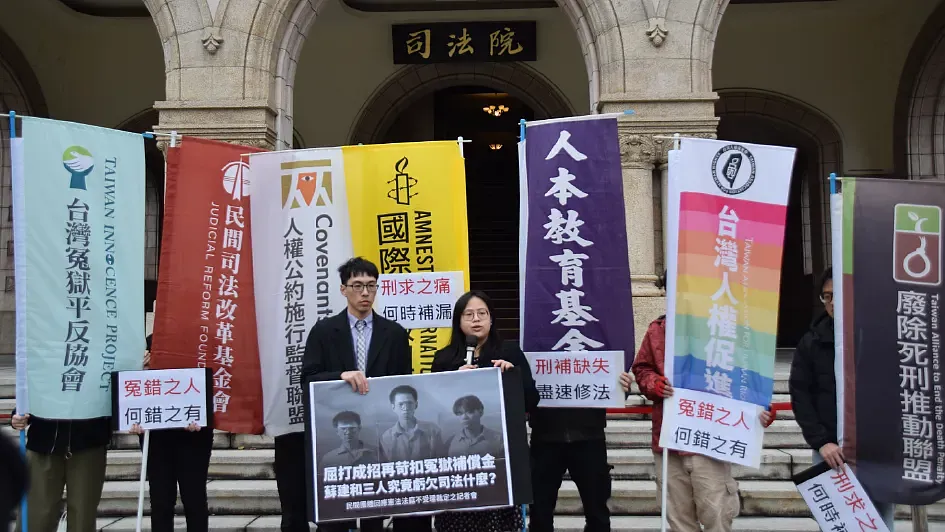
Press Conference | Coerced Confessions Followed by Unjust Deductions from Wrongful Imprisonment Compensation: What Does the Judiciary Still Owe Su Chien-ho and the Other Two?—Civil Society Organizations' Response to the Constitutional Court's Dismissal Ruling
Last edited: 2026-07-27
Last Friday (December 29, 2023), regarding the petition filed by wrongful imprisonment victims Su Chien-ho, Liu Bing-lang, and Chuang Lin-xun challenging Article 7 of the Criminal Compensation Act—which resulted in the improper deduction of their compensation—the Constitutional Court issued a "dismissal ruling" with 9 votes in favor and 3 against (with 3 Justices recusing themselves), dealing another severe blow to the three victims' chances of attaining fairness and justice.
Seven organizations, including the Judicial Reform Foundation, Taiwan Association for Human Rights, Taiwan Alliance to End the Death Penalty, Amnesty International Taiwan, Taiwan Association for Innocence, Foundation for Education and Culture, and the Covenants Watch, deeply regret this outcome and jointly issue the following statement:
1. Confessions Obtained Through Torture Used as Grounds to Deduct Compensation
From the age of 18 to 39, starting from the very moment Su Chien-ho and the other two were accused of a crime, they spent as long as 21 years proving their innocence. One of the primary causes of this major miscarriage of justice was that the police tortured Su Chien-ho and others in order to obtain a criminal confession.
Regarding the fact that Su Chien-ho and others were subjected to severe torture, the Control Yuan had previously censured the Ministry of Justice and the National Police Agency. In the final judgment acquitting Su Chien-ho and others, the court also combined "testimony from cellmate witnesses in the detention center," "results of physical examinations upon entry," and "records of painkillers dispensed" to conclude that Su Chien-ho and others had indeed been tortured. Yet, absurdly, when Su Chien-ho applied to the court for criminal compensation due to wrongful imprisonment, the court took the view that no torture had occurred, ruled that he bore "culpable grounds" due to his confession, and slashed his compensation to less than 1/3 of the usual amount (a total of NT$15.84 million for the three of them)! This outrageously absurd judgment was surprisingly accepted by the Criminal Compensation Division of the Judicial Yuan.
Put simply, this is tantamount to the court telling defendants who were tortured and served over 11 years of wrongful imprisonment: "Although you were tortured, because you still confessed to the crime, your wrongful imprisonment compensation must be deducted!"
How is treating wrongfully accused victims with such crude and arrogant judicial attitudes anything less than bullying?
2. Although the Unconstitutional Provision Was Repealed via Amendment, It Cannot Rescue the Rights Stripped from the Victims
In view of the problems in the practical application of "culpable grounds," the Judicial Yuan proactively proposed its deletion, which was completed and given its third reading by the Legislative Yuan on December 15, 2023. What was deleted this time was precisely Article 7 of the Criminal Compensation Act, which Su Chien-ho and others had petitioned the Grand Justices to declare unconstitutional.
However, although the unconstitutional provision has been deleted, there is no way to compensate Su Chien-ho and others for the unfair treatment they suffered.
During the legislative amendment process, the JRF synthesized all criminal compensation cases over the past 12 years, revealing a total of 299 individuals whose compensation was reduced due to "culpable grounds" (accounting for 23.6% of the total number of recipients). Assuming even distribution among compensation authorities across Taiwan, each court handled fewer than 10 such cases. Therefore, the JRF also proposed an amendment bill hoping to grant past victims whose compensation was reduced an opportunity to petition for a retrial, but it was not accepted by the Judicial Yuan and the Legislative Yuan and thus failed to pass.
3. It Is Regrettable That the Grand Justices Failed to Actively Defend the Rights of Wrongful Imprisonment Victims
Following the failure to legislate a retroactive application clause, the final remaining chance for Su Chien-ho and the other two rested with the Grand Justices. However, the Grand Justices used procedural grounds to dismiss the case—which clearly presented unconstitutional circumstances—by a 9:3 vote (Justices Huang Jui-ming, Jan Forest, and Hsieh Ming-yang submitted a dissenting opinion).
In plain terms, the reason why the Grand Justices dismissed the case in Ruling No. 149 of the Constitutional Court in the 112th Year (2023) is:
When petitioning for constitutional litigation regarding past cases, only "final criminal judgments" are exempt from time limitations. Because "criminal compensation cases" are not "final criminal judgments," and too much time has passed in this case, the Constitutional Court will not process it on procedural grounds.
We believe the rationale used by the Grand Justices for dismissal is open to debate. There should be no warranty period for the restoration of justice to victims of wrongful convictions.
First, looking at the form, the agency rendering the criminal compensation decision is precisely the "criminal division" of each court. Procedurally, the trial proceedings involve the assessment of criminal evidence. Looking at the substance of the proceedings, the courts also use "culpable grounds" to assess whether "the victim's innocence is truly that innocent?" In reality, this amounts to re-examining the facts of the case after a victim has already been found innocent to see "what was suspicious about the victim? and how did they 'get what they deserved'?"—to the extent that they do not deserve to receive too much compensation!
Judging from the Su Chien-ho case, the subtext of the compensation court is: "Since you didn't do it, you shouldn't have confessed even when tortured. Since you confessed, causing the court to previously misjudge you as guilty, deducting your wrongful imprisonment compensation is only fair!"
In practice, the courts have metamorphosed criminal compensation proceedings into a trial concerning the "residual criminal suspicion" of wrongful imprisonment victims—judging from the facts of the case, if a defendant is an "acquitted defendant who is not 'that' innocent," their compensation must be deducted! Past wrongful imprisonment victims have long faced this kind of predicament, yet the Grand Justices lightly dismissed it on the grounds that it was not a "final criminal judgment," which is truly regrettable.
4. Reform the Criminal Compensation System and Stop the Humiliation of Wrongful Imprisonment Victims
Criminal compensation cases possess the characteristic of the "State" acting as the perpetrator and the individual as the "victim." The granting of wrongful imprisonment compensation is by no means a humble request by the victim, but a fundamental requirement for the restoration of justice.
The courts' improper slashing of compensation for wrongful imprisonment victims, the turning of a blind eye to the restoration of justice during the amendment process, and the Grand Justices' missed opportunity to safeguard victims' constitutional rights all demonstrate a lack of proactive self-reflection capacity within judicial organs, and simultaneously constitute secondary humiliation toward victims of wrongful imprisonment!
Regarding the systemic issues of the Criminal Compensation Act, civil society organizations jointly put forward four demands as follows:
- For past cases where wrongful imprisonment compensation was deducted under Article 7 of the Criminal Compensation Act, the Legislative Yuan should promptly amend the law to provide appropriate avenues for relief.
- Regarding the time limit for petitioning for a retrial, Article 22 of the Criminal Compensation Act stipulates that applications may absolutely not be filed after 5 years, which raises constitutional doubts; the Judicial Yuan should study amendments and promptly submit them to the Legislative Yuan for deliberation.
- Regarding past and present occurrences of torture and ill-treatment, as well as the social reintegration, support, and reputation restoration of wrongful imprisonment victims, the National Human Rights Commission should investigate and clarify current systemic deficiencies.
- In response to citizens suffering torture or other improper treatment by state power during investigations, the Legislative Yuan should swiftly pass the Enforcement Act of the Convention against Torture to establish comprehensive prevention, investigation, and remedy mechanisms.
Press Conference Time
Thursday, January 4, 2024, at 10:00 AM
Press Conference Location
In front of the Judicial Yuan Judicial Building (No. 124, Sec. 1, Chongqing S. Rd., Zhongzheng Dist., Taipei City)
Attendees
Li Ming-ju | Pro Bono Lawyer for the Su Chien-ho Criminal Compensation Constitutional Litigation Case, Deputy Executive Director of the Judicial Reform Foundation
Lü Cheng-yen | Pro Bono Lawyer for the Su Chien-ho Criminal Compensation Constitutional Litigation Case, Director of the Legal Policy Department of the Judicial Reform Foundation
Chiang Meng-chen | Office Director, Covenants Watch
Lin Tzu-wei | Legal Director, Taiwan Alliance to End the Death Penalty
Shih I-hsiang | Senior Researcher, Taiwan Association for Human Rights
Li Chen-yuan | Specialized Commissioner for Education and Human Rights Policy, Foundation for Education and Culture
Kao Fu-hsuan | Senior Youth and Campaign Advocacy Specialist, Amnesty International Taiwan
Wei Yu-an | Publicity Specialist, Taiwan Association for Innocence
Media Contact
Lü Cheng-yen, Attorney-at-Law, Director of the Legal Policy Department, Judicial Reform Foundation
Phone: 02-2523-1178#37
Email: elvin@jrf.org.tw
This article is an AI-generated translation of the original Chinese text. In the event of any discrepancy, the Chinese version shall prevail.