
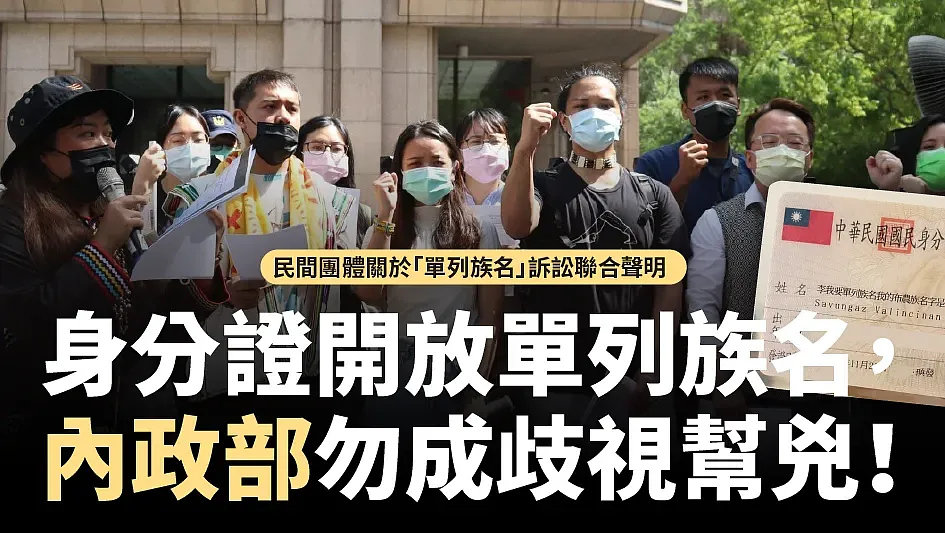
Allowing Single-Listing of Indigenous Names on National ID Cards: The Ministry of the Interior Must Not Become an Accomplice to Discrimination! Joint Statement by Civil Society Organizations Regarding the Lawsuit on Single-Listing of Indigenous Names
Last edited: 2026-07-27
On January 11, 2024, the verdict was handed down in the "Call My Real Name Action Group"'s "Single-Listing of Indigenous Names Lawsuit" filed against household registration authorities. The Taipei High Administrative Court ruled (Judgment No. 110-Su-1140) in favor of six plaintiffs, while one plaintiff received an unfavorable ruling. The main text of the judgment requires: The household registration offices of Zhongzheng District in Taipei City, Tamsui District in New Taipei City, and Shoufeng Township in Hualien County shall revoke the original administrative dispositions rejecting the six plaintiffs, and shall approve their applications for single-listed indigenous name registration on their national ID cards.
Indigenous partners have been fighting for indigenous rights through the movement of "indigenous name registration," demanding that state laws confront the specificity of indigenous peoples and refrain from using Han-centric laws to restrict indigenous rights. At the same time, this reflects upon how indigenous peoples suffered colonial violence under foreign regimes throughout different historical stages, hoping to appeal to the state for indigenous transitional justice through the struggle for traditional indigenous names.
To respond to the single-listing name registration campaign by the "Call My Real Name Action Group," four organizations—the Judicial Reform Foundation, Amnesty International Taiwan, the Taiwan Association for Human Rights, and the Covenants Watch—released a joint statement paying tribute (acknowledgement) to indigenous peoples regarding the single-listing name judgment (six plaintiffs winning and one losing), and put forward two demands as follows:
- The Ministry of the Interior should abolish unlawful administrative interpretations and immediately implement indigenous rectification operations.
- The Executive Yuan should comply with the ICERD and accelerate the promotion of the Anti-Discrimination Act.
1. The Ministry of the Interior Should Abolish Unlawful Administrative Interpretations and Immediately Implement Indigenous Rectification Operations
The current administrative interpretation by the Ministry of the Interior regarding the Name Act (binding Chinese characters with indigenous names) prohibits indigenous people from solely using indigenous romanization systems to register their names on national ID cards. The reasoning is: "Considering social stability, the names used by citizens should be consistent with the names registered in the household registry... However, taking into consideration the convenience of use by various agencies (units), indigenous people are permitted to solely use traditional names in Chinese characters. Since the romanization symbols of traditional names are not commonly known by the general public, they should not be used alone."
However, the Indigenous Languages Development Act passed in 2017 and the National Languages Development Act passed in 2019 both explicitly state that the languages of all indigenous peoples are "national languages." Furthermore, Chinese characters also contain many rare and difficult-to-identify characters; differentiation should not be applied to indigenous romanization systems solely on the grounds of "social stability" and "administrative convenience."
Prior to today's judgment, Judgment No. 110-Su-1084 of the Taipei High Administrative Court had already pointed out that the provision on "adopting Chinese names" in Article 3 of the Name Act, based on the constitutional interpretation of indigenous languages as national languages, should be expanded to mean "adopting national language names." In addition to approving the single-listed indigenous name registrations of indigenous plaintiffs in accordance with the administrative court's judgment, the Ministry of the Interior should further abolish current administrative interpretations in accordance with the intent of the judgment. It should not use administrative indolence as a reason to claim that the national ID card name modification system has not yet been upgraded and revised (household registration offices also provide manual handwriting methods); nor should it use the excuse that winning judgments are only binding on the plaintiffs and relevant agencies to reject applications from other non-litigant indigenous people for single-listed indigenous name registration. We strongly urge the Ministry of the Interior to immediately open up registrations for single-listed indigenous names and actively implement name rectification operations.
2. The Executive Yuan Should Comply with the ICERD and Accelerate the Promotion of the Anti-Discrimination Act
The International Convention on the Elimination of All Forms of Racial Discrimination (ICERD) is one of the nine core United Nations human rights conventions. Taiwan signed it in 1966, ratified it in 1970, and deposited the instrument of ratification with the UN Secretary-General. The ICERD is also the first United Nations human rights convention to enter into force in our country, possessing domestic legal effect.
In addition, our country will undergo international review regarding the ICERD this April. The National Human Rights Commission of the Control Yuan proposed independent evaluation opinions on the ICERD last August, affirming "indigenous name rights" and recommending that public sectors comply with the ICERD's explicit provisions safeguarding the rights of indigenous peoples to choose and use their own languages and to practice their cultural traditions and customs, without being subjected to assimilation or integration by any means whatsoever. Appropriate strategies should also be adopted to formulate and implement relevant training programs to enhance the professional competencies of public officials in relevant departments.
Furthermore, the Department of Human Rights and Transitional Justice of the Executive Yuan announced the "National Human Rights Action Plan" the year before last, promising to draft an equality law—namely, the "Anti-Discrimination Act"—as a matter of priority for the state to promote human rights, and expected to submit the draft to the Legislative Yuan after the elections this year.
As civil society organizations concerned with the Anti-Discrimination Act, we strongly urge the state to re-examine egalitarian measures against discrimination through the issue of single-listed indigenous names. It should use all appropriate means to prohibit and terminate any form of racial discrimination and prejudice, implement the indigenous provisions of the Additional Articles of the Constitution and the Indigenous Peoples Basic Act, and cease using reasons such as social order stability and administrative convenience as stumbling blocks to ethnic equality.
Organizations Issuing the Joint Statement
Judicial Reform Foundation
Amnesty International Taiwan
Covenants Watch
Taiwan Association for Human Rights
Press Contacts
Lin Ch'eng-ch'ing, Assistant Legislative Researcher, Judicial Reform Foundation
Phone: 02-2523-1178#9
Email: kacan@jrf.org.tw
This article is an AI-generated translation of the original Chinese text. In the event of any discrepancy, the Chinese version shall prevail.