
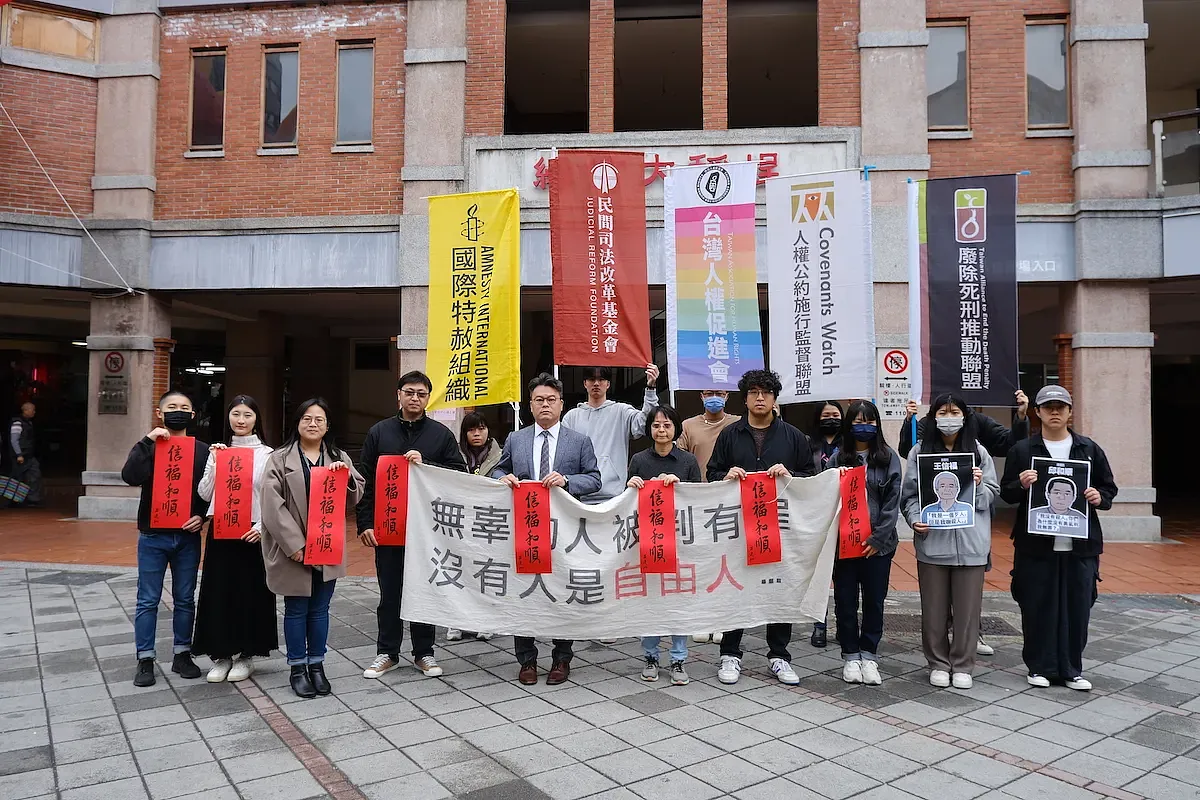
Awaiting Rescue in Death-Row Wrongful Convictions, May Happiness and Harmony Bring the Lunar New Year: Taipei Dadaocheng "Happiness and Harmony" Spring Couplet Distribution Event and Press Conference
Last edited: 2026-07-27
Today, the rescue teams for Ch'in Ho-shun and Wang Hsin-fu held a press conference at the Yongle Plaza in Dadaocheng and distributed "Happiness and Harmony" spring couplets to passing citizens and shop owners along the Dihua Street Lunar New Year shopping street. In addition to extending New Year greetings—wishing everyone a happy, safe, and harmonious New Year—the event also served as a reminder not to forget Wang Hsin-fu and Ch'in Ho-shun, two individuals trapped on death row awaiting rescue in these wrongful death penalty cases.
Li Ming-ju, Deputy Executive Director of the Judicial Reform Foundation, stated that today civil society groups came together to the New Year shopping street not only to greet the public for the New Year, but also to raise awareness about the wrongful death penalty cases of Wang Hsin-fu and Ch'in Ho-shun, who remain imprisoned and await rescue as the Lunar New Year approaches. We hope their plight and cases can be seen by everyone. The "Happiness and Harmony" spring couplets we are distributing today were written by Su Chien-ho, a survivor of a wrongful death penalty case. We hope that through the spring couplet distribution, alongside expressing our best wishes, we can let everyone know that wrongful death penalty cases are not history—they are real events still happening in Taiwan today.
Lin Chun-hung, Convener of the Ch'in Ho-shun Legal Defense Team, explained that the terms "Ho-shun" (harmony and smoothness) and "Hsin-fu" (happiness and fortune) are very common in Taiwanese society and carry wonderful meanings. Yet, the two individuals bearing these names are currently stuck in our detention facilities because our judicial system has been unable to clear their names. Ch'in Ho-shun has been imprisoned in Taiwan's correctional facilities for thirty-six years, setting the longest detention record in Taiwan's judicial history. Thanks to assistance from various sectors, his case has become increasingly well-known. The Control Yuan has issued three investigative reports on this case, all pointing directly to obvious flaws within it. The Ch'in Ho-shun case features clear alibis and evidence of torture, yet the court still sentenced Ch'in Ho-shun to death. This is why the rescue team must continue to voice support, hoping that the new government, the President, and the Legislative Yuan will pay attention to this case. We hope Ch'in Ho-shun will have the opportunity to return home for the New Year.
Chang Chuan-fen, Chairperson of the Taiwan Association to Death Penalty Abolition, mentioned that Wang Hsin-fu and Ch'in Ho-shun are two individuals unable to be present today, so we are speaking in their place to share their stories with everyone. The facts of Wang Hsin-fu's case are as follows: a young man at a karaoke bar shot and killed two people. The court concluded that the young man who fired the shots was Wang Hsin-fu's subordinate and acted under his instructions, and thus also sentenced Wang Hsin-fu to death. During the investigation of Wang Hsin-fu's case, it was clear that there were no fingerprints on the gun, and those present stated that the young man was not Wang Hsin-fu's subordinate. Nevertheless, the court still sentenced Wang Hsin-fu to death in the absence of evidence. He has been locked in prison since 2006, is now over seventy years old, and his physical health is deteriorating. While everyone is joyfully preparing for the Lunar New Year, wrongful death penalty cases receive absolutely no public attention. They are victims—victims of the state's judicial system. Innocent people have been found guilty, and they are the ones left with nowhere to turn for help within this system.
Finally, Legislator Puma Shen stated that standing alongside civil groups today stems from the hope to support two important wrongful conviction cases: those of Ch'in Ho-shun and Wang Hsin-fu. These are not the only wrongful convictions in Taiwan; figuring out how to make the judicial system more progressive and reduce such cases is the primary task. From the authoritarian era to the present, our judicial system has inherently suffered from deep-seated problems, let alone the fact that in some countries—even those without Taiwan's historical background—the systemic risks within the entire judicial system are quite high. Assuming an error rate of one percent, and further dividing "convicting the innocent" and "acquitting the guilty" into two categories to calculate at 0.5 percent, in the United States, that would still amount to 6,000 wrongful convictions a year. Regarding death penalty cases, perhaps as many as one in twenty could be a wrongful conviction—and this may still happen in countries primarily relying on scientific evidence. Looking back at Taiwan, even though we now have so-called scientific crime-solving, the judicial system still has a long way to progress. It is Taiwan's tragedy that we remain unable to resolve wrongful convictions caused by systemic issues coupled with insufficient evidence and the inability to conduct cross-examinations. During the New Year, everyone is in high spirits, preparing to reunite with their families. But we must remember that a vast number of people are trapped in such false, unjust incarcerations, unable to reunite with their families or enjoy the joyful festive atmosphere outside with everyone. Therefore, we hope everyone will continue to pay attention to these cases.
On the back of the "Happiness and Harmony" spring couplets are words addressed by Su Chien-ho to the two defendants of wrongful conviction, transforming his own experience of eventually achieving exoneration into a blessing: "Although the judiciary is constantly progressing, wrongful convictions also continuously exist. Because of my own encounters, I understand that wrongful convictions require the general public to actively confront them. A new year is here once again; I hope everyone can experience happiness and smoothness, that wrongful convictions truly cease to exist, and that we can all work hard together to bring back happiness and harmony."
Beyond legal remedies, through advocacy actions, we hope to let more people know about the injustice and tragedy that befell them, not to forget them, and to pray that Wang Hsin-fu and Ch'in Ho-shun may soon return home for a family reunion.
[Jointly Stating Groups]
Ch'in Ho-shun Rescue Team
Judicial Reform Foundation
Amnesty International Taiwan
Taiwan Association for Human Rights
Taiwan Association to Death Penalty Abolition
Covenant Watch
Taiwan Association for Innocence
[Press Contact]
Tsai Meng-chu Mido | Advocacy Specialist, Judicial Reform Foundation
This article is an AI-generated translation of the original Chinese text. In the event of any discrepancy, the Chinese version shall prevail.