
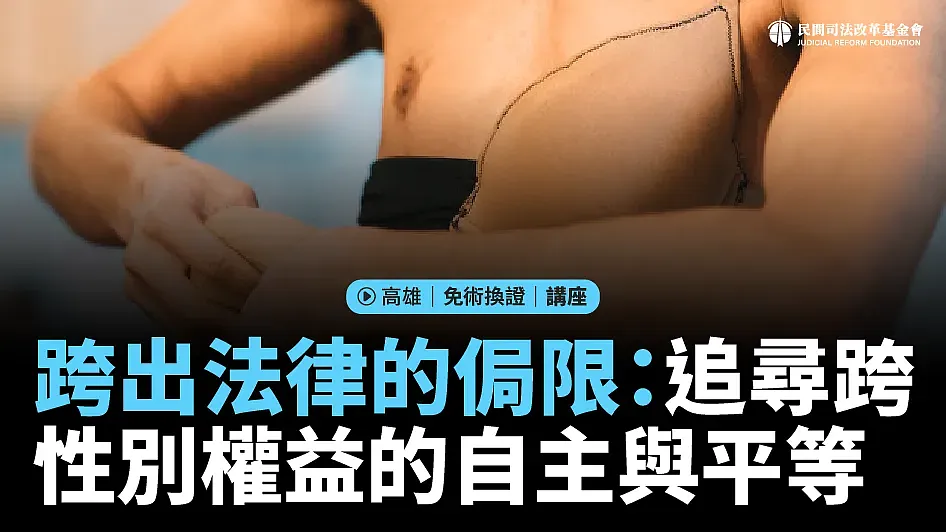
Court Observation Recruitment and Lecture | Beyond the Limits of the Law: Pursuing Autonomy and Equality in Transgender Rights
Last edited: 2026-07-27
Beyond the Limits of the Law: Pursuing Autonomy and Equality in Transgender Rights
In recent years, some transgender individuals have pursued legal action regarding the alteration of sex registration on their national identity cards to secure the right to self-determination of gender. Their objective is to challenge an unjust and illegal administrative ruling currently enforced by the Ministry of the Interior. This unlawful ruling requires transgender individuals to undergo sexual reassignment surgery and obtain diagnoses from two psychiatrists. However, a comprehensive review of the Household Registration Act reveals no mandatory provisions requiring sex reassignment surgery for "sex registration alteration." Consequently, the Ministry's unlawful ruling not only violates the gender equality principles of the CEDAW convention but also serves as a persistent nightmare for transgender individuals on their journey to self-identity.
This seminar invites Attorney Li Ling-wei, legal counsel for the Hsiao-Na case, as the keynote speaker, and Director Hu Yu-ying of the Graduate Institute of Gender Studies at Kaohsiung Medical University as the discussant. They will guide participants through the legal narrative of Kaohsiung's Hsiao-Na case, linking it to the broader advocacy movement for transgender rights—including rights advocacy for diverse genders, judicial mobilization for legal gender recognition without surgery (surgical exemption), and international legislative trends—to jointly reflect on gender equality, judicial justice, and identity underlying the pursuit of surgical exemption for legal gender recognition.
Lin Ch'eng-ch'ing, Assistant Researcher Legal Policy Department, JRF
Keynote SpeakerLi Ling-wei, Attorney Legal Counsel for the Kaohsiung Hsiao-Na Case, Deputy Convenor of the JRF Gender Judicial Reform Group
DiscussantHu Yu-ying, Associate Professor Director, Graduate Institute of Gender Studies, Kaohsiung Medical University
- Time: March 28 (Thu.) 19:00-21:00
-
Location: Southern Office of the Taiwan Association for Human Rights (10F-4, No. 157, Yishing 2nd Rd., Chianjhen Dist., Kaohsiung City)
In-person participation only, limited to 40 attendees. Excess registrations will be placed on a waiting list.
Kaohsiung Hsiao-Na Case on Legal Gender Recognition Without Surgery (Third Preparatory Proceedings)
How the judiciary fulfills its function of safeguarding human rights, alongside the domestic implementation and judicial practice of international human rights conventions, is of vital importance. Notably, under the framework of the Convention on the Elimination of All Forms of Discrimination against Women (hereinafter referred to as CEDAW), how Taiwan's judiciary can align with international human rights standards has been the subject of extensive discussion in recent years regarding transgender issues.
In September 2021, the Taiwan Alliance to Promote Civil Partnership Rights (TAPCPR) assisted in the victory of the Hsiao-E case regarding legal gender recognition without surgery at the Taipei High Administrative Court. The court ruled that transgender individuals are not required to undergo forced sexual reassignment surgery to apply for a change in sex registration.
In October 2023, the Grand Bench of the Supreme Court of Japan (consisting of all 15 judges) unanimously declared the "mandatory surgery requirement" unconstitutional (with mainstream Japanese legal opinions viewing the Supreme Court's unconstitutionality rulings as having erga omnes effect), overturning the previous ruling delivered in 2019 by a Petty Bench of the Supreme Court (5 judges).
Progress of the Hsiao-Na Case
This court observation focuses on the Hsiao-Na case heard by the Kaohsiung High Administrative Court, involving an application for sex registration alteration submitted to the household registration office, which was rejected based on the Ministry of the Interior's administrative ruling. Following a defeat at the Kaohsiung High Administrative Court and a subsequent appeal to the Supreme Administrative Court, the Supreme Administrative Court rescinded the original judgment on September 21, 2023, remanding the case back to the Kaohsiung High Administrative Court for retrial.
The reasoning in the Supreme Administrative Court's judgment explicitly states:
"An individual's continuous self-gender identity falls within the core scope of protection guaranteed by Article 22 of the Constitution concerning human dignity, the free development of personality, and personality rights. Although the legal determination of an individual's gender has initially been judged by external physiological sex characteristics at birth, when an individual's outward gender inclination—based on their internal self-comprehension and awareness—differs from their legally assigned gender, the State should respect the individual's freedom and right to self-determine their gender, provided it does not impair social order or the public interest, and recognize that individuals may apply to change the gender registered in their household registration pursuant to Article 21 of the Household Registration Act."
"Item 2 of the Ministry of the Interior's directive issued on November 3, 2007 (Tai-Nei-Hu-Tzu No. 0970066240), which requires male-to-female transgender individuals to undergo gender-affirming surgeries involving the removal of male reproductive organs such as the penis and testicles before they may apply for a sex registration change pursuant to Article 21 of the Household Registration Act, lacks legal basis and severely violates the applicant's bodily autonomy, right to health, human dignity, and personality rights, thereby breaching the principle of legal reservation and the principle of proportionality... The original trial court imposed conditions not prescribed by law regarding the application of Article 21 of the Household Registration Act, and the examples it cited all pertained to errors in original sex registrations, constituting an error of improper application of laws and regulations."
On December 19, 2023, the court held the first preparatory proceedings following the remand. During the proceedings, the judge requested Attorney Li Ling-wei (Hsiao-Na's legal counsel) to submit administrative judgments from other cases in Taiwan concerning legal gender recognition without surgery to serve as a reference for the court's review. Additionally, Attorney Li noted that the foreign legislative examples cited in the Supreme Administrative Court's judgment regarding surgical exemptions have undergone changes in certain jurisdictions and that the information was not fully up to date; she therefore indicated to the court that she would compile and provide the latest data on foreign legislative examples.
In January of this year, Attorney Li also filed a motion with the court for expert testimony, inviting Professor Ch'en I-ch'ien from the Graduate Institute of Gender Studies at Shih Hsin University and Psychiatrist Huang Ts'an-wen to provide their respective opinions. Through the perspectives of gender studies and psychiatry, she hopes to assist the judge in understanding the current dilemmas faced by the transgender community while broadening legal horizons to prevent the law from continuing to marginalize and oppress transgender groups.
On February 27 of this year, following the conclusion of the second preparatory proceedings for the Hsiao-Na case, the court stated that the relevant evidence was sufficient, noting that arguments for both favorable and unfavorable judgments were adequately articulated in the verdicts, rendering it unnecessary to summon witnesses for professional opinions. The court indicated that it would proceed directly to the final oral argument proceedings to conclude the case. However, through strong persuasion by Attorney Li Ling-wei, the court agreed to summon Professor Ch'en I-ch'ien to present relevant opinions. These legal opinions regarding transgender rights will be presented during the preparatory proceedings on Thursday, March 28, with the aim of helping the judge better understand why transgender individuals are fighting for legal gender recognition without surgery.
The JRF Gender Group will once again mobilize students from local universities such as National Kaohsiung University, National Kaohsiung Normal University, and Kaohsiung Medical University who care about gender human rights to conduct court observation at the Kaohsiung High Administrative Court, followed by a seminar held that evening to invite everyone concerned about the Hsiao-Na case to communicate and share insights.
March 28 (Thu.) 10:40
LocationThird Courtroom, Kaohsiung High Administrative Court (No. 180, Singnan Rd., Nanzih Dist., Kaohsiung City)
Q & A
Q. What is "legal gender recognition without surgery" (surgical exemption)?
In recent years, some transgender individuals have pursued legal action regarding the alteration of sex registration on their national identity cards to secure the right to self-determination of gender. The reason is that the current administrative ruling by the Ministry of the Interior forcibly requires transgender individuals applying for a sex registration change to meet two conditions:
1. A diagnostic evaluation report assessed by two specialized psychiatrists.
2. A certificate issued by a qualified medical institution documenting the domestic removal of male or female sexual organs.
In addition to requiring a psychiatric and psychological gender diagnosis, the ruling mandates that transgender individuals undergo sexual reassignment surgery or gender-affirming surgery before their application for sex registration alteration can be approved.
However, a comprehensive review of the provisions of our country's Household Registration Act reveals no stipulations requiring "sex registration" to conform to physiological sex structures, chromosomes, or hormone-related sex characteristics—collectively known as physiological sex (sex). Article 21 of the Household Registration Act states: "When there is an alteration in registered household items, an application for alteration registration shall be made," and it does not restrict alterations solely to instances where physiological sex changes following birth registration. In other words, gender as referred to in our Household Registration Act is not limited to physiological sex, but should also encompass psychological gender based on an individual's self-identity, or social gender (gender) constructed by social and cultural norms regarding the binary concepts of male and female.
Consequently, from the aforementioned perspective, certain courts have held that transgender individuals do not need to be forced to undergo sexual reassignment surgery to apply for a sex registration change. For instance, the Hsiao-E case accepted by the Taipei High Administrative Court, assisted by TAPCPR the year before last, secured a favorable verdict. Furthermore, although the Constitutional Court declined in February of this year to accept the petition for constitutional interpretation filed by transgender individuals seeking surgical exemption on procedural grounds, it emphasized that judges are not bound by administrative rulings when adjudicating cases and may express appropriate differing opinions. In other words, judges should return to the statutory provisions of the Household Registration Act to determine whether applications for sex registration alteration are legally grounded.
Q. Where can I find relevant materials?
- TAPCPR "Let's Understand Transgender" Website
- Taipei High Administrative Court 109-Su-275 Judgment (TAPCPR Hsiao-E Case)
- Supreme Administrative Court 110-Shang-558 Judgment (Kaohsiung Hsiao-Na Case)
- Constitutional Court Ruling "112-Hsian-Tsai-4" (Dismissal of Petition)
- TAPCPR Press Release Responding to the Constitutional Court's Dismissal
Contact Person
Advocacy Specialist Hsieh Chia-chen
jane@jrf.org.tw
04-23292372#11
This article is an AI-generated translation of the original Chinese text. In the event of any discrepancy, the Chinese version shall prevail.