
Child and Youth Protection Reporting Practice - Taipei Bar Association Rule of Law Education Event Records (2)
Last edited: 2026-11-04
Speaker: P'eng Wei-ch'üan (Social Work Supervisor)
Time: February 20, 2024
Location: Taipei Bar Association
Event: Child and Youth Protection Reporting Practice - Taipei Bar Association Rule of Law Education Event Sidelights (2)
Encountering Juveniles
Regarding juvenile counseling work, I would first like to introduce everyone to the social work treatment model. Over the past few years, having been invited to share in schools and various institutional fields, I have found that most resource organizations actually harbor a lot of curiosity and imagination about the Juvenile Justice Act. In recent years, while implementing parent-child education, we have also tried to incorporate different resources (such as lawyers) into juvenile counseling work. The sharing topics included the impact of the Civil Code amendments lowering the age of majority to 18. Through discussions on this issue, we also discovered two contrasting schools of thought: the juveniles receiving services felt they were completely free and could do whatever they wanted, whereas parents of juveniles within the conventional system worried whether their children were ready. This presents a confrontation and different facets of two extreme worlds. Additionally, last year we also invited lawyers to share on the Convention on the Rights of the Child, which is another crucial foundational convention for the Juvenile Justice Act. Regarding the regulations of the Juvenile Justice Act, we also hope that all lawyers can further examine the differences between the Criminal Code and juvenile laws.
How do social workers receive cases? Generally speaking, there is a case-assignment system that categorizes different flows from the system, and the sources of cases typically include the Department of Education, the Police Department, and the Social Welfare Department. Because there is a screening and diversion mechanism, under the current post-amendment framework, the Juvenile Guidance Committee prioritizes administrative precedence (focusing on juveniles at risk). However, the Juvenile Justice Act categorizes juvenile behavior patterns in great detail, and certain juvenile behaviors are classified as deviant behaviors as defined in the Regulations on the Prevention and Guidance of Deviant Behaviors. The aforementioned are all initially intervened by the administrative end. By reclassifying and lowering the threshold of behaviors, juveniles are prevented from entering the heavier backend judicial system too early and becoming stigmatized.
Returning to practice, the majority of intake sources are still police apprehensions, supplemented by the education and social welfare departments. In addition, there are proactive requests for help from parents, cases proactively discovered by social workers in the community, or court referrals. Taking New Taipei City's current situation as an example, there is a high-risk family integrated service center. This unit serves as a centralized case-assignment unit that integrates the aforementioned reports from various bureaus and departments, conducting detailed diversion for cases involving domestic violence, sexual assault, drug abuse, and others. On another front, the Juvenile Guidance Committee maintains close cooperation with the juvenile courts. New Taipei currently corresponds to four major courts, and each court transfers cases depending on the circumstances. Furthermore, because social workers have been deeply rooted in communities for a long time, they also proactively identify potential cases, or parents proactively seek help due to their children's behavioral issues. After the amendments, administrative organs take the primary role while judicial organs take the secondary role; however, the frontend administrative organs have a greater division of labor among units. Current regulations also mostly use enrollment status and behavior patterns to sort and classify, avoiding resource duplication that would instead deplete social work manpower.
The Juvenile Guidance Committee currently focuses on at-risk behaviors specified in the Juvenile Justice Act and deviant behaviors specified in the Regulations on the Prevention and Guidance of Deviant Behaviors; these are the behavior patterns of Juvenile Guidance Committee cases defined by regulations. Behaviors defined under Article 2, Paragraph 1, Subparagraph 3, Items 1-8 and the latter half of Item 15 of the Regulations on the Prevention and Guidance of Deviant Behaviors fall under the responsibility of the Juvenile Guidance Committee, while other items are assigned to the Social Welfare Department and the Education Department to receive cases based on whether the juvenile has student status.
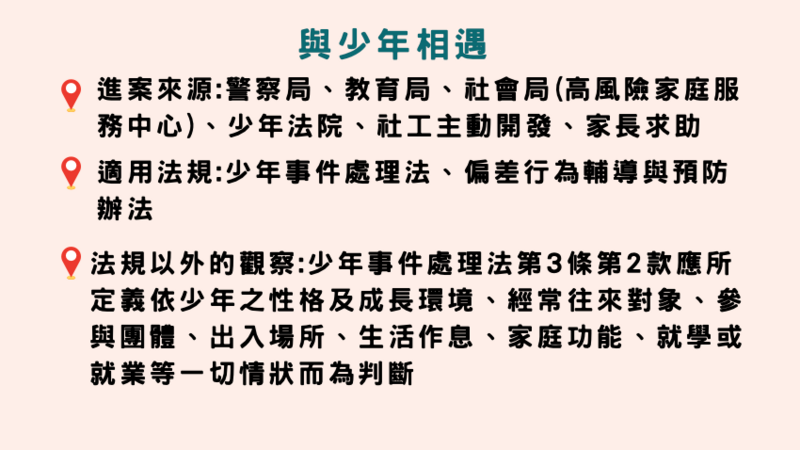
In practical settings, social workers and legal practitioners may view behavioral issues from different angles and perspectives. For instance, our focus lies on the need for protection of juveniles as defined in Article 3, Paragraph 2, Second Subparagraph of the Juvenile Justice Act. The need for protection is judged based on all circumstances, including the juvenile's personality, growth environment, frequent associates, frequented places, daily routine, family functioning, and schooling or employment. It is an evaluation dimension aside from the degree of case involvement. If you, our partners, enter schools to conduct advocacy, you might want to first understand the social workers' treatment process—from how cases are received and case sources, to the perspectives through which social workers evaluate and counsel.
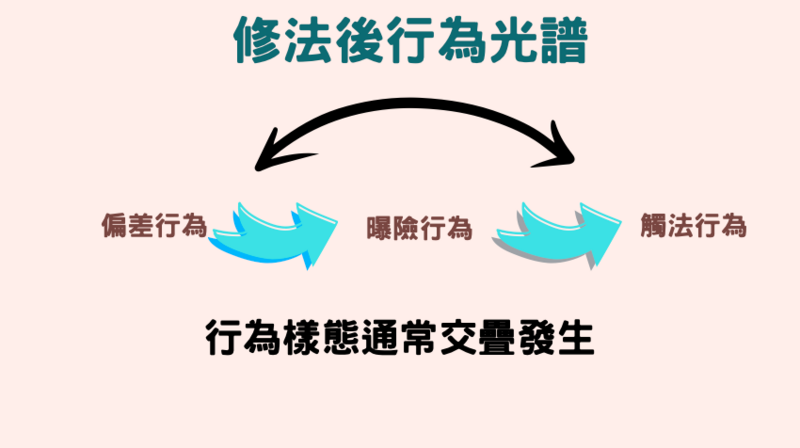
According to the behavioral spectrum, ranging from shallow to deep in terms of severity are deviant behaviors, at-risk behaviors, and law-breaking behaviors. Juveniles often simultaneously exhibit overlapping patterns of all three behaviors. For example, in fraud cases, as soon as a juvenile's call center is raided, drugs are found at the scene. Fraud is a law-breaking behavior, but when they are subsequently caught possessing Category 3 or 4 drugs and are subjected to a urine test that comes back positive, an at-risk behavior is also generated. In addition, the juvenile's association with gang organizations constitutes deviant behavior. Therefore, it is often very difficult to classify their behavior and directly divert them. When a juvenile's behaviors overlap, many resources are focused on this juvenile. Consequently, when a juvenile has to narrate an event or a process to multiple resource units that supposedly care about them, it is a naked process of continuous exposure. Thus, how to connect, integrate, and divide the services of various units after the regulatory amendments is an important issue for this part of cooperation.
As long as a juvenile case involves trafficking and enters the court through case assignment, the court will directly arrange Legal Aid Foundation resources, assigning legal aid lawyers to review case files and understand the course of events. From the perspective of lawyers assisting in juvenile cases, they will face issues involving a treatment structure different from general criminal cases. For example, juveniles involved in cases tend to explain their behavior as minor and downplay their involvement, or because defense counsel may not clearly understand the juvenile law's need for protection, case defense might instead foster a mentality of opportunism in the juvenile. Generally speaking, protective measures include non-prosecution (dismissal of the case), reprimand, weekend guidance, probation, and community service, while severe situations involve placement or reformatory education. When assisting clients, do most defense counsel strive for the juvenile's best interests and thus hold different views from the juvenile court judges? Throughout the process handled by the juvenile court, defense counsel may not necessarily understand the considerations of judges and probation officers. How defense counsel and the juvenile court can reach a consensus to serve the best interests of the juvenile and satisfy the juvenile's need for protection are actually matters we can brainstorm together.
Treatment Services
Returning to social work services, these generally involve application for intake, interviews, home visits, data collection, followed by assessing the juvenile's behavioral risks and setting counseling goals, then formulating intervention objectives and plans, and finally evaluating case closure. Direct service settings may involve case closure or the continuous re-formulation of intervention plans due to changes in the juvenile's behavior and enhancement of support systems. In addition, service capacity in each region is affected by hotspots and manpower. Taking New Taipei City's vast jurisdiction as an example, ten years ago a single person served multiple jurisdictions such as Hsintien, Wulai, Shiding, Shenkeng, and Pinglin, handling 30 to 40 juveniles under active counseling per month plus new cases, which also caused limitations in service capacity. Despite this, social workers still assess the need for protection and behavioral severity to decide whether to open a case—for example, evaluating the juvenile's environmental systems, such as family, school, and community, and whether they are employed. If the systemic support is acceptable, social workers may not intervene immediately and instead transfer the case to more appropriate current resources. Furthermore, schools have their own three-tier counseling system, ranging from school teachers and specialized guidance teachers to school social workers, offering resources across different systems. Currently, having or lacking student status serves as a clear dividing line for the Juvenile Guidance Committee and other units when dividing labor, avoiding resource duplication. However, at-risk behaviors stipulated by the Juvenile Justice Act enter the Juvenile Guidance Committee directly regardless of student status; deviant and law-breaking behaviors are classified to prevent resource duplication, so as to avoid the dilemma in direct services where a juvenile has to cope with numerous resources over the same incident.
In service settings, there are voluntary and involuntary cases. Taking at-risk cases received over the past six months as an example, the majority of intakes are involuntary cases. As you can imagine, when counseling personnel possess no public authority whatsoever, and juveniles are unable to perceive that at-risk behaviors are serious problems, frontline workers attempting to counsel and reach out to juveniles often face the dilemma of being rejected. Therefore, we also want everyone to understand what these involuntary cases are roughly thinking. When we bring systems and resources before these juveniles, how to transform involuntary cases into voluntary ones that cooperate with counseling and utilize resources requires spending a lot of time building a counseling relationship. Second, involuntary cases are relatively unwilling to develop a trusting relationship with us; third is relational antagonism. Juveniles feel that social workers are snitches who will report them to probation officers and parents, making it difficult for them to speak the truth. In addition, juveniles prefer to maintain the status quo or believe that dealing with it when a bigger problem arises is another counseling dilemma. Consequently, workers often wait back and forth for the juvenile. Because workers lack coercive power, investigating and gathering information takes more time, and new information must be constantly sorted out during the counseling process to reformulate intervention treatment plans. Therefore, in the process of handling involuntary cases, it is relatively difficult to deduce a standard set of treatment service procedures using a fixed counseling model, and sometimes just as a case is evaluated for closure, a major incident occurs again, causing the case to return to the starting point of counseling. Thus, in practical service processes, accompanying juveniles requires longer-term intervention to have a chance of transforming relationships and advancing counseling work, making it relatively difficult to see changes in juveniles in the short term. Moreover, many external events continuously accumulate and happen, making it harder for counseling work to present the outcomes expected by public opinion.
Social workers have three major dimensions of work—casework, group work, and community work. Another even more important work is resource linkage, which is the core philosophy of "empowerment" and "client self-determination." Only by arousing the juvenile's autonomy can they go further. Currently, resources frequently linked for drug abuse cases include Taipei City's Unique Project and New Taipei City's Non-Ocean Project. Through the intervention of medical-end resources, cases are assisted in rebuilding their understanding of physical and mental issues and self-awareness. Moreover, social workers not only link resources but also accompany clients in utilizing them. Therefore, they attend medical consultations to understand the juvenile's dialogues and interactions with doctors and case managers, using this companionship to understand whether the medical resource end's treatment by doctors is suitable for the juvenile, and sorting through the positive and negative feelings brought by the medical treatment process. Whether juveniles like an adult or a resource is very subjective; social workers must be very sensitive to the matter of relationships. Therefore, while linking resources, social workers are simultaneously accompanying children in utilizing these resources to maximize the effectiveness of resource intervention. In addition, cooperation by the Juvenile Guidance Committee also includes the social, educational, and judicial systems. During court attendance accompaniments, judges will also ask social workers about the juvenile's current status in community treatment and community observations, and social workers' statements in court may affect their subsequent counseling relationship with the juvenile. Therefore, how to utilize resources is what makes training a social worker no easy task.
Regarding reporting, the first page of the Social Safety Net Care e-Platform requires you to select which category of issue the case belongs to. According to regulations, mandatory reporting must be carried out within 24 hours. If a juvenile is involved in a drug case, reporting will be conducted in accordance with the norms mentioned in Article 53 of the Convention on the Rights of the Child. However, reporting also encounters ethical dilemmas; caution must be exercised during the reporting process to avoid harming the service recipient. A common phenomenon in practice is that because preparatory work for reporting was not done well, juveniles refuse all subsequent social work and counseling resource interventions after being reported in a rather rough manner. Therefore, how to prepare in advance for reporting is something that teachers and frontline workers must handle with caution.
Ethical Dilemmas
Regarding ethical issues frequently encountered by juveniles, these are the dilemmas between confidentiality, protecting their rights and interests, or complying with laws and regulations. Juveniles may feel proud of their drug use and trafficking experiences, but workers must also inform them of the subsequent procedures upon learning of them because social workers have a reporting responsibility. Yet, when clarifying the historical process of a juvenile's past events, it is indeed difficult to avoid hearing some statements detrimental to the development of children and youth, at which point social workers will face ethical predicaments.
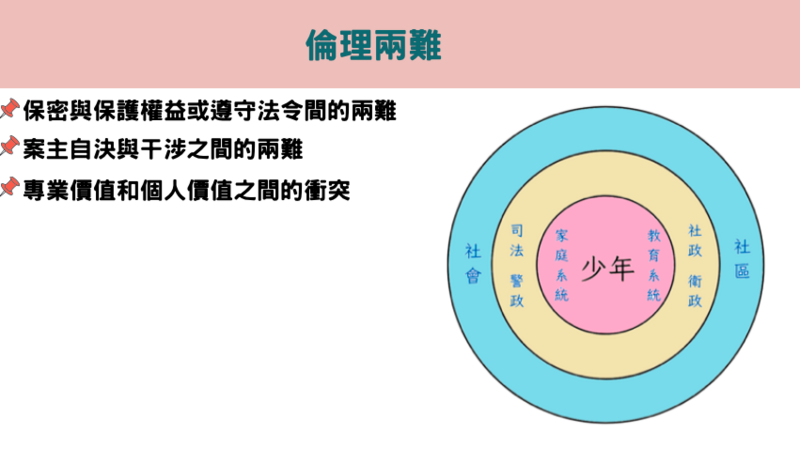
Another part of work treatment is client self-determination versus external intervention by resource units. Can juveniles exercise self-determination? Recently, following amendments to the Juvenile Justice Act, there is an expectation to enhance juveniles' right to expression, but to what extent can a juvenile's self-determination go? Alternatively, how can we assist during the process of granting rights to children and youth?
Furthermore, truly the most difficult ethics is when the worker's personal values and beliefs conflict with external values. Looking back at the juvenile practice field over the past decade, with the juvenile as the core, observing the juvenile's environment (family education, justice, school, community) and ultimately the entire social system, how many resources can actually play a functional role?
Becoming Better Adults?
Setting aside the juveniles' delinquent behaviors, what exactly is the difference between these juveniles and us? In fact, juveniles and we are similar; both want a more stable life. But why did the juveniles choose such a path? And what on earth will truly satisfy those juveniles? In practical settings, if we look from the individual behavior of a juvenile to their growing environment (family, school), and after a juvenile's delinquent behavior occurs, the system smoothly pushes the juvenile outward, it is not hard to understand why more serious social problems will subsequently arise. When families are unable to fulfill the internal and external needs of juveniles, pushing them outward to external peer connections, and they find no sense of achievement at school, they are even more likely to be absorbed by attractive external gangs. Our juveniles all say that they follow a "company" rather than a gang. To continue operating within it and avoid external questioning, juveniles will explain high-risk behaviors as going to "check things out" rather than "providing support." How do juveniles cultivate these concepts and construct a new worldview within their growth environment? To understand and reinterpret the meaning behind their behaviors, workers must return to the juvenile's developmental trajectory. In the past, besides stereotyped economic problems and families with dysfunctional family functions, today's dual-income families are also by no means exempt from the risk of juveniles expanding outward into gang organizations due to parenting and alienated parent-child relationships. Therefore, using stereotypes to deduce the reasons why juveniles easily walk down a certain path requires extreme, extreme caution, as inferences and evaluations are often not necessarily so.
How does the "company" mentioned in the mouths of juveniles treat them? The company provides a sense of identity that families and schools cannot offer, which truly supplements the sense of achievement and self-esteem that juveniles fail to obtain in school and family. Returning to the dilemma mentioned earlier, how can workers help juveniles see a better world? Perhaps it requires having more dialogues and connections with juveniles, letting juveniles see different adults. For example, when lawyers go to schools to give speeches, juveniles will definitely be very curious about you and have many questions they want to consult about. At this time, opportunities for interactive dialogue can be designed, or you can also care about school and juveniles' current affairs.
When counseling juveniles, people often evaluate what the need for protection under Article 3, Paragraph 2 of the Juvenile Justice Act is. Workers must truly live alongside juveniles. Viewed through Maslow's hierarchy of needs, if a juvenile lacks money for food and clothing, telling them to work hard to make money, learn skills, and attain a better life is actually out of touch with reality. This is why goals and intervention methods must be constantly set when working with juveniles. When short-term goals are achieved, the juvenile's basic living needs are truly resolved, and a more suitable entry point is found, can we move forward to the next goal.
What I often fear most is when external friends ask me: how many successful counseling cases have you had in these ten years? But looking back, upon re-reflection, what is truly important is not change, but what resources the worker put in during the process of companionship. Taking the recent accompaniment of the parents of a closed-case juvenile to apply for legal aid resources, the goal was to let the juvenile and their parents acquire more resources to face challenges, and the connections generated by interaction and dialogue go far beyond imagination because interaction allows service recipients to see a different world and learn about different solutions.
From a systematic perspective, juveniles often seek themselves and external identity in unfavorable growth environments. Juveniles learn initial interactions with people through family relationships, and furthermore, entering campus and connecting with school peers also shapes their self-definition. Major incidents happening to juveniles are often opportunities to explore my feelings. Throughout these cyclical processes, their family relationships, school relationships, and major events are continuously sorted out. When discussing drug addiction, current treatment mechanisms consider addiction to be a disease that will relapse. But the continuous emergence of a juvenile's various behavior patterns is also what I call a relapse. We hope for their recovery, but juvenile growth is a dynamic process. How we accompany them in recovering and repairing through every major incident and setback—workers may hold great expectations for a juvenile's recovery, but the process of recovery always involves finding one's positioning anew amidst every fall and rebound from rock bottom. In the future, if you go to schools for advocacy, you can also prepare more experiences and stories related to juveniles, using methods of closing the distance and interaction to make juveniles empathize.
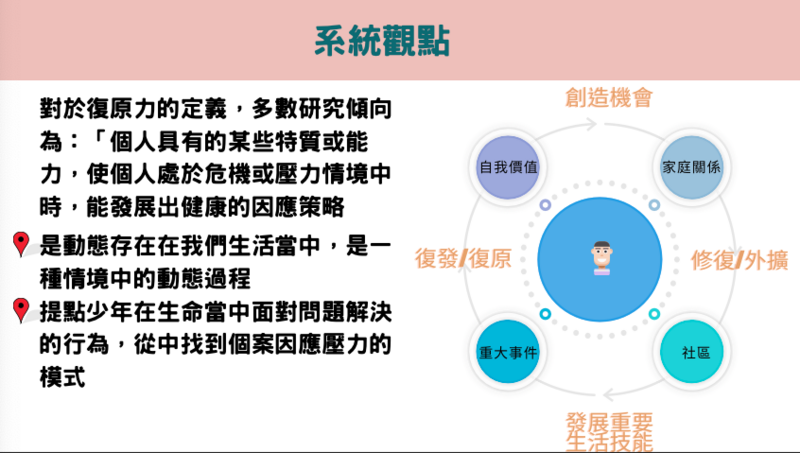
Recalling why workers help children find resources, it is because we never know which positive resources can truly catch and touch a juvenile's heart, and frontline workers (social workers, teachers, and probation officers) cannot catch them for a lifetime. Linking community forces allows counseling work to go further. When you go to schools for advocacy in the future, you can also share how to make good use of and vitalize resources to assist these juveniles.
In the past, friendly employers were once linked for juveniles; however, during the process, because juveniles felt that making money through legal work was slow, they subsequently returned to gang organizations, until a friend died in a car accident resulting from gang violence, which made the juvenile start pondering how to walk their path in life. The occurrence of each event is a critical turning point for working with juveniles. Workers can avoid listening to juveniles' narrations with an attitude of disgust, and instead understand the underlying reasons, using mechanisms to find dialogue and communication with juveniles, understand what is happening between the juvenile and their environment, and subsequently assist in building opportunities for self-reflection. As you are all about to walk into schools in the future, how do you view the meaning behind juvenile behavior? Are you looking at the social problems constantly generated by juveniles, or are you looking at the juveniles' needs for protection? It is suggested that in the process of inter-system dialogue, one must understand what the world looks like in the eyes of adolescents; true understanding leads to genuine dialogue.
This article is an AI-generated translation of the original Chinese text. In the event of any discrepancy, the Chinese version shall prevail.