

Campus Substance Use Issues and Intervention — Taipei Bar Association Rule-of-Law Education Activity Records (3)
Last edited: 2026-11-04
Speaker: Campus Substance Use Issues and Intervention — Wu Chih-han (Guidance Counselor); General Questions and Discussion — Hsu Chia-ling, P'eng Wei-ch'üan, Wu Chih-han
Date: February 20, 2024
Location: Taipei Bar Association
Activity: Campus Substance Use Issues and Intervention — Taipei Bar Association Rule-of-Law Education Activity Sidelights (3)
I am a guidance teacher and the head of the guidance section at Cheng-Cheng Junior High School.
Cheng-Cheng represents the final safety net of the social safety network—the place where, after exhausting numerous efforts, someone says, "I am out of options, let's send them in first!"
Students may stay here for around three years, but in reality, juveniles spend an average of about two years in a correctional school. While a reformatory education sentence is formally three years, Cheng-Cheng's tiering system and treatment practices mean a juvenile typically leaves after about two years.
Coming back to the issue of substance use, as the lawyer mentioned earlier, fraud has actually accounted for the highest crime rates in recent years, but fraud and drugs mostly go hand in hand. I mention this because under current regulations, drug use counts only if detected through testing. Consequently, when juveniles arrive at a correctional school, they usually talk about everything without reservation because they no longer care; saying more won't add any new cases anyway, as most matters are already concluded. Unless someone specifically points fingers at them externally, whatever glorious achievements they recount about their outside exploits to our correctional school teachers cannot be used as new evidence to retry them. Therefore, they generally hold nothing back once inside.
Our students come from vastly different backgrounds, but most of them have been involved in substance use and fraud. However, their very first contact with drugs is often passive—perhaps influenced by peers and driven by curiosity to try it for the first time.
When we refer these drug-using juveniles back to mainstream schools, teachers at those schools are genuinely worried and panicked, fearing that these youths will corrupt other students and wondering if drugs will spread on campus.
Furthermore, in assessing whether a family has become dysfunctional, we do not measure by money, but rather by whether there is a relational rupture between the juvenile and their family. We find these families to be polarized: some relentlessly pressure the student and send them to private schools, while others completely neglect them. Students sent to private schools may realize their family background differs from others, triggering a comparative mindset and a desire to make money. Yet, the jobs available to them are often in logistics, and under such circumstances, they may encounter drugs. Because items like rainbow cigarettes are relatively inexpensive, working youths can afford to maintain continuous contact with these substances.
For students who have always stayed within the institutional system, intimidation-based education works well. For these out-of-system youths, however, it is basically useless, nor will they admit that their urinary frequency issues stem from substance use.
When they first arrive here, they are all very thin. We take good care of them until they are physically robust before referring them back to mainstream schools. Upon returning to school, some reintegrate into the system, while others still return to their old ways.
In fact, the juveniles themselves worry about relapsing once they leave, and they ask to remain under protective supervision. They genuinely want to improve, yet they are simultaneously terrified that their environment hasn't changed and that people will point fingers at them. If they "run away" because of this, lacking educational credentials, they have no choice but to return to their previous jobs. Combined with high profit margins from those jobs, they become even less able to reintegrate into the mainstream system.
Although general society is unfriendly toward offenders, I hope mainstream school teachers understand that catching them is crucial. I also hope lawyers can explain to teachers how the law operates.
Every contact with a juvenile who has broken the law matters enormously; after a single interaction, they might never come back. Regardless of who initiates contact, the homeroom teacher is invariably present. But if the homeroom teacher constantly interrogates the juvenile, it may cause the youth to memorize a script just to cope with various professionals. Therefore, what we must focus on is what we can do for the juvenile, rather than perpetually grilling them. What we need is to convey and reveal: whether you come tomorrow or not, the school and I will always be here, and we will catch you—giving them an anchor to replace their fractured family. Yet mainstream school teachers tend to take very clear-cut stances, holding rigid positions and viewing themselves as professionals.
Before talking to a juvenile, we must consider:
-
Do I have enough background knowledge regarding substance use issues?
-
Have I built a relationship with this child?
Building a relationship must start from daily interactions, but without being overly intrusive; when they want to talk, they will speak on their own.
The difficulty lies in the fact that mainstream teachers grew up within the system, making it hard for them to empathize with why these youths behave this way. They often harbor a black-and-white worldview, do not understand harm reduction, and believe that anyone still using drugs is simply "bad," failing to recognize that extending the intervals between uses holds inherent value.
What we need to promote is: take it slow. Furthermore, before communicating with a juvenile, one must examine their own view of human nature.
This is not to say a black-and-white worldview is inherently bad, but perhaps there are more suitable roles to communicate with the youth. Doing this in a school setting is very difficult, so as a teacher, how to communicate with juveniles without being swayed by one's values is vital and forms the core.
Personally, I do not support moralizing sermons—especially in mainstream schools where moralizing truly fails and merely provokes student rebellion. It is acceptable in a correctional school only because the scores determining their release are in the hands of the teachers. Mainstream youths, however, couldn't care less: you have nothing to do with me, so why should I listen to you? They have been lectured to exhaustion since childhood and might even respond with profanity. This is the dilemma faced by mainstream school teachers.
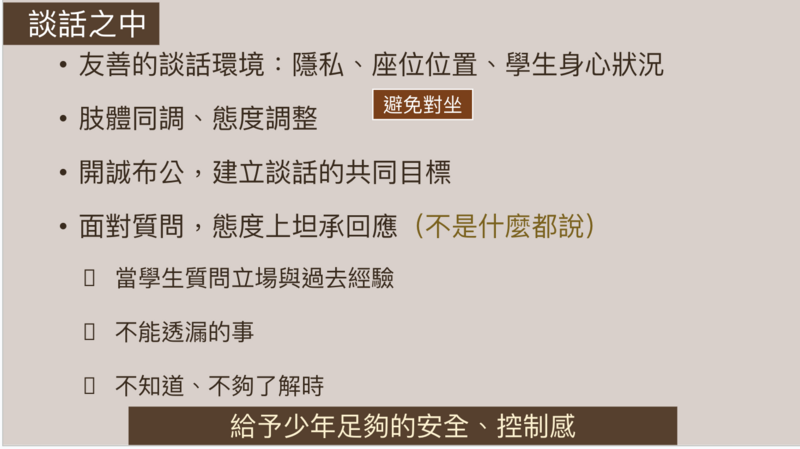
Teachers may worry, harboring many internal monologues before contacting a student: Will I be hit? Am I doing a good job? Do I understand any of this? Since on-campus legal consultations are reportedly being promoted, teachers might wish to consult legal issues there.
Many teachers do not understand the law, which is why they need your help as lawyers to explain statutory provisions, let teachers understand the consequences of inaction, and introduce available social resources.
Armed with this knowledge and an understanding of the students' subculture, teachers can communicate in a way the students actually understand.
The school counseling room can also be utilized, but if a student's mental and physical state is unstable, do not force communication. Usually, once a child builds a relationship with you, they will honor their commitments to you.
Mainstream teachers without professional training may find it difficult to voice empathic language, but an empathic posture is achievable. Teachers can mirror the student's body language; if a student's posture is defensive, simply adopt a natural stance.
When facing challenges from students, such as: Are you doubting me right now? If you trust me, stop talking, etc., you should:
1. Respond candidly, though not revealing everything (reporting details, etc., do not need to be shared). For example: Yes, I cannot tell you, and the reason is X (such as protecting someone), so I truly cannot tell you.
2. State the reason why you came to talk with them.
3. Maintain curiosity—for instance: I really don't know what you are talking about, I'm quite curious, could you tell me?
Sometimes the tension in adolescents manifests as bravado or anger to protect themselves, but when you give them sufficient security, they become more capable of facing you.
I will also state directly: I am approaching you regarding the issue of substance use. Whether you have or haven't used, I have this task to discuss with you today.
Maintain a curious attitude: I want to understand you, not to satisfy any selfish desires, but simply to understand you and to catch you—that is why I am asking more questions.
Why tell teachers about the reporting procedure? If a juvenile does mention matters requiring a report during the conversation, the teacher can convey the message that regardless of the procedure, the teacher will always be here, communicating that I will walk alongside you. One can also inquire about the juvenile's worries and attitude. Most importantly, it depends on whether the school's attitude is genuinely to catch the juvenile.
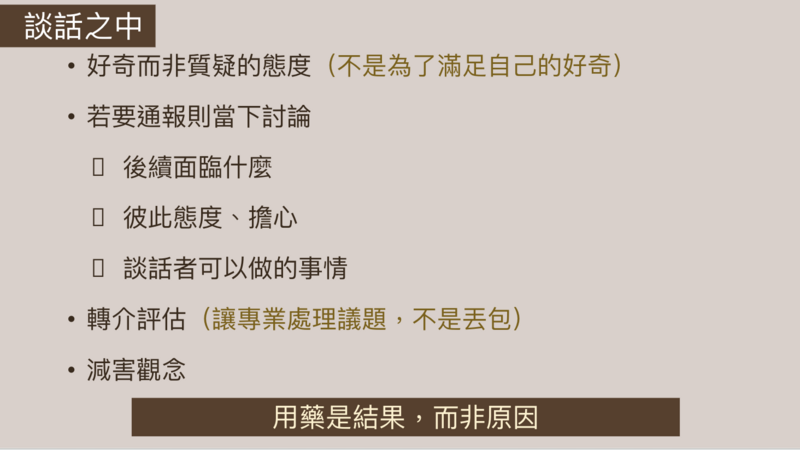
Referral: Substance use is a symptom, not the root cause
Juveniles do not use drugs simply because they want to; it may stem from emotional or family problems. However, when teachers make referrals without first explaining what will happen to the juvenile, problems arise. Different divisions of labor must be mentioned during talks so that the youth does not get the feeling of "Are you abandoning me?"
What I want teachers to know: If a juvenile can extend the interval between drug use or use legal substitute medications, isn't that visible progress? This is no different from someone blowing up every 3 days improving to blowing up every 10 days—both show progress. Yet many teachers still cannot accept this, believing that any substance use equals being bad. But juveniles cannot climb straight up; they will inevitably fluctuate, though looking at the overall long-term picture, there is progress.
They are very sensitive, and the words of school teachers matter greatly. Referring to them as "drug addicts" leaves a deep impact. We must let juveniles know that we do not discriminate: even if you made a mistake, we still accept and help you.
Indicators for schools to spot potential substance use among students:
-
A student smelling unusually fragrant, which might be an attempt to mask substance use; pay closer attention.
-
Daily interactions (continually building or breaking relationships), weight gain or loss.
Who are we competing with for the students?
-
The school system must maintain the family's pulling force.
-
External school systems have many partnerships aimed at retaining students within the social safety network.
Ex. My dad doesn't care about me, but the boss (gang leader) at the company cares about me, so I want to stay there. Therefore, we are competing with these companies for this student.
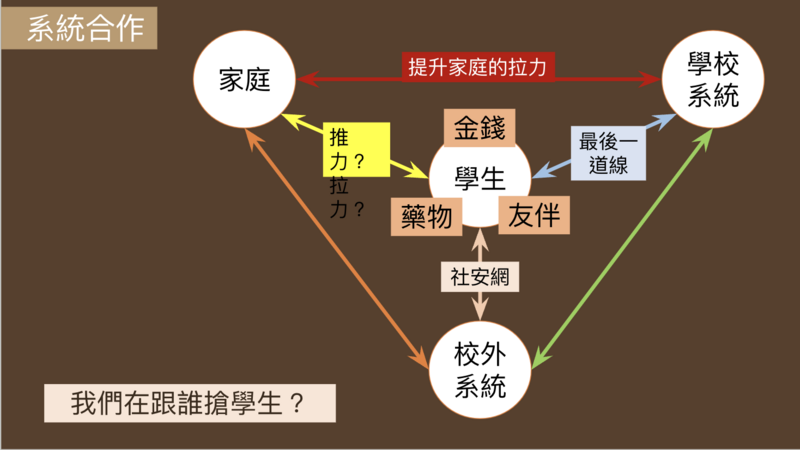
Why must schools hold meetings continually? The primary purpose is to enable the school to exercise its resource-linking function: dividing labor without duplicating it, giving us a chance to snatch children back from those places.
Meetings convened by any unit are fine, but they must comply with regulations, respect the Personal Data Protection Act, and observe ethics and confidentiality without leaking information. Yet many schools have no secrets.
Before the meeting:
-
Notices to parents should preferably be sent via double-registered mail.
-
Prior to inviting parents, the school should hold a preliminary briefing to organize talking points and prepare how to soothe the parents' emotions, as parents are usually less than rational and tend to blame the school for falling short—a situation also seen in correctional schools. If the school can accommodate parents' anxieties and self-blame, emotional conflicts will be drastically reduced.
Additionally, internal rumors or dissenting opinions may circulate among teachers; it is ideal if the organizer proactively approaches and talks to that teacher beforehand.
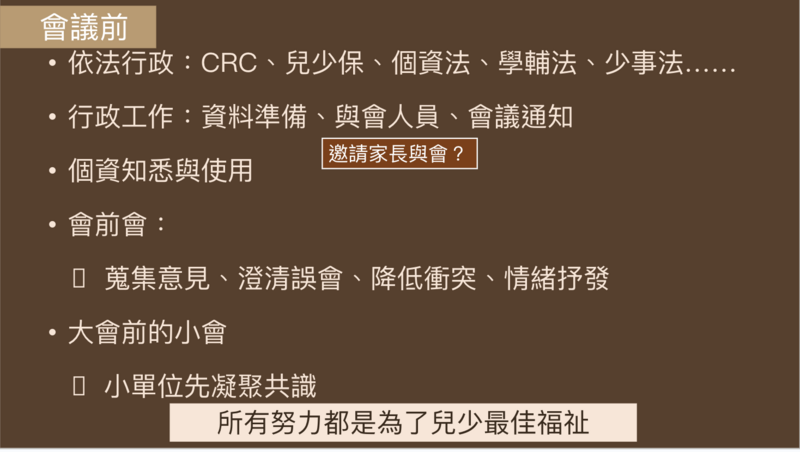
All the aforementioned objectives aim to minimize conflicts and clear up misunderstandings during formal meetings, because we are all here for the children rather than to manage adult emotions. This also ensures subsequent division of labor proceeds smoothly.
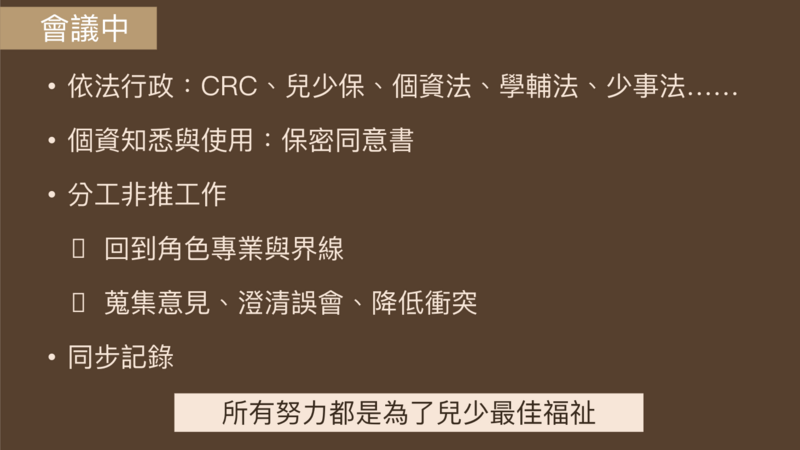
Furthermore, with a smooth division of labor, a confidentiality agreement is truly vital.
# Division of labor is not passing the buck: For example, some teachers might say that social workers are more capable so let them handle it, or that it is the job of the office of student affairs.
Therefore, we must return to professional school roles: we do not pass off work, but we also avoid duplication (some teachers are overly zealous, which can prevent other professionals from exercising their expertise).
# Clarifying misunderstandings to reduce conflict: Return to professionalism and boundaries. This is also why we must ensure consensus is reached pre-meeting to make the meeting run smoother. If minutes can be recorded synchronously during the meeting for everyone to see, it prevents people from going back on their word or causing disputes later; objections should be raised on the spot.
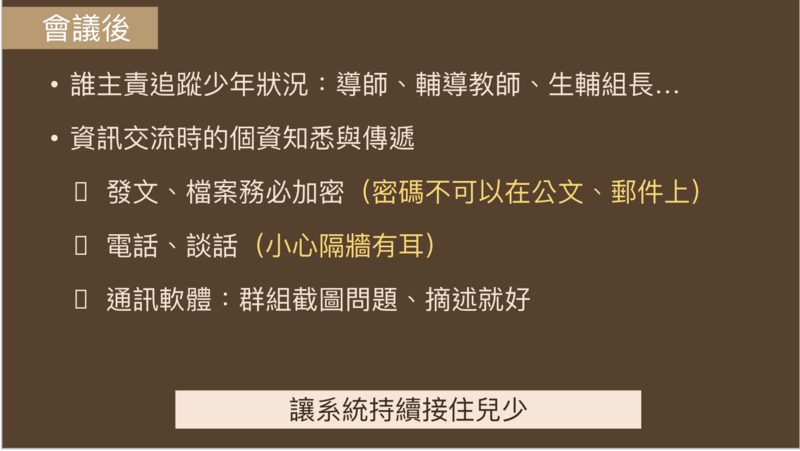
# Post-meeting: Who takes primary responsibility for tracking troubled youth (decided during the meeting)
How to communicate confidentially on campus: Exercise extreme caution, as screens can be screenshotted or conversations overheard. Discussions must be concise, referring to individuals as "students" or "cases" while avoiding names and student IDs. The purpose is to allow the subsequent support system to continue catching and functioning for the juvenile.
Conclusion: Schools truly are the bridge between families and society. These dysfunctional families desperately need schools to catch these youths. We genuinely need and thank these schools and teachers.
# Questions:
1. I would like to ask how lawyers can or should coordinate with professional roles such as social workers and teachers under this division of labor, and how they can provide assistance. What are the views of the three speakers?
A. In the judicial context, my personal experience is that some assistant counsel accompany juveniles and parents to pre-trial investigations. However, I personally find that when lawyers are present, pre-trial investigations are very difficult to conduct because I need to ask about many family details. After finishing questioning on the case, I usually ask the assistant counsel if they would like to leave first, and I often find that once the lawyer leaves, the juvenile and parents become much more relaxed.
Now, regarding how assistant counsel can help:
Previously, Attorney Wu asked how we formulate treatment recommendations. Treatment recommendations involve numerous factors. The first is the severity of the offense; if the penalty is high, asking us to recommend simply "dispensing with a hearing and issuing a reprimand" is impossible. If the penalty is not the primary focus, we look at the juvenile's need for protection. Here, we consider whether the family and school possess the functional capacity to assist the juvenile if the law does not intervene. Therefore, the juvenile's school records are also taken into account. In practice, assistant counsel might disagree if our recommended treatment is too heavy—for instance, if the probation officer recommends reformatory education while parents hope for protective supervision. Because juvenile court hearings are collaborative adjudications, assistant counsel can articulate their thoughts on the spot, questioning the probation officer's rationale to better understand the factors they considered. They can also supplement opinions on treatment alternatives or suggest options that haven't been tried yet. Through such negotiation, probation officers usually soften their stance and are glad to see resources keep the juvenile in the community. This is an area where assistant counsel can make an effort.
B. From a social work perspective, because social workers hold very high expectations for assistant counsel, but as mentioned earlier, in juvenile cases we focus more on the juvenile's need for protection and the underlying reasons for specific treatments.
During assistance, assistant counsel may make promises or raise expectations that sometimes give more socialized juveniles an opportunity to manipulate the law. This also causes them to adopt an indifferent attitude when speaking with social workers—frequently telling social workers things like, "No, my assistant counsel told me to say it this way." But if they are allowed to skirt the rules every time, it becomes hard to make them face their own role, and problems will only repeat themselves.
Therefore, when assistant counsel and social workers collaborate, I try to tell my partners that if assistant support is involved, we need to talk with the assistant counsel so they understand why social workers or probation officers hold certain views or look at things from a different angle.
C. In mainstream schools, teachers need legal concepts and advice so they know how to proceed next and what judicial procedures await them; this is what teachers relatively lack.
In correctional schools, there are two types. One consists of families willing to pay for a lawyer, which requires little worry. The other involves a minority of youths who were entrapped by companies; what they need is legal protection knowledge. Due to their family background or personal knowledge, they do not know what social resources are available to help them—such as Legal Aid. Unaware of these resources and facing high compensation claims, they may turn right back around and commit another fraud.
2. I heard a key point emphasizing the need to encourage schools or parents to catch these children. Is there a concrete strategy on how to persuade school teachers to help do this, or at least stop them from doing things they shouldn't?
A. Social Worker: Drawing from my experience attending school preparation days in recent years, I strongly encourage the Taipei Bar Association—if the opportunity arises—to begin connecting and dialoguing with nearby schools to boost teachers' proactivity. Telling them only what happens after certain actions is passive; we want them to be proactive. I feel that through school activities such as parent seminars and preparation days, we can help school partners stuck in relatively closed environments and rigid systems recognize that education isn't just about transmitting knowledge, but also life connection, making legal awareness more practical. To loosen up teachers within the system, I suggest bridging concepts rather than merely lecturing on statutory provisions.
B. Probation Officer: At Chun-Hui network meetings, many teachers told me to notify them if a juvenile does something else so they can inform the probation officer. I think this is understandable because the youths they face are exceptions in class, and their worries and anxieties are justified—fearing impacts on school enrollment or other students. This also highlights how many regulations designed in law to protect juveniles may require further advocacy. Teachers are reasonable people; they will understand. If a lawyer undertakes this advocacy role, teachers will accept it because of their respect for legal authority.
C. Guidance Teacher: The fastest method would be imposing fines just like the Gender Equity Education Committee, though I know that's unlikely. I also recognize this touches upon value judgments, and I understand not everyone accepts this stance. However, we are continuously conducting advocacy. When advocacy is sustained long enough, or when certain cases occur and move us toward where we need to be, I believe teachers witness it firsthand and are willing to make adjustments for their students. In doing so, what we must carefully avoid is letting teachers with relatively extreme viewpoints become the instructors for that specific class. Schools have the authority during case meetings to flexibly adjust grades and teaching assignments, and they can simultaneously factor in environmental friendliness toward the child when discussing class placement.
This article is an AI-generated translation of the original Chinese text. In the event of any discrepancy, the Chinese version shall prevail.