
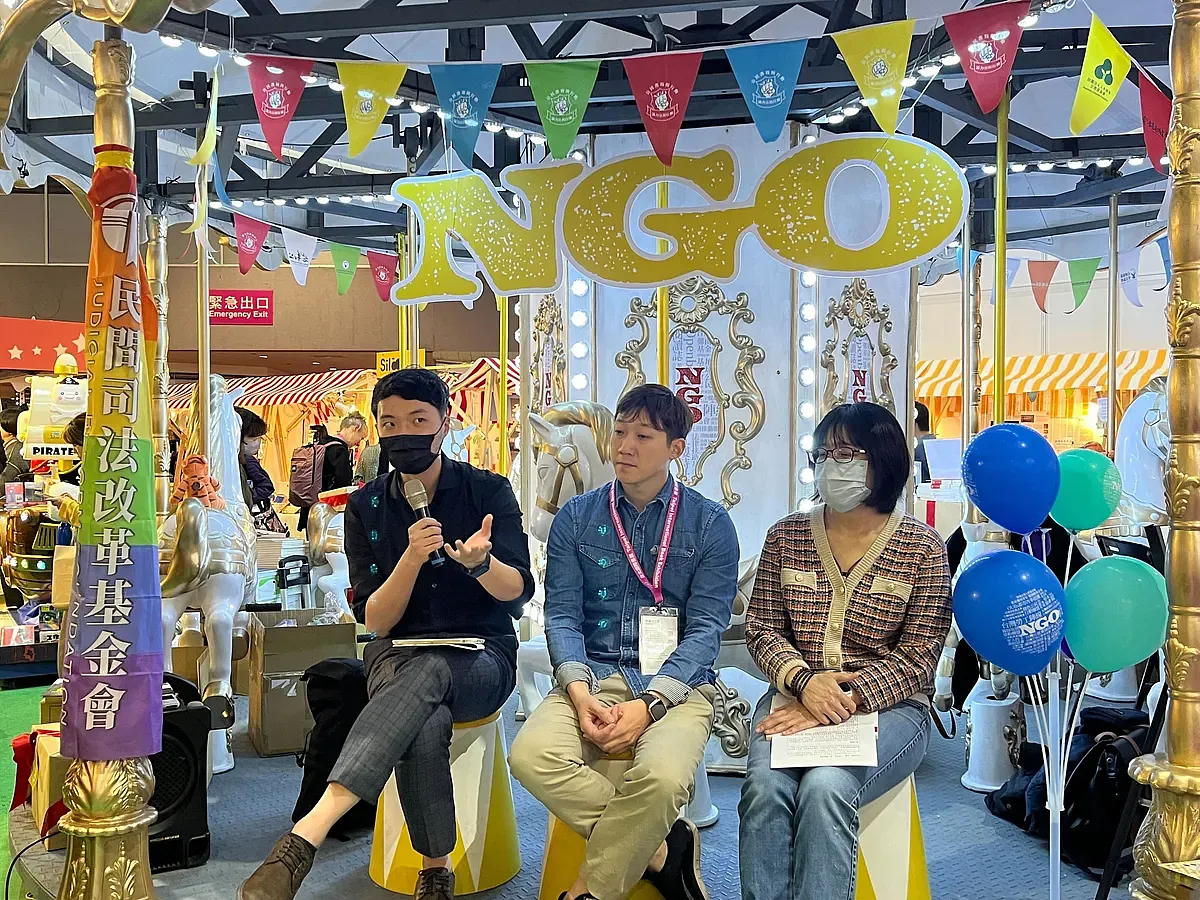
"Coexistence & Symbiosis: Do You Understand Kids' Affairs?" – Author Sharing Event for "The Drug-Using Teenager: Campus Regulations and Counseling Practice for Teachers"
Last edited: 2026-07-27
Moderator: Lin Chun-ju (Attorney-at-Law, Member of the Standing Executive Committee of the JRF)
Speakers: P'eng Wei-ch'üan (Social Work Supervisor), Ch'en Wen-ju (Assistant Professor of Social Work)
Time: February 23, 2024
Venue: 2024 International Book Exhibition NGO Citizen Lecture
Event: Coexistence & Symbiosis: Do You Understand Kids' Affairs?
Lin Chun-ju (Attorney-at-Law)
From the types of drugs, the context of specific behaviors, to how they intertwine with specific laws within the order constructed by the law, we see many current realities and shaped patterns of drug use. Why are these patterns important? Why does this book discuss things this way? Because we need to know what kind of mechanisms might be controlling the plot behind those stories.
Everyone might recall that during school morning assemblies in the past, teachers would say that drugs are serious, and the Criminal Code punishes them very severely. Drugs are like skull and crossbones—terrifying and harmful. These superficial statements, or statements emphasizing harsh punishments and severe penalties, are often obstacles to a deeper understanding of the issue. They merely use rigid language in dialogue. To me, the most critical aspect of the drug issue is that the shame, anxiety, and stereotypes intertwined with drugs are what we need to transcend. Regarding so-called drug use, if we can uncover the user's reasons and the values they perceive, only by knowing these values can we truly understand how to formulate an intervention.
For me personally, what I want to say is: telling the truth brings us closer to the truth. Revealing those genuine feelings gives us a chance to truly approach human nature. Therefore, when we hear children or teenagers tell me that using 8 packs a day is no big deal, or that selling drugs is super profitable and makes so much money in a day that others can't even see your taillights, what we see in these practices are the teenager's risk-taking behavior and spirit of wanting to be different from others, while at the same time, they may also face the risk of brain disease. How do we talk to them about this? I think revealing the truth and exposing our genuine feelings is important.
When teenagers encounter setbacks or anxiety in life, when they do not know what to do and feel annoyed, their first reaction is usually regret rather than introspection. Only when that regret and peace of mind emerge, and when the sense of shame is felt—even before subsequent introspection becomes the most important thing—witnessing the truth and sincerity of repentance is the story this book wants to tell. From the perspectives of social work, law, and the campus, we offer recommendations from our respective angles. We do not know everything, but we pray to use sincerity and truth to gain more understanding and find ways to uncover the truth.
P'eng Wei-ch'üan (Social Work Supervisor, Youth Counseling Association)
In our practical field, we find that the process of teenagers using drugs is not necessarily out of novelty; quite a lot of it stems from relationships. Relationships are connections between people. One person pulls another into starting to use drugs. In my nearly 11 years of service experience, when thinking about the issue of drugs, we can consider what traits adolescents have. They may have a lot of impulsivity, curiosity, and many things they want to try. Their paths of experimentation are somewhat different from those of us within the conventional institutional system. Teenagers take risks and pursue a sense of achievement, so we ask: how can they use drug use to represent a sense of achievement? I think what is more important is that we can understand this group of teenagers. When this society fails to catch them, it seems that another kind of circumstance catches them instead. Social workers' fear is that we do not know who will slip through the cracks. We often see our teenagers being stigmatized.
Throughout my 11 years of working experience, I am often asked whether teenagers have changed. What is the change defined by the general public? It might be stopping use altogether, but for us social workers, the process of change and transformation is whether they know how to seek help during a relapse. This book discusses reporting, intervention, and accompaniment, but more importantly, when there is sometimes no immediate change, how does the general public view this issue? When we invest resources and see no transformation over several years, how do we perceive the significance and goals of investing these efforts? What have we done for these drug-using teenagers? It may be easy for us to criticize them, but how can we understand more? Not everyone has to become a social worker, but everyone can potentially become a good supporter and companion to some extent. I don't know your upbringing backgrounds, but have you ever encountered adults around you who pretended to listen to you, yet after you finished speaking, they didn't quite understand what you were saying? This is the most common situation we encounter in the practical field. Many adults are present—many teachers, many workers—yet it seems they never truly understand teenagers. You can also imagine what a teenager would feel in this context. Our teenagers often view very realistically how adults treat them.
Drug use is not driven by a single reason. It has many intertwined causes. Various professionals can approach this using their expertise. We can look at how other people's logical thinking approaches this matter, which is also something we social workers really need to be seen in the practical field. From this perspective, everyone can actually be a social worker, and everyone has the opportunity to exert a tiny bit of influence and spend a little effort caring for adolescents.
In recent years, the question we are most frequently asked is about the juvenile crime rate. Looking at the statistical figures, people find that the juvenile crime rate is so high, and the recidivism rate is very high. Why? Some people start to explain it as a result of the declining birth rate. From the perspective of the practical field, frontline workers do not face a reduced set of problems simply because of the declining birth rate. What matters is whether we can understand more about what is happening to adolescents. Drug use is not simply drug use; behind it lie quite a few complex economic issues. In the practical field, you increasingly see many social realities—that is not merely social news. When we counsel teenagers to quit drugs and stop using them, we should understand the reasons behind their relapse into drug use. We often say that drug use is an illness. Aside from psychological issues, what conditions are happening in their social environment? Have we understood them? If something happened in their family, or something happened at school—what actually happened? This is truly worth exploring.
I feel that public opinion often dictates how social workers should act. In fact, what is more important for social workers is counseling, rather than being swept away by public opinion or having their focus distracted. The important thing is to have a very clear goal and head straight toward it. However, sometimes people's voices really do distract us social workers from many, many of our functions.
Ch'en Wen-ju (University Social Work Department Teacher)
Before becoming a school teacher, I worked as a social worker for over a decade and stayed in the practical field. My work primarily focused on adult drug users, but I had contact with drug issues starting around adolescence. My two partners have already shared quite a bit about the developmental contexts of drug users. I think a major purpose of writing this book is to hope that teachers do not feel helpless within the system. That is, when their children turn to them for help saying they have used drugs, teachers do not immediately think only of reporting. Instead, they can handle the reporting process with nuance and consider what else they can do for these children, as well as whether they can relatively create an environment on campus where children know that reporting does not equate to calling the police and being locked up—that even if they mistakenly used statutory drugs due to certain circumstances, they still have tools and channels for self-help and mutual rescue.
The second part is hoping to prevent these students from feeling shame within the system—preventing them from feeling that seeking help is shameful or that they are branded with a criminal label. From a scientific perspective, addiction is not a crime; it is a disease. Psychiatry now defines addiction as a chronic disease, a disease of the brain. Medicine does not deal with whether it is a crime or not. Medicine does not handle criminal matters. Viewed from the perspective of a patient, regarding addiction—whether it is alcohol, so-called drugs, or perceived drug addiction and gambling—there is actually a therapeutic intent and responsibility involved. Because they are placed in the role of a patient rather than a criminal.
If our children have indeed progressed from using drugs to a state of addiction, we must ask: does our country, our society, or our various systems expect this child to receive treatment first or punishment first? Moreover, if that punishment involves a high degree of compulsory state intervention for a crime, the sentencing for drug offenses varies according to different schedules with different criminal penalties, and the severity under the Criminal Code is quite high. Therefore, we hope through this book that when these children seek help within the system, they will not feel ashamed. But we have an even greater purpose: although this book is written for guidance counselors, we are even more eager to prevent people outside the system from feeling that this has nothing to do with them. It is as if once there are professionals—teachers, social workers, lawyers, and counselors—these addicts have nothing to do with the general public, nor do we want the general public to feel helpless just because they find the topic of drugs too professional.
Let me share a few short stories with you. First, let's talk about what drug education is. Over twenty years ago, I worked as a social worker in a drug rehabilitation village and encountered quite a few drug users. Let's discuss just how successful society's drug education is. Look at how many people are at the book fair right now; we could conduct a random survey and ask: Do you know that taking drugs is illegal in Taiwan? Right? Is there anyone who thinks taking drugs is not illegal in Taiwan? I think most of us know that using statutory drugs is a criminal act, that's correct. But what kind of issues has this underlying cognitive component driven?
When I was young, the slogan at the time was "Everyone has a responsibility to counterattack the mainland," followed by another phrase: "Everyone has a responsibility to oppose drugs," because that was when the global war on drugs began, a slogan coined by President Nixon. Concepts like this have extended all the way to the present. Thus, when ketamine became popular about a decade ago, we saw many schools posting various posters like "A moment of pulling K, a lifetime of diapers." I once interviewed a child who originally did not use ketamine, but he suffered from irritable bowel syndrome. Whenever he had exams or midterms, he would get very anxious and constantly run to the restroom; he would constantly run to the restroom during exams. He would also constantly run to the restroom when nervous in class. However, once this concept of "a moment of pulling K, a lifetime of diapers" and frequently running to the restroom became equated with drugs, his classmates began saying to him, "You must be pulling K, otherwise why do you always run to the restroom?" He began to be ostracized and labeled, and then some teachers and his parents asked, "Does your child seem to have a problem? It seems they might be using something they shouldn't." At that time, the parents were also very anxious: "Does my child need to go to the hospital again?" But he was fine at home; he didn't have frequent urination at home, and when taken to the urologist, no medical problems were found.
I want to mention this point first through this story: how does our social education, through our understanding of a certain drug, create a very unnatural situation that causes children to resist? (Fear?) Drugs, and even generate peer identification.
Wei-ch'üan mentioned quite a bit about traumatic contexts earlier. Actually, since you mentioned scams, I was reminded that just recently I met a senior drug user who has now stopped using. He said to me, "Hey, Teacher Ch'en, are you still doing drug research?" I said, "Yes." He said, "Do you want to study the relationship between drugs and fraud?" I asked, "What relationship is there?" He replied, "In the past, we were all too stupid; when we were young, we were poor and went to sell drugs to make a lot of money." In the process of drug transactions to exchange for rewards, drugs used to be more frequently accompanied by other criminal acts such as firearms, etc. But this senior drug dealer told them that they now think fraud is actually a good business, because if you sell drugs and get caught, there is a current offense and physical evidence, whereas fraud is completely buying and selling on empty credit—you don't need to acquire a physical item, you can just do it with your mouth and a phone. I asked, "Then what relationship do you want me to study between fraud and drugs?" He said, "The more prevalent fraud becomes, the better some of our drugs sell, such as amphetamines, because they use those kinds of upper-stimulant drugs to keep the people making phone calls and clicking on cases on the internet energized." Just as Chun-ju mentioned earlier about Ah-ching in *The Workers*, many physical laborers or those carrying heavy physical burdens actually consume coffee, betel nuts, or some stimulating drugs. When the dosage in their bodies reaches a certain level, they need slightly higher-potency drugs—much like when you binge-watch a TV series, initially thinking the first and second episodes are great, and eventually ending up staying up all night to binge-watch them. That is a gradual process of addiction.
Substances do not become addictive immediately upon a single use during the addiction process. Yet our education keeps telling us not to touch drugs, because touching them once leads to addiction. For the user, after touching it and finding they are not addicted, they will feel this education is fake. They will then begin to feel they can control their own drug use. This happens because they lack a fundamental understanding of the mechanism and comprehension of addictive substances. Our book briefly touches on this part, allowing people to gain a rudimentary understanding of what drug side effects are and what the nature of drugs is, as well as the impacts and effects they may have on people.
I am not saying we should abandon the original drug education; it certainly has vast room for improvement. However, we more eagerly hope to provide alternative information to engage in deeper dialogue with the general public. Because it is difficult. Sometimes people ask me, "Then would you want to try drugs?" I would reply, "Not yet."
Why do I say "not yet"? I cannot guarantee I will never use them in my entire life because many drugs initially started as therapeutic medications, and only after reaching a certain degree of abuse did they require state regulation. I believe that behind all regulations lies goodwill toward people—for instance, allowing them to have resources and certain channels to obtain assistance. Therefore, I want to say to my partner Wei-ch'üan: do not worry. If we have at least some non-professional partners in the field who can become social supporters, I feel just like a sentence written by a partner in our book: "It takes a village to raise a child." I really like this quote.
I feel that the issue of drugs is truly difficult to eliminate in human history, but to some extent today, we must develop more than just coexistence; we must provide life choices other than drug use and reduce their vulnerable situations.
I would like to share one final short story with you. Today is our second public book-sharing exchange. During the first session, the day before was the Taiwan LGBT Pride Parade, and I went to Ximending. I saw two teachers there at the site, and through some twist of fate, I interacted with them. They told me they were high school teachers, and the reason they attended the LGBT Pride Parade was because they discovered some children in their class had homosexual or diverse sexual orientations, and they felt that as educators, they should step forward to support their children in gaining social respect. That day, I wondered: when will the teachers of these children whom we serve—our campus teachers—be able to openly and proudly tell the general public one day: "Although my child uses drugs, I want to continue teaching them, keep them in school, and preserve their right to education"? Just as Wei-ch'üan said, when they make mistakes in their youth, we need to discipline them and provide relatively clear guidance, but we must also give them opportunities at the same time. If we give them a few more opportunities, perhaps they will have greater energy to continue engaging in dialogue on this issue.
Conclusion
Wen-ju: I am very grateful to the Judicial Reform Foundation for being willing to value this issue, which is closely related to our legal education. We all know that if we stand directly on a binary opposition approach, we may only be able to deal with the issue of whether a crime has been committed. I believe that the legislative purpose expected of all laws is not to make people's lives worse, but to enable people and the general public to coexist peacefully to a certain extent. If some people commit crimes, the purpose of legislation or punishment is also in the hope that they will have a chance at rehabilitation and a fresh start. If judicial education becomes strictly single-track—sending these people to prison—then we must consider that we may face a massive cost issue. Do these people in correctional institutions possess so-called social productivity? This is a question worth pondering deeply, especially given such a high recidivism rate. We truly need broader dialogue. This does not mean unconditionally accepting people after they commit crimes; we do not adopt that path. We hope to find viewpoints on the drug issue within this path that the general public can also accept, understand, and agree with. Only then can we create other resources, such as shifting medical resources into the judicial system, into correctional institutions, and into campus educational reforms.
Wei-ch'üan: Thank you to the Judicial Reform Foundation, and thank you to a group of people with ideas and passion who work hard together for a specific cause. I find this process healing, and it reveals possibilities. Social work is about constantly searching for resources and finding various possibilities. I often think: if we can lead teenagers to see a different world, what would that look like? If we expect them to become better adults, will we be those good adults? I will take teenagers to meet different adults—perhaps people from the mainstream world or non-mainstream individuals. In the process of meeting, chatting, and interacting, life seems to undergo a wondrous transformation. Is it change, you ask? I cannot call it change, but I feel it is a kind of vision. One day, social workers will leave the service field, but that kind of vision is an experience teenagers take away with them. I think what is crucial is how we imprint something they can carry away in their lives. A teacher's words, everyone's words, and a glance are actually felt by teenagers. So if we can create a possibility where everyone can converse—yet because they are still relatively prone to being stigmatized by society, it remains difficult to discuss and dialogue openly on this issue—I hope that through the exchange process, people can generate many imaginations on how to make this matter better. I hope this book can also help everyone become a better adult.
Chun-ju: Chia Zhangke directed a film called *Mountains May Depart*, which contains the line: "Everyone can only accompany you for a small stretch of the road." The target audience of this book is school teachers. Teachers may be the ones accompanying students through this brief segment of the treatment process. Teachers also feel nervous; teachers arrange the daily order of their lives, and they also plan how to treat this person. We hope this book can help teachers alleviate their anxiety and nervousness, because teachers play a very crucial role. We also hope that following the 2019 amendments to the Juvenile Justice Act introducing administrative priority, aside from social workers, the teacher side is equally vital. Therefore, if we accompany them through a stretch of the road, I hope the people along this road can walk with greater peace of mind. Amidst the complex legal concepts of reporting, having a simple manual is not the answer, but rather the starting point for everyone's discussion. Just like today, people are willing to stay here for an hour listening to us share these stories, which I find deeply touching. Once again, thank you to the Judicial Reform Foundation, thank you to the authors, and thank you to everyone in the audience.
This article is an AI-generated translation of the original Chinese text. In the event of any discrepancy, the Chinese version shall prevail.