
JRF Newsletter
March E-newsletter | Besides Freedom of Expression Day, April 7 is also "his" birthday!
Last edited: 2026-07-27
March Judicial Reform Review
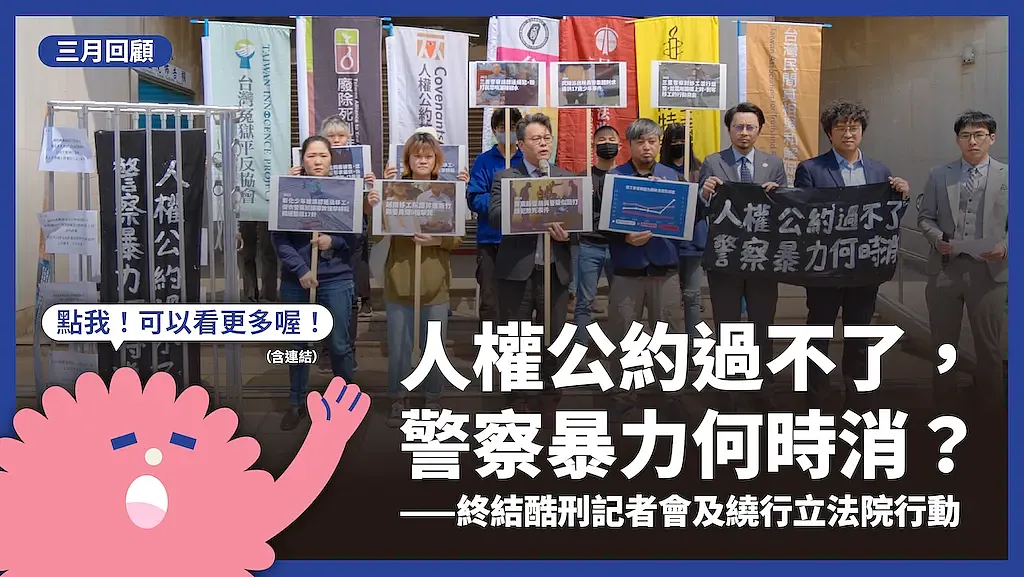
Can't Human Rights Conventions Pass, When Will Police Violence End?——Press Conference and Legislative Yuan Perimeter March to End Torture
In response to the recent endless stream of police brutality incidents involving improper law enforcement in Taiwan, civil society organizations launched a press conference and perimeter march on March 11, inviting legislators from various parties to attend to express the importance placed on human rights protection and jointly put forward the following four demands:
1. The Executive Yuan should as soon as possible submit the draft Implementation Act of the Convention against Torture to the Legislative Yuan for deliberation.
2. The three major parties in Congress should support the prompt passage of the Implementation Act of the Convention against Torture and propose amendment drafts regarding this Act.
3. The National Human Rights Commission of the Control Yuan should systematically review Taiwan's police law enforcement status to eradicate similar incidents from happening again.
4. The National Police Agency should establish the "Police Special Project and Performance Management Commission" in accordance with the resolution of the 2017 National Congress on Judicial Reform, thoroughly reviewing the police performance evaluation system.
In Taiwan, which prides itself on being a state governed by the rule of law, why do incidents of torture—which should have long become history—continue to occur? Civil society organizations and multiple legislators jointly call for the prompt completion of legislation to "prohibit torture" and a review of the police performance system!
📍As can be learned from the historical lessons of wrongful conviction cases such as the Chiang Kuo-ch'ing case, the Su Chien-te case, and the Cheng Hsing-tse case, torture is the starting point of many miscarriages of justice. The reason why torture still occurs in Taiwan today is not a problem caused by individual police officers, but rather due to systemic causes behind the scenes.
📍We call on the Control Yuan and the National Human Rights Commission to conduct a systematic investigation into the current state of police enforcement, identify the root causes of torture, and urge the National Police Agency to promptly complete the relevant reforms from the 2017 National Congress on Judicial Reform to curb human rights violations stemming from the performance system.
📍Fully assess and promptly resolve the pressure environment currently faced by police due to systemic risks, thereby allowing the Convention against Torture to be implemented across various law enforcement levels.
📍Legislation of the Convention against Torture not only protects public human rights but also enhances police credibility. For example, during the 318 Sunflower Student Movement ten years ago, the March 24 Executive Yuan suppression incident demonstrated the police's abuse of force, which was not only a violation of human rights but also shattered public trust in police personnel performing their duties earnestly.
▍Full Statement: https://www.jrf.org.tw/articles/2663
▍Press Conference Visual Card: https://reurl.cc/bDQbWr
Ten o'clock Legal Seminar⟢

Torture was a commonly used method by the authoritarian regime to purge dissidents. After the lifting of martial law, the culture within the judicial system remains deeply influenced by the authoritarian system, and even today, the conditions of the "presumption of guilt" and forced confessions under severe duress still exist in Taiwanese society.
In addition to commemorating April 7 as Freedom of Expression Day in honor of Cheng Nan-jung's martyrdom, it is also the birthday of Ch'i Ho-shun, Taiwan's longest-detained death row inmate, who has been imprisoned for 36 years.
Ch'i Ho-shun was arrested by the Taipei City Police Department Criminal Investigation Division in 1988 in connection with the K'o Hung Yu-lan case and the Lu Cheng case. However, in both cases, no evidence whatsoever could be found to prove that Ch'i Ho-shun and other defendants were actually involved. The prosecution's charges were entirely built upon 288 written confessions from the defendants, and these confession contents were obtained through torture and coercion by investigating police officers during the investigation stage.
In 1998, the court convicted four of the police officers for deprivation of personal liberty and perjury. Even though the handling police officers of that year were impeached by the Control Yuan for torture and found guilty by final court judgments, and even though some police officers were willing to come forward out of conscience to testify for the defendants regarding the fact that they suffered torture, the court still showed no willingness to summon the police officers or retry the case.
After the Ch'i Ho-shun case was finalized in 2011, the pro bono legal team and numerous volunteers concerned with this case worked hard to run around for his rescue, exhausting all possible extraordinary relief avenues, including retrials, extraordinary appeals, and petitions for constitutional interpretation, yet they are still kept out of the judiciary's door to this day.
Legal relief procedures have been exhausted; where should a wrongful conviction go? We invited Attorney Li Yi-chuan from the Ch'i Ho-shun pro bono legal team on the YouTube channel "Ten o'clock Legal Seminar" to use the Ch'i Ho-shun case as an example to introduce to everyone how wrongful conviction rescue groups conduct rescues, what the relief methods are, and the layers of difficulties wrongful conviction cases encounter within the judicial system.
▍Video Highlights:
📍Criminal case process
📍Relief methods after judgment finalization
📍Special relief procedures — retrial, extraordinary appeal, constitutional litigation/constitutional interpretation
📍Other relief channels
Beyond legal relief, the JRF and other civil society organizations continuously use advocacy actions, such as short-speech events, campus exhibitions, and street flash mobs... in hopes of arousing public attention toward death row wrongful convictions, ensuring that victims of the national judicial system are not forgotten; they also continue to care about the legislation of the Convention against Torture to prevent any more wrongful convictions born from torture. This year, Ch'i Ho-shun has turned 64. We hope that Ah-shun, who has spent the greater half of his life in prison, can leave the abyss soon and have a day when he can return home to celebrate his birthday.
▍Ch'i Ho-shun Case: https://www.jrf.org.tw/keywords/20
▍Further Reading - Justice That Could Not Be Spoken Back Then: The Conscience of a Retired Police Officer surnamed Wu: https://www.jrf.org.tw/articles/2465
April Event Preview.ᐟ.ᐟ

➤ Taichung Exhibition and Events
JRF Taichung Office 2024 Brand New Exhibition "Leaving the Abyss—On the Road of Wrongful Conviction Rescue"
⭐ Exhibition Reservation
Dates |2024/03/01 (Fri.) – 2024/11/30 (Sat.)
Open |Tuesday to Friday 14:00-20:00; Saturday 11:00-17:00
Closed |Sunday, Monday, and National Holidays
Location |JRF Taichung Office (No. 845, Sec. 2, Taiwan Blvd., Xitun Dist., Taichung City)
Registration |https://www.jrf.org.tw/articles/2607
⭐Is Blindness Incapacity?——The "Chen Ching-kai Case" and Scientific Communication in the Courtroom
Time |2024/04/13 (Sat.) 13:30-16:00
Location |JRF Taichung Office (No. 845, Sec. 2, Taiwan Blvd., Xitun Dist., Taichung City)
Moderator |Ma Ch'ien-ya / Former Executive Secretary of the Chen Ching-kai Case Legal Team
Speaker |Chien Kai-lun / Pro Bono Lawyer of the Chen Ching-kai Case Legal Team
Discussant |Chen Hsi-yin / CEO of Taiwan Media Center for Science
Discussant |Chen Ching-kai / Wrongful Conviction Defendant
Registration |https://www.jrf.org.tw/articles/2621
➤ 2024 Szu-Szu into TALK
⭐"She's in Jail" Documentary Screening and Post-screening Discussion
Time |2024/04/26 (Fri.) 19:00-21:30
Location |JRF Taichung Office (No. 845, Sec. 2, Taiwan Blvd., Xitun Dist., Taichung City)
Discussant |A / Representative of The 29 Principles
Discussant |Tsai Meng-han / Managing Partner of Hung-Hsiang Law Firm
Registration |https://www.jrf.org.tw/articles/2602
➤ Lawyers' Events
⭐"Exerting Lawyers' Pro Bono Influence!" Series (II): Sharing of Practical Experiences by Lawyers Who Studied International Human Rights Law Abroad
Time |2024/04/20 (Sat.) 14:00-16:00
Location |Taiwan Bar Association (Room C, 7th Fl., No. 4, Sec. 1, Zhongxiao W. Rd., Zhongzheng Dist., Taipei City)
Moderator |
Attorney Li Ming-ju / Deputy Executive Director of Judicial Reform Foundation
Attorney Huang Li / Chairperson of the New Lawyers Committee of the Taipei Bar Association
Attorney Ch'en Yu-fan / Chairperson of the Human Rights Committee of the Taiwan Bar Association
Speaker |
Attorney Huang Yu-chung / LL.M., Cornell University, USA
Attorney Liu Tzu-shuo / MPhil in Theory and Practice of Human Rights, University of Oslo, Norway
Attorney Sung Yi-hsiu / LL.M., Georgetown University, USA
Attorney Weng Kuo-yen / LL.M. in Human Rights Law, University of Nottingham, UK
Attorney Li Ai-lun / LL.M., SOAS University of London, UK
Attorney Hung Shih-hsuan / Ph.D. in Law, Waseda University, Japan
Registration |https://www.jrf.org.tw/articles/2630
⭐Seminar on Practical Responses in the Post-Dummy Account Era | Taichung Session
Time |2024/04/20 (Sat.) 14:00-16:00
Location |Taichung Bar Association (32nd Fl., No. 218, Sec. 2, Taiwan Blvd., West Dist., Taichung City)
Moderator |Su Juo-lung / Chairperson of the Taichung Bar Association
Speaker |Wang Yen / Attorney, Executive Member of the Judicial Reform Foundation
Discussant |Chen Hsin-lang / Chief Prosecutor of Taiwan Taichung District Prosecutors Office
Registration |https://www.jrf.org.tw/articles/2670


This article is an AI-generated translation of the original Chinese text. In the event of any discrepancy, the Chinese version shall prevail.