
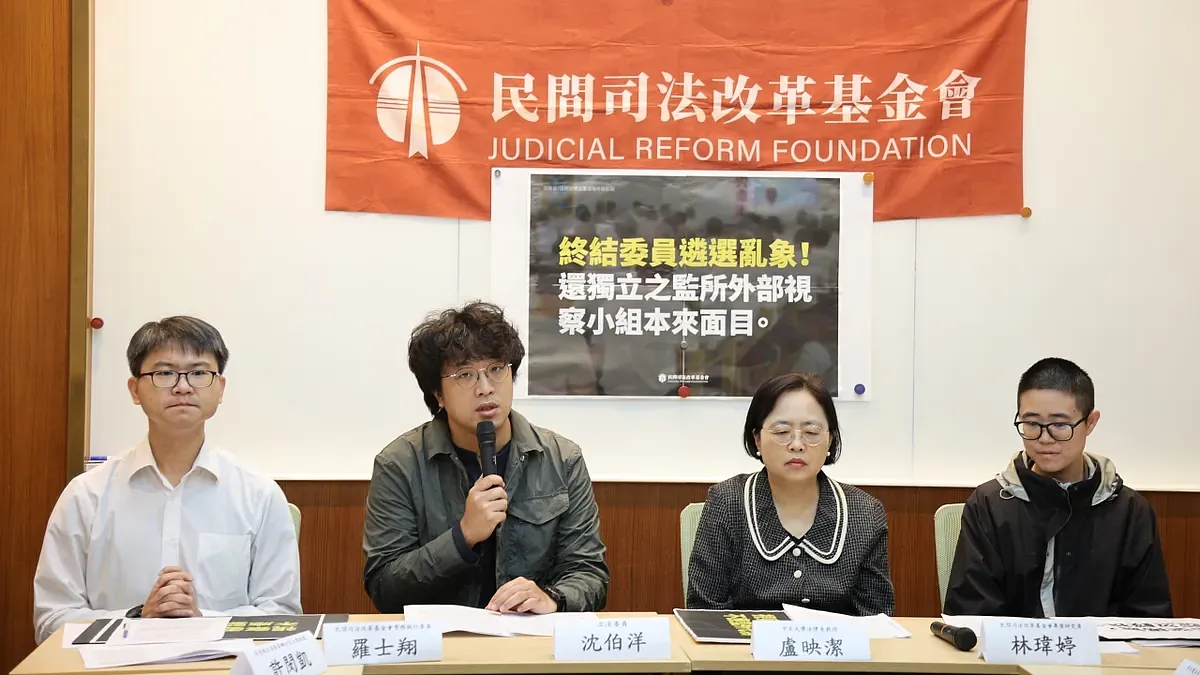
Press Conference: Ending the Chaos in Member Selection and Restoring the True Face of Independent Prison External Oversight Groups
Last edited: 2026-11-03
On July 15, 2020, the new Prison Act and Detention Act came into effect. One of their key focuses is to implement the principle of transparency and protect the rights of inmates, requiring all prisons and detention centers to establish independent "external oversight groups." As these external oversight groups approach their third term at the end of the year since their establishment, severe problems in the selection of oversight members remain in urgent need of resolution. If the Ministry of Justice and the Agency of Corrections continue to turn a blind eye, external oversight will be reduced to a mere formality—a superficial and toothless system. In response, our Foundation makes the following four appeals and statements:
1. Prisons Proposing Lists of Prospective External Oversight Members Creates a Conflict of Interest Equivalent to "Players Refereeing the Game," Leading to Endless Chaos:
Since the establishment of the external oversight groups, the JRF has continuously monitored the selection and appointment of members. We have found that Article 4, Paragraph 1 of the Implementation Measures for External Oversight Groups of Prisons and Detention Centers grants correctional institutions the authority to propose lists of prospective members, resulting in various chaotic phenomena that erode the externality and independence of the oversight groups:
Regarding the selection issues of the first term of prison external oversight members, the JRF held a press conference on January 19, 2022, for an annual review of the external oversight groups, pointing out: As of August 30, 2021, there were a total of 253 external oversight members, among whom 180 were "institution-recommended," while 51 were not included in the "talent pool of experts and scholars for external oversight groups." The proportion of members who were not recommended to the talent pool from external sources was as high as 91%. Among the 51 correctional institutions, 34 had oversight groups where all members were found by the institutions themselves, with zero externally recommended members, reaching a proportion of 67%. The Foundation appealed at the time that the current member selection procedure could by no means ensure the independence and externality of external oversight members, and the Ministry of Justice should immediately amend the provisions regarding the member selection procedure in the Measures.
In response to external expectations, the Ministry of Justice amended the Measures on November 8, 2022, stipulating that the number of non-institution-recommended members must reach at least one-half of the total membership (see Article 5, Paragraph 3 of the Measures). However, this amendment failed to remove the authority of prisons to propose prospective member lists, leaving the root cause of the selection problems unresolved and leading to subsequent chaos.
-
Rejecting External Recommendations and Favoring Institution-Recommended Members:
Following the completion of the second-term member selection, our Foundation compared previously backed-up public data and discovered that a large number of members originally categorized as "institution-recommended" had been changed to "self-recommended" or recommended by the units where the members were employed. This clearly demonstrates a systematic evasion of the amended Measures' requirement that non-institution-recommended members must constitute at least half of the total members. Following an investigation by the Control Yuan (113 Judicial Investigation Character No. 0002), it was revealed that the filling out of "institution-recommended / non-institution-recommended (self-recommended)" for oversight group members was almost entirely delegated to the respective correctional institutions. To meet the requirement that "non-institution-recommended members must reach one-half," the Agency of Corrections and the prisons frequently and directly modified originally institution-recommended members into non-institution-recommended ones. In the Control Yuan's investigation report, the following suspected forgery of documents even appeared: -
Arbitrarily Modifying Member Recommendation Sources to Evade Regulatory Requirements of Externality:
Investigating Member asks: When renewing your term, did you fill out that talent pool yourself? External oversight group member O of XX Prison answers: The institution gave us a form to fill out and then handed it over to the institution to process.
Investigating Member asks: Looking at your data, it is filled out as self-recommended; is that actually the case?
Member O answers: Because they all actively contacted me, I feel I was recommended by the institution.
The chaos in the selection process ultimately led the Control Yuan to point out in its 113 Judicial Investigation Character No. 0002 Investigation Report that Article 5, Paragraph 1 of the Measures—which stipulates that institutions (i.e., various prisons) propose lists of prospective members—undoubtedly creates a severe conflict of interest where the subject of oversight enjoys initial screening power over "which experts and scholars are included in the talent pool." This covertly gives the prisons, which ought to be overseen, substantial influence over member selection, severely deviating from the legislative intent of Article 7, Paragraph 1 of the Prison Act and Article 5, Paragraph 1 of the Detention Act; furthermore, it undermines public expectations and trust in the external oversight group members, demonstrating that the Ministry of Justice has violated the delegated legislative requirements of Article 7, Paragraph 4 of the Prison Act and Article 5, Paragraph 4 of the Detention Act, constituting dereliction of duty.
2. Regulations on Disclosing Member Conflicts of Interest Appear Unimplemented and Insufficient
-
Regulations on Disclosing Member Conflicts of Interest Appear Unimplemented:
Article 8, Paragraph 4 of the Measures stipulates that "Persons currently having contracting, trading, mandate, or leasing relationships with the institution or inmates shall not serve as external oversight group members for that institution." However, by reading external oversight reports and cross-referencing relevant data, the Foundation discovered numerous instances where individuals serving as lecturers in prisons also served as external oversight members for the same prisons. Such lecturers may have legal relationships of a mandate nature with the prison, rendering these experts and scholars ineligible to serve as external oversight members for that prison.
Our Foundation also discovered that at the end of March 2023, a "Mr. Chou" who served as an external oversight group member for a certain minimum-security prison (and ceased serving as a member after April 2024) was reported by the media as being implicated in and convicted of the crime of compulsory indecency. Media reports revealed that "Mr. Chou" had previously served as a lecturer at the minimum-security prison. This incident highlights that prisons are very likely utilizing existing networks to find existing collaborators to serve as members—a practice that inherently and easily leads to conflicts of interest for members. It also raises doubts as to whether "Mr. Chou" was still serving as a lecturer at Mingde Minimum-Security Prison during his tenure as a member, and whether he complied with regulatory requirements requiring the absence of a mandate relationship with the prison.
-
Regulations on Member Conflicts of Interest Are Insufficient:
In addition, our Foundation discovered instances where doctors practicing in prisons and social workers providing services inside prisons served as external oversight group members for those prisons. Because legal mandate or contracting relationships can exist solely between the prison and the contracting corporate entity without involving the natural persons providing services inside the prison, such natural persons do not necessarily have contracting or mandate relationships with the prison or inmates. Nevertheless, such situations clearly involve conflicts of interest, yet relevant regulations lack any disclosure or handling mechanisms, impairing the independence of the external oversight groups.
The Control Yuan's 113 Judicial Investigation Character No. 0002 Investigation Report also pointed out that Article 8, Paragraph 4 of the Measures only stipulates that "Persons currently having contracting, trading, mandate, or leasing relationships with the institution or inmates shall not serve as external oversight group members for that institution." However, business relationships such as contracting, trading, mandate, or leasing with the institution in practice usually involve "legal entities rather than natural persons." Consequently, employees belonging to such legal entities who possess backgrounds as social workers, doctors, etc., are not among those prohibited from serving as external oversight group members under Article 8, Paragraph 4 of the Measures mentioned above, leaving conflict-of-interest issues unresolved. This can be described as a legislative omission and constitutes a dereliction of duty.
3. Oversight Reports Ghostwritten by Prisons? Members Do Not Know How to Write Them, or Write Them Casually and Carelessly? What on Earth Has Gone Wrong with the Operation of Oversight Groups?
Through our continuous reading of prison external oversight reports, the Foundation also discovered that the external oversight reports of some prison oversight groups are nearly identical to the meeting minutes prepared by the institutions, while others are extremely brief and make it difficult to understand the content of the oversight. There are suspicions that oversight reports are being ghostwritten by the institutions. While reading the oversight meeting minutes of a certain external oversight group for the third quarter of 2022, the Foundation discovered a member proposing: "Up to now, oversight reports have been written by the institution; this should be changed so that our group reviews and consolidates them." However, after discussion, the oversight group still resolved: "Please have the institution draft the oversight report format, and this group will review it." This meeting minutes excerpt shows that while individual members of the oversight group may be willing to actively participate, the overall tendency or atmosphere of the oversight group remains passive.
Why are such oversight reports nearly identical to meeting minutes prepared by prisons, or overly brief? Are prisons ghostwriting the reports? Do oversight group members not know how to write reports? Or are they just writing them casually to get by? What on earth has gone wrong with the operation of these oversight groups? The Ministry of Justice and the Agency of Corrections, which bear the statutory responsibility for selecting and appointing external oversight group members, should squarely face and understand this issue, and improve the situation by reorganizing poorly functioning oversight groups. Furthermore, the Control Yuan's 113 Judicial Investigation Character No. 0002 Investigation Report also suggested that the Ministry of Justice should, based on its authority and responsibilities, study how to increase the budget for external oversight groups to provide appropriate staffing and administrative resources to assist external oversight group members in performing their duties; this would not only alleviate the workload of handling personnel in subordinate correctional institutions but also prevent oversight reports from being ghostwritten by prisons, thereby achieving the original legislative intent of implementing the principle of transparency and protecting the rights of inmates.
Our Appeals
Preparatory work for the selection of third-term members has already begun. To prevent the chaos in the selection of first- and second-term external oversight group members from continuing and hollowing out the externality and independence of the prison external oversight groups, our Foundation puts forward the following four appeals:
-
Delete the authority granted to prisons under Article 4, Paragraph 1 of the Implementation Measures for External Oversight Groups of Prisons and Detention Centers to propose lists of prospective members, returning to the provisions of the parent statutes—the Prison Act and the Detention Act—which stipulate that the Agency of Corrections shall submit them to the Ministry of Justice for核定 (approval) before selection and appointment.
-
Amend the recommendation mechanism for the expert and scholar talent pool to prevent prisons from finding members in advance and then asking those members to use methods such as "self-recommendation" to be included in the talent pool, thereby evading the rule that non-institution-recommended members must exceed half.
-
Perfect the disclosure of and response strategies for member conflicts of interest. Any situation suspected of potential conflict of interest should be disclosed, especially business dealings with prisons, rather than being limited merely to contracting, trading, mandate, or leasing relationships with prisons. Only then can the Ministry of Justice or the Agency of Corrections review cases during member selection operations. Once a conflict of interest arises, the response is not necessarily an absolute ban on serving as a member; rather, depending on the circumstances of the individual case, it may involve non-appointment or varying degrees of recusal mechanisms.
-
The Ministry of Justice and the Agency of Corrections should thoroughly review external oversight reports and cross-reference them with meeting minutes. If an external oversight group's oversight report is overly brief or nearly identical to the meeting minutes prepared by the prison, they should investigate what went wrong with that group's operations. This should be addressed by reorganizing and phasing out members who are unwilling or unable to commit to oversight tasks, while retaining and newly appointing members who are willing to participate, and by providing appropriate resources and assistance to willing members so they can fulfill their potential.
[Time] Wednesday, April 10, 2024, at 10:00 AM
[Location] Room 101, Legislative Yuan Research Building (Chung-Hsing Building), No. 3-1, Sec. 1, Chinan Rd., Zhongzheng Dist., Taipei City
Attendees
Lo Shih-hsiang | Standing Executive Committee Member, Judicial Reform Foundation
Lin Wei-ting | Project Researcher, Judicial Reform Foundation
Lu Ying-chieh | Professor, Department of Law, National Chung Cheng University; Principal Investigator, "Dim Glow: Prison External Oversight Report Reading Project and Death Row Inmates Correspondence Project" under the University Social Responsibility Practice Plan
沈伯洋 | Legislator
Hsu Min-kai | Legislative Bill Assistant, Office of Legislator Wu Szu-wah
Chen Ching-jung | Legislative Bill Assistant, Office of Legislator Wu Tsung-cheng
Contact Person
Lin Wei-ting, Legislative Researcher, Judicial Reform Foundation
02-2523-1178 ext. 32
This article is an AI-generated translation of the original Chinese text. In the event of any discrepancy, the Chinese version shall prevail.