
Press Release | Judicial Oversight and Challenges in the Post-#MeToo Era
Last edited: 2026-07-27
Last May, Taiwan's #MeToo movement kicked off with a political worker speaking out. Subsequent reports on #MeToo cases flooded media platforms, moving from the political sphere to media, arts, film and television, the judiciary, sports, campuses, and other fields. More and more victims of sexual assault and sexual harassment bravely stepped forward to disclose their experiences and stories.
Last July, during a legislative recess, the Legislative Yuan rapidly amended the law through an extraordinary session to complete the revision of the "Three Gender Equality Acts." However, the legal reforms catalyzed by Taiwan's #MeToo movement did not end the nightmare of sexual assault and sexual harassment victims; instead, many victims began facing judicial counterattacks from perpetrators. For example, perpetrators accused victims' #MeToo disclosures of being defamatory through the offense of obstructing reputation under the Criminal Code, or filed civil tort lawsuits demanding compensation for damage to their reputation. Over the past few months, the Judicial Reform Foundation, the Garden of Hope Foundation, and Legislator Fan Yun's office have continuously received relevant individual grievances stating that while they could not file sexual harassment or sexual assault lawsuits against perpetrators due to statutory limitation periods and insufficient evidence, they nonetheless had to bear the legal risks of speaking out in the #MeToo movement, resulting in secondary victimization.
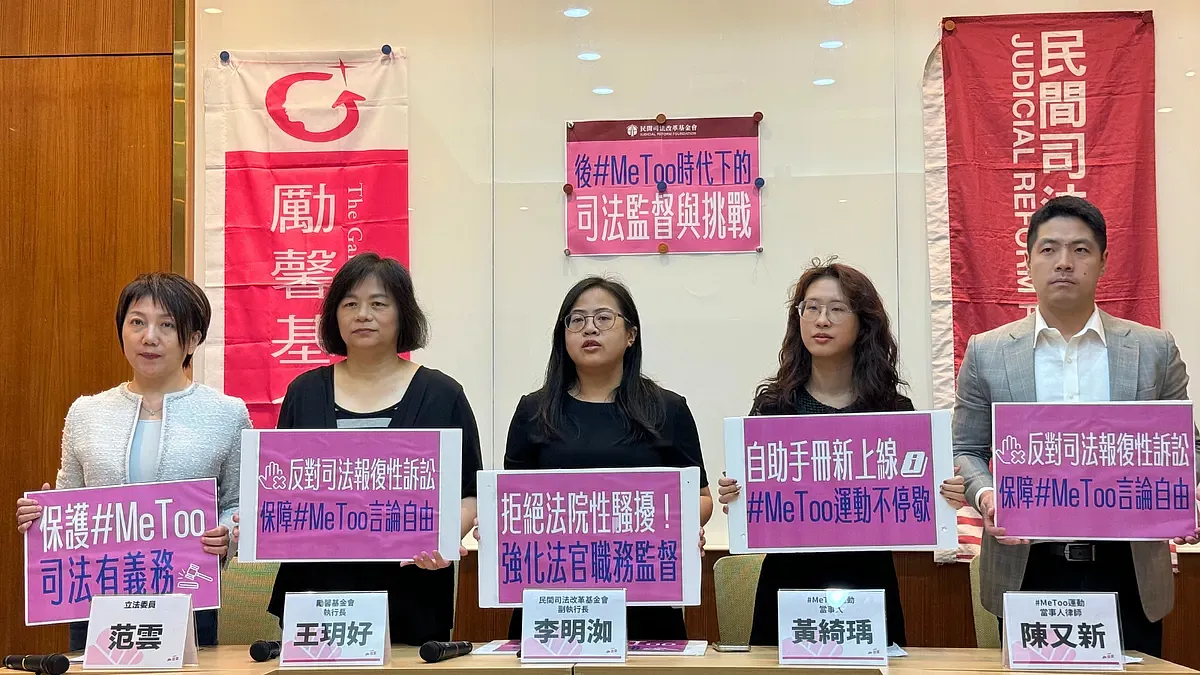
To this end, the Judicial Reform Foundation and Legislator Fan Yun's office held a joint press conference, inviting #MeToo movement participant Huang Ch'i-yu, attorney Ch'en You-hsin, Garden of Hope Foundation CEO Wang Yueh-hao, and legislators concerned about the #MeToo movement to attend and speak. They expressed their views on judicial issues in the post-#MeToo era, echoed Gender Equality Education Day on April 20 by examining Taiwan's judicial environment from a gender equality perspective, and expressed hope that #MeToo activists can continue to speak out and mobilize collectively without being silenced by perpetrators:
1. Facing judicial harassment after the #MeToo movement, we call on the judicial system to carefully consider the potential chilling effect of "strategic lawsuits against public participation" (SLAPPs) and urge the Legislative Yuan to attach importance to the institutional protection of victims in such cases
In the post-#MeToo era, many #MeToo activists and victims have been sued by perpetrators and thus forced into judicial proceedings, which constitutes "strategic lawsuits against public participation" (SLAPPs). These are customary methods used by the powerful to intimidate journalists, non-governmental organizations, and ordinary citizens. Their ultimate goal is not judicial relief, but judicial harassment of critics; by resorting to litigation, they make citizens hesitant, silence them, and deter them from participating in public affairs discussions, thereby creating a chilling effect. In other words, perpetrators use litigation as a means to retaliate against and intimidate #MeToo activists so they dare not publicly express their #MeToo experiences on social media platforms, attempting to use the pressure of judicial proceedings to force parties into settlements and cover up the perpetrators' past sexual harassment or sexual violence.
The case of #MeToo activist Huang Ch'i-yu highlights the characteristics of SLAPPs. The perpetrator, Li Huai-nung, exercised the power and influence of an attorney to commit sexual harassment against the victim. Prompted by Huang Ch'i-yu's courageous disclosure, Li Huai-nung stated on Facebook that his sexual harassment behavior was indeed true and publicly apologized to the victim. However, after Huang Ch'i-yu filed a complaint regarding Li Huai-nung's attorney ethics and professional conduct with the Taipei Bar Association, she was criminally prosecuted for defamation by Li Huai-nung. Although the case has not yet been formally indicted, the party must still cooperate with police and prosecutors' investigative procedures while worrying about suffering adverse judicial consequences. Coincidentally, during the Garden of Hope Foundation's case rescue efforts, in cooperation with other organizations to form a pro bono legal team, there were 913 consultations and 171 open cases, with 47% of the parties requiring legal assistance. Among them, 8 victims were counter-sued, and the Garden of Hope has provided referrals to pro bono lawyers for assistance. Beyond sexual trauma, #MeToo activists must face criminal and civil litigation, resulting in continuous harassment and multiple traumas.
Accordingly, we call on the judicial system to view #MeToo judicial cases with caution and consider the chilling effect that "strategic lawsuits against public participation" may have on the whistleblowing and speaking-out actions of #MeToo activists. At the same/time, we also call on the Legislative Yuan to adopt relevant measures to counter retaliatory and intimidating SLAPPs against #MeToo activists. For example, foreign jurisdictions provide institutional protection for #MeToo movement victims (such as the invalidation of non-disclosure agreements in the United States and the Protection of Public Participation Act in Canada), enacting relevant laws to prevent #MeToo activists from suffering retaliatory judicial harassment.
2. Facing post-#MeToo judicial harassment, the Judicial Reform Foundation will consolidate collective experiences to launch a "Self-Help Manual" online
The revision of the "Three Gender Equality Acts" (Gender Equality in Employment Act, Gender Equality Education Act, and Sexual Harassment Prevention Act) last July centered on victim protection, strengthening "effective" punitive measures to crack down on perpetrators, completing "victim-friendly" rights protections and services, and hoping to establish a professional and "reliable" sexual harassment prevention system. However, during the rapid legislative process, attention was not paid to the judicial risks faced by #MeToo activists and victims, and quite a few victims suffered judicial prosecution by perpetrators. Consequently, after speaking out in the #MeToo movement, victims still have to deal with judicial procedures initiated by perpetrators, such as police questioning, prosecutor investigations, and court hearings. Amidst complicated legal procedures, some #MeToo victims bear immense pressure and lack relevant legal resources.
To this end, the Gender Group of the Judicial Reform Foundation is preparing the "Self-Help Manual for Victims of the #MeToo Movement," which will be published online in May for public viewing. The self-help manual will integrate the latest legal provisions, judicial judgments, and procedural regulations, hoping to provide a concise and practical legal guide for #MeToo movement victims. We understand that stepping forward to speak out in the #MeToo movement is no easy task, and parties will face various queries and challenges. Although a self-help manual cannot help parties foresee all possible pressures, it can at least provide parties with a way to identify the legal risks they need to consider and channels where they can seek resource support.
3. Incidents of sexual harassment by judicial leaders occur frequently, undermining public confidence in seeking justice through the judiciary. We call on the Legislative Yuan to strengthen the regulatory density of occupational supervision under the Judges Act to make the relief environment more friendly
Regarding the abuse of workplace power and resource advantages by judicial leaders to commit sexual harassment, apart from ex-post accountability mechanisms such as gender equality and disciplinary procedures, the current regulatory density of the Judges Act regarding the qualifications, selection procedures, evaluation, and dismissal that judicial leaders ought to possess is truly too low. The sexual harassment incident involving former Disciplinary Court President Li Po-tao of the Judicial Yuan last year is of particularly indicative significance. Taiwanese citizens are questioning how the Judicial Yuan, which is responsible for realizing fairness and justice, can face sexual harassment incidents occurring internally. Former Shihlin District Court Presiding Judge Tsai Ming-hung, in addition to being prosecuted for the crime of forcible indecency, was also impeached by the Control Yuan and referred to the Disciplinary Court for trial. According to media reports, Control Members pointed out that the Tsai Ming-hung case reflects structural and systematic cover-up problems within the Judicial Yuan and district courts. For this reason, the JRF believes that if the Judicial Yuan cannot properly handle and review this, it will not only severely damage public confidence in the judiciary, but will also make victims of sexual harassment and sexual violence nationwide unable to believe that courts can handle gender equality incidents impartially.
In the past, whenever judicial discipline issues arose, the JRF consistently proposed amendments to the occupational supervision provisions of the Judges Act, explicitly stipulating standards that presidents and chief prosecutors must possess and be qualified to set as examples for all judges and prosecutors, and adding provisions that the Judicial Yuan and the Ministry of Justice may replace them when they are "unfit" for office. Meanwhile, in addition to strengthening supervision over judicial leaders, our association further advocates that judicial leaders, as role models, should shoulder the responsibility of supervising inappropriate behavior by their subordinate judges and prosecutors, such as explicitly incorporating "behavior violating judicial ethics norms" into the scope of occupational supervision. In other words, the problem of sexual harassment within the judicial system can no longer be viewed as an isolated case. To strengthen internal self-discipline within the judiciary and prevent major judicial discipline and gender equality incidents, the JRF calls on the Legislative Yuan to swiftly amend the occupational supervision provisions of the Judges Act.
In summary, the hasty amendment of the three gender laws last year failed to account for the fact that #MeToo activists still have to endure judicial harassment from perpetrators, and also overlooked the gender equality issues within the judicial system itself. We hope that the achievements of the #MeToo movement will not stop at the revision of the three gender laws last July, but that we will see and improve upon Taiwan's judicial issues in the post-#MeToo era.
Summary of Attending Representatives and Remarks
Li Ming-ju|Deputy Executive Director, Judicial Reform Foundation
The issue of sexual harassment within the judicial system can no longer be viewed as an isolated case. Amendments to the occupational supervision provisions of the Judges Act should be carried out to facilitate improvements in gender equality.
Huang Ch'i-yu|#MeToo Movement Participant
We look forward to the Taipei Bar Association making an impartial adjudication to defend legal ethics, the dignity and professional ethics of legal professionals, and to prevent creating a chilling effect on #MeToo activists.
Ch'en You-hsin|Attorney for #MeToo Movement Participant
Many cases show that perpetrators, after apologizing, often retaliate against #MeToo victims through civil and criminal litigation, thereby stifling the possibility of potential victims speaking out.
Wang Yueh-hao|Executive Director, Garden of Hope Foundation
The Garden of Hope Foundation cooperates with the Taiwan Bar Association to provide legal assistance through a pro bono legal team, supports adopting the foreign system where "non-disclosure agreements are non-binding," and argues that gender equality incidents should not be wiped away by non-disclosure agreements between parties.
Fan Yun|Legislator
The Ministry of Justice and the Judicial Yuan should focus on the ethical education of judicial personnel to fundamentally improve the problem of lacking gender equality concepts. Additionally, if legislators break the law themselves, they should also be referred to the Legislative Yuan's Committee on Discipline for severe punishment.
Press Contacts
Lin Ch'eng-ch'ing, Assistant Legal Researcher, Judicial Reform Foundation
kacan@jrf.org.tw
02-2523-1178 ext. 14
This article is an AI-generated translation of the original Chinese text. In the event of any discrepancy, the Chinese version shall prevail.