
2024.04.23 Constitutional Court | Death Penalty Case Oral Argument | Attorney Li Nien-tsu
Last edited: 2026-07-27
Retribution is not a right of the crime victim, and retributive justice lacks teleological justification.
Next, let us discuss the purpose of the death penalty. The death penalty invades the body, inflicts pain, and deprives life to maintain social order through deterrence and retribution. Is this justified?
First, regarding deterrence: the death penalty is no longer the sole mandatory sentence, as life imprisonment is now invariably listed alongside it. When measuring the deterrent effect of the death penalty, the effect of life imprisonment cannot be factored into it. If life imprisonment deters 90% of crimes and the death penalty deters 99%, the deterrent effect of the death penalty can only be the additional 9%. This is because choosing not to execute does not mean releasing the offender, but rather imposing life imprisonment—a fact that anyone committing a capital offense necessarily knows.
How much additional deterrence can the death penalty provide? In truth, it is difficult to ascertain with certainty. Is it proportional in terms of sacrifice and utility to deprive a life for the sake of an unevidenced deterrent effect? The answer depends on what the value of life is.
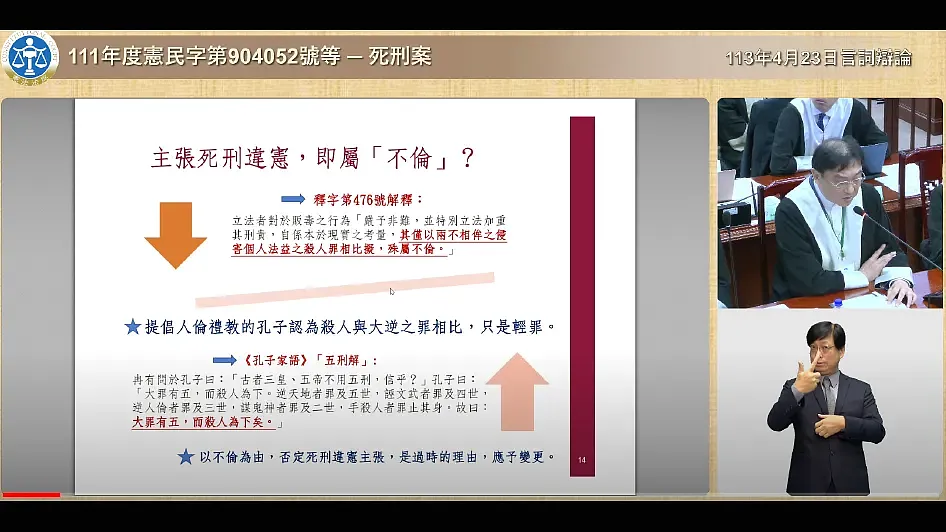
Moreover, Judicial Yuan Interpretation No. 576 has long established that life is priceless.
Next, let us discuss retribution. The Criminal Code demonstrated from the very beginning that the death penalty is a cruel form of retribution. Executions carried out with bloodshed in bustling city squares had the greatest deterrent effect, yet the Criminal Code abandoned public executions in favor of covert ones. The legislative reasoning was that the death penalty is cruel and unhelpful for moral reformation. But are covert executions not cruel? If we are willing to be cruel—so much so that even the deterrent effect of public execution can be abandoned—then cruel retribution is the true purpose of the death penalty.
Retribution stems from vengeance and retaliation. The law does not permit victims to retaliate, and the Constitution should not allow the government to commit retaliation in the name of retribution. Please do not masquerade the death penalty as compensation for the victim. Furthermore, both retribution and retaliation lack rational objective standards; they are purely arbitrary operations of emotion and sentiment. Judges deeming someone deserving of death leads to the imposition of death, and sentencing repeatedly employs emotional language lacking objective standards, such as "reviled by both gods and men, intolerable by heavenly principles, utterly unpardonable, and making one's hair stand on end." This provides evidence of the irrationality of capital punishment. Capital judgments also feature the famous dictum, "seeking life yet unable to obtain it." This phrase merely asserts that execution is absolutely necessary, yet it remains a mere conclusion without reasons.
If the conviction that "execution is absolutely necessary" stems from the offender being so evil that their continued survival poses a danger, that is not retribution, but social defense. However, an inmate is entirely under the control of public authority; long-term imprisonment is already sufficient to defend society. There is no state of emergency, and defending society cannot be a justified reason to deprive someone of life.
If the conviction that "execution is absolutely necessary" stems from the offender being so evil as to barely be human, it violates the core values and commandments of the Constitution. Humans possess human dignity, and the key is mutual respect and equality. While a person may express the opinion that another lacks humanity, no one is qualified to order or personally carry out the termination of another's life, turning an equal, living person into a corpse on the spot, stripping away their human status and reducing them to an object.
Nor does a person automatically stand above others simply by becoming a judge, acquiring the qualification to order or commit murder. No one can derive the power to kill through the authorization of the people. Voters are equal to one another and possess no sovereign power to kill others; therefore, they cannot vote to authorize judges to rename defendants as enemies and kill them systematically.
What on earth are retribution or retributive punishment? Killers must die. Liu Pang retained the death penalty of the Ch'in dynasty down to the present day, yet this remains a theory of retribution. "Heaven's way is manifest, and retribution is infallible"—the subtext is self-deification, acting on behalf of Heaven. The heroes of the marshes of Mount Liang also spoke of acting on behalf of Heaven, but a judge is a judge, not a god, not Heaven, and not a hero of Mount Liang.
The foundation of democracy is not divine right, but rationality. The belief that execution is absolutely necessary is not rational. Today, grounded in the rationality of the rule of law, we condemn defendants who harbored murderous intent, and we must no longer harbor murderous intent ourselves, stopping killing with killing, after the fashion of the cruel laws of Ch'in and the suppression of violence with violence.
For over two thousand years, the urge to kill has refused to dissipate. It is time to draw a period. Humans must not wish to kill simply because someone else has killed, nor may they use Asian values, in the name of the law, to systematically kill. To insist that execution is absolutely necessary is to pose as a supreme heavenly deity holding the ultimate power over life and death. Thank you, Your Honors, for listening.
This article is an AI-generated translation of the original Chinese text. In the event of any discrepancy, the Chinese version shall prevail.