
2024.04.23 Constitutional Court | Oral Argument on the Death Penalty | Attorney Li Hsuan-yi
Last edited: 2026-07-27
Good morning, Justices, and citizens watching through the camera. I am Attorney Li Hsuan-yi, counsel for the petitioners.
Herein, I wish to argue that the existence of the death penalty causes the state to become derelict in its duty, leading to lapses in investigating the root causes of crime and in caring for victims after a final judgment is rendered.
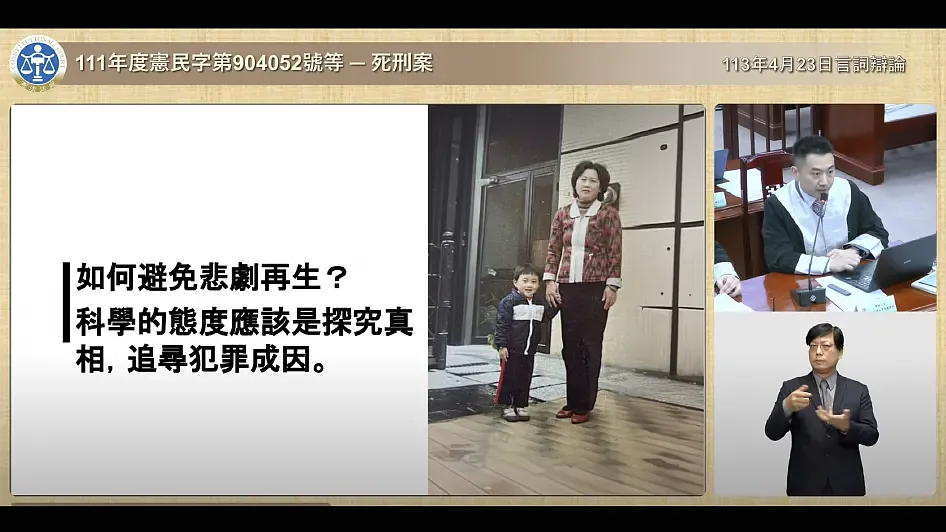
No one is qualified to claim who can represent victims, but I know my own story. In 1986, during the summer after my freshman year in high school, my grandmother, who raised me single-handedly, encountered a robbery on a sweltering summer night and died alone on the street. I still remember the terrified, rigid expression on my grandmother's hospital bed. During the mourning period, my mother never broke down, but on the way home after the funeral, she suddenly wailed like a doll, crying out: "I don't have a mother anymore!"
At that time, I had a strong intention to kill the perpetrator with my own hands. I wanted revenge. Fate is mocking. Criminal investigation made no progress. A model mother encountering a robbery in the dead of night. Death, please deliver it to the police. My grandmother was reduced to nothing more than a text box in a newspaper.
How I envied others for still having a name to curse; I was even robbed of the opportunity to hate anyone.
After entering university, I, who had been consumed by the fire of hatred day in and day out, was somewhat liberated by knowledge. The analysis of various crimes in criminology set me free. I applied the theories I learned to my own story, guessing the causes of the defendant's crime.
Why did the criminal strike? There are many rumors. A young man, one strikes while the other waits on a scooter to pick him up. Perhaps it was to make a comeback at a casino, or an unemployed middle-aged man driven to desperation, committing a momentary heavy blow just for a warm meal. Or perhaps something simpler: fools drinking and getting high, toying with others for amusement. Who are they? Which community do they belong to? Why is their understanding of human life so superficial? Is it family, school, the military, or the workplace? Which link disconnected them from us?
Every single one of you and I is an angel from a mother's womb. Why? In the end, we cultivate such hateful sinners. If we can understand the process of depravity, why are we obsessed with killing that fallen angel while ignoring the Satan that tempted him? Shouldn't the root causes of crime be pursued and hunted down instead? Fairy tales always have many good metaphors.
In Harry Potter, openly acknowledging the return and existence of the dark lord Voldemort is not allowed. Because that would confirm the failure of the administrative system, much like confirming that heinous person produced by our society. Originally, we had many opportunities to save him from being tempted by Satan.
If we could truly hunt down the root causes of crime, the dysfunctions within the state system would be continually exposed and subsequently repaired. I gradually realized that the person I wanted to hunt down was not the defendant, but the root cause of the crime. Only by doing so can we possibly prevent tragedies from happening again.
May is coming, and Mother's Day is approaching. For me, my grandmother was the source of my sense of security and happiness; she cannot just die like this. I believe my grandmother's death must carry a message as heavy as Mount Tai.
I thus redefine my grandmother's death as a reminder that we must embrace the people around us. Only by solidifying and closely connecting human relationships, and by not abandoning, discriminating against, or excluding anyone around us, can the root causes of crime possibly be eradicated. Otherwise, on a small scale, individual crimes will repeat endlessly; on a large scale, like national wars, it will never cease. Stop responding to violence with violence. Inquire into what the source of violence is, and deal with that source.
The abolition of the death penalty is not based on European humanistic thought. Rather, it is the inevitable reaction of someone who has stared into pain for too long. This task, which looks simple but is actually as difficult as ascending to heaven, is the duty of the state. Abolishing the death penalty means directly confronting and blocking the root causes of crime.
Embracing everyone in our arms with an equal heart is the only way to truly prevent tragedies from happening again. This demand stems from the fundamental requirements of the Constitution, rather than a choice of moral virtue. From wanting to kill at the time of the incident to not wanting to kill 28 years later—this is my transformation. Yet, despite the long passage of time, the trauma of crime does not disappear; rather, it cunningly coexists with the victim.
The perspectives of victims before a final judgment is rendered should be heard. However, the state should pay even closer attention to whether the care for victims after a final judgment is neglected, as trauma quietly erodes victims in units of decades. The state should study this harm with greater dedication.
I underwent psychological counseling in my adulthood, which confirmed the phenomenon of a parentified youth during the time of my case. This caused distorted intimate relationships and attachment issues accompanied by crying in my adulthood.
I am fortunate; my family embraced my absurd emotions and kept me from making mistakes and falling into depravity. But my happiness is not guaranteed. The cunning nature of trauma requires the state to step in and study it, thereby establishing effective systems to assist. It is difficult, I know, but showing compassion to victims is the Taiwanese value, and they deserve it. Today, the existence of the death penalty diminishes the state's determination to embark on this arduous path.
For a better and safer society, please let us face the problem directly and stop using the death penalty to escape.
Next, I hand my microphone over to my colleague.
This article is an AI-generated translation of the original Chinese text. In the event of any discrepancy, the Chinese version shall prevail.