
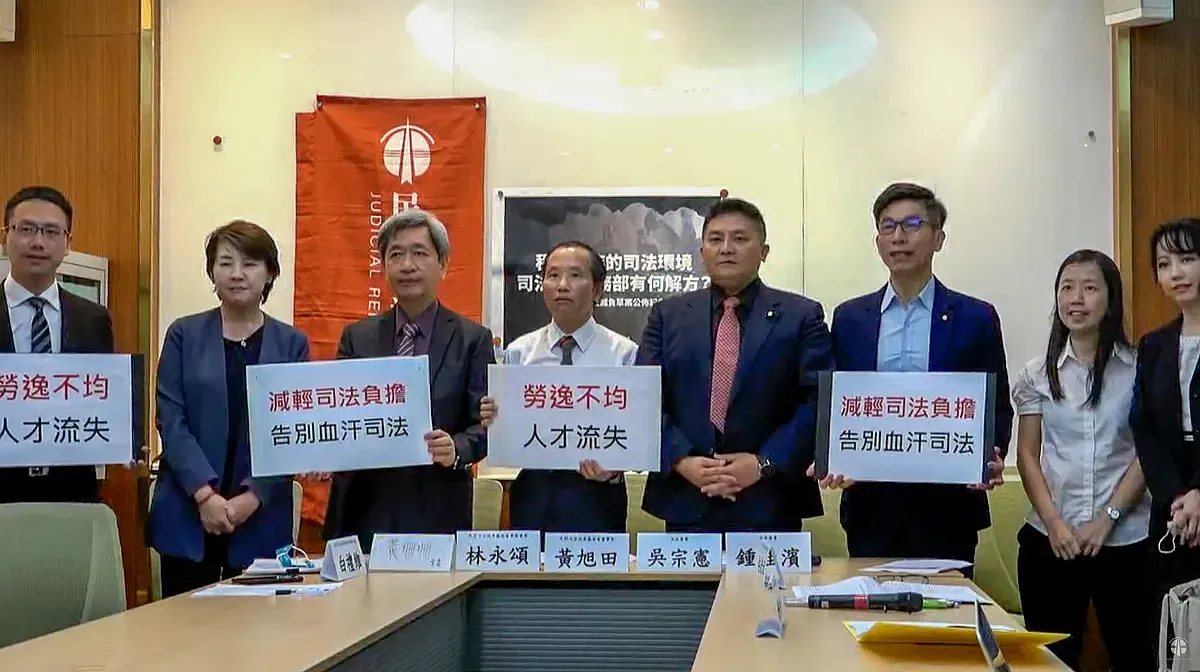
Press Conference | Solutions for the Judicial Environment Worn Out by Overwork: What Are the Judicial Yuan and Ministry of Justice's Answers? —— Press Conference on the Release of the Civil Version of the Draft Judicial Burden-Reduction Act
Last edited: 2026-07-27
Recently, issues regarding the overwork of judges and court clerks have frequently arisen, drawing renewed attention from all sectors to the problem of excessive judicial burdens. With a surge in cases accepted by courts and prosecutors' offices, judicial officers being overworked to the point of exhaustion is a frequent occurrence. Clerks, court bailiffs, and other colleagues are unable to bear the load, leading to many resignations. The current judicial environment is clearly unconducive to judicial personnel fully performing their duties, and directly impacts the protection of the people's right to litigation and other rights.
On the 12th, the Judges Association appealed for institutional reforms such as limiting case assignments and relaxing performance evaluations. On the 17th of this month, the Judicial Yuan convened a review meeting addressing the issue of judge overwork, preliminarily adopting four resolutions, including "relaxing performance evaluation measures" and "preventing abusive litigation."
This Foundation once again calls upon the Judicial Yuan and the Ministry of Justice—in addition to advocating for an increase in personnel—to actively promote a "subtractive engineering" approach. Under the premise of not diminishing public rights, they should streamline procedures and reduce non-essential work to improve the working environment for judges and prosecutors. Addressing the direction of alleviating judicial burdens, this Foundation puts forward the following 3 demands:
1. The Judicial Yuan and the Ministry of Justice should actively promote "subtractive engineering" to reduce the unreasonable burdens on judges and prosecutors.
2. The Judicial Yuan and the Ministry of Justice should use objective research methods to analyze the status of judicial overwork, and make public relevant reports and improvement measures.
3. Presidents of various courts and chief prosecutors of prosecutors' offices should actively improve working environments plagued by "uneven distribution of labor" and "overworking those who are capable."
I. Casting a Brick to Attract Jade: Civil Society Introduces 10 "Subtractive Engineering" Initiatives
Frontline personnel in courts and prosecutors' offices have long been under high-pressure environments of excessive loads. Aside from insufficient human resources and steadily increasing caseloads, we believe it is necessary to thoroughly review current case-handling procedures, minimizing unnecessary work burdens as much as possible so that judges and prosecutors can dedicate their energy to meaningful trial work.
As early as 2020, the Judicial Reform Foundation established the "Special Amendment Group for Enhancing Judicial Quality and Alleviating Judicial Burdens," continuously inviting judges, prosecutors, practicing lawyers, and experts and scholars to participate in discussions. In January 2022, we released 7 proposals, including "expanding the scope of application for suspension of prosecution and plea bargaining" and "allowing simplified (summary) judgments to use judgment pronouncement records instead of written judgments." Recently, we have added 3 more proposals: "simplification of judgments and prosecutorial documents," "expanding the scope of cases subject to mandatory civil legal representation," and "discretionary non-prosecution for minor offenses," while continuing to discuss measures such as "an injunction system to prevent abusive civil litigation." We hope to serve as a catalyst to urge the Judicial Yuan and the Ministry of Justice to face the importance and necessity of alleviating judicial burdens through "subtractive engineering," and to swiftly propose improvement measures and planning. The reform directions studied by this Foundation are as follows (see the appendix for details):
- Relax regulations regarding prosecutors and police not transferring suspects into custody.
- Relax the scope of suspension of prosecution and its supporting measures.
- Relax the scope of application for plea bargaining and its supporting measures.
- Allow consent to express opinions in writing uniformly when presenting evidence and documents in criminal procedures.
- Allow criminal simplified (summary) judgments to use judgment pronouncement records instead of written judgments.
- Recommendations on the workflow for judicial assistants to assist in drafting judicial documents.
- Outsource and translate other cases by analogy to criminal procedure cases.
- Simplification of civil and criminal judgments.
- Expand the scope of cases subject to mandatory civil lawyer representation.
- Add provisions for direct non-prosecution dispositions without investigation for petty offense cases.
- Injunction system to prevent abusive civil litigation (under study).
In addition to judges and prosecutors, we believe that the work burdens and environment of court clerks, bailiffs, court officers, and other court and prosecutorial personnel are also in urgent need of improvement. If all sectors of society have ideas regarding the improvement of court workloads and environments, we hope they will offer suggestions and join the discussion.
In this regard, we call upon the Judicial Yuan and the Ministry of Justice to actively promote "subtractive engineering" to reduce the unreasonable burdens on judges and prosecutors.
II. Merely Increasing Personnel Is Insufficient to Improve the Case-Handling Environment
Faced with the problem of excessive judicial burdens, the long-standing solution of the Judicial Yuan and the Ministry of Justice has simply been to "increase personnel." However, while increasing personnel can alleviate the caseload per capita, meaningless procedural waste and mechanical work of low necessity will still consume the working energy and time of judges and prosecutors. If this is not effectively resolved, it may only accelerate the turnover and burnout of judicial personnel.
What is questionable is whether the Judicial Yuan and the Ministry of Justice have systematically collected frontline opinions recently, understood the general extent and causes of overtime work, and conducted statistical analyses of workloads in response to long-standing complaints from the grass-roots. Have they conducted detailed studies since 2005 and 2007? Have they objectively evaluated the streamlining of case workflows and reasonable staffing levels from the perspective of management professionalism? How was the recent figure announced by the Judicial Yuan—stating a need for an additional 5,536 personnel—calculated?
To objectively alleviate the long-standing crisis of excessive judicial burdens, we call upon the Judicial Yuan and the Ministry of Justice to make public relevant policy evaluation information and make up for the deficiencies in current methods. If necessary, objective evaluations and research should be conducted by external, independent experts or institutions with management expertise.
III. Uneven Distribution of Labor, Overworking the Capable, and Striking a Blow to Grassroots Morale: When Will Judicial Leaders Produce a Plan?
The judicial working environment, which is in urgent need of improvement, is also highlighted by the severe problems of "uneven distribution of labor" and "overworking those who are capable" across all courts and prosecutors' offices. In practice, to prevent problematic judges and prosecutors from "getting into trouble," leaders often assign them to handle "work that will not lead to major mistakes," rarely demanding proactive improvement measures or punishments (such as the disciplinary case of Prosecutor Wu, dubbed the "King of Rejected Cases" by the media).
Within the judicial circle, this is neither new nor a secret. This working culture undoubtedly emboldens underperforming judicial personnel without restraint, which in turn makes the workloads of conscientious colleagues unbearable, forming the absurd phenomenon of bad money driving out good. We have repeatedly asked the Judicial Yuan to review this phenomenon and hold leaders truly accountable, but it has fallen on deaf ears, with no one caring.
Therefore, how to reasonably "relax performance evaluations" without exacerbating the phenomenon of "bad money driving out good" or creating new problems requires rigorous evaluation. In particular, while performance evaluations on case-handling deadlines create pressure, they also help the public receive timely judicial remedies.
In this regard, we call upon presidents of all courts and chief prosecutors of prosecutors' offices to actively improve the working environments of "uneven distribution of labor" and "overworking those who are capable" through methods such as official supervision.
Press Conference Time
Monday, April 29, 2024, 10:00 AM
Press Conference Location
Room 102, Legislative Yuan Research Building (Chung-Hsing Building), No. 3-1, Sec. 1, Chinan Rd., Zhongzheng Dist., Taipei City
Attendees
Huang Hsu-T'ien | Chairman, Judicial Reform Foundation
Lin Yung-Sung | Standing Board Director, Judicial Reform Foundation
Pai Li-Wei | Standing Executive Committee Member, Judicial Reform Foundation
Jen Hsiao-Hsiang | Standing Executive Committee Member, Judicial Reform Foundation
Lin Yen-Chün | Pro Bono Lawyer, Special Burden-Reduction Group
Wu Tsung-宪 | Legislator
Chung Chia-Pin | Legislator
Huang Shan-Shan | Legislator
Media Contact
Attorney Lu Cheng-Yen, Director of Legal Policy Department, Judicial Reform Foundation
Phone: 02-2523-1178#37
Email: elvin@jrf.org.tw
This article is an AI-generated translation of the original Chinese text. In the event of any discrepancy, the Chinese version shall prevail.