
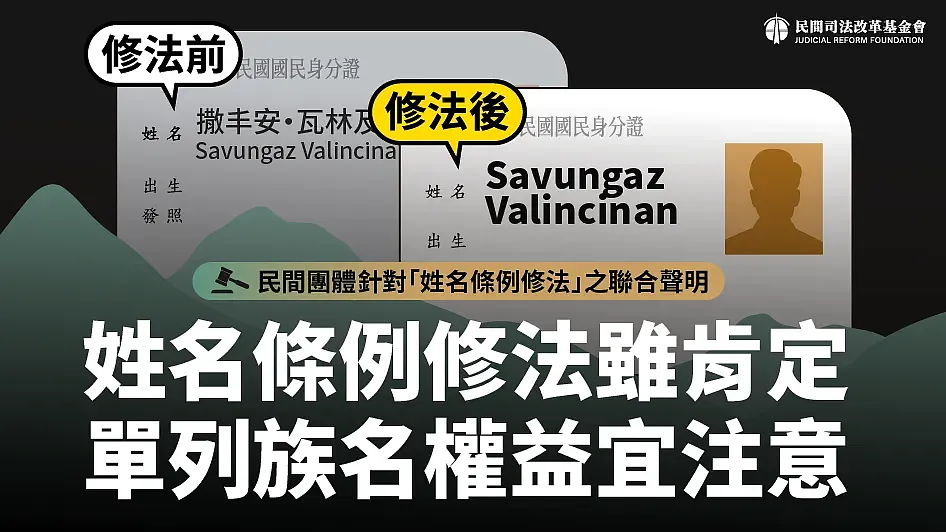
Joint Statement|Welcoming the Amendment to the Name Act, but Attention Should Be Paid to the Right to Solely Register Indigenous Traditional Names—Joint Statement by Civil Organizations on the "Amendment to the Name Act"
Last edited: 2026-07-27
On May 14, 2024, the Legislative Yuan passed the third reading of the amendment draft to the Name Act, adding Article 9, Paragraph 1, subparagraph 7: "Indigenous peoples who register traditional names according to their cultural customs and practices may apply to change their names," without any restriction on the number of name changes. Furthermore, Article 2, Paragraph 3 was added: "Taiwan's indigenous peoples who register traditional names according to their cultural customs and practices may use indigenous scripts."
This means that in the future, when registering household administration and applying for passports, indigenous peoples will be able to solely use indigenous scripts on their identity documents.
While human rights and indigenous organizations—including the Judicial Reform Foundation, Amnesty International Taiwan, the Taiwan Association for Human Rights, the Covenants Watch, the Indigenous Youth Front, the Taiwan Indigenous Peoples Policy Association, the Association of Indigenous Peoples' Youth Public Participation, and the "Call Me By My Indigenous Name" Action Group—affirm this legislative amendment, they have raised two statements regarding the restoration of indigenous traditional names as follows:
1. The Ministry of the Interior shall ensure that all indigenous persons are able to apply for registering their tribal names using indigenous scripts in accordance with this legislative amendment
2. The Legislative Yuan should review the "only once" restriction on restoring tribal names
1. The Ministry of the Interior shall ensure that all indigenous persons are able to apply for registering their tribal names using indigenous scripts in accordance with this legislative amendment
In the past, before the sole registration of indigenous scripts was permitted, restoring indigenous traditional names only offered the option of "Chinese character transliteration," and it was impossible to solely use indigenous scripts to register one's tribal name. The newly passed Article 2, Paragraph 3 of the third reading added the provision "may use indigenous scripts," finally lifting this inappropriate restriction.
In accordance with the intent of the amendment, indigenous persons who restored their tribal names and registered them as "Chinese character transliteration" prior to the amendment may naturally apply again to solely register with "indigenous scripts."
In other words, regardless of the reasons for previously restoring traditional names in the form of "Chinese character transliteration," or for personal reasons applying to restore a "Chinese character transliteration" tribal name back to the original Han Chinese name, under current law they still have one opportunity to "restore the tribal name solely using indigenous scripts." They will not lose the opportunity to solely use indigenous scripts to register their tribal name simply because they "have already restored their tribal name to Chinese character transliteration" or "have already applied to restore their Han Chinese name."
Therefore, it is recommended that the Ministry of the Interior, in consultation with the Council of Indigenous Peoples, issue official letter interpretations to relax the interpretation of "restoring traditional tribal names," and combine this with the provision on sole registration of tribal names under Article 2, Paragraph 3 of the Name Act, so as to understand the restoration of traditional tribal names as "restoring traditional tribal names by solely using indigenous scripts."
Civil organizations previously issued a joint statement demanding that the Ministry of the Interior revoke its unlawful official letter interpretation. In the past, indigenous peoples were prohibited from solely using indigenous scripts to register their tribal names on their national identity cards. The reason given by the Ministry of the Interior was: "In view of considerations for social stability, citizens' use of names should be consistent with the names registered in household administration... However, taking into consideration the convenience of use by various agencies (units), it can be agreed that indigenous peoples may solely use traditional names in Chinese. As for the romanized spelling symbols of traditional names, since they are not widely known by various sectors of society, it is inappropriate to use them alone."
We suggest that public departments must abide by the International Convention on the Elimination of All Forms of Racial Discrimination (ICERD), which explicitly proclaims the protection of the right of indigenous peoples to choose to use their own languages and to practice their cultural traditions and customs, and shall not restrict the constitutionally protected cultural rights of indigenous peoples on the grounds that "indigenous persons who have previously restored their tribal names through 'Chinese character transliteration' have already exceeded the number of times allowed for restoration or modification."
2. The Legislative Yuan should review the "only once" restriction on restoring tribal names
Following this amendment, indigenous peoples, whether using Han Chinese names or tribal names, all have one opportunity to change their name identity, and they may also apply to change back to the name prior to the change.
However, this amendment failed to address the legitimacy issue of restricting the "restoration and change to a tribal name" or "restoration and change to a Han Chinese name" to only once. Institutionally speaking, the statutory status of indigenous peoples is determined based on the requirements of the Status Act for Indigenous Peoples, which has nothing to do with whether a Han Chinese name or a tribal name is used for registration. In other words, changes between tribal names and Han Chinese names do not directly lead to overly complex changes in rights and obligations. Consequently, the "only once" rule may unduly restrict the rights of indigenous peoples to cultural identity and self-determination of names.
According to statistics from the Ministry of the Interior, a total of 2,670 indigenous persons restored their traditional names over the past 5 years (from 2018 to 2022, accounting for approximately 4.5‰ of the indigenous population), among which 1,078 persons registered birth declarations using "traditional names" (accounting for approximately 1.8‰ of the indigenous population). In addition, 500 persons "applied to restore their original Han Chinese names" (accounting for approximately 0.8‰ of the indigenous population).
From the above statistical data, it can be seen that the willingness of indigenous peoples to restore traditional names is not high, and there are even indigenous peoples applying to restore their original Han Chinese names. We believe that since indigenous languages are one of the national languages, indigenous peoples should be encouraged to use traditional tribal names. It is recommended that when the Legislative Yuan amends the Name Act in the future, it should relax or abolish the restriction on the number of times restorations can be made.
Furthermore, since Article 9 of the Name Act has officially incorporated tribal names into the scope of "name changes," and indigenous languages are also official national languages; thus, in terms of interpretation, if tribal names involve the circumstances of Item 1 (identical names) and Item 6 (vulgar or indecent names), applications for name changes may naturally also be submitted to household registration authorities under the concept of tribal names. We believe that the Ministry of the Interior should actively adopt this reasonable method of interpretation to mitigate the inappropriate restrictions imposed by current laws on indigenous people changing their names or restoring their tribal names.
Joint Statement Organizations
"Call Me By My Indigenous Name" Action Group
Covenants Watch
Judicial Reform Foundation
Taiwan Indigenous Peoples Policy Association
Taiwan Association for Human Rights
Indigenous Youth Front
Association of Indigenous Peoples' Youth Public Participation
Amnesty International Taiwan
Taiwan Alliance of Citizens with Disabilities
Press Contact
Lin Ch'eng-ch'ing, Assistant Legislative Researcher, Judicial Reform Foundation
Phone: 02-2523-1178 #14
Email: kacan@jrf.org.tw
This article is an AI-generated translation of the original Chinese text. In the event of any discrepancy, the Chinese version shall prevail.