
Press Conference | "President Lai, How Will Judicial Reform Proceed?" Press Release
Last edited: 2026-07-27
President-elect Lai Ching-te will assume office as Taiwan's 16th president next Monday (May 20, 2024). Facing the unfinished judicial reform legacy left by President Tsai Ing-wen, we want to ask President Lai: How will judicial reform proceed? Will your pre-election commitments be fulfilled?
Prior to the presidential election, the Judicial Reform Foundation (JRF), the Taiwan Bar Association, and 16 other organizations jointly visited presidential candidates from all parties, putting forward two major demands:
- Upon taking office, the presidential candidate should broadly incorporate public voices, establish mechanisms for open dialogue, and build social consensus on judicial reform and human rights protection.
- Upon taking office, the presidential candidate should establish a permanent "Judicial Reform Committee" that incorporates public participation to establish stable and effective review and monitoring measures for the implementation of reform initiatives.
In response, then-candidate Lai Ching-te agreed that public opinion should be broadly incorporated and that open dialogue mechanisms should be established to build consensus; he also noted that utilizing a permanent, task-oriented mechanism to implement judicial reform is a direction worth reviewing and executing.
On the eve of President Lai's inauguration, eight organizations—including the Judicial Reform Foundation, the Association for Taiwan Police Autonomy, the Taipei Women's Rescue Foundation, the Taiwan Labour Front, the Taiwan Association for Human Rights, the Covenants Watch, the Youth and Children's Human Rights Association of Taiwan, and the National Alliance on Mental Illness—reconvened to jointly call on President Lai to swiftly fulfill his reform commitments.
1. Swiftly Initiate Social Dialogue and Build Consensus on Judicial Reform
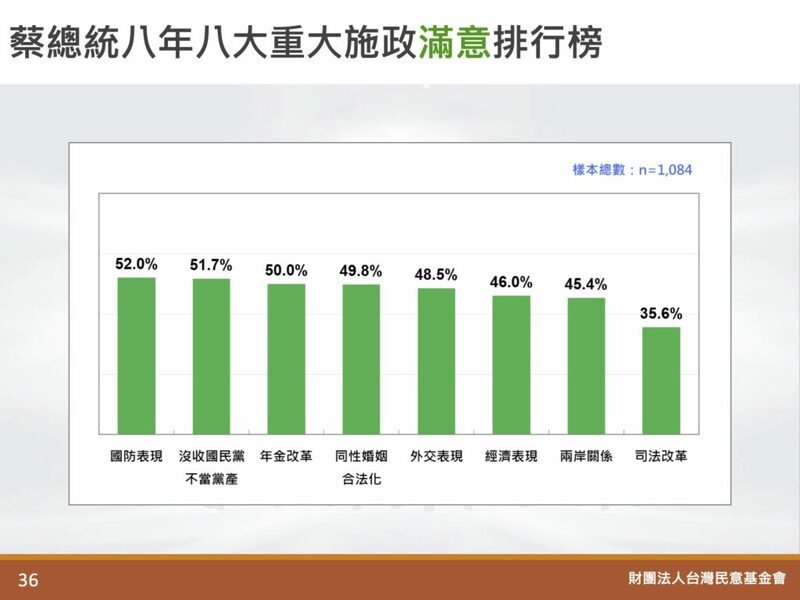
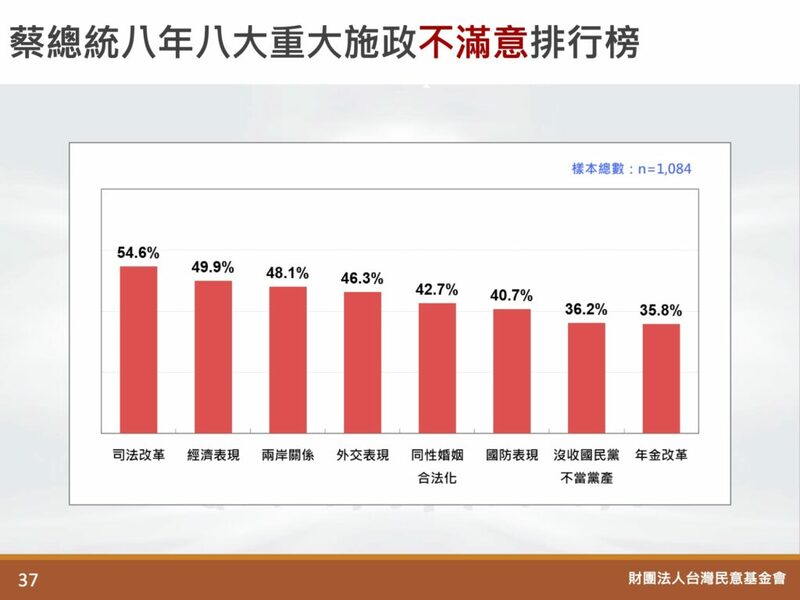
According to a survey released on April 23 by the Taiwanese Public Opinion Foundation, judicial reform had the lowest satisfaction rating among President Tsai Ing-wen's eight major policy areas at only 35.6%, while dissatisfaction reached as high as 54.6%, ranking the highest and showing a clear gap compared to other policies.
Between 2016 and 2017, President Tsai Ing-wen adopted 326 resolutions through the National Judicial Reform Conference. While progress has been made on some items, there are also six major shortcomings with zero progress (refer to the August 7, 2023 press release). Given the stagnation of related reforms, there is a genuine need for a item-by-item review. Emerging post-2017 judicial reform issues of significant importance—such as "excessive judicial burdens severely impacting the quality and speed of case handling"—must also be re-discussed.
Meanwhile, ahead of the legislative elections in November last year (2023), the JRF also put forward seven major judicial reform issues to all political parties. In response, the Democratic Progressive Party (DPP) agreed with the issues we raised, but was largely noncommittal or ambiguous in its proposed solutions (refer to the DPP's response to the 7 judicial reform questions). This further corroborates that related reform issues urgently require dialogue to build consensus. We also expect that throughout the dialogue on various judicial reform issues, the Kuomintang (KMT) and the Taiwan People's Party (TPP) will honor their pre-election commitments to accelerate and support reform (refer to the responses to the 7 judicial reform questions by the KMT and the TPP).
Regarding the unfinished business of the former president's reforms, we believe the new administration should take it seriously, swiftly initiate dialogue, incorporate diverse opinions from all sectors, and build social consensus to advance the next phase of judicial reform.
2. Establish a Permanent Monitoring Mechanism to Fulfill Judicial Reform Commitments
A major reason why the resolutions of the National Judicial Reform Conference failed to be implemented individually is the lack of a "permanent monitoring mechanism," which prevented competent authorities such as the Judicial Yuan and the Ministry of Justice from being proactive and effective when promoting reforms.
Take "consolidating and elevating the quality of first-instance trials" for instance: although the Judicial Yuan proposed appellate court reforms focusing primarily on restricting citizens' right of appeal, it offered virtually no corresponding countermeasures to "strengthen the quality of civil and criminal first-instance trials," and reviews regarding the rules of evidence fizzled out.
A similar situation occurred with resolution items overseen by the National Police Agency (NPA). Although the NPA agreed that the police performance evaluation system is in dire need of reform, it explicitly rejected the resolution to "establish a Police Performance Management Committee"; to this day, police performance targets are still rated by the Association for Taiwan Police Autonomy as "unrealistic, unreasonable, and unlawful."
There are far too many examples showing that even when collective efforts produce forward-looking and progressive reform resolutions, they ultimately fizzle out due to resistance from administrative agencies. We hope that President Lai Ching-te will honor his pre-election commitments by establishing a permanent "Judicial Reform Committee" under the Office of the President to earnestly and proactively advance reforms, bringing genuine change to the judiciary.
Attendees
Huang Hsu-t'ien | Chairperson, Judicial Reform Foundation
Lin Yung-sung | Standing Board Director, Judicial Reform Foundation
Tu Ying-ch'iu | Executive Director, Taipei Women's Rescue Foundation
Sun Yu-lien | Secretary-General, Taiwan Labour Front
Lin Che-ning | Secretary-General, Youth and Children's Human Rights Association of Taiwan
Hsiao Jen-hao | Standing Board Director, Association for Taiwan Police Autonomy
Huang Sung-li | Director of Policy Center, Covenants Watch
Wang Hsi | Deputy Secretary-General, Taiwan Association for Human Rights
Chang Che-ch'eng | R&D Specialist, National Alliance on Mental Illness
Tso Hsin-p'ing | Advocacy Specialist, Youth and Children's Human Rights Association of Taiwan
Kao Chun-chieh | Advocacy Specialist, Taipei Women's Rescue Foundation
Press Contacts
Lü Cheng-yen, Attorney-at-Law, Director of Legal Policy Department, Judicial Reform Foundation
Phone: 02-2523-1178 #37
This article is an AI-generated translation of the original Chinese text. In the event of any discrepancy, the Chinese version shall prevail.