
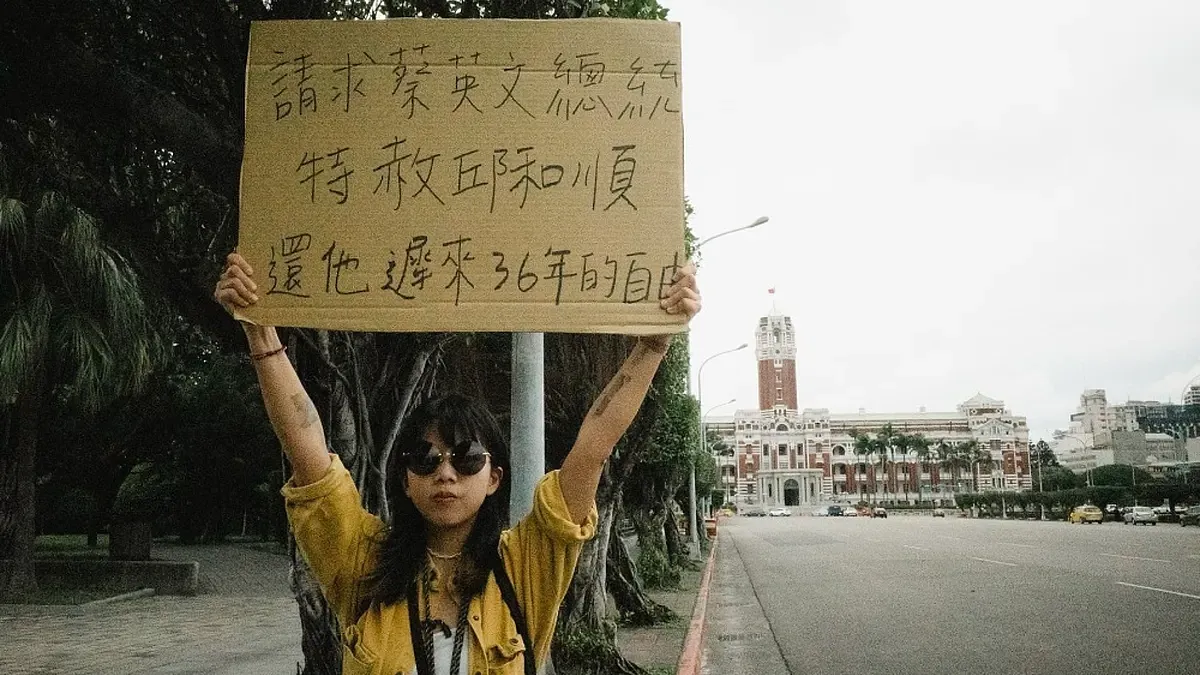
Op-Ed | The Error the Judiciary Refuses to Face: A Earnest Plea to the President to Pardon Chiou Ho-shun and Restore 36 Years of a Free Life
Last edited: 2026-07-27
I. A Miscarriage of Justice Resulting from Police Abuse of Torture at the Close of the Authoritarian Era
When the Chiou Ho-shun case occurred in 1988, Taiwan was in the midst of democratic transition. Throughout nearly half a century of authoritarian rule, coerced confessions through torture were a defining authoritarian feature of Taiwan's judicial system and an indelible historical memory.
Chiou Ho-shun, a native of Chu-nan, Miao-li, was accused by secret witness Lo Chi-hsun of participating in the 'Ko Hung Yu-lan Murder Case' and the 'Lu Cheng Kidnapping Case'. Ch'iu and his co-defendants were subjected to torture by the Taipei City Police Department through brutal methods such as beatings and waterboarding. Although Ch'iu had an alibi, he could not withstand the torment of torture and ultimately 'confessed under duress' to crimes he did not commit.
During the harrowing period of authoritarian rule, the torture suffered by Ch'iu and his co-defendants, along with the confessions extracted thereby, were actually handled by requiring the defendants themselves to disprove the voluntariness of their confessions, rather than by adhering to the due process of criminal procedure. Furthermore, even when the defendants tried every possible means to prove that their confessions were extracted under duress, their cries and weeping under torture never reached the judges' ears, and the scars and pain branded upon their bodies failed to catch the judges' eyes.
During the trial of the Chiou Ho-shun case at the Hsinchu District Court, Ch'iu and his co-defendants proclaimed their innocence to the judge. Control Yuan Member Wang Ch'ing-feng at the time even initiated an investigation into the police officers who carried out the torture, exposing the intolerable and brutal facts of coerced confessions and successfully moving to impeach them; the courts even certified the torture as fact and convicted the police officers. Nonetheless, successive courts continued to sentence Ch'iu to death based on the confessions extorted from him and his co-defendants. Ultimately, on July 28, 2011, the Supreme Court dismissed the appeal, rendering the death sentence in the Chiou Ho-shun case final.
Following the finalization of the death sentence, the volunteer defense counsel held a press conference to campaign for Chiou Ho-shun, garnering high levels of domestic and international attention. To this day, aside from global rescue campaigns launched by Amnesty International, former UN Special Rapporteur on Torture Manfred Nowak also visited Taiwan to understand and investigate the case, becoming the first to confirm that this case violated the anti-torture provisions of the International Covenant on Civil and Political Rights. Domestically, numerous human rights organizations, such as the Judicial Reform Foundation and the Taiwan Association for Human Rights, joined the rescue efforts. In the interim, the Control Yuan issued two investigative reports on the case, pointing out that a miscarriage of justice had indeed occurred. The Prosecutor-General filed an extraordinary appeal on behalf of Ch'iu, which was dismissed by the Supreme Court. The volunteer legal team also repeatedly filed for retrials based on the Control Yuan's investigative findings, all of which were similarly dismissed. Therefore, although the case is widely recognized domestically and internationally as an unredressed miscarriage of justice, the doors of judicial relief have remained firmly closed. Since the final judgment, Ch'iu has been detained for over 36 years, making him the longest-detained person in the world.
The Mock Asian Human Rights Court—Asia's first human rights court—selected the Chiou Ho-shun case as its inaugural trial, wherein Ch'iu accused the government of the Republic of China of violating international human rights conventions during the proceedings of his case. After months of preparation and four days of hearings, the Mock Asian Human Rights Court delivered its judgment on October 17, 2019, declaring that the ROC government violated Articles 7 and 14 of the International Covenant on Civil and Political Rights concerning the state's obligation to guarantee people's rights to a fair trial and to freedom from torture and inhuman treatment.
The judges of the Mock Asian Human Rights Court unanimously concluded that Chiou Ho-shun suffered severe unlawful harm due to obvious court procedural failures, gross errors in the determination of law and facts, excessive procedural delays, and the massive amount of time wasted as the case bounced back and forth through appellate proceedings. Consequently, they demanded that the ROC Supreme Court re-examine the convictions and sentences handed down against Ch'iu in a fair and necessary manner to remedy and rectify the violations of basic human rights he suffered. This marks yet another occasion where the international community has focused on the Chiou Ho-shun case and substantively scrutinized the ROC government's violations of human rights obligations, bearing profound historical significance for the rescue of Chiou Ho-shun and Taiwan's judicial reform.
II. Two Decades of Advocacy by Civil Society Groups and 100,000 Pardon Petitions: Judicial Errors President Tsai Ing-wen Refuses to Face
Although Chiou Ho-shun had an alibi, he could not withstand the torment of torture and ultimately 'confessed under duress' to crimes he did not commit. Later, although the courts verified that torture had indeed taken place, they still sentenced Ch'iu to death based on the confessions extracted under torture from him and his co-defendants. Finally, in 2011, the Supreme Court finalized Ch'iu's death sentence.
Beginning in 2009, the 'Chiou Ho-shun Rescue Team' and the volunteer legal team launched rescue operations. Spanning more than 10 years, 'judicial relief has been exhausted': retrials and extraordinary appeals have been filed, petitions for constitutional interpretation have been lodged, and Control Yuan reports have been issued. Everything that could be done, should be done, and could be conceived of has been done. The final remaining avenue is to petition the President to exercise the 'power of pardon'.
In 2020, the Rescue Team officially submitted a 'Petition for Pardon' to President Tsai Ing-wen. The petition encompassed figures from domestic and international legal, political, academic, artistic, and religious circles, jointly petitioning the President to pardon Chiou Ho-shun, with 327 public figures from various fields signing the petition alongside 60 civil society groups from 28 different countries. To this day, Tsai Ing-wen has yet to respond to the pardon request.
Speaking of 'pardons', President Tsai has previously issued two executive pardon orders. One was for two Army generals sentenced under the Anti-Corruption Act for misappropriating mess funds; the other was for Wang Kuang-lu, one of the litigants in Judicial Yuan Interpretation No. 803 (the Indigenous hunting constitutional interpretation case).
These two unannounced pardons share a common thread: both cases were 'deeply sympathetic'. One involved an Army major general and his subordinate who dedicated their service to the country, yet had to pay the price of an excessively harsh four-year prison sentence for misappropriating NT$2,880 in mess funds. The other litigant, Wang Kuang-lu—although the Grand Justices' interpretation ultimately upheld restrictions on indigenous cultural hunting rights—was a 'filial hunter' who braved legal risks to hunt because his mother wanted to taste game meat, resulting in a three-and-a-half-year prison sentence served 'in the name of filial piety'.
Yet Chiou Ho-shun seemingly does not warrant President Tsai's sympathy, for he is a 'local ruffian' and a 'death row inmate' with no tear-jerking backstory behind him, even though the Chiou Ho-shun case harbors numerous doubts, and even though the forced confessions under torture in his case demonstrate that the authoritarian remnants of the judiciary following martial law and democratization still persist.
Perhaps the cost of a pardon is implicitly acknowledging just how dysfunctional our nation's judiciary is. However, this is the state's mistake, and an error the judiciary refuses to face. We have the responsibility to speak out for this; Chiou Ho-shun should not be held accountable for the state's errors. Let him walk out of prison alive, while there is still time.
III. While There Is Still Time, Pardon Chiou Ho-shun, End the Authoritarian Tragedy, and Return Him to Freedom Soon
Article 40 of the Constitution vests the President with the power to grant pardons in accordance with the law to remedy the exhaustion of judicial remedies. A classic example of such judicial exhaustion is precisely a miscarriage of justice that the judiciary fails to correct and redress on its own. For instance, in the case of Mr. Su Ping-k'un, former President Chen Shui-bian ordered a full pardon absolving him of his crime and sentence pursuant to Article 3 of the Amnesty Act, because Mr. Su had suffered unjust conviction yet found no doors open in the judiciary to clear his name.
Although the Chiou Ho-shun case is widely regarded domestically and internationally as the most urgent wrongful conviction awaiting rescue in our country, whether it is the retrials applied for on Ch'iu's behalf four times by the volunteer legal team or the extraordinary appeal filed by the Prosecutor-General, all have been dismissed by the courts. This case originated from torture, yet the courts have never been able to completely draw a line between themselves and the gravest form of unlawful state violence that is torture, nor have they possessed the courage to correct their own mistakes. The case has thus become a massive stain on Taiwan's judicial system and human rights record in the international arena.
Having endured torturous suffering brought on by 36 years of detention, Chiou Ho-shun's physical health has deteriorated day by day, suffering from multiple organ ailments affecting his heart, immune system, and teeth. Volunteers and civil society organizations who rescue and care for this case have lost confidence and harbor grave doubts as to whether Ch'iu can live to see the blue skies and bright sun outside the prison walls, fearing deeply that he might draw his last breath inside prison.
Today, only the power of pardon vested in the President by the Constitution can put an end to the injustice in Chiou Ho-shun's case. Painfully recognizing that the judiciary can no longer be expected to clear Ch'iu's name, the volunteer legal team and individuals from all walks of life who have dedicated themselves to his rescue for years have no choice but to petition newly inaugurated President Lai Ching-te to follow the precedent of the Su Ping-k'un case and order a full pardon absolving Chiou Ho-shun of his crimes and sentence.
Chiou Ho-shun wrote in a recent letter: 'I woke up at 3 o'clock this morning. In recent years, right after finishing my daily prayers, I always lean against the window frame, quietly appreciating the beauty of the night sky and breathing in the fresh breeze blowing by—it feels so wonderful, you know? Confined for so long in this cruel environment of a 1.86-ping tiny cell, I've stubbornly fought with all my might every step of the way, living a bitter life like a madman, staying true to myself. Surviving the long, merciless years of 36 years purely through stubborn persistence is a miracle. Prosecutors, judges, and police during the martial law era brutally murdered too many democratic predecessors and citizens—they are truly odious. A-shun would still choose to be just like this now, and would never choose to be tortured to death. A-shun is struggling with all his might precisely to wait for more young people of the new generation to step up and defend fairness and justice in the judiciary.'
We earnestly implore outgoing President Tsai Ing-wen, or incoming President Lai Ching-te, to exercise the power of pardon conferred by the Constitution, grant Mr. Chiou Ho-shun a full pardon absolving him of his crimes and sentence, and bring an end to 36 years of injustice.
※ Members of the Chiou Ho-shun Case Rescue Team hail from the Judicial Reform Foundation, Taiwan Association for Human Rights, Taiwan Alliance to End the Death Penalty, Amnesty International Taiwan, Covenants Watch, and the Taiwan Innocence Project. Chiou Ho-shun's Facebook Fan Page.
▍This op-ed was published on May 17, 2024, in Up Media: 'The Error the Judiciary Refuses to Face: A Earnest Plea to the President to Pardon Chiou Ho-shun and Restore 36 Years of a Free Life'
This article is an AI-generated translation of the original Chinese text. In the event of any discrepancy, the Chinese version shall prevail.