
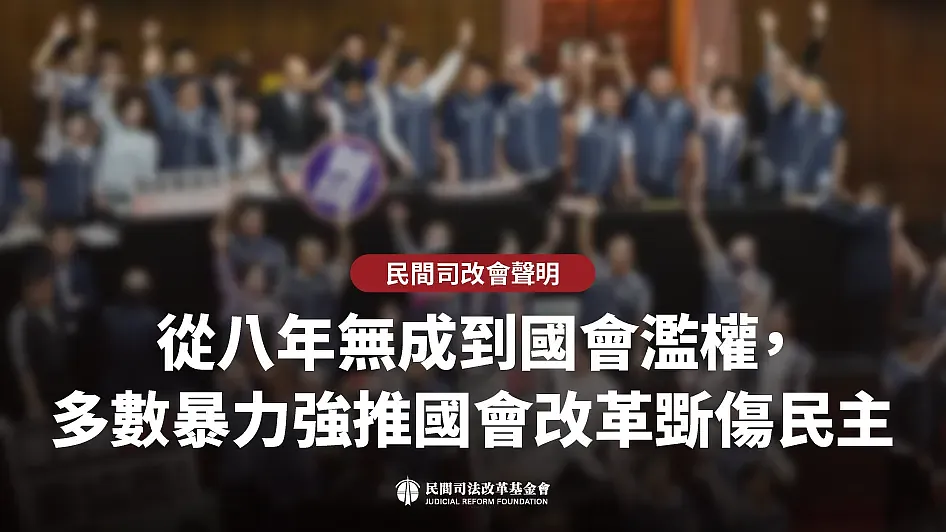
Statement | From Eight Years of Inaction to Congressional Abuse of Power: The Majority's Tyranny in Forcing Through Congressional Reform Damages Democracy
Last edited: 2026-07-27
Last Friday (May 17), severe physical conflicts erupted in the Legislative Yuan during its deliberation of bills concerning "congressional reform," resulting in several legislators being injured and sent to the hospital. That evening, concerned citizens spontaneously gathered outside the Legislative Yuan. The legislative session extended until midnight that day and is set to continue deliberating related bills today (May 21).
The core of this congressional conflict lies in the opposition parties holding a majority of seats (Kuomintang, Taiwan People's Party) joining forces to pass congressional reform bills that the ruling party (Democratic Progressive Party) failed to deliver over eight years of governance, thereby triggering a series of legislative conflicts. In response, the Judicial Reform Foundation issues three statements and appeals as follows:
1. All congressional reform bills must undergo substantive discussion; the meeting minutes of May 17 should not be recognized.
2. The congressional legislative process must adhere to due process and involve thorough debate, with ruling and opposition parties accepting public oversight.
3. The ruling party must recognize the public's fervent expectations for congressional reform and adopt more proactive measures.
I. Congressional Reform Delayed for Eight Years: The Ruling Party Bears Undeniable Responsibility
The core of this legislative conflict lies in the Kuomintang and the Taiwan People's Party joining forces to forcefully push through the "congressional reform bills."
During the 2016 general election, congressional reform was one of the primary campaign appeals of the Democratic Progressive Party (DPP). However, after winning a legislative majority, the DPP invoked the principles of "first to propose, first to vote" and "res judicata" to forcefully advance its own bill for a priority vote, procedurally sealing off any possibility for opposition proposals and civil society suggestions to be incorporated into legislation. Over the span of eight years, important reform items such as "strengthening congressional investigative powers," "improving the exercise of the power of personnel consent," and "implementing self-discipline among legislators" made zero progress. It is fair to evaluate that the DPP, standing in the position of the ruling party, was unwilling to promote congressional reform because it did not wish to see legislative power strengthened to oversee executive power. In fact, when the ruling party and the parliamentary majority party are one and the same, this phenomenon occurs repeatedly and has been witnessed by the majority of citizens.
From this perspective, the DPP—having proposed its own version—can certainly now accuse the opposition parties of joining forces to force bills through, but it also bears unshakable responsibility for today's chaos.
II. The KMT and TPP Embrace Double Standards, Crying "Reform" While Opposing Reform
Whether the opposition parties' promotion of congressional reform is progressive, meets public expectations, and transcends partisan interests must be carefully examined through the content of their proposed bills and practical actions, undergoing thorough debate to present the merits of all viewpoints. However, in this wave of bill promotion, we have seen more of the high-handedness of majority tyranny.
Today's KMT and TPP in the legislature claim to promote congressional reform on the one hand, while on the other hand joining hands to revive the bad habit of the Procedure Committee blocking bills, running completely counter to the ideals of congressional reform. Furthermore, the KMT caucus refused on February 19 of this year to submit self-regulatory information concerning conflict of interest to the Citizen Congress Watch. We must ask: how can such an attitude of refusing oversight lead anyone to believe in the opposition's purpose in promoting "congressional reform"?
Regarding the content of the bills, the "crime of contempt of Congress" that the KMT and TPP hope to pass clearly has an excessively broad scope and unclear procedures. Meanwhile, without a resolution by the full legislative session, officials who violate an individual inquiring legislator's request to provide information could be subjected to fines or referred for impeachment and disciplinary action, which truly constitutes an extreme expansion of "individual legislators' investigative powers."
These issues have greatly heightened public skepticism regarding the legitimacy of their reforms. Especially following the disorderly parliamentary performance of the KMT and TPP, it raises deep suspicion as to whether this is a "banner of reform" or a "mandate for the abuse of power"?
This approach of "crying reform while opposing reform" has continuously eroded the legitimacy of the "congressional reform" banner since February. What the public sees is not a vision for reform, but the overbearing arrogance of opposition parties after securing a parliamentary majority.
III. Calling for the Resumption of Cross-Party Dialogue to Resolve the Congressional Stalemate
(1) Both Procedural and Substantive Legitimacy of the Current Amendments Are Widely Questioned
Amidst the aforementioned controversies, the current KMT and TPP majorities have adopted aggressive strategies, excluding the DPP's bills from entering committee for substantive review. Naturally, this violates the congressional reform ideal of "rational discussion and transparent openness." We urge that, regardless of political party, no one should abuse mechanisms such as "direct second readings, reserving entire bills, killing proposals, and motions to adjourn" to cut off discussion.
We believe that "criticizing the ruling party for abandoning its reform commitments" cannot legitimize the "complete veto of the ruling party." Instead, once the ruling party also puts forward drafts and raises reasonable doubts about the KMT and TPP versions, all political parties should return to substantive debates on the content and appeal to the public regarding the ideals of reform.
In fact, what the KMT and TPP are currently refusing to dialogue with is not just the ruling party, but civil society as a whole. What civil society groups care about most is that before the majority parties read out the privately negotiated clauses during the May 17 session, all sectors had no way of knowing what our legislature would ultimately be transformed into!
Today, while holding high the banner of congressional reform, the practice of conducting neither committee reviews nor party-协商 (caucus negotiations) to substantively discuss the contents of drafts is evidently inappropriate. Receiving clauses from opposition parties that shut down dialogue channels on the very day of the meeting—clauses slated for immediate third reading—can this be the congressional reform supported by the people? If so, what the public sees is not a steadfast commitment to pushing reforms, but the uncontrolled running amok of majority tyranny.
According to Article 63 of the Constitution, bills passed by the Legislative Yuan must first be "debated" and then "decided" before they can be considered procedurally "passed." If there is "debate without decision," "decision without debate," or "neither debate nor decision," it is difficult to consider them as having met the basic constitutive requirements of a "law." Such a deficiency constitutes an obvious and major flaw contrary to the law, inconsistent with Article 63's requirement of "decision" following "debate," as referenced in the dissenting opinion of Grand Justice Yang Chien-hua in Judicial Yuan Interpretation No. 342.
Furthermore, pursuant to Article 7 of the Organic Law of the Legislative Yuan and the Act Governing the Legislative Yuan's Power, the Legislative Yuan's resolutions on bills and budgets must undergo a "three-reading" process, during which stages such as review and debate must take place before being put to a vote. The purpose of this provision is to give minority opinions an opportunity to be voiced, and through open proceedings, to allow the general public to influence voting results, highlight controversial points, ensure that conflicting interests are properly balanced, and enhance the substantive correctness of decisions through rigorous procedures.
In short, democratic politics is not merely about counting heads; it requires understanding, critical thinking, and deliberation before decision-making. Structurally and in detail, this relies on the support of procedures and techniques. Any adjustments and changes to democratic procedures and technical designs must be made with situational awareness and foresight, while avoiding the complete emotional rupture of citizens. Rejecting substantive discussion is already a blow to democracy!
(2) Stop the Chaos and Let Ruling and Opposition Parties Jointly Resolve the Problem!
Within our constitutional system, the institution equipped to converge public will and integrate it is the Legislative Yuan, composed of legislators elected by the people. However, the current electoral system concentrates seats among a few major parties, thereby compressing the diverse opinions of Taiwan's democracy. Therefore, the majority party must be all the more cautious and respectful of the popular will represented by the minority party.
Ultimately, the various new systems proposed under congressional reform are merely tools of oversight. How these tools function still depends on how political parties and legislators wield them! We believe that, past and present, parliamentary bad habits and majority tyranny should not be tolerated. If the opposition parties believe that the content of their proposed reform bills is legitimate, they should all the more initiate dialogue, defend the legitimacy of their proposals, lead by example through actions, and accept public oversight, rather than blocking the scheduling and review of bills in the Procedure Committee or through any other means.
As for the ruling party, it should proactively confront its previously broken reform promises. Beyond dismissing the proposals of the majority parties as unreasonable, it should also present proactive and concrete, feasible plans to grant legislative power appropriate and effective ways to oversee executive power.
In summary, we believe that both the ruling and opposition parties bear a certain degree of responsibility for the current parliamentary stalemate. Both sides should take a step back and sit down together to restore the legislature's function of open, transparent, and rational discussion. Only then will congressional reform cease to be merely a change in statutory text, and instead transform the current state of parliamentary and policy debate through practice and the restraint of disorderly behavior.
Our Aspirations:
Although different political claims confront one another in policy and ideology, they should still reconcile and cooperate at the level of a free and democratic constitutional order. While political actors and opinion leaders can fiercely accuse those holding opposing views of being "anti-democratic," this does not benefit the legislature's function of converging and integrating public will, nor does it mend the fractures among the general public caused by political disagreements. There is no permanent majority party in politics; thus, every political party should understand the constitutional significance of parliamentary procedural rules as the rules of the political game. They should no longer view them as purely technical secondary norms that matter little if violated, to be followed only when strategically needed. The legislative procedures of the Legislative Yuan should not be an improvised creation, arbitrarily altered at any time through rulings or resolutions by the speaker or the majority party based on partisan interests. Otherwise, even if party will is enforced and supporters are temporarily gratified, it will ultimately fail to win the trust of the entire citizenry.
By reasonably designing and jointly adhering to proper parliamentary procedures—ensuring that diverse public opinions receive procedural safeguards and fair treatment, allowing all to freely and fully express their views, respecting, understanding, communicating, and compromising with one another—we hope that conclusions generated through proper procedures will convince all parties. Only thus can Taiwan's democracy continue to deepen, consolidate, and flourish.
Press Contact
Lü Cheng-yen, Attorney-at-Law, Director of the Department of Legal Policy, Judicial Reform Foundation
Phone: 02-2523-1178 #37
This article is an AI-generated translation of the original Chinese text. In the event of any discrepancy, the Chinese version shall prevail.