
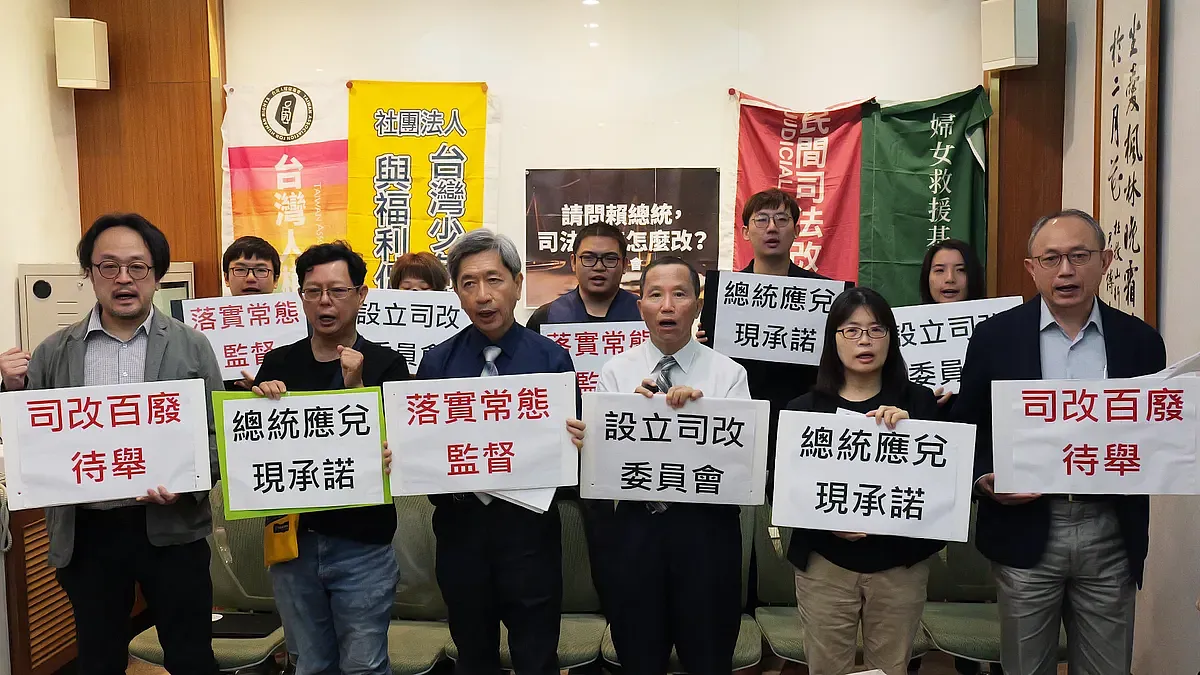
Excerpts from Statements | Press Conference: "President Lai, How Will Judicial Reform Be Carried Out?"
Last edited: 2026-07-27

Tu Ying-ch'iu | Executive Director, Awakening Foundation
Relax the personnel caps for judicial authorities under the Act Governing Total Personnel Quotas of Central Government Agencies, and prioritize increasing the number of judges for juvenile and family courts.
When meeting with presidential candidates, the Awakening Foundation proposed the integration of the CEDAW (Convention on the Elimination of All Forms of Discrimination against Women) and the CRC (Convention on the Rights of the Child) into judicial judgments, shortening the time required to review and issue protection orders, and fostering gender awareness—all of which require proper training and reasonable caseloads. In recent years, numerous legal amendments and increasingly complex social problems have necessitated the resolution of disputes and the protection of victims' rights through judicial litigation.
However, while the number of cases and their complexity increase year by year, the number of judicial personnel has not grown proportionally, thereby impacting the speed and quality of adjudication. Taking the issuance of protection orders under the Domestic Violence Prevention Act as an example, the number of protection orders surged from 10,518 (note: original text typo) to 25,306 in 2023. In 2023, the average processing time for review and issuance was 50 days, while provisional protection orders averaged 23 days for review and issuance out of 12,000 cases.
In addition to protection orders, family court judges must handle complex family cases, such as divorce and custody cases, as well as appeals in non-litigation matters. This has caused family cases to suffer due to an insufficient number of judges. Furthermore, following the regrettable juvenile homicide incident in New Taipei City last year, there is an urgent need to establish specialized juvenile and family courts in the northern, central, and eastern regions, along with adequate staffing to cope with these demands.
Due to restrictions imposed by the Directorate-General of Personnel Administration under the Act Governing Total Personnel Quotas of Central Government Agencies, judicial staffing is severely inadequate. The statutory personnel ceiling for the Judicial Yuan is 15,000, yet in 2024 it has already reached 14,508. Due to shortages of judges and related personnel across various courts, the number of pending, unresolved cases in 2023 reached an astonishing 3,547,741. The Judicial Yuan urgently needs an additional 5,536 personnel, with a shortage of approximately 500 judges alone. The countermeasure to "strengthen the quality of civil and criminal first-instance adjudication" is to first increase manpower to alleviate the pressure of caseloads, lift the total personnel quota restrictions, and increase the number of judicial personnel—particularly judges and supporting staff for juvenile and family matters.

Chang Chê-ch'eng | Research and Development Specialist, Taiwan Alliance of Citizens with Disabilities
Existing judicial procedures and environmental facilities frequently fail to account for the conditions of persons with disabilities, causing them to encounter difficulties when participating in judicial litigation. For instance, in the current participation of citizen judges, there is no clear indication of whether appropriate support personnel are available to assist participants with different disabilities during deliberations, nor how deliberation procedures can be flexibly adjusted.
Moreover, the past National Drifts on Judicial Reform only involved a single disability organization, failing to reflect the predicaments faced by other disability categories in judicial procedures during subsequent discussions. It is hoped that after President Lai takes office, he will respond to the calls of civil society organizations by convening relevant judicial reform conferences, while also considering inviting diverse disability representatives and organizations to attend, incorporating pluralistic and different opinions to further realize the spirit of equal access to justice under the CRPD (Convention on the Rights of Persons with Disabilities).

Hsiao Jen-hao | Standing Director, Taiwan Police Association
During the 2017 National Judicial Reform Conference, there were two police-related resolutions: one concerning the Police Performance Management Committee, and the other the Police Education and Training Committee. Regarding these two resolutions, although the latter did not establish an organization committee, police education and training have indeed progressed gradually; however, the performance reform of the former still lacks clear progress.
1. Addressing Police System Issues in a Regular and Comprehensive Manner
Our association believes that over the past few years of advocacy, "systemic police law enforcement issues" have begun to receive attention, yet controversial cases remain numerous. Examples include large-scale controversies such as the massive "Operation Slash" document forgery cases, and the crackdown on runaway migrant workers in Changhua which affected innocent second-generation immigrants. Aside from these major controversies, suspected collusion, unlawful stop-and-frisks, and the fabrication of evidence for urine test performance ratings still occur frequently.
The current state of police performance and law enforcement issues over the past few years is that civil society raises prominent problem cases, to which administrative agencies may either respond with adjustments or ignore due to practical factors, resulting in a loose and fragmented approach to advancement. Behind this situation lies the reality that a comprehensive reform mechanism is needed to tackle this issue.
2. The Human Resource Management Crisis in the Criminal Justice System: Long-Ignored and Finally Collapsing
In our years of promoting reforms to the police performance system, our association has consistently advocated for "cross-referencing policy demands with human resource demands," because human resources are not limitless. Our surveys over the past few years show that police performance requirements have consistently demanded twice the capacity of human resources, and last year that figure reached five times. If the frontline police are in such a state, one can only imagine the subsequent conditions in prosecutors' offices, courts, and prisons.
Strained human resources will eventually collapse one day—just like the current frequent suicides among police officers and judges, clerks dying from overwork, and prosecutors repeatedly sounding the alarm over overwork. In criminal justice work, people generally believe this is done for social justice, advising others not to fuss too much, to accumulate spiritual merit, and to silently shoulder the excessive workload. However, the ultimate result of this mindset is that we must eventually face the reality that manpower cannot keep up with workload. Yet, years of "not fussing" make it very difficult to begin clarifying and managing the issue. How to confront this problem will be a challenge for the new government.
3. Promoting Reform, Strengthening Mechanisms, and Building Trust in the Judiciary
International research and discussions on police performance in recent years actually encompass three dimensions of problems.
First, police policies inherently carry intrusive characteristics. When the government formulates policies, it should not merely rely on frontline compliance while failing to assess risk issues. For example, the legislative precedent in the United States prohibiting "numerical performance requirements for the use of force" stems from the experience and reflection that performance requirements concurrently generate infringing behaviors.
Second, regarding the effectiveness of human resource utilization in policies and the calibration of human burdens, police unions in the United States and France have criticized performance systems for transforming into human exploitation. In policy research, discussions explore how "certain strategies may seem effective, but empirically lack cost-effectiveness," thereby seeking policy transformation. In Taiwan, such discussions are absent, turning instead into a pattern of "involution" that leads to overwork and internal friction. This structural policy issue requires clarification and resolution.
Third is the coordination between public demand and policy planning. As US police union officials have criticized, "the performance system has distorted police work," turning it into work performed for the sake of statistics while alienating community governance. As our country's police administration has evolved, it has more or less formed an internal police competition system that is detached from the public's needs.
Although several years have passed since the relevant judicial reform resolutions were made, and while there has been some progress, the overall deterioration of labor conditions in the criminal justice system demonstrates that the pace of reform is still not fast enough. An overworked system cannot properly respond to public needs, and over time, this will impair the judiciary.
Our association calls on the new government to treat these as priority issues. Only through a rational system with appropriate human resource allocation and freedom from overwork can the rights of frontline personnel be safeguarded and public trust be secured.
This article is an AI-generated translation of the original Chinese text. In the event of any discrepancy, the Chinese version shall prevail.