
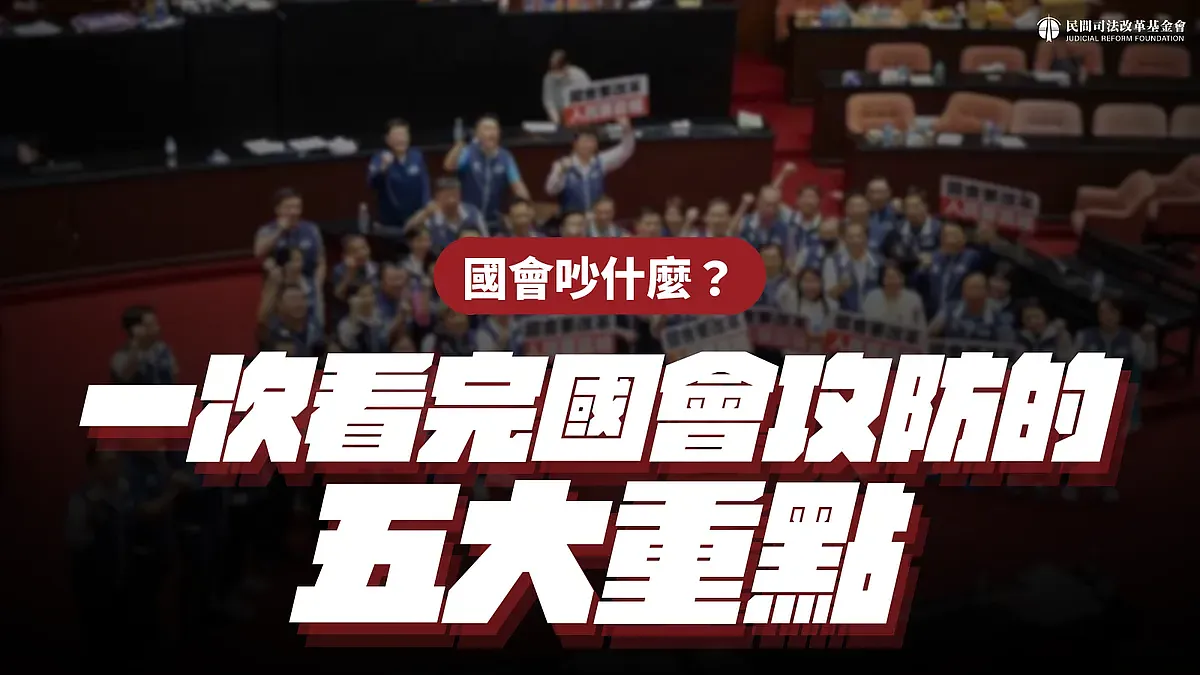
Q&A | What is the Dispute in the Legislative Yuan About? Five Key Takeaways on the Legislative Clashes
Last edited: 2026-07-27
(Updated at 17:00, May 22, 2024)
Last Friday (May 17), severe physical clashes broke out in the Legislative Yuan during a plenary session addressing bills such as "congressional reform," resulting in several legislators being injured and sent to the hospital. That evening, concerned citizens spontaneously gathered outside the Legislative Yuan. The session on that day lasted until 12 midnight, and continued deliberation on related bills took place on May 21 and 24. Below, we have compiled the five key takeaways regarding the legislative confrontations:
Q1: Is it true that regarding the congressional reform bills, legislators "never saw them beforehand, nor were they published online"?
This question should be examined by separating it into "drafts" and "amendment motions."
▍Regarding "Drafts"
The 24 draft versions proposed by individual legislators and caucus groups have all been published on the Legislative Yuan Bill Inquiry webpage. Taking this legislative revision as an example, by entering the keyword "Law Governing the Legislative Yuan's Power," one can review the drafts of the KMT, DPP, and TPP versions.
▍Regarding "Amendment Motions"
This part is more closely related to the congressional conflicts this time: Were the "(further) amendment motions" published? Was it a "black box"?
The so-called "amendment motion" refers to modification opinions proposed by legislators on the day of the plenary session regarding the original proposal, and its voting priority comes before the original proposal. An amendment to an amendment motion is a "further amendment motion," and its voting priority is even ahead of the "amendment motion." Therefore, one can see that in the parliamentary confrontation, both camps ultimately proposed "further amendment motions" to strive for priority voting, thereby delaying (the Green camp) or accelerating (the Blue and White) the voting progress.
Because "(further) amendment motions" are proposed on the day itself, the議事處 (Agenda and Proceedings Division) has not or could not announce them online. Upon receiving a proposal, the Agenda and Proceedings Division will print and compile physical agendas for all members, but this requires preparation time. Depending on the complexity of the bill and the volume of proposals, legislators may not necessarily have the latest "amendment motions" on hand during the meeting and discussion. Taking May 17 as an example, the time when legislators obtained the complete amendment motions (proposed by all three parties: the Democratic Progressive Party, the Kuomintang, and the Taiwan People's Party) was already that evening (the provisions of this amendment motion were scanned and uploaded in full text by Legislator Shen Pao-pan).
From the past to the present, when drafts are to be passed in third reading lacking consensus, many are handled by voting on the "(further) amendment motions" of various versions. However, in principle, (further) amendment motions are modifications targeting a few or specific provisions, rather than a method for proposing complete bills. Therefore, under the circumstance that this legislative revision was not thoroughly discussed in committees (see Q2 and Q3), the Blue and White camps synthesized the final version they wished to pass at the very last moment, and Legislator Huang Kuo-chang even claimed in a live broadcast the day before that the content of the final version was a "top secret," thus triggering severe controversy.
Q1-1: During the voting on provisions at the plenary session on May 17, why were not all versions read aloud? Is this allowed?
According to Article 9 of the Law Governing the Legislative Yuan's Power: "During the second reading, the bill shall be read aloud, and discussion shall be proposed sequentially or article by article." Therefore, all versions of proposals should be read aloud during the second reading. Under general circumstances, committee reviews will discuss which version of the provisions to adopt and synthesize a "provision passed by the review committee." Those without consensus are sent to caucus negotiation. During the caucus negotiation stage, various political parties integrate internal opinions and conduct negotiations on a caucus basis. In this regard, if committee review and caucus negotiation had been duly conducted this time, the 24 versions proposed by various parties could have been synthesized, and only the versions of the final 3 political parties would need to be voted on.
Taking the plenary session handling the "Stalking Prevention Act" on November 19, 2021, as an example, under circumstances where there was procedural consensus, the reserved provisions were directly read out before the second reading vote to save time. However, when handling the highly controversial "Labor Standards Act" (one fixed day off and one flexible rest day) on January 10, 2018, each original proposal, amendment motion, and further amendment motion was read aloud one by one. In the first few votes, the DPP caucus's further amendment motion was voted on and passed first, and other proposals were no longer voted on. After protests by opposition parties, the voting order was changed to be conducted according to the People First Party caucus, the Kuomintang caucus, and the Democratic Progressive Party caucus.
Regarding the situation this time, at 18:51 on May 17, the Legislative Yuan plenary session began article-by-article discussion, and parliamentary staff read out all versions of Article 2 (including the original proposal, amendment motion, and further amendment motion). Around 19:00, intense physical clashes broke out between the two sides, leading to Legislator Shen Pao-pan falling headfirst from a height due to tugging, resulting in an emergency hospital transfer. Because multiple DPP legislators fell and were sent to the hospital during the clashes, the President of the Yuan announced a recess. The meeting resumed at 19:52, and the reading of Article 2 was completed around 20:05. During this period, parliamentary staff spent about 25 minutes reading all proposals.
In order to pass the bill as quickly as possible, after the Kuomintang and Taiwan People's Party passed Article 2, they immediately proposed to "only read out the further amendment motion versions of each party caucus, and include all others in the gazette records," which was passed by vote. Consequently, during subsequent votes at the plenary session, other versions were no longer read aloud.
Q2: Is it true that the DPP proposed a draft, but it was not scheduled into the plenary session agenda?
It is true that the DPP version draft was not scheduled into the plenary session agenda this time.
The first scheduled review of the congressional reform bills this time was on April 1, and the DPP version draft passed the first reading in the plenary session on April 9. During the Judiciary and Organic Laws and Statutes Committee meeting on April 15, the rotating convener Wu Tsung-hsien of the KMT stated: The "reconsideration period" for the DPP version would not end until the 16th, and therefore it could not be reviewed concurrently on the 15th.
However, the regulation that "committees cannot schedule reviews during the reconsideration period" can actually be handled by rescheduling the meeting to April 17, or by asking various parties to sign a "consent form not to reconsider." The Blue and White camps abandoned this approach and refused joint review, which the DPP considered a malicious refusal to schedule the review.
Subsequently, DPP Convener Chung Chia-pin attempted to review the DPP version of the draft Law Governing the Legislative Yuan's Power on April 18. The meeting started at 9:00 a.m., but shortly after the afternoon session began, Convener Chung Chia-pin announced a recess to prevent Blue legislators from proposing to adjourn the meeting. Nevertheless, right after the recess ended at 17:30, a motion to adjourn was immediately proposed and passed. Chung Chia-pin continued to schedule related drafts for review on April 25, and when the meeting reached 17:08, a motion to adjourn proposed by Blue legislators was passed.
On April 26 and May 3, the DPP attempted to directly submit its proposal to the second reading stage during plenary session procedures and negotiate it concurrently with the Blue and White proposals, but both attempts failed to pass the vote.
Later, on May 6 and May 8, Convener Chung Chia-pin attempted to arrange a review of the DPP version of the draft Legislator Ethics Act. However, shortly after the meeting started, Blue legislators proposed a motion to adjourn, preventing it from being forwarded to the plenary session.
Q3: Is it true that the bill "was not substantively discussed at all"?
Regarding the provisions amended by the DPP, as mentioned earlier, due to reasons such as meeting time running out and adjournment during the discussion process, and the refusal to directly submit proposals to the second reading, they were not scheduled into the current agenda.
As for Fu Kun-chi's version and the TPP version drafts, when scheduled for agenda item-by-item review in the Judiciary and Organic Laws and Statutes Committee of the Legislative Yuan on April 15, Convener Wu Tsung-hsien, after reading out the provisions, asked the legislators present whether there were any objections to passing them according to the amended versions, and stated that any objections would result in reserving the provisions and sending them to caucus negotiation without opening them for discussion. This move triggered strong backlash from Green legislators, who subsequently proposed 40 motions to adjourn and 2 motions to censure Wu Tsung-hsien, all of which were jointly voted down by the Blue and White camps. Ultimately, all 15 cases reviewed on the 15th were reserved for negotiation without consensus, and in subsequent caucus negotiations, all parties also failed to reach a consensus.
In addition, the Legislative Yuan held 3 public hearings on congressional reform on April 3, 10, and 11, but these did not belong to "committee discussions."
Therefore, it is difficult to say that the drafts of the Blue, Green, and White parties were properly discussed article by article. The solution to this problem probably requires all parties to demonstrate sincerity in communication in order to fundamentally resolve it.
Q4: Is it true that "show of hands voting" allegedly violates the Legislative Yuan Parliamentary Practice Rules? Is it a sloppy voting method that has not appeared since 1989?
The reason why a show of hands voting was adopted in this plenary session was because the Kuomintang and Taiwan People's Party, in order to allow Legislative Yuan President Han Kuo-yu to preside over the proceedings and hold the meeting smoothly, had to prevent the DPP from occupying the podium. However, during voting, members must return to their seats to use voting machines and cannot continuously occupy the podium. Consequently, Kuomintang and Taiwan People's Party legislators adopted the method of occupying the podium while conducting a show of hands vote right where they stood.
Referring to Article 35 of the Legislative Yuan Parliamentary Practice Rules, it can be found that "show of hands voting" is indeed a statutory voting method. In addition, the same article also stipulates that the voting method to be adopted may be decided and directly announced by the President of the Yuan.
The Legislative Yuan plenary session only installed and began using voting machines in 1992, and since then, plenary session votes have almost exclusively used voting machines. From the current norm of Legislative Yuan plenary sessions, a show of hands vote is indeed quite an exceptional circumstance.
Voting by voting machine allows one to clearly know the voting intention of each member with a clear record. A show of hands vote requires relying on video recordings and immediate circumstances to confirm or infer members' voting intentions, and the Legislative Yuan Gazette cannot record members' voting intentions.
Q5: Were the two Hua-Tung construction cases actually going to be deliberated on the day of May 17?
Observing the agenda announcement of the day on the Legislative Yuan Proceedings and Gazette Information Network (after agenda modification), the brief table of discussion items below indeed contains the "Special Act Draft for Island-Wide High-Speed Rail Construction" and the "Special Act Draft for Hua-Tung Fast Highway Construction."
However, before May 16, there was a consensus in caucus negotiations that the Hualien transportation construction drafts would be handled after the new minister took office (for the meeting records of this part, please refer to the screenshot from Legislative Yuan Parliamentary Confrontation Techniques). Therefore, theoretically, the two Hua-Tung construction cases would not be discussed on May 17. However, amidst parliamentary confrontations lacking mutual trust and characterized by high conflict, the Kuomintang's scheduling of cases agreed not to be discussed into the plenary session may also have caused external concern and distrust, leading outsiders to believe that the Kuomintang intended to force these cases through.
In addition, the Taiwan People's Party proposed requiring the May 17 plenary session to deliberate until the completion of the 4th item, which was passed by vote, whereas the aforementioned two cases were respectively the 7th and 8th items.
This article is an AI-generated translation of the original Chinese text. In the event of any discrepancy, the Chinese version shall prevail.