
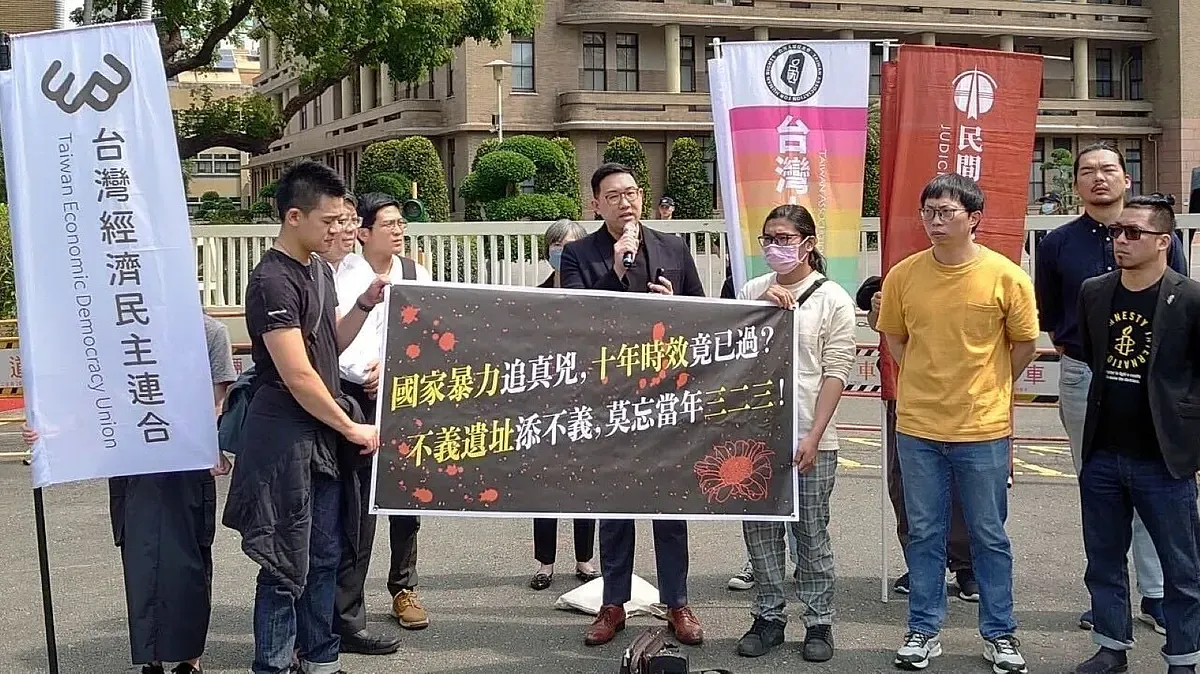
323 10th Anniversary Press Conference: Seeking the True Perpetrators of State Violence, Has the Ten-Year Statute of Limitations Already Expired?
Last edited: 2026-08-06
Seeking the True Perpetrators of State Violence, Has the Ten-Year Statute of Limitations Already Expired? Adding Injustice to Sites of Injustice, Never Forget March 23!
Around 7:30 PM on March 23, 2014, following the occupation of the Legislative Yuan, participants of the Sunflower anti-CSSTA movement gathered at the Executive Yuan to protest. Between 1:00 AM and 4:00 AM on March 24, they were dispersed by police officers using disproportionate violence and coercive measures. Judicial authorities ruled that the execution of the dispersal duties exceeded the principle of proportionality, and the state should bear national compensation liability. A primary resolution passed by the Legislative Yuan during the review of the central government general budget for fiscal year 2015 also demanded: "The National Police Agency shall be urged to investigate and penalize police officers who beat members of parliament and citizens." Furthermore, the Control Yuan's investigation report (112 Nei Diao 0015) issued on March 23, 2023, pointed out: "Investigation Finding 2: The National Police Agency has yet to penalize the derelict personnel."
According to Article 20 of the Public Functionary Discipline Act, the disciplinary statute of limitations for illegal and derelict acts by public functionaries is ten years for suspension, and five years for reduction of retirement benefits, demotion, salary reduction, fines, demerits, and warnings. Only the most severe punishments—dismissal, removal from office, and deprivation of retirement benefits—have no statute of limitations. However, the Economic Democracy Union recently commissioned Legislator Shen Bo-yang to make a written inquiry to the National Police Agency of the Ministry of the Interior, with the following results:
(1) The Taipei City Government's National Compensation Review Committee actually concluded that the commanders or sector commanders on the scene from the Taipei City Police Department and the Zhongzheng First Precinct "did not request dispersal or forced removal exceeding the principle of proportionality, nor did they request injurious acts such as striking with shields." Furthermore, because "courts at various levels conducted extensive investigations and were still unable to ascertain the specific identities of those few police officers," no recourse for compensation was sought from the actual perpetrators.
(2) The National Police Agency responded that "since more than five years have passed since the occurrence of this case, administrative disciplinary actions can no longer be additionally pursued."
Lai Chung-chiang, convener of the Economic Democracy Union Think Tank, expressed deep grief over the perfunctory attitude of "officials shielding officials" demonstrated by both the central and local governments. The Chinese Nationalist Party (KMT) government's authoritarian rule in Taiwan lasted for a long 47 years (from 1945 to 1992), making it difficult to investigate and hold accountable the actual perpetrators of state violence. Consequently, the Transitional Justice Act had to fill the deficiencies of transitional justice by designating "Sites of Injustice," and the Executive Yuan held the "Inauguration Ceremony for the Designation of Sites of Injustice" just this past 228 Peace Memorial Day. However, in 2014—long after Taiwan's democratization—large-scale state violence still occurred within the highest administrative organ, and despite demands for accountability from the legislative, judicial, and監察 (Control) branches of a democratic state, it remains unobtainable. After eight years under the Tsai Ing-wen administration following the rotation of political parties, accountability has still not been pursued for those involved. This is tantamount to state injustice after democratization, akin to committing state injustice once again upon the site of injustice at the Executive Yuan!
Lai Chung-chiang demanded that after taking office, Lai Ching-te's administration must within four years investigate and hold accountable the actual perpetrators of this state violence (under the Public Functionary Discipline Act, the punishments of dismissal, removal from office, and deprivation of retirement benefits have no statute of limitations); otherwise, there can be no ambiguity between democracy and authoritarianism, and the Executive Yuan should vacate its original office building, converting the original site into a National Injustice Memorial Museum. This would warn the world that democracy may regress and authoritarianism may return. It compels us to reflect on whether, after more than thirty years of democratization and multiple rotations of ruling parties, the bureaucratic system of "officials shielding officials" remains a forbidden zone for Taiwan's democratization.
Wei Yang, a party involved in the March 23 Executive Yuan incident, stated that ten years ago, after the Legislative Yuan was occupied, the administrative organs still failed to directly respond to the demands of the anti-CSSTA movement, which was why the crowd turned to the Executive Yuan to protest the government's abuse of power. Both March 23 and March 18 were exercises of civil disobedience. Wei Yang pointed out that the Executive Yuan incident not only re-enacted state violence, but the judicial accountability directed at participants also reflected authoritarian remnants. For example, regarding the charge of "inciting others to commit offenses" brought against him, as long as someone calls on society to protest the government's dereliction of duty, regardless of whether others subsequently respond, they may be accused of incitement—a clear suppression of the people's freedom of assembly and association with suspected unconstitutionality. Wei Yang emphasized that while the frontline police officers who used disproportionate force during the dispersal of the Executive Yuan incident should certainly be punished, pursuing state violence is not about making scapegoats of rank-and-file police officers, but about clarifying who ordered the violent dispersal. Where lies the responsibility of then-senior officials such as Ma Ying-jeou, Chiang Yi-huah, Fang Yang-ning, and Wang Cho-chiun? He hopes the truth will come to light.
Ch'en Yü-fan, chairperson of the Human Rights Committee of the Taiwan Bar Association, stated that Taiwan's authoritarian history shows that state violence is not an isolated incident, but the systematic use of police agencies and resources to violate people's rights—something regrettably still playing out in blood in modern, democratized Taiwan. Ch'en Yü-fan pointed out that the injuries sustained by the dispersed individuals during the Executive Yuan state violence incident were to their heads and faces; these are injuries that could never be caused by peacefully lifting away protesting crowds. The serious violation of the principle of proportionality was condoned by the government. Ch'en Yü-fan called on the incoming Lai Ching-te administration to uncover the truth behind the Executive Yuan state violence incident, including who ordered the dispersal and who ultimately carried out the blows, vowing not to stop until the truth is brought to light.
Wang Hsi, deputy secretary-general of the Taiwan Association for Human Rights, stated that the police violence against citizens in the early hours of March 23 and March 24 at the Executive Yuan is one of Taiwan's most representative egregious cases in recent years, highlighting several aspects: First, the Assembly and Parade Act still designates the Executive Yuan as a restricted zone. Combined with factors such as political power struggles at the time, protestors at the Executive Yuan and Legislative Yuan faced differing degrees of police threats. Therefore, we continue to call on the Taiwan government to immediately amend the Assembly and Parade Act and delete the provisions concerning restricted zones. Second, accountability for police violence and state violence has completely failed. Whether through internal administrative controls or judicial remedies, both seem to turn a blind eye to the elephant in the room—that police officers clearly and brutally beat citizens, yet no one knows who they are. If even clarifying where responsibility lies cannot be done, how can society discuss reconciliation or prevent future violent law enforcement?
Speech by Huang Yu-chung (Member of the 318 Duty Lawyers Group)
The scenes of police inflicting violence and injury upon participating citizens on the night of March 23 ten years ago remain vivid today. Afterwards, instead of reviewing the excessive law enforcement of that night, the police further launched large-scale prosecutions against citizens, subjecting many people not only to the physical injury and psychological fear suffered that night, but also to the pressure of criminal prosecution. This was the triple trauma inflicted upon the people's bodies, minds, and national identity by state violence ten years ago.
Such tactics are essentially a re-enactment of the authoritarian ruling methods of the martial law era. Although there was a subsequent rotation of ruling parties, throughout President Tsai Ing-wen's eight years in office, cases of police excessive law enforcement have still occurred endlessly. Victims have included teachers, social workers, and migrant workers. Police still readily use violence, handcuffs, and even firearms against citizens. In judicial practice, it is also common for police to falsely accuse citizens of obstructing official duties, or to illegally collect and use personal data. All of the above indicate that the police power of the state apparatus has remained unchecked over the past few years, continuing to treat citizens as objects that can be treated roughly—a mindset vastly different from a so-called democratic and rule-of-law society.
Starting from that night of March 23 ten years ago, the JRF and the Taipei Bar Association not only organized a duty lawyers group to defend citizens' rights, but also devoted immense effort to compiling text and image materials, attempting to explore the truth of that night through various channels including the courts, the Control Yuan, and the Legislative Yuan. The Taiwan Association for Human Rights also specially compiled and published an Anti-Riot Manual for Protests in response to the state violence of March 23, allowing citizens participating in street movements to learn how to protect themselves. Yet now, ten years later, a new president is about to take office, but the state apparatus remains passive and silent on this issue. For the injured citizens, cooperating activists, supporting duty lawyers, and other members of civil society, the causal relationship and attribution of responsibility for that night—from the administrative decisions made by the president, the Executive Yuan, and the National Police Agency to the occurrence of state violence on the scene—remain completely unknown.
What we want to know today is: When will the DPP, which has long prided itself on fighting against dictatorial rule, stop isolating the public from the truth of that March 23 night during its upcoming term in office? When will it investigate and reform the police system, where authoritarian shadows and a culture of violence are deeply intertwined?
The Sunflower Movement is not a stage for specific individuals, nor is it a shortcut for the DPP to return to power. It is the cry of the people of Taiwan against state injustice, an intuitive reaction by the people of Taiwan to execute their democratic will. If those in power truly hear the voices of the people and truly receive the will of the people, please promptly give the victims of the Sunflower Student Movement a fair and transparent truth, disclose the detailed information of the state violence event on the night of March 23 ten years ago from decision-makers to executors, and conduct appropriate investigations and disciplinary actions. Today, on its tenth anniversary, we demand that those in power start from the factual truth of the night of March 23, engage in an open and transparent dialogue with the people, and jointly build the autonomous space of civil society and cultivate the fertile soil of democracy. This is precisely the democratic value defended by the people of Taiwan in the Sunflower Movement ten years ago.
Statement by Amnesty International Taiwan
Tenth Anniversary of Police Violence Against Sunflower Movement Activists: Taiwan's Government Still Fails to Fully Protect the Right to Peaceful Assembly. From the evening of March 23 to the early hours of the following day, 2014, multiple activists participating in the "Sunflower Movement"—Taiwan's anti-CSSTA movement—suffered violent attacks by police officers while gathering to protest at the Executive Yuan. Ten years later, many police officers who engaged in improper law enforcement have still not been held legally accountable. Amnesty International Taiwan issues this statement declaring that the government's connivance and shielding of police violence violates international human rights law regarding the protection of the right to peaceful assembly, and is no different from the practice of authoritarianism. A 2013 [Note: 2023] investigation report by the Control Yuan pointed out that multiple activists engaged in peaceful demonstrations such as sitting in place and forming human chains were attacked by riot police using police equipment such as batons and shields. The number of citizens injured and sent to the emergency room alone was nearly four times the police's statistics, meaning the number of injured citizens was severely underestimated. Rulings by the Taipei District Court and the Taiwan High Court also confirmed that there were indeed facts of citizens being violently beaten, exceeding the principle of proportionality.
During the investigation stage, the then-Executive Yuan and the Taipei City Police Department either lost files, failed to conduct evidence collection video recordings, or submitted unrelated audio-visual files, making it difficult for judicial authorities to investigate the process of police beating citizens and hold the perpetrators of violent law enforcement accountable. Even though some assaulting police officers were clearly documented by civil society with identifiable faces and violent actions, the National Police Agency has not only failed to discipline the derelict personnel to this day, but only a single squadron leader received two demerits. Although the Public Functionary Discipline Act still provides channels for disciplinary actions without a statute of limitations, the National Police Agency recently refused to cooperate with further investigations and punishments on the grounds that "more than five years have passed, and administrative disciplinary actions can no longer be additionally pursued."
This article is an AI-generated translation of the original Chinese text. In the event of any discrepancy, the Chinese version shall prevail.