
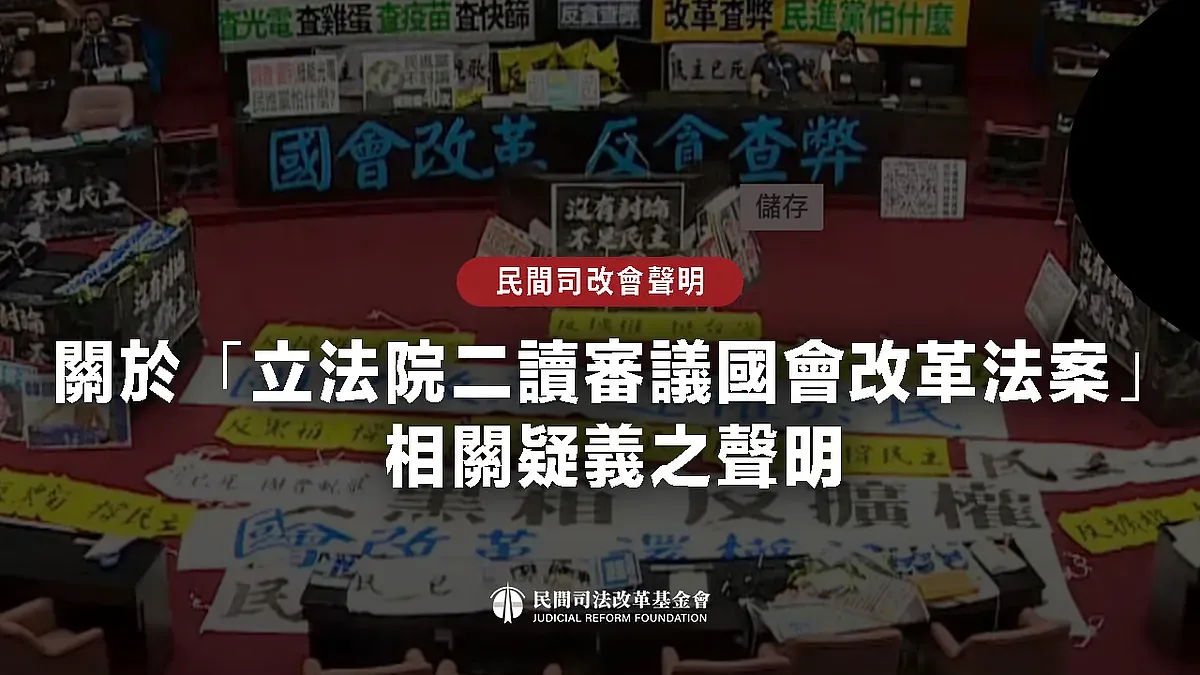
Statement | Statement Regarding Concerns Over the Legislative Yuan's Second-Reading Deliberations on the "Congressional Reform" Bills
Last edited: 2026-07-27
Updated at 22:08 on May 28, 2024: Provisions concerning the Act Governing the Legislative Yuan's Power have passed their third reading, and the text below reflects the passed provisions. Deliberations on the Criminal Code are still ongoing.
Regarding the joint introduction of draft amendments such as the Act Governing the Legislative Yuan's Power by the Kuomintang (KMT) and the Taiwan People's Party (TPP) at the very last minute via "counter-amendment motions," this Foundation issued a statement on May 21 pointing out their procedural flaws and demanding that all political parties flying the banner of congressional reform lead by example.
Nevertheless, leveraging their majority in the legislature, the KMT and TPP insisted on proceeding with a clause-by-clause vote on their proposed version to complete the third reading on May 22. In response, the Democratic Progressive Party (DPP) caucus has publicly stated that if the KMT and TPP insist on completing the third reading of the bills, it does not rule out filing for a constitutional litigation over the passed legislation.
Given that the provisions in question involve significant public interest and have not undergone substantive discussion, this Foundation, as a civil society organization long dedicated to judicial reform and other legal affairs, has a responsibility to publicly raise concerns regarding each provision and offer our comments one by one. Upon examining the version jointly proposed by the KMT and TPP, we have found that it indeed raises numerous concerns of violating legal principles and even the Constitution. Therefore, should the DPP caucus file for constitutional litigation and provisional measures, certain provisions in the versions of the KMT and TPP are indeed at risk of being declared unconstitutional, which would further exacerbate confrontation between the ruling and opposition parties and political chaos.
Because the lengthy voting process prevented the legislative majority from completing the second-reading procedure today, the strong backlash from civil society has already triggered protests with 100,000 citizens gathering around the Legislative Yuan. In response, this Foundation solemnly makes the following two appeals:
1. The KMT and TPP must squarely face the fact that their proposed bills raise numerous procedural and substantive concerns of unconstitutionality and illegality, and immediately halt further floor deliberations and voting.
2. The three major parties in Congress should recognize the public's earnest expectations for congressional reform and negotiate appropriate bill deliberation procedures and passage schedules.
I. Five Major Issues with the Crime of Contempt of Congress
Article 141-1 of the Criminal Code (KMT-TPP Counter-Amendment Motion Version): A public servant who, when hearing or being questioned at the Legislative Yuan, makes a false statement regarding a matter of material relevance known to them, shall be sentenced to imprisonment for not more than one year, short-term detention, or a fine of not more than NTD 200,000.
Concerns Regarding the Provisions:
1. Coercive measures in the exercise of investigative powers risk exceeding Grand Justices' Interpretations
Paragraph 2 of the Reasons of Grand Justices' Interpretation No. 585 states: "The methods for the Legislative Yuan's exercise of its investigative powers are not limited to the right to review documents—which entails requesting relevant agencies to provide reference materials related to matters involving the Legislative Yuan's exercise of powers or checking original documents from relevant agencies; when necessary, it may also, through a resolution of the plenary session, require people or government personnel related to the matters under investigation to testify or express opinions, and impose reasonable coercive measures against those who violate the obligation to assist in investigations, within the scope of imposing administrative fines..." Paragraph 27 of the Reasons states: "As for the coercive powers accessory to the Legislative Yuan's exercise of investigative powers, they shall be limited to the imposition of administrative fines." Therefore, regarding the coercive force that may be adopted for congressional investigative powers, it has been clearly deemed that it should remain "within the scope of imposing administrative fines (administrative penalties)." Consequently, using "criminal penalties" as a means in the draft risks exceeding the intent of the aforementioned interpretation.
2. The crime may be established simply during committee or questioning procedures
Questioning differs from hearings and investigations. However, this offense may be established simply when an "individual legislator" questions someone in a committee, without requiring a resolution by the plenary session. In this regard, if understood as the "crime of contempt of Congress," it raises the controversy of whether questioning by an individual legislator—which does not constitute an investigation—possesses sufficient authority to represent the legislature to warrant criminal punishment.
At the same time, if an administrative official's error in answering questions is caused by incorrect information or misleading provided by the questioning legislator, how should the administrative official's responsibility be assessed?
3. The absence of "swearing an oath" as an element of the offense raises doubts about how it operates
If its nature is considered to be the "crime of perjury before Congress," it should be analogized to the "crime of perjury." In this regard, it can be observed that it lacks the element where the actor "is required to swear an oath."
The problem with this design is that the situations it applies to include "being questioned," which does not fall under providing testimony to clarify facts. Conversely, if an oath-taking procedure is added, it would create the bizarre spectacle of all administrative officials having to swear an oath before participating in question-and-answer sessions at the Legislative Yuan. Whether implementing this institution conforms to the principles of mutual respect and equality between the executive and legislative branches is questionable.
Regarding the design of the questioning system, when an administrative official gives an improper response, holding them politically accountable in accordance with the principle of responsible government is the proper track for democratic political institutional design. This is the accountability method universally adopted by countries with questioning systems, which differs from the congressional investigative power system. To strengthen behavioral norms, pursuing administrative responsibility when civil service ethics are violated should be sufficient.
4. The investigation and clarification of legislative facts should follow the quasi-judicial procedure of hearings
When administrative officials are questioned at the Legislative Yuan, the matters inquired about span a vast array of topics. This is not a testimony procedure specifically designed for clarifying facts, and directly imposing punishment for perjury within such a procedure is inappropriate.
If facts relevant to the exercise of the Legislative Yuan's powers need to be clarified during the questioning process, they can also be investigated and clarified under due process of law through the quasi-judicial procedure of convening formal investigative hearings, with appropriate penalties subsequently imposed for false statements.
5. What constitutes "matters of material relevance" is difficult to foresee
Even though the punitive scope of this offense is limited to "matters of material relevance," it remains questionable whether it possesses sufficient legal clarity to enable the person being questioned to reasonably foresee it. For example, if an erroneous answer is given regarding important statistical data involving legislative facts, does this fall under "matters of material relevance"? Moreover, under the versions proposed by the KMT and TPP, the element of the crime is not based on "matters of material relevance to the exercise of the Legislative Yuan's powers," but rather on "matters of material relevance known to them (the public servant)." In other words, whether a crime is established is based on the public servant's subjective cognition of what is material, which is likewise vague and truly problematic.
II. Creating the Power to "Question the President," Which Exists Nowhere in the Constitution
Article 15-4 of the Act Governing the Legislative Yuan's Power (KMT-TPP Counter-Amendment Motion Version):
I. After the President concludes their state of the nation report, legislators may pose oral or written questions regarding matters that are unclear in the report.
II. When legislators conduct the aforementioned oral questioning, the President shall immediately answer in sequence; matters such as speaking time, number of speakers, sequence, and party proportions shall be determined through party caucus negotiations.
III. Regarding the written questions posed by legislators under Paragraph 1, the President shall reply in writing within seven days. However, if matters involve too broad a scope, an extension of five days may be granted.
Concerns Regarding the Provisions:
1. Our Constitution contains no provision allowing legislators to question the President
Our governmental system adopts a semi-presidential system. The President is directly elected by the people and appoints the Premier, who leads the cabinet team to be accountable to the legislature. The legislature may question cabinet heads in accordance with constitutional provisions.
Accordingly, both the President and the legislature possess independent democratic legitimacy. The President is not directly accountable to the legislature, and neither the Constitution nor the Additional Articles of the Constitution contain provisions allowing legislators to question the President. Comparing the use of "reporting" versus "attending to respond to questioning" in Article 4 of the Additional Articles of the Constitution and Article 67 of the Constitution respectively, it is also apparent that the constitutional framers intentionally stipulated that the President has no obligation to attend for questioning, and legislators have no power to question the President.
Therefore, requiring the President to "immediately answer" questions posed by legislators after concluding the state of the nation report conceptually appears to depart from the notion of a "state of the nation report" and essentially transforms into a form of "questioning," which seems to conflict with our constitutional system.
2. Neither the United States nor France limits oral responses to "immediate answers"
Although governmental systems vary across countries, nations with heads of state possessing independent democratic legitimacy can serve as institutional references for one another.
Taking the United States and France as examples, the U.S. Constitution requires the President to report on the state of the union to Congress from time to time, which gradually evolved into the convention of the President delivering an annual State of the Union address. The French Constitution stipulates that when exercising the power to deliver a presidential message, the French President has two options: submitting a written message or personally appearing before Parliament to speak. It is worth noting that to manifest the constitutional spirit—under either a presidential or semi-presidential system—that the President is not accountable to Parliament, neither the U.S. nor France adopts an "immediate answer" format for state of the union addresses, nor is there any institutional design allowing members of parliament to pose questions to or question the President.
III. Officials Being Questioned Can Do No Right, Can This Truly Foster Good Interactions Between the Executive and Legislative Branches?
Article 25 of the Act Governing the Legislative Yuan's Power (KMT-TPP Counter-Amendment Motion Version):
I. Responses to questioning shall not exceed the scope of the questioning, and counter-questioning is prohibited.
II. Except for avoiding obvious and immediate danger to national defense and foreign affairs, or matters that should be kept secret by law with the consent of the chairperson, the person being questioned shall not refuse to reply, refuse to provide information, conceal information, give false replies, or engage in other acts of contempt of Congress.
III. The person being questioned shall not be absent without the consent of the Legislative Yuan plenary session or committees.
IV. If a person being questioned violates the provisions of Paragraphs 1 to 3, the chairperson may stop them, order their attendance, and require the person being questioned to reply.
V. If a person being questioned still violates the rules after being stopped, ordered to attend, or required to reply by the chairperson pursuant to the preceding paragraph, a motion may be proposed by the chairperson or the questioning legislator, seconded or supported by five or more attending legislators, and upon resolution by the plenary session, the person being questioned shall be fined not less than NTD 20,000 and not more than NTD 200,000.
VI. In the circumstances of the preceding paragraph, if the party fails to correct the violation within a time limit, fines may be imposed successively for each violation upon expiration of the time limit.
VII. If the sanctioned party is dissatisfied with the fine disposition under the preceding two paragraphs, they may file an administrative lawsuit with the administrative court having jurisdiction over the location of the Legislative Yuan within two months starting from the day after the service of the disposition document.
VIII. Government personnel who violate the provisions of Paragraphs 1 to 3 shall, upon a proposal by the chairperson or the questioning legislator, secondment or support by five or more attending legislators, and resolution by the plenary session, be referred for impeachment or disciplinary action.
IX. Government personnel who make false statements when questioned at the Legislative Yuan shall have their criminal liability prosecuted in accordance with the law.
Concerns Regarding the Provisions:
1. Lack of clear standards risks exacerbating parliamentary conflicts
Regarding so-called "counter-questioning" or engaging in "other acts of contempt of Congress," the regulatory terminology is extremely vague. Furthermore, KMT legislator Wu Tsung-hsien (吳宗憲), when asked by the international media outlet Deutsche Welle on May 23, "What is the explicit definition of counter-questioning?", stated that "a detailed explanation will be provided after the legislation is completed to give a full account to the people nationwide." This shows that even the legislators leading the proposal do not know how to define legal terms such as "counter-questioning," "still violating after being required to reply," or "other acts of contempt of Congress." Such terms all violate the principle of legal clarity.
Moreover, situations where questions and answers involve classified matters and may not be answered are judged and decided on the spot by the chairperson, yet clear standards are likewise lacking. Therefore, in cases where the chairperson deems that intervention is necessary, the opposition and ruling parties may engage in endless disputes over the chairperson's parliamentary rulings. Whether this is appropriate for parliamentary operations is also questionable.
2. Disclosing classified matters should follow statutory procedures and is difficult to decide on the spot during oral questioning and answering
The disclosure of classified matters should follow statutory procedures, and the person being questioned may not necessarily have the authority to disclose them. Therefore, administrative officials will likely find it difficult to decide on the spot during oral questioning at the Legislative Yuan whether they may proceed with disclosure. When they cannot decide or find it difficult to decide, they face the risk of unilateral sanction; yet if they disclose the information, they may bear responsibility for violating confidentiality obligations. Caught in this dilemma, they fall into a conflict of duties.
3. Legislators may not necessarily possess the professional capacity to judge matters that should be kept secret
As a supervisory body, legislators hold a different stance from the questioned agencies under supervision, making it difficult to expect legislators to maintain an objective and neutral judgment regarding refusals to answer. Furthermore, whether a matter belongs to a category that should be kept secret is something individual legislators cannot be expected to all possess the professional capacity to judge. Sometimes, even to judge whether something is a classified matter, it is necessary to adopt certain confidential, non-public procedures. Under this concern, allowing legislators to unilaterally penalize administrative officials beforehand likely violates the principle of mutual respect and equality between the legislative and executive branches.
4. Difficulties regarding clear criminal liability
The concerns regarding the provision that "those who make false statements when questioned shall have their criminal liability prosecuted in accordance with the law" are identical to those regarding the crime of contempt of Congress under item "I."
IV. Flawed Design of the Hearing System Risks Being Abused in Actual Operation
Article 59-4 of the Act Governing the Legislative Yuan's Power (KMT-TPP Counter-Amendment Motion Version):
Government personnel or relevant persons from society related to the investigated matter who are invited to attend may, when necessary and with the consent of the chairperson, be accompanied and assisted by lawyers, relevant professionals, or other assistants.
Article 59-5 of the Act Governing the Legislative Yuan's Power (KMT-TPP Counter-Amendment Motion Version):
I. Attending persons in any of the following circumstances may refuse to testify or express opinions: 1. Classified matters of state involving national security, national defense, and foreign affairs. 2. Interrogations or confrontations raised beyond the scope of the hearing's investigative purpose. 3. Matters for which testimony may be refused in accordance with the provisions of the Administrative Litigation Act. 4. Personal privacy or other secrets protected by clear provisions of law.
II. Those who are absent without justifiable reason, refuse to express opinions, refuse to testify, or refuse to provide information may, upon a resolution of the Legislative Yuan plenary session, be fined not less than NTD 10,000 and not more than NTD 100,000, with fines being imposed successively for each violation.
III. If the sanctioned party is dissatisfied with the fine disposition under the preceding paragraph, they may file an administrative lawsuit with the administrative court having jurisdiction over the location of the Legislative Yuan within two months starting from the day after the service of the disposition document.
IV. Government personnel attending hearings who make false statements when testifying shall, upon a proposal by the chairperson or the questioning legislator, secondment or support by five or more attending legislators, and resolution by the plenary session, be referred for impeachment or disciplinary action.
V. Government personnel attending hearings who make false statements when testifying shall have their criminal liability prosecuted in accordance with the law.
VI. Relevant persons from society attending hearings who make false statements when testifying may, upon a resolution of the Legislative Yuan plenary session, be fined not less than NTD 20,000 and not more than NTD 200,000.
VII. If the sanctioned party is dissatisfied with the fine disposition under the preceding paragraph, they may file an administrative lawsuit with the administrative court having jurisdiction over the location of the Legislative Yuan within two months starting from the day after the service of the disposition document.
Concerns Regarding the Provisions:
1. The scope of subjects regulated is overly broad and needs further narrowing
Regarding provisions related to hearings, apart from government officials, the text stipulates that "relevant persons from society" may be invited to attend and may not refuse without justifiable reason, with violators subject to fines ranging from NTD 10,000 to 100,000. The term "relevant persons from society" is ambiguous in meaning and is not even restricted to persons related to the purpose of the hearing, raising concerns of being overly broad.
2. Lack of due process of law to protect invited attendees from non-attendance
The Legislative Yuan's exercise of investigative powers must be restricted to matters "substantially relevant to the exercise of the powers conferred upon it by the Constitution" (referencing Grand Justices' Interpretation No. 585). Therefore, to facilitate invited attendees in determining whether they have an obligation to attend, whether notifying citizens to attend meets the requirement of necessity for the investigation, and whether the questions asked during the investigation lack relevance or exceed the necessary scope, the notice of investigation must specifically record the purpose and scope of the specific bill (investigative purpose and scope).
However, the draft versions of both the KMT and TPP are entirely devoid of this, and there are no provisions regarding a review period, risking violations of due process of law and the principle of proportionality.
3. The exercise of the right to refuse testimony lacks standards and methods for determination
Regarding regulations on testifying at hearings, although grounds for refusal exist, standards and methods for determination are lacking. Furthermore, as to what procedure should be followed to submit the matter to a Legislative Yuan resolution when differences arise among various legislators regarding whether a witness at a hearing may refuse to testify, the provisions are likewise silent.
4. Lack of mechanisms to prevent abuse
In actual operation, this testimony mechanism risks degenerating into a situation where both sides engage in rhetoric, individuals are penalized for refusing to answer, and then seek relief at the administrative court. Aside from raising concerns about whether it is appropriate to transfer related political disputes to the courts for judgment, this design also lacks the strengthening of internal self-regulatory mechanisms within the Legislative Yuan. Furthermore, if a court "certifies" that the Legislative Yuan's penalizing resolution is improper, aside from the political responsibility of the majority party, are there self-regulatory mechanisms to prevent abuse?
5. Inadequate procedural protections for witnesses
The nature of the Legislative Yuan's hearing procedure is similar to the hearing procedure under the Administrative Procedure Act. Accordingly, under systematic interpretation, since Paragraph 1 of Article 24 of the Administrative Procedure Act stipulates that a party may appoint a lawyer as their agent, Article 59-4 of the second-reading version of the Act Governing the Legislative Yuan's Power instead stipulates that whether invited government personnel or relevant persons from society related to the investigated matter may retain a lawyer requires the chairperson's consent. This is a clear imbalance in the legal system and overtly infringes upon parties' right to assistance by counsel.
Some commentators argue that persons invited to attend all possess the status of witnesses, and therefore witnesses have no right to independently retain lawyers. However, persons invited to attend may also, due to their testimony at the Legislative Yuan hearings, become implicated in administrative illegality or even deemed suspected of criminal offenses. For example, the U.S. Congress has previously used the hearing system to gather criminal evidence regarding the Capitol riot that resulted in five deaths. Therefore, since invited government personnel or relevant persons from society related to the investigated matter may face the pursuit of administrative responsibility or even criminal liability, based on the due process of law under Article 8 of the Constitution and the core intent of Article 16 to protect the people's right to litigation, they have the right to independently retain lawyers, which should remain unaffected by whether the chairperson grants consent.
***
Congressional institutional reform is an important issue for democratic reform in our country, and this Foundation also supports the necessity of prompt reform and strengthening the legislature's ability to oversee the executive branch. However, amidst procedural flaws marked by a lack of dialogue and rushed voting, the slogan of "congressional reform" has gradually been cast under a shadow and may even cause public misunderstandings, thereby obstructing reform. The Taiwan Association for Human Rights / Taiwan Judicial Reform Foundation here reiterates the necessity of congressional reform and calls upon all political parties in the Legislative Yuan to engage in rational dialogue and refrain from passing highly controversial legislative content that has not undergone substantive discussion.
This article is an AI-generated translation of the original Chinese text. In the event of any discrepancy, the Chinese version shall prevail.