
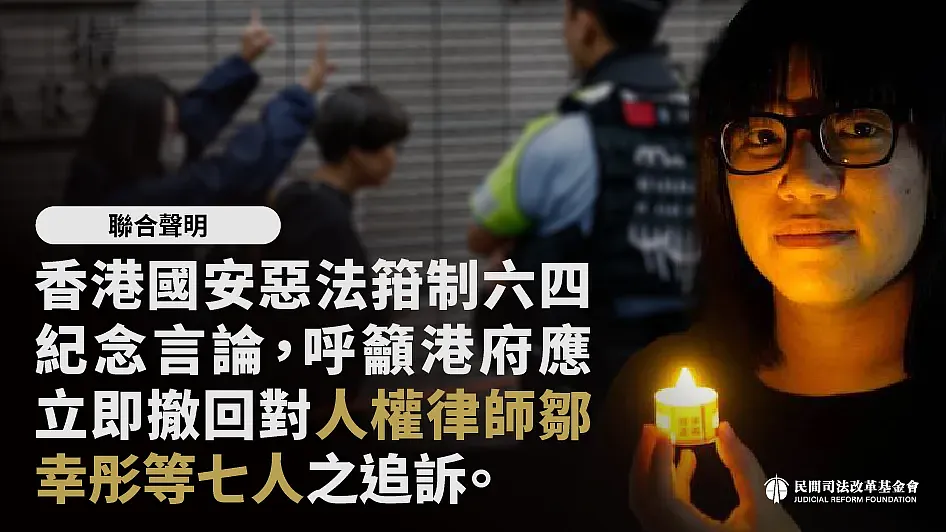
Joint Statement: Hong Kong's National Security Evil Law Suppresses June 4 Commemoration Speech – Urging the Hong Kong Government to Immediately Withdraw Prosecutions Against Human Rights Lawyer Ch'en Hsing-t'ung and Seven Others
Last edited: 2026-07-27
In response to the Hong Kong National Security Department's detention of human rights lawyer Ch'en Hsing-t'ung, her mother, and five other pro-democracy activists—totaling seven individuals—on May 28 and 29, 2024, under the Safeguarding National Security Ordinance (referred to as the National Security Ordinance) enacted pursuant to Article 23 of the Basic Law on suspicion of offenses with seditious intention, our organization issues this statement and puts forward three demands:
1. The Hong Kong government should immediately release the seven individuals and cease suppressing activities commemorating June 4.
2. The Hong Kong government should comprehensively revise the provisions of the Safeguarding National Security Ordinance that violate human rights.
3. Taiwanese society and government should continue to support the space for Hong Kong's democratic movement.
Case Update: On the eve of June 4, the Hong Kong government arrested Ch'en Hsing-t'ung's maternal uncle on the same grounds.
1. The Hong Kong government should immediately release the seven individuals and cease suppressing activities commemorating June 4
Barrister Ch'en Hsing-t'ung and six others were determined by the Hong Kong government (hereinafter the "HK Government") to have violated Article 24 of the National Security Ordinance—"offences involving seditious intention"—by publishing June 4-related information on the Facebook page "Chow Hang Tung Club". However, these accused posts merely shared textual and graphical experiences such as "participating in the June 4 vigil" and "visiting the Tiananmen Mothers." They did not contain a single mention of the slogan "redress the June 4 incident," nor did they call on people to attend June 4 rallies or spontaneously commemorate June 4. Being simple expressions of thoughts and reflections, they naturally should not constitute the "crime of seditious intention" intended to incite hatred or contempt against the Chinese or Hong Kong governments, which carries a maximum penalty of 7 years' imprisonment. Furthermore, if this case is determined to involve "collusion with external forces" (including Taiwan), the maximum sentence could be increased to 10 years.
Another worrisome aspect lies in Paragraph 3 of the same article, which stipulates that "a person who has in his possession without reasonable excuse any publication having a seditious intention commits an offense," carrying up to 3 years' imprisonment. This means that if ordinary Hong Kong citizens screenshot and save posts from the "Chow Hang Tung Club", they could face judicial persecution and even sentencing due to the expansive interpretation by the HK Government.
Civic organizations call upon the HK Government to immediately release Ch'en Hsing-t'ung and the other six individuals and withdraw the prosecution in this case. In particular, the HK Government should immediately release Ch'en Hsing-t'ung and put an end to the years of harassment and arbitrary deprivation of her personal and speech freedoms. Furthermore, apart from halting the unreasonable detention of the parties in this case, the HK Government should stop intimidating its own people and terminate the suppression of freedom of speech and assembly for commemorating June 4.
2. This arrest corroborates international skepticism regarding the legislation of Article 23 of the Hong Kong Basic Law; the HK Government should comprehensively revise the human rights-violating aspects of the National Security Ordinance
The HK Government's arrest of Ch'en Hsing-t'ung and the other six individuals marks the first time the HK Government has invoked the National Security Ordinance since it was gazetted and took effect on March 23, enacted pursuant to "Article 23 of the Basic Law." During the legislation of the National Security Ordinance, international communities issued stern warnings that its charges would be abused. By "weaponizing" the law, the HK Government continues to intensify its suppression of freedom of speech, using the sanctioning of dissidents to create a chilling effect in an attempt to extinguish the last remaining vitality of Hong Kong's civil society. Within a mere month of the National Security Ordinance taking effect, it has caused independent bookstores to close and even forced the Hong Kong bureau of Radio Free Asia, established nearly 30 years ago, to shut down. Even members of Hong Kong's Legislative Council, overwhelmed by pressure, have voluntarily removed social media pages commenting on current affairs.
Today, merely two months or so since the National Security Ordinance took effect, China and the HK Government have already begun using this evil law to eliminate free speech and purge civil society. In particular, they deliberately initiated the first-ever invocation of the National Security Ordinance right as the June 4 anniversary approached, attempting to kill the chicken to scare the monkeys and suppress any June 4 commemorative actions and speech.
This arrest undeniably corroborates the stern doubts expressed by international communities during the legislative process of the National Security Ordinance earlier this year. The National Security Ordinance contains glaring and severe flaws and loopholes in both litigation procedures and substantive elements. Procedurally, the National Security Ordinance hollows out the due process rights that detainees ought to enjoy; for instance, Article 79 restricts a detainee's right to choose a lawyer, and Article 80 restricts the right of detained or unarrested persons to seek legal advice. Substantively, the criminal charges are filled with vague and broad constitutive elements. Taking the definition of "seditious intention" under the offenses involving seditious intention in this case as an example, Article 23, Paragraph 2, Item b of the National Security Ordinance includes "an intention to bring into hatred or contempt against the constitutional order of the Special Administrative Region, or the executive, legislative or judicial organs thereof, among Chinese citizens, permanent residents of the Hong Kong Special Administrative Region, or persons in the Region." However, what exactly are "hatred or contempt"? How are they defined? What are the boundaries of their scope? The statutory provisions fail to define them. Such statutory provisions, lacking clarity and generating boundless interpretive space, pervade the entire National Security Ordinance. Even if judicial harassment proceedings run their course to the end, courts may not necessarily find a defendant guilty; yet, prior to a final acquittal, the physical and mental suppression suffered by defendants is sufficient to foster a chilling effect of self-censorship. Not to mention that Article 100 explicitly mandates that "any case involving national security shall be tried by a designated judge," casting grave doubt on the fairness and neutrality of court judgments.
Therefore, civic organizations call upon the Hong Kong government not only to immediately withdraw the prosecution against Ch'en Hsing-t'ung and the other six individuals, but also to comprehensively review the National Security Ordinance, amend the provisions pointed out in the United Nations Special Rapporteur's report as violating the Universal Declaration of Human Rights, the International Covenant on Civil and Political Rights, and the International Covenant on Economic, Social and Cultural Rights, cease eliminating dissidents under the guise of national security, and return a space of freedom and a home free of fear to the people of Hong Kong.
3. The extraterritorial effect of the National Security Ordinance will extend the scope of China's speech suppression to Taiwan and around the world, yet in the face of authoritarian expansion, Taiwan should continuously support the space for Hong Kong's democratic movement
Moreover, the scope of suppression under the National Security Ordinance is not limited to Hong Kong and mainland China; it extends worldwide.
In its preamble, the National Security Ordinance states: "Any institution, organization and individual in the Region shall abide by the laws in force in the Region for safeguarding national security and shall not engage in acts and activities that endanger national security, and shall, upon request by the aforementioned organs carrying out national security work in accordance with the law, provide assistance in accordance with the law." This explicitly extends the scope of law enforcement to any individual and organization in Hong Kong; even foreigners are caught within the strike zone of the National Security Ordinance as long as they are physically in Hong Kong at the time.
Aside from suppressing foreigners within its borders, Hong Kong people and organizations remain subject to the extraterritorial effect of the National Security Ordinance and find it difficult to speak freely even after leaving Hong Kong and heading overseas. For example, regarding "Division 4—Acts etc. with Seditious Intention" which Ch'en Hsing-t'ung and the seven others are accused of being involved in, pursuant to Article 28 of the National Security Ordinance, if an act committed outside the territory by any Hong Kong resident, body established in Hong Kong, or body with a place of business in Hong Kong would constitute an offense if committed within the territory, "that resident or body commits the offense."
This case proves that merely expressing online speech commemorating June 4 can lead to criminal charges carrying prison terms of 7 to 10 years, posing a severe threat to anyone, especially Taiwanese people and Hong Kongers in Taiwan. This follows the creation of extraterritorial jurisdiction under Articles 37 and 38 of the Hong Kong National Security Law on June 30, 2020, representing yet another transnational repression weapon added by the HK Government through the National Security Ordinance to ensnare both foreigners abroad and Hong Kongers overseas.
Even so, Taiwan must continue to support Hong Kong's freedom and democracy. This year marks the 10th anniversary of Taiwan's Sunflower Student Movement (318), as well as the 10th anniversary of Hong Kong's Umbrella Movement and the 5th anniversary of Hong Kong's Anti-Extradition Law Amendment Bill Movement. During those times, Taiwan and Hong Kong, as two active grounds for democratic movements, engaged in exchanges and provided mutual moral and practical support and encouragement. In the recent Bluebird Movement, Hong Kongers in Taiwan—despite facing severe threats—were not absent. Aside from individuals or groups of Hong Kongers participating in support, many Hong Kong-related civil organizations, including Hong Kong Outlanders, Taiwan-Hong Kong Association, and Taiwan Association for Human Rights Support of Hong Kong, supported the Bluebird Movement in their own ways. Civic organizations look forward to the Taiwanese government and general public continuing to provide the most steadfast moral support to Hong Kong. Furthermore, moral support must be translated into sustained practical action; the democratic movement is a long marathon, and only through continuous, steady perseverance can there be any chance of breaking free from authoritarianism.
As the June 4 anniversary approaches, everyone is invited to come to Liberty Square to commemorate, to stand with Hong Kong through action, and to support human rights activists worldwide who steadfastly uphold their convictions and defend freedom!
【June 4 35th Anniversary Vigil: Pursuing Democracy without Fear or Favour. Ideals are bullet-proof】
Date|June 4, 2024
Time|18:40
Location|Liberty Boulevard, Chiang Kai-shek Memorial Hall
Statement Contact Person
Judicial Reform Foundation, Attorney Huang grace.huang@jrf.org.tw
List of Co-signing Organizations
Judicial Reform Foundation
Taiwan Association for Human Rights Support of Hong Kong
April 24 Education Foundation
China Democracy College Association
Network of Chinese Human Rights Defenders (Covenants Watch)
Chen Wen-chen Memorial Foundation
Taiwan-Hong Kong Association
Taipei Bar Association Human Rights Committee
Taiwan Bar Association Human Rights Committee
Taiwan Alliance for Advancement of Human Rights - Tibet
Taiwan Association for Death Penalty Abolition
Taiwan-Hong Kong Democracy Guardian Group
Taiwan Labour Front
Taiwan Association for Human Rights
Hong Kong Outlanders
Global Greens Taiwan
Taiwan Association for Parents and Children Co-learning Education
Taiwan Yung-Society
Lady Liberty Hong Kong
ACAT Germany (Action by Christians for the Abolition of Torture)
Federal Association of Vietnamese Refugees in the Federal Republic of Germany
Transitional Justice Working Group (TJWG)
(Signatures are still being collected; welcome to join)
This article is an AI-generated translation of the original Chinese text. In the event of any discrepancy, the Chinese version shall prevail.