
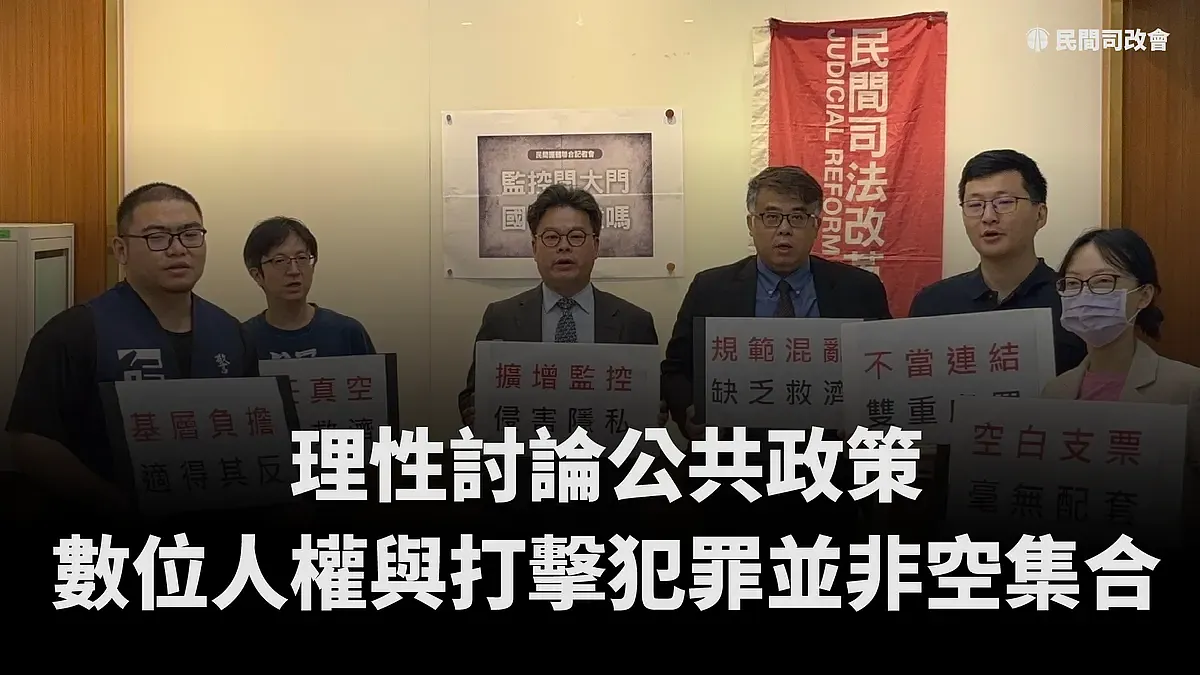
Statement | Rational Discussion of Public Policy: Digital Human Rights and Combating Crime Are Not Mutually Exclusive—JRF’s Response to Comments by "Prosecutors for Reform"
Last edited: 2026-07-27
Yesterday (June 5), "Prosecutors for Reform" issued a statement claiming that our Foundation's expression of views on the legal framework for technological investigation "attempts to recklessly obstruct it, fundamentally disrupting the nation, acting akin to protecting fraud syndicates and effectively becoming accomplices," and that "such actions are no different from harming the judiciary and forfeiting the rights of victims."
The aforementioned statement by "Prosecutors for Reform" failed to carefully examine the demands made in the joint press conference held on the 4th by our Foundation alongside the Taiwan Police Rights Association, the Judicial Reform Committee of the Taiwan Bar Association, the Taiwan Association for Human Rights, and the Open Culture Foundation. It clearly lapsed into emotionalism and involved personal attacks, falling short of the standards of rational debate expected in a public forum. Our Foundation feels this is highly inappropriate and deeply regrets it. However, as related coverage may still draw public attention to this legislative amendment, our Foundation hereby responds to relevant concerns regarding the amendment as follows:
Our Foundation and the aforementioned NGOs jointly held the "Opening the Floodgates to Surveillance: Does Parliament Consent?" joint press conference (press release and livestream video available at this link), aimed at calling upon relevant authorities not to overlook human rights protections while combating crime, and offering recommendations on problematic provisions in related drafts in the hope that Parliament will strictly vet and clarify these issues.
To be clear, our Foundation did not directly express opinions on the Act for Technological Investigation and Protection during the press conference. In fact, regarding technological investigation methods such as GPS tracking and IMSI-catchers, our Foundation also supports their use by prosecutors and police under appropriate control mechanisms to crack down on crimes. To this end, our Foundation has long held meetings to deliberate on a civil society version of the draft and organized seminars; during the Executive Yuan's drafting process, we also formally communicated our views on the amendments to the authorities on multiple occasions to jointly foster a comprehensive legal system. Based on the responsibility of NGOs to monitor the government, it is natural to raise different opinions regarding parts of the draft deemed concerning, and the content is rightfully subject to public scrutiny.
Taking Articles 3 and 11-1 of the Executive Yuan's draft amendments to the Communication Security and Surveillance Act as an example, they authorize prosecutors and police to retrieve "internet traffic records" from a suspect's mobile phone when it is necessary and relevant to a criminal investigation. According to statistics published by the Ministry of Justice in 2023, as many as 94% of case lines were directly retrieved by prosecutors' (consent), while less than 6% of cases involved applications for court approval.
In other words, the vast majority of cases have not been reviewed and vetted by the courts, nor are the subjects of retrieval notified afterward. However, compared to "user data" or "communication records" previously retrieved via the same methods, the "internet traffic records" proposed for retrieval in this legislative amendment carry far more information and privacy implications.
According to the definition in the draft, the concept of "internet traffic records" corresponds to the "digital footprints" left by users when browsing the internet on mobile phones and personal computers. This includes "device identification data," "internet IP addresses" (which may allow one to infer a home location if fixed broadband is used at home), "what websites were visited at what times and how long one stayed," "clicking from website A to a link into website B and then viewing website C," or "which apps were used at what time." These digital footprints are detailed enough to piece together a person's life, behaviors, habits, and even personality, thoughts, and political preferences.
At the same time, Article 3-1 of the draft adopts an open-ended definition, using "examples" rather than explicitly listing a specific scope. Its nature—that it should not involve "communication content"—is only explained in the legislative reasoning. Such a legislative approach runs counter to the legislative purpose emphasized by the amendment: "limiting data types for the sake of clarity." Since the Executive Yuan also acknowledges that clarifying the scope of retrievable digital footprints is quite important, this part certainly has room for review. Furthermore, important matters such as the retention period, retrieved items, and supervision methods for these data are only summarily delegated to subsidiary legislation. Whether the density of this statutory reservation is sufficient is also open to question.
The purpose of public dialogue is to seek the truth, not to engage in factionalism! Our Foundation expects all sectors of society to express concrete arguments on the opinions regarding the "Four Anti-Fraud Bills" based on a rational, issue-focused attitude, effectively cite evidence, and understand each other's positions to jointly promote the improvement of the legal system. We also call upon the Legislative Yuan during its deliberation to synthesize opinions from all sectors, clarify doubts, and make up for omissions, thereby improving investigation methods for prosecutors and police and enhancing the government's crime-prevention capabilities under the premise of safeguarding people's rights.
This article is an AI-generated translation of the original Chinese text. In the event of any discrepancy, the Chinese version shall prevail.