
Op-Ed | June 26 International Day in Support of Victims of Torture: How Much Longer Must We Wait for the Convention against Torture?
Last edited: 2026-07-27
When faced with violence inflicted by others, we may still have a shred of strength to fight back or resist. However, if the state is the one inflicting the violence today, what do we have to contend with it?
June 26 is the "International Day in Support of Victims of Torture." This year also marks the 40th anniversary of the adoption of the United Nations Convention against Torture. Taiwan prides itself on being a rule-of-law nation founded on human rights, and we naturally assume that torture and prisoner abuse have long since become things of the past. However, recent frequent occurrences of police abuse of power and violent law enforcement cannot help but make us reflect: is "torture" simply hiding deeper?
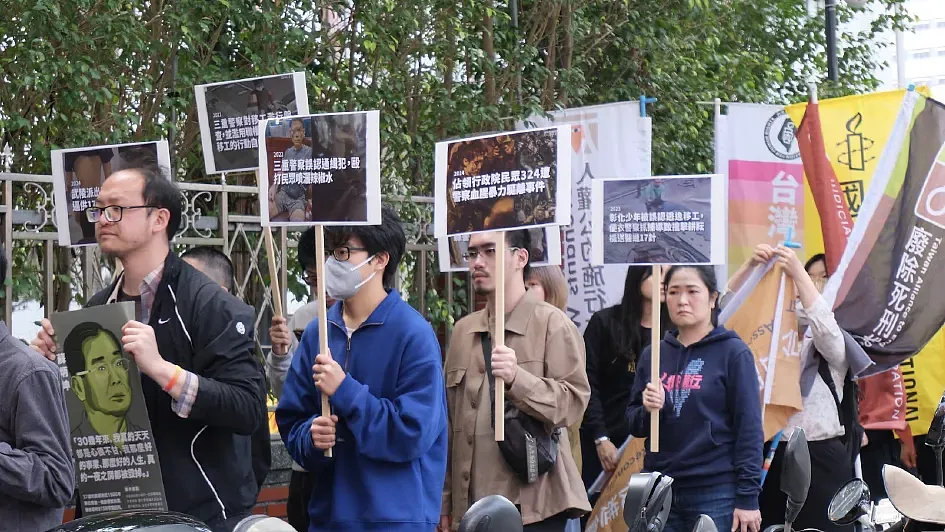
In February of this year, officers at the Pingtung County Police Bureau allegedly beat a suspect during law enforcement, resulting in the suspect's suspected death; just days later, officers from the Wuling Police Station collectively tortured a 17-year-old youth who happened to walk past the police station, without any concrete evidence. Coincidentally, in both cases, the police "happening" failed to turn on their body-worn cameras during law enforcement.
Looking back at widely known instances of police overreach in recent years: a youth in Changhua was suddenly grabbed and injured by plainclothes police simply because his appearance was mistaken for that of an escaped migrant worker, requiring 17 stitches (July 2023); Sanchong police mistook a citizen for a wanted person, beating them and spraying pepper spray, causing multiple injuries (September 2022); Zhongli police unlawfully stopped and questioned a music teacher, putting her in a headlock and handcuffing her (April 2021); and Kaohsiung Prison guards led inmate trusties in abusing a prisoner, beating him to death (October 2019). In fact, a 2020 research report by the Central Police University pointed out that between 2015 and 2020, there were 56 news reports regarding improper police law enforcement that may have constituted cases of torture and other ill-treatment.
This reflects two major problems:
First, our nation's police system suffers from issues requiring a comprehensive review. For instance, the police system's long-standing "unreasonable performance requirements" often leave frontline officers running ragged and even driving them to take risks and enforce the law through illegal means. The aforementioned cases of improper stops and searches, police misidentifications and beatings, and the suppression of citizens on the streets all highlight the pressing need to review and improve the police performance evaluation system and the legalization of related principles.
Second, from the early forced confessions and even wrongful executions of defendants in miscarriages of justice such as Chiang Kuo-ch'ing (江國慶), Su Chien-ho (蘇建和), and Chiou Ho-shun (邱和順), to the recent numerous cases of police overreach and human rights violations, all of these consistently demonstrate that the state must squarely face the importance and urgency of a "mechanism for the prevention of torture."
"Torture" has existed in human society for thousands of years. People have devised many novel, ingenious yet excruciatingly cruel methods to inflict pain on others and enjoy the process of abusing them. Even in medieval and early modern societies, "torture" was a legally legitimate practice and morally permissible. Yet, "torture" is an extreme act of cruelty, high humiliation, and trampling of human dignity in human society, often causing irreversible and untreatable physical and mental trauma to its victims.
The United Nations Convention against Torture was adopted by the UN General Assembly on December 10, 1984, and officially entered into force on June 26, 1987. June 26 was subsequently designated as the "International Day in Support of Victims of Torture." Although modern society appears to abhor "torture," all over the world, including in today's Taiwanese society, inhumane "torture" continues to be enacted time and again amidst desperate screams and wails in many unseen corners.
The Executive Yuan completed the draft of the "Enforcement Act of the Convention against Torture" in 2018, domesticating the Convention and its protocols to fulfill related regulations and state obligations, and submitted it to the Legislative Yuan for deliberation in hopes of aligning with international human rights standards. Regrettably, it subsequently failed to pass the third reading in the Legislative Yuan and fizzled out.
Six years later today, the aforementioned multiple cases of improper law enforcement and state violence make us realize that "torture" has not yet faded away in Taiwan. To prevent future victims from having silent cries for help and nowhere to seek compensation, the "Enforcement Act of the Convention against Torture" remains necessary and urgent. If Taiwan can swiftly pass the "Enforcement Act of the Convention against Torture" and establish an independent national preventative mechanism against torture at the state level to ensure that all agencies rigorously implement the provisions of the Convention, it may finally complete the missing puzzle piece in our nation's human rights protection.
Full text published in Up Media on June 26, 2024
This article is an AI-generated translation of the original Chinese text. In the event of any discrepancy, the Chinese version shall prevail.