
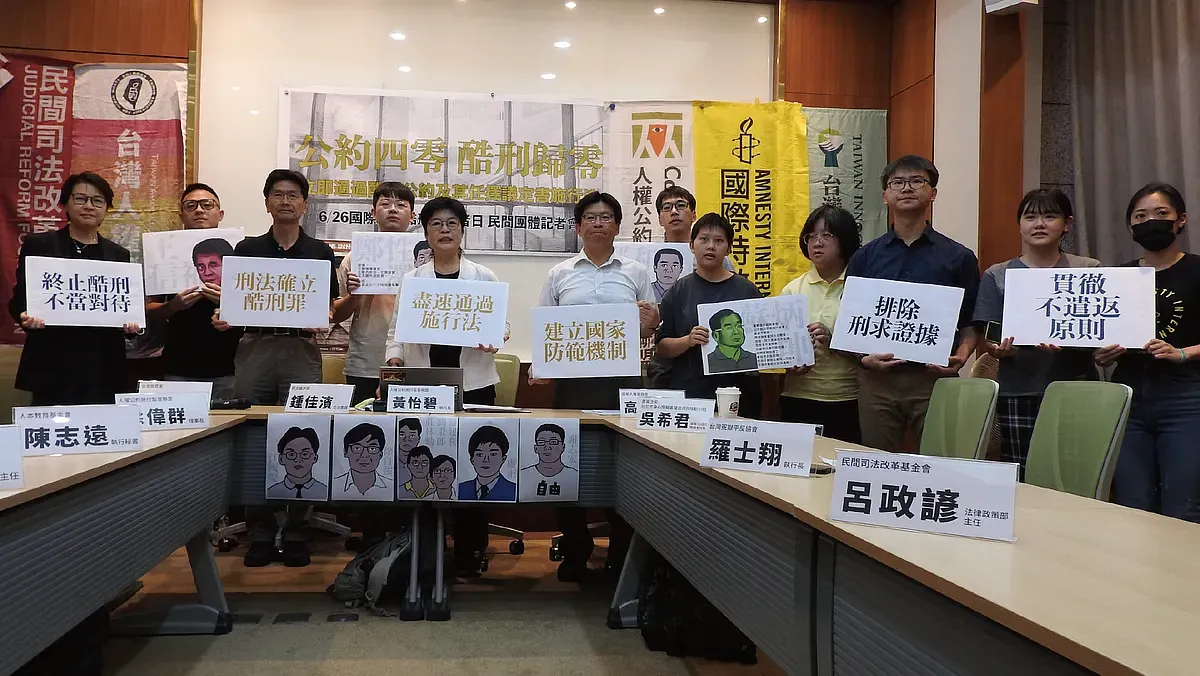
Civil Society Organizations Press Conference | Convention Zero, Zero Torture: Immediately Pass the Enforcement Act of the Convention against Torture and Other Cruel, Inhuman or Degrading Treatment or Punishment and Its Optional Protocol
Last edited: 2026-07-27
This morning (June 26), seven civil society organizations including the Covenants Watch, alongside victims of human dignity humiliation and mistreatment by medical institutions, National Human Rights Commission members, and legislators, held a press conference to mark the "International Day in Support of Victims of Torture." They once again strongly urged the new government and the new parliament to swiftly pass the "Enforcement Act of the Convention against Torture and Other Cruel, Inhuman or Degrading Treatment or Punishment and its Optional Protocol" and establish a National Preventive Mechanism (NPM) to eradicate torture. Beyond passing the enforcement act, the government must also, in accordance with the Convention, uphold the principle of non-refoulement, criminalize torture, punish perpetrators, provide remedies and compensation for victims, and establish an anti-torture task force under the Executive Yuan responsible for coordinating and supervising competent authorities to end torture.
#Taiwan Lacks Active and Effective Actions to End Torture
We may pride ourselves on Taiwan's reputation as a benchmark for democracy and human rights in Asia, remaining quite confident in our human rights situation and believing that administrative, medical, nursing, or educational personnel would not arbitrarily inflict physical or mental pain on detainees, residents, or students. In reality, however, understanding the torture and ill-treatment occurring in places where freedom is restricted—such as disability or psychiatric care institutions, child placement or educational institutions, prisons and detention centers, and detention or placement facilities for non-nationals—through media or Control Yuan investigation reports is like viewing a leopard through a tube. Taiwan needs legislation to establish the definitions, content, criminal liability, and remedial mechanisms for torture and ill-treatment, and it also needs a National Preventive Mechanism to proactively visit places where individuals are deprived of liberty. Through prevention, improvement, accountability, and remedy, Taiwan can become a society where everyone lives with dignity.
Hsu Wei-kuan (徐偉群), Chairperson of the Covenants Watch and a key promoter of human rights conventions and mechanisms, pointed out that Taiwan continuously delays the legislation of the Enforcement Act of the Convention against Torture. Torture is internationally recognized as one of the gravest crimes and is prohibited under the Universal Declaration of Human Rights and the ICCPR. The Tsai administration twice submitted enforcement act drafts that ultimately failed. The new government and the new parliament should take more proactive actions to end torture, including passing the enforcement act to clearly define, identify, and criminalize torture, and establishing a substantially effective National Preventive Mechanism. The National Human Rights Commission should simultaneously launch a systematic national inquiry into torture to promote and protect human rights.
#Stop Torture and Ill-Treatment in Medical and Educational Institutions
Wu Hsi-chun (吳希君), a psychosocial disability representative on the Taipei City Rights Promotion Panel for Persons with Disabilities and a member of Fountain House, shared instances of torture and ill-treatment in medical institutions based on her hospitalization experiences in various hospitals. In a single-person isolation room lacking washing facilities or a toilet and lit 24 hours a day, she spent two days confined inside. Isolation rooms cut people off and do not aid emotional recovery, yet she was subjected to forced medication. Experiences such as the emergency bell in the ward bathroom being broken—forcing her to live amidst waste—and being forcibly separated from her children upon admission left her disappointed and traumatized, causing lingering fear to this day. She called for alternatives that respect human dignity. Li Tzu-i (李姿儀), another member of Fountain House, also mentioned that during her hospitalization, she was threatened that if she cried from homesickness, she would be locked in an isolation room where temperatures were only 10-19 degrees Celsius, even causing her to catch a cold; the treatment was worse than that in prison.
Chen Chih-yuan (陳志遠), Executive Secretary of the Association for the Promotion of Humanistic Education, stated that when thinking of children's and youths' rights, one intuitively thinks of the Convention on the Rights of the Child, but in certain cases, "torture" is the only word that suffices to describe these atrocities. For instance, teacher Tsai at Youth Junior High School subjected students to massive corporal punishment, humiliation, violent attacks, and sexual bullying, while the Education Bureau's investigation mechanism failed to promptly identify and address campus violence and improper discipline. Similarly, Ching-Hsi Junior High School, the National Taiwan College of Performing Arts, and a special education school in southern Taiwan have repeatedly witnessed campus torture and ill-treatment. Executive Secretary Chen called on the government to not only fulfill its obligations under the Convention on the Rights of the Child but also domesticate the Convention against Torture to concretely address campus torture and ill-treatment incidents.
#Eradicate Torture in Judicial Proceedings and Provide Compensation
Lo Shih-hsiang (羅士翔), Executive Director of the Taiwan Innocence Project, directly pointed out that "torture" and "extorted confessions" were major characteristics of past miscarriage-of-justice cases in Taiwan, such as the Cheng Hsing-tse (鄭性澤) case and the Su Ping-kun (蘇炳坤) case. Cheng Hsing-tse was tortured and interrogated by police, forcing him to make a false confession, and was exonerated 11 years after his death sentence became final; however, the legal system failed to hold the law enforcement officers accountable for improper conduct or provide compensation, and his state compensation lawsuit was dismissed. Su Ping-kun was subjected to torture by police yet maintained his innocence, but was still convicted, only to be exonerated 32 years later. Executive Director Lo reiterated that torture causes immense physical and mental suffering to victims, which is difficult to erase even after exoneration, and called for the passage of the enforcement act and the establishment of a monitoring mechanism to build a torture-free Taiwan.
Lin Tzu-wei (林慈偉), Legal Advocacy Officer of the Taiwan Alliance to End the Death Penalty, cited General Comment No. 36 of the ICCPR to affirm that an increasing number of countries view the death penalty as a "cruel, inhuman, or degrading" punishment, and that executing individuals without notifying them of the execution date constitutes abuse. Most death row inmates in Taiwan have been imprisoned for nearly two or three decades, experiencing the "death row phenomenon" and facing severe physical and mental issues, with some dying from illness or suicide. Civil society organizations have long advocated for wrongfully convicted death row inmates Chiou Ho-shun (邱和順) and Wang Hsin-fu (王信福), and the physical and mental torment they have suffered is deeply concerning. Officer Lin analyzed suggestions from international experts, pointing out that if Taiwan continues to maintain the death penalty, it will be difficult to realize its vision as a shaper of human rights standards in Asia.
#Improve Administrative Procedures and Mechanisms to Prohibit Torture
Lu Cheng-yen (呂政諺), Director of the Legal Policy Department at the Judicial Reform Foundation, reviewed widely known police over-enforcement incidents over the past five years. He pointed out that the root cause lies in the unscientific and unreasonable performance evaluation requirements long maintained by Taiwan's police system, which exhaust frontline grassroots police officers and even drive them to take risks and enforce the law through illegal means; many of these actions even involve violations of the Convention against Torture. Director Lu once again called on the Executive Yuan to swiftly submit a draft enforcement act to improve human rights protections, provide remedies, and end torture. At the same time, the National Police Agency should establish a "Police Special Project and Performance Management Committee" to thoroughly review the police performance system and issues regarding improper police enforcement.
Lai Yen-jung (賴彥蓉), Refugee Issue Specialist at the Taiwan Association for Human Rights, criticized the government for failing to implement the ICCPR's "principle of non-refoulement." Due to the lack of a Refugee Act, asylum mechanisms, and border asylum windows, many high-risk cases are repatriated without assessment. Tibetans in Taiwan face deportation, having exhausted all remedies, due to detention condition determination procedures that lack transparency and consistency, and law enforcement officers having a superficial understanding of the history of the Tibetan exile. For overstaying foreigners, prolonged detention and the routine use of handcuffs during transfers are commonplace, and incomplete regulations are even utilized for solitary confinement, ignoring risk assessments and the necessity of such measures. Specialist Lai called for the implementation of the principle of non-refoulement and the improvement of detention conditions.
#Legislative Commitments and Administrative Measures for the Enforcement Act
Legislator Huang Shan-shan (黃珊珊) of the Taiwan People's Party recalled that the enforcement act draft was submitted to the Legislative Yuan twice in 2018 and 2020 but ultimately failed to pass. Among the UN core human rights conventions, besides the Convention against Torture, the International Convention for the Protection of All Persons from Enforced Disappearance and the International Convention on the Protection of the Rights of All Migrant Workers and Members of Their Families have also not yet been domesticated; currently, only a Control Yuan task committee handles related work. Legislator Huang acknowledged the necessity of legislation, noting that it must go through party caucus negotiations, and on behalf of the Taiwan People's Party committed that once the Executive Yuan submits a draft, it will be listed as a top-priority bill. She also pledged to integrate the versions proposed by the Taiwan People's Party and civil society organizations to facilitate counter-proposals and legislative discussions.
Legislator Chung Chia-pin (鍾佳濱) of the Democratic Progressive Party candidly stated that Taiwan's human rights practices still have room for improvement, and the prohibition of torture must be treated seriously. Starting from successfully supervising the Ministry of Justice to improve prison conditions, Legislator Chung further analyzed that situations involving arrests, state coercive powers, and compulsory actions are where torture and ill-treatment are most likely to occur. Therefore, conducting a more comprehensive review of existing laws and regulations will help realize the eradication of torture. For instance, before the enforcement act is enacted, administrative regulations can be used to implement and urge human rights protections. This is an issue the Legislative Yuan will simultaneously cultivate and advance.
▋Press Contacts:
Huang I-big (黃怡碧)|Executive Director, Covenants Watch 0935-456-272
▋Co-organizers:
Association for the Promotion of Humanistic Education, Covenants Watch, Taiwan Association for Human Rights, Taiwan Innocence Project, Taiwan Alliance to End the Death Penalty, Judicial Reform Foundation, Amnesty International Taiwan
▋Speakers:
Hsu Wei-kuan (徐偉群)|Chairperson, Covenants Watch
Chen Chih-yuan (陳志遠)|Executive Secretary, Association for the Promotion of Humanistic Education
Wu Hsi-chun (吳希君)|Member, Fountain House; Psychosocial Disability Representative, Taipei City Rights Promotion Panel for Persons with Disabilities
Li Tzu-i (李姿儀)|Member, Fountain House
Huang Shan-shan (黃珊珊)|Legislator, Taiwan People's Party
Lo Shih-hsiang (羅士翔)|Executive Director, Taiwan Innocence Project
Lin Tzu-wei (林慈偉)|Legal Advocacy Officer, Taiwan Alliance to End the Death Penalty
Chung Chia-pin (鍾佳濱)|Legislator, Democratic Progressive Party
Lu Cheng-yen (呂政諺)|Director of Legal Policy Department, Judicial Reform Foundation
Lai Yen-jung (賴彥蓉)|Refugee Issue Specialist, Taiwan Association for Human Rights
Kao Yung-cheng (高涌誠)|Member, National Human Rights Commission
This article is an AI-generated translation of the original Chinese text. In the event of any discrepancy, the Chinese version shall prevail.