
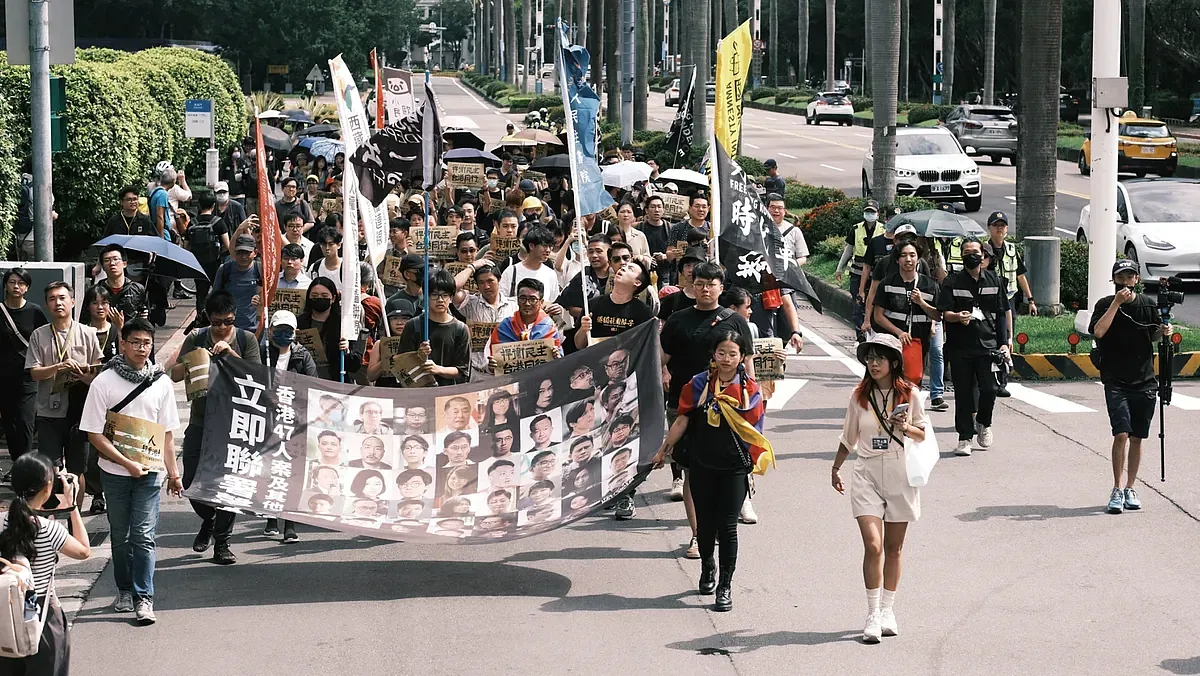
Mido's Statement|Hong Kong Freedom June 2024 Taipei March —— Defending Democracy, Taiwan and Hong Kong Hand in Hand
Last edited: 2026-07-27
Hello everyone, I am Mido, an advocacy officer at the Judicial Reform Foundation (JRF). In addition to Taiwan's judicial reform and wrongful conviction cases, JRF has also long monitored the human rights movement in Hong Kong. Since the outbreak of the Anti-Extradition Law Amendment Bill Movement in Hong Kong in 2019, JRF has expressed its support through various solidarity actions. Drawing especially from our experience in the March 18 Sunflower Student Movement in 2014, we all know that the most severe battleground lies after a movement ends—how to continue taking action so that the truth is not forgotten by time and the public. At this moment, Hong Kong is facing the Chinese and Hong Kong governments using "law" as a weapon to suppress freedom of speech. As an organization that has long focused on justice and human rights, JRF should stand up all the more to condemn the actions of the Hong Kong government.
In March of this year, the Legislative Council of Hong Kong passed Article 23 legislation in its third reading. Following the 2020 Hong Kong National Security Law, this further suppresses democracy and freedom of speech in Hong Kong under the guise of eliminating external forces, and serves to cut off Hong Kong's connections with the outside world, leaving Hong Kong people even more isolated and helpless.
Immediately following this in May, the representative song of the Anti-Extradition Movement, "Glory to Hong Kong," was banned by the High Court of Hong Kong from being disseminated on the grounds of being a "weapon endangering national security." This means the song has officially become the first banned song in Hong Kong, and individuals can be sentenced by the state for disseminating or possessing it.
Only about two months after Article 23 took effect, China and the Hong Kong government have already begun using this wicked law to eradicate free speech. In June, the Hong Kong police arrested eight people, including Hong Kong human rights lawyer Chow Hang-tung (Chou Hsing-tung), on charges such as inciting hatred on "sensitive dates." Because they posted information related to June Fourth on Facebook, these accused posts were merely simple shares of graphic and textual experiences such as "participating in the June Fourth vigil" and "visiting the Tiananmen Mothers," without even mentioning the slogan "Vindicate the June Fourth Incident" or calling on people to attend June Fourth rallies or spontaneously commemorate June Fourth. Why can a simple sharing of thoughts constitute the "crime of sedition," facing up to seven years of imprisonment, or even up to ten years if deemed to have colluded with external forces? This poses a serious threat in particular to Taiwanese people and Hongkongers in Taiwan, as the scope of suppression under Article 23 is not limited to Hong Kong and China, but extends worldwide.
To this end, JRF has also connected with civil society groups in Taiwan to jointly issue a statement calling on the Hong Kong government to immediately release Chow Hang-tung and others, withdraw the prosecution in this case, stop intimidating its own people, and stop suppressing freedom of speech and assembly to commemorate June Fourth.
Finally, I want to say that we, as people in Taiwan, must continue to support Hong Kong's freedom and democracy, and support and encourage one another both morally and through action. If history cannot be preserved, if participants cannot speak out, memories will vanish into the torrent of time. This is a long-term struggle. We must speak for Hong Kong what cannot be spoken, allowing the truth to be passed down. Lastly, many people might say that Hong Kong is dead, but I feel that true death is doing nothing and gradually being forgotten by the public. Yet our Hong Kong friends are still striving in the cracks, holding on in their own way. Therefore, I hope Taiwanese people can continue to support them, witness their experiences, remain vigilant against authoritarianism, and not easily surrender our rights—just like the Bluebird Movement, expressing our thoughts through action.
This article is an AI-generated translation of the original Chinese text. In the event of any discrepancy, the Chinese version shall prevail.