
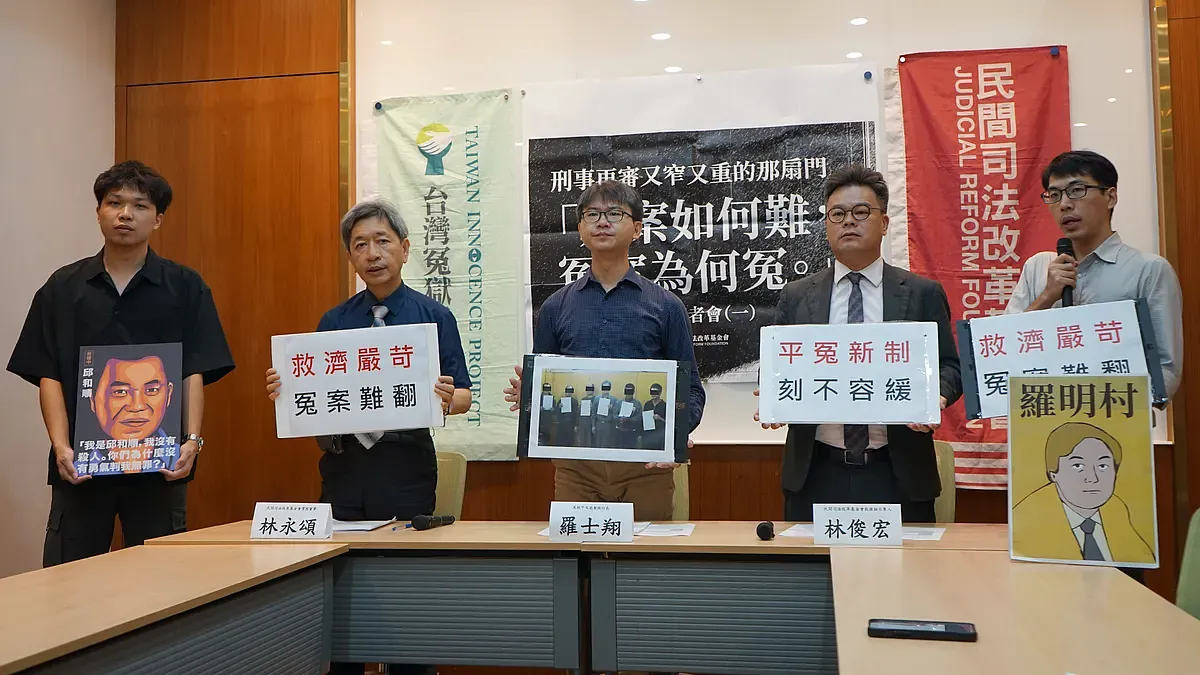
Press Conference | The Narrow and Heavy Gate of Criminal Retrial: "How Hard Are Difficult Cases, Why Are Wrongful Convictions Wrongful" Press Conference Series (Part 1)
Last edited: 2026-07-27
The exoneration of wrongful convictions is a belated but necessary justice that can be given to innocent judicial victims.
However, does our country's criminal procedure truly provide sufficient safeguards for the relief of wrongful convictions? Can innocent people be effectively exonerated through judicial procedures? Why have some scholars described our country's criminal retrial as a "system bordering on death"?
Through a series of three press conferences, we will explain the respective problems existing in our country's systems of "criminal retrial," "extraordinary appeal," and the "Review Committee for Convicted Cases." The solution was actually pointed out as early as the conclusion of Resolution 5-4 of the 2017 National Congress on Judicial Reform: the government should learn from foreign systems and deliberate on establishing an independently functioning "criminal conviction review mechanism." Regarding this direction, we will also explain it in the upcoming nongovernmental version of the draft bill.
The theme of the first press conference in this series is the flaws in our country's "criminal retrial" system. Regarding retrials in criminal litigation, we will put forward the following 4 explanations and assertions:
1. Our country's criminal retrial system has limited utility in the relief of wrongful convictions
2. Our country should reform the wrongful conviction relief system by establishing a "Wrongful Conviction Relief Committee" and a "Post-Conviction Review Court"
3. Investigative authorities and courts should comprehensively review the causes of wrongful convictions and the ills of the judicial trial culture
4. To advance judicial reform and relieve the innocent, the President should initiate a "Judicial Reform Committee," and the Judicial Yuan should deliberate on amending the laws
1. Our country's criminal retrial system has limited utility in the relief of wrongful convictions
A criminal retrial in our country is an extraordinary relief system for re-examining disputes over case facts in cases where a final judgment has already been rendered.
Before January 2015, criminal retrials in our country had limited relief functions because the "new evidence" required to initiate a retrial had to be restricted to cases possessing both "novelty" and "certainty." "Novelty" meant that the evidence must have already existed during the original court trial but was not discovered before the judgment. "Certainty" meant that "observed purely from the form of the new evidence itself, without requiring investigation procedures, it is obviously deemed sufficient to shake the original final judgment."
Because the above conditions excessively narrowed the relief function of retrials and were heavily criticized by scholars, the requirements for the aforementioned elements were finally relaxed during the 2015 legal amendments.
However, after the legal amendments, the function of criminal retrials did not flourish as a result. On the contrary, judging from statistical data over the 9 years from the implementation of the new law to the present, the approval rate for retrials after the amendment has still maintained an extremely low ratio without significant improvement. The table below shows the trial results and approval rates for retrial cases by various district courts and high courts in the 10 years before the amendment and the 9 years after the amendment.
| First 10 Years Before Amendment (2005~2014) | First 9 Years After Amendment (2015~2023) | |
|---|---|---|
| Total Applications | 16,081 | 16,188 |
| Total Approved Retrials | 179 | 290 |
| Overall Approval Rate | 1.11% | 1.79% |
| District Court Approval Rate | 2.8% | 3.63% |
| High Court Approval Rate | 0.5% | 0.99% |
Observing the trend further and comparing the 10 years before the amendment with the period up to the present (nearly 9 years), it can be found that the approval rate of district courts rose from 2.8% to 3.63%, and the High Court approval rate rose from 0.5% to 0.99%. Although there has been an increase, it is still a drop in the bucket. It can be known from these statistical data before and after the legal amendments that our country's "criminal retrial" system is no longer a system that can be improved through "simply modifying legal requirements." Rather, within the trial system and court culture, it is often not easy to change the cognition of established facts for cases that have already been finalized.
The unfinished business of reforming the wrongful conviction relief system can be illustrated from our experience in rescuing wrongful convictions in recent years. The following three cases, all of which have been pointed out as questionable in investigation reports by the Control Yuan, are cited:
Taking the Lo Ming-ts'un case as an example, before filing for a retrial, requests had been made 48 times for the Prosecutor-General to initiate an extraordinary appeal. In 2013, the Control Yuan also issued an investigation opinion stating that the prosecutor in this case had filed an untimely appeal, yet the requests were repeatedly dismissed by the Prosecutor-General on the ground that "such new evidence discovered after the original final judgment should be separately pursued through retrial procedures for relief." When a retrial was filed anew in 2016, it was again dismissed by the Supreme Court in 2018 on the ground that "what is involved in this case is a circumstance regarding the improper application of law by the original final judgment, which falls under the scope of an extraordinary appeal."
Some people might think that the low approval rate for initiating retrials represents that the original trial quality reached a certain standard with very few errors. However, what is the quality of our country's criminal trials in practice? Taking those famous cases in our country that were locked out by "retrials," the conviction of Chiou Ho-shun was entirely built upon 288 written confession records made by the defendants and others that were full of flaws, contradictory in their confessions, and extracted under torture.
In addition, taking the Teng P'ing-hsiang case as an example, Teng P'ing-hsiang was initially targeted because his scooter looked similar to the scooter shown in the surveillance footage of a college student robbery, leading police to suspect he was the suspect. However, the surveillance footage was actually blurry and difficult to determine whether it was the same scooter. Moreover, the time captured by the surveillance camera was 00:59, which differed by 29 minutes from the robbery occurrence time stated by the college student; thus it could not be determined whether the person in the footage was the perpetrator. After investigation, the Control Yuan further pointed out procedural flaws in the identification process—such as only letting Teng P'ing-hsiang wear prison clothes and handcuffs, which could produce suggestive or guiding effects, and failing to inform the witness that the criminal suspect does not necessarily exist among the persons being identified—which violated identification regulations. (Refer to Control Yuan 2020 Judicial Investigation Document No. 25). However, even with such severe flaws, the court was still unwilling to grant a retrial for the Teng case or give an opportunity for relief. In other words, it is really difficult to self-justify our country's low approval rate for initiating criminal retrials on the grounds that "the original judgment quality already reached a certain standard."
| Lo Ming-ts'un Case | Chiou Ho-shun Case | Teng P'ing-hsiang Case | |
|---|---|---|---|
| Trial Dilemma |
Both the Supreme Prosecutor's Office and the Supreme Court considered that the relief for the case did not fall under their respective unit's jurisdiction:
|
Successive retrial applications were all dismissed: 2011, 2014~2015 Successive extraordinary appeal requests were all dismissed: 2011, 2013, 2014, 2017 |
Successive retrial applications were all dismissed: 2018, 2023 |
| Remarks |
|
Control Yuan 2020 Judicial Investigation Document No. 44 letter-requested the Ministry of Justice to forward the matter to the Review Committee for Convicted Cases of the Taiwan High Prosecutors Office to ascertain the truth; the case is currently under deliberation within the review committee with no progress yet. | After the Control Yuan Report (2020 Judicial Investigation Document No. 25) letter-requested the Prosecutor-General to initiate an extraordinary appeal, an extraordinary appeal was initiated by the Prosecutor-General, but the Supreme Court dismissed it, and the volunteer lawyers' group filed a retrial application, which was also dismissed and finalized. |
2. Our country should reform the wrongful conviction relief system by establishing a "Wrongful Conviction Relief Committee" and a "Post-Conviction Review Court"
Resolution 5-4 of the 2017 National Congress on Judicial Reform states: "Not wronging anyone through post-conviction relief systems is the unabandonable vocation of judicial justice. To reduce wrongful convictions and protect human rights, the function of the judiciary to relieve the innocent after a guilty verdict is finalized should be strengthened, and the relief system after criminal cases are finalized should be perfected: IV. To increase channels for wrongful conviction relief and give wrongly judged innocent persons an opportunity to obtain a reopened trial, it is recommended that the government deliberate on establishing an independently functioning 'criminal conviction review mechanism' (such as the independent mechanisms in the UK and Norway, namely the criminal cases review commission system), specializing in the investigation of finalized guilty cases to apply for or prompt the initiation of retrials for the innocent."
In response to the inadequacy of relief in our country's criminal retrial system, this Foundation referenced systems such as the UK's Criminal Cases Review Commission (CCRC), Norway's Criminal Cases Commission, and the North Carolina Innocence Inquiry Commission in the United States, to draft amendments to our country's Control Act, Organic Act of the Committees of the Control Yuan, Court Organization Act, and Code of Criminal Procedure, suggesting that an agency dedicated to wrongful conviction investigation and relief should be established, and cases brought by such an agency should be tried by a specialized court (hereinafter referred to as the "Four Acts for Wrongful Conviction Relief").
Regarding the "Wrongful Conviction Relief Committee," our country's Control Yuan has long possessed the powers and experience to investigate incidents, and its concern for and contributions to human rights issues are obvious to all. For example, regarding many wrongful convictions in our country, the Control Yuan has produced detailed investigation reports explaining the contradictions between the facts and judgments in the cases, as well as pointing out procedural flaws in investigation and trial, some of which have thereby been exonerated (including death penalty cases that have now been exonerated, all of which had investigation opinions submitted by the Control Yuan leading to subsequent retrials and exonerations). Therefore, this Foundation suggests that this "Wrongful Conviction Relief Committee" should be established under the Control Yuan as an agency dedicated to the investigation and relief of wrongful convictions.
In terms of criminal procedure, as mentioned earlier, because our country's court trial culture already finds it difficult to alter the determination of facts, cases for which relief is applied by the "Wrongful Conviction Relief Committee" should be tried exclusively by the "Post-Conviction Review Court" established under the Judicial Yuan, and trials should be conducted through procedures of lay participation or the Citizen Judges Act.
3. Investigative authorities and courts should comprehensively review the causes of wrongful convictions and the ills of our country's court trial culture
In addition to improving the plight of our country's wrongful conviction relief through the aforementioned methods, we further call upon investigative authorities and judicial authorities to systematically and comprehensively review the various causes of wrongful convictions in our country's practice. They should also examine why our country's court trial system, even when there is much clear evidence to overturn a case, still finds it difficult to alter the determination of trial facts. Furthermore, why is it that in certain cases, even when Control Yuan investigation reports have pointed out that the facts in the case are unclear and procedural flaws exist, they still fail to enable parties to wrongful convictions to be exonerated?
The exoneration of a wrongful conviction is belated justice. Belated justice is already cheap justice; yet when even belated justice cannot be granted, it is undoubtedly an extreme injustice to the country and society.
As for our country's investigative authorities and courts, although chronic ills accumulated by the culture of various organs over a long period cannot be reversed simply by institutional legislative amendments, this Foundation and nongovernmental organizations will continue to monitor and promote reform in the future. Regarding how to avoid the causes of wrongful convictions, we will always stand on the front line and continuously put forward our ideals and persistence.
4. To advance judicial reform and relieve the innocent, the President should initiate a "Judicial Reform Committee," and the Judicial Yuan should deliberate on amending the laws
Regarding the perfection of the above systems, nongovernmental organizations have drafted a complete bill awaiting publication at a later date. This Foundation calls upon President Lai to convene a national congress on judicial reform to discuss and deliberate on how to implement the part regarding perfecting the "criminal conviction review mechanism" in the resolutions of the 2017 National Congress on Judicial Reform. In addition, before his election, President Lai also promised that after being elected, he would establish a standing "Judicial Reform Committee" incorporating public participation to establish stable and effective review and monitoring measures for the implementation of reform measures. Accordingly, this Foundation suggests that the special wrongful conviction relief mechanism and other important judicial reform issues should be discussed together upon the establishment of the "Judicial Reform Committee."
Furthermore, the Judicial Yuan, as our country's trial practice organ and also the competent authority for the Code of Criminal Procedure, should promptly deliberate on amending the laws and open legislative revision seminars inviting broad participation from nongovernmental organizations, to jointly deliberate on how to implement the resolutions of the National Congress on Judicial Reform so as to solidify the realization of human rights protection.
Press Conference Attendees
Lin Yung-sung, Attorney / Standing Director, Judicial Reform Foundation
Lo Shih-hsiang, Attorney / CEO, Taiwan Association for Innocence, and Volunteer Defense Attorney for the Teng P'ing-hsiang Case
Lin Chun-hung, Attorney / Convener of the Rescue Division, Judicial Reform Foundation, and Volunteer Defense Attorney for the Chiou Ho-shun and Lo Ming-ts'un Cases
Press Contacts
Lü Cheng-yen, Attorney / Director of the Legal Policy Department, Judicial Reform Foundation
Phone: 02-2523-1178#37
Email: elvin@jrf.org.tw
This article is an AI-generated translation of the original Chinese text. In the event of any discrepancy, the Chinese version shall prevail.