
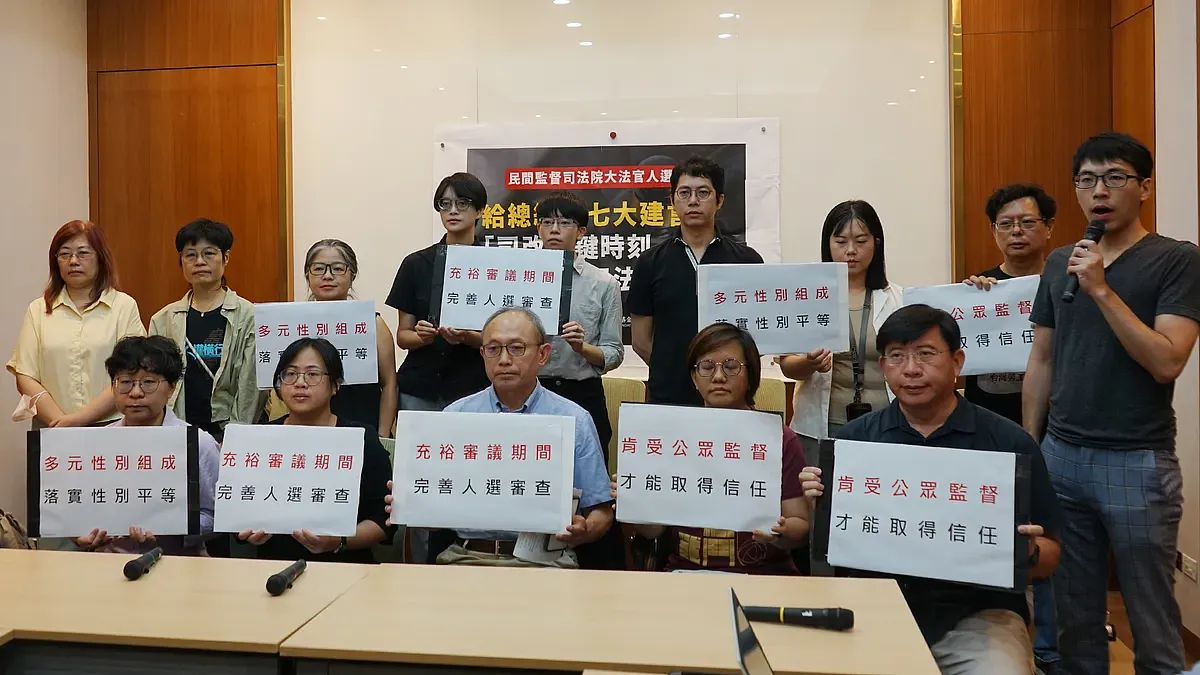
Press Conference | "Critical Moment for Judicial Reform: Who Will Be the Next President of the Judicial Yuan?" Seven Recommendations to the President by the Alliance for Monitoring Judicial Yuan Grand Justice Nominees
Last edited: 2026-07-27
Grand Justices of the Judicial Yuan have historically interpreted the Constitution and laws, led Taiwan's constitutional development, and repeatedly played key roles in adjudicating various controversial social issues. The terms of seven Grand Justices—President concurrent Grand Justice Hsieh Tsung-li, Vice President concurrent Grand Justice Tsai Chi-tung, Chang Ch瓊-wen, Huang Jui-ming, Hsieh Chih-hsiung, Chan Sen-lin, and Huang Chao-yuan—will expire at the end of October this year. According to media reports, the Office of the President is expected to initiate the nomination process in July. As guardians of the Constitution, Grand Justice candidates must be chosen with the utmost care.
To this end, 15 groups—including the Alliance for Constitutional Promotion, Taiwan Labour Front, Covenants Watch, Disabled Peoples International Republic of China, Citizen Congress Watch, Taipei Bar Association, Taiwan Association for Human Rights, Taiwan Forever Association, Taiwan Criminal Defense Lawyers Association, Taiwan Alliance to Promote Civil Partnership Rights, Taiwan Association for Innocence, Taiwan Alliance to End the Death Penalty, Judicial Reform Foundation, Awakening Foundation, and Environmental Jurists Association (listed in stroke order)—have jointly formed the "Alliance for Monitoring Judicial Yuan Grand Justice Nominees."
To make the President's exercise of the nomination power more complete and proper, and to ensure sound and sufficient communication with civil society, the Alliance hereby proposes the following seven major demands:
1. The Office of the President should consider the diversity of its members and the balance of gender ratios when forming the Review and Recommendation Committee.
2. After receiving recommendations from all sectors, the President should publish the qualified nominees to solicit public opinions.
3. Grand Justice candidates should possess sound integrity, professional knowledge, and progressive constitutional and human rights values.
4. The composition of Grand Justices should emphasize diversity and gender ratios.
5. When making nominations, the President should consider the nominees' willingness to accept public scrutiny.
6. When nominating Grand Justices to concurrently serve as President and Vice President of the Judicial Yuan, the President should emphasize their views on judicial reform policies as well as their capacity and willingness for social communication.
7. It is respectfully requested that the President reserve sufficient deliberation time for the Legislative Yuan to ensure the proper exercise of the consent power.
1. The Office of the President should consider the diversity of its members and the balance of gender ratios when forming the Review and Recommendation Committee.
To exercise the nomination power, the Office of the President will customarily establish the "Judicial Yuan Grand Justice Nomination Review and Recommendation Committee" (hereinafter the "Review and Recommendation Committee"), convened by the Vice President, to assist the President in fulfilling the constitutional duty of nomination.
However, looking back at the composition of previous "Review and Recommendation Committees," they have not only been male-dominated but also largely comprised of senior legal professionals with prior experience working in the Judicial Yuan, making the criteria overly homogeneous. In response, the Alliance respectfully urges that the composition of the "Review and Recommendation Committee" also account for diversity and gender balance, and incorporate human rights experts and scholars who care about the rights of disadvantaged groups.
2. After receiving recommendations from all sectors, the President should publish the qualified nominees to solicit public opinions.
In past constitutional practice, there have been instances where, after the President announced a nominee, different opinions from various sectors led the nominee to voluntarily resign from the nomination.
On the other hand, referencing the current procedure for lawyers transitioning to judges, the Judicial Yuan publishes the applicants' educational and working background information sufficient to identify them, invites all sectors of society to enthusiastically provide feedback, and subsequently conducts subsequent selections.
To strengthen the legitimacy of nominations and promote positive social communication, it is requested that after the recommendation period closes, the President should first publish information such as the names, educational and career backgrounds, legal publications, or lists of representative written documents of qualified nominees, and allow a certain period to solicit public opinions. Only then can the perspective of review not be limited to partial viewpoints, thereby strengthening the legitimacy of the nomination and the rigor of the procedure.
3. Grand Justice candidates should possess sound integrity, professional knowledge, and progressive constitutional and human rights values.
Given that the judgments of the Grand Justices will have a comprehensive and profound impact on the lives of all citizens, we call upon the President to ensure that Grand Justice nominations are fair and objective, without using ethnicity, region, background, or ideology as the primary basis, and to thoroughly examine the following three major traits:
-
Moral Integrity
Nominees must not have blemishes in their moral integrity or records inconsistent with the reputation of Grand Justices, so as not to affect the credibility of their adjudicative duties. Therefore, the records of nominees regarding human rights issues and gender equality should be reviewed under the highest standards to ensure they have no relevant negative records. -
Constitutional and Human Rights Values
Nominees should possess progressive constitutional and human rights values so as to uphold judicial independence when exercising their duties, and should fully understand the meaning of the Constitution in safeguarding people's fundamental rights, thereby proposing creative, progressive, and liberal legal arguments on constitutional issues arising from social changes and conceptual developments. -
Knowledge and Professionalism
Nominees should have rich knowledge and professional competence to present persuasive legal arguments to the public on major and difficult constitutional and legal disputes.
To fairly, objectively, and professionally evaluate Judicial Yuan Grand Justice nominees and provide a reference for public appraisal, the Alliance will collect relevant data on different dimensions of issues; after thorough discussions, we will conduct monitoring actions and pose questions as a reference for the general public and the Legislative Yuan's review.
4. The composition of Grand Justices should emphasize diversity and gender ratios.
Aside from considering the aforementioned traits, to ensure that the Constitutional Court—composed of 15 Grand Justices—possesses considerable diversity conducive to brainstorming and open debate on important constitutional issues, the President should consider the backgrounds of nominees when making nominations. For those nominated based on academic qualifications, special care should be taken to avoid the excessive concentration of backgrounds within a single academic institution.
According to General Recommendation No. 23 (paragraphs 16 and 29) of the Convention on the Elimination of All Forms of Discrimination against Women (CEDAW), the composition of Grand Justices should also meet the requirement that the proportion of either gender shall not be lower than one-third. Therefore, for this nomination, the President should nominate no more than six males to comply with the aforementioned convention requirements.
However, this is merely the minimum requirement for complying with gender equality. We believe that as guardians of the Constitution and human rights, the Constitutional Court should not have more than eight persons of either gender in its composition, so as to prevent a single gender's perspective and habitual thinking from being overly magnified. In other words, the males nominated this time should preferably be no more than four, and all nominees should possess a sound awareness of gender equality, so that the constitutional requirement of gender equality can be implemented.
5. When making nominations, the President should consider the nominees' willingness to accept public scrutiny.
The review intensity of personnel consent power should be made rigorous, and enhanced scrutiny of nominees should command a broad consensus in society. Therefore, if nominees lack the willingness to dialogue with the general public and be subject to scrutiny, they may also find it difficult to obtain the Legislative Yuan's consent as suitable candidates.
In this regard, it is respectfully requested that the President duly consider the nominees' willingness and attitude toward accepting public scrutiny when making nominations, so as to facilitate public understanding and supervision of the suitability of Grand Justice candidates.
6. When nominating Grand Justices to concurrently serve as President and Vice President of the Judicial Yuan, the President should emphasize their views on judicial reform policies as well as their capacity and willingness for social communication.
In exercising the nomination power this time, the President must also nominate Grand Justices to concurrently serve as the President and Vice President of the Judicial Yuan, which is crucial to the future policies of judicial reform and their success or failure. The Alliance believes that nominees for the President and Vice President of the Judicial Yuan should meet the following standards and traits:
- Have made important contributions to Taiwan's democratic movement or judicial reform.
- Have a profound realization and understanding of the difficulties people encounter in the judiciary, and be able to earnestly and sincerely dialogue with the public and collect public opinions on the judiciary to achieve the goal of expanding participation.
- Be willing to actively dialogue with the public, civil organizations, and other organs through public forums, forge reform consensus through open and transparent means, and possess the determination and capability to implement major reforms.
7. It is respectfully requested that the President reserve sufficient deliberation time for the Legislative Yuan to ensure the proper exercise of the consent power.
To enable the Legislative Yuan to genuinely exercise its consent power through a rigorous procedure based on sufficient and complete information and to supervise the suitability of nominees on behalf of all citizens, it remains necessary for the Legislative Yuan and individual members to request documents, submit written inquiries, hold public hearings or briefings, and draft review reports. In particular, if political parties can untie the straitjacket of party discipline so that legislators can rigorously examine the legal arguments, human rights concepts, ideological standpoints, and professional capabilities of nominees as the basis for granting consent, even more adequate time is required. To this end, it is respectfully requested that the Office of the President note that at least two months of ample deliberation time should be reserved when conducting related operations, allowing the Legislative Yuan to make necessary investigations in advance and schedule the review timeline, thereby preventing the procedure from being hurried and perfunctory.
Attendees
Huang Sung-li / Convenor of the Alliance for Monitoring Judicial Yuan Grand Justice Nominees, Executive Committee Member of the Alliance for Constitutional Promotion
Wei Pei-hsuan / Vice Chairperson of the Taiwan Association for Human Rights
Sun Yu-lien / Secretary-General of the Taiwan Labour Front
Chin Yu-jung / Secretary-General of the Awakening Foundation
Chien Chih-chieh / Secretary-General of the Taiwan Alliance to Promote Civil Partnership Rights
Chang Hung-lin / Chief Executive of Citizen Congress Watch
Sylvia Yi-pi Huang / Executive Director of Covenants Watch
Vivian Liu / Executive Director of the Taiwan Alliance to End the Death Penalty
Tang Yu-ying / Chairperson of the Judicial Reform Committee, Taipei Bar Association
Li Ming-ju / Deputy Executive Director of the Judicial Reform Foundation
Chen Li-chen / Executive Secretary of the Taiwan Criminal Defense Lawyers Association
Chang Chia-ling / Director of the Disabled Peoples International Republic of China
Huang Hui-yu / Deputy Director of the Taiwan Forever Association
Lo Fang-chen / Lawyer at the Environmental Jurists Association
Press Contacts
Lü Cheng-yen, Attorney-at-Law, Director of the Legal Policy Department, Judicial Reform Foundation
Telephone: 02-2523-1178#37
Email: elvin@jrf.org.tw
This article is an AI-generated translation of the original Chinese text. In the event of any discrepancy, the Chinese version shall prevail.