
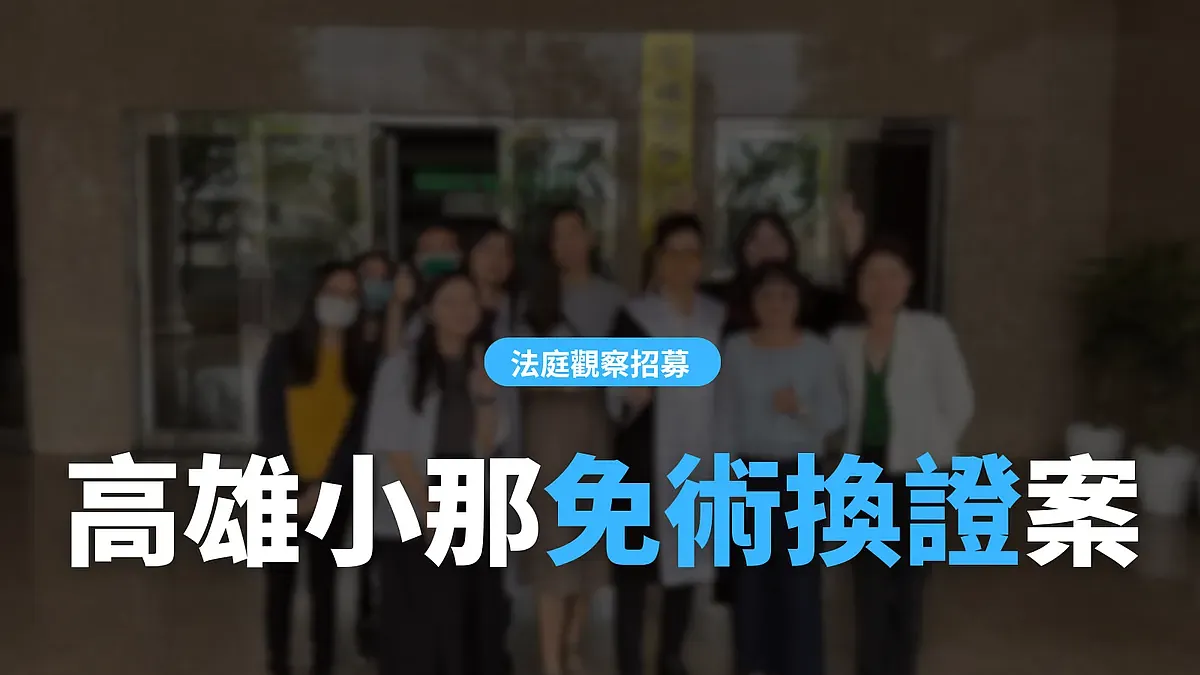
Court Observation Recruitment | Kaohsiung Hsiao-Na Gender Marker Change Without Surgery Case (Oral Argument)
Last edited: 2026-07-27
How the judiciary fulfills its function of protecting human rights, as well as the domestic implementation and judicial practice of international human rights conventions, is of paramount importance. Notably, under the framework of the Convention on the Elimination of All Forms of Discrimination Against Women (CEDAW), how Taiwan's judiciary can keep pace with international human rights standards has been a subject of extensive discussion in recent years regarding transgender issues.
In September 2021, the Taipei High Administrative Court ruled in favor of Hsiao-E in a gender marker change without surgery case assisted by the Taiwan Alliance to Promote Civil Rights Partnerships (TAPCPR), holding that transgender individuals are not required to undergo mandatory sex reassignment surgery to apply for a change of gender registration.
In October 2023, the Grand Bench of the Supreme Court of Japan (comprising all 15 justices) unanimously declared the "mandatory surgery requirement" to be unconstitutional (with the majority of Japanese legal opinions holding that a declaration of unconstitutionality by the Supreme Court has erga omnes effect), overturning the previous ruling made by the Supreme Court Petty Bench (5 justices) in 2019.
In May 2024, the Taipei High Administrative Court ruled in favor of Nemo in another gender marker change without surgery case assisted by TAPCPR. Nemo had applied to the Taipei City Xinyi District Household Registration Office for a gender marker change in June 2022. After the application was rejected and a subsequent administrative appeal was dismissed in July of the same year, Nemo filed an administrative lawsuit in early December. After a 22-month administrative litigation process, Nemo ultimately achieved a complete victory.
Current Status of Hsiao-Na's Case
This court observation focuses on Hsiao-Na's case, which is being tried by the Kaohsiung High Administrative Court (hereinafter "Kaohsiung High Administrative Court"). This case similarly involves an application to the household registration authority for a gender marker change that was rejected pursuant to the current administrative ruling (letter) issued by the Ministry of the Interior regarding gender registration. After losing the case in the Kaohsiung High Administrative Court, an appeal was taken to the Supreme Administrative Court. On September 21, 2023, the Supreme Administrative Court vacated the original judgment and remanded the case back to the Kaohsiung High Administrative Court for retrial.
The reasoning of the Supreme Administrative Court's judgment explicitly states:
"An individual's continuous self-gender identity falls within the core scope of human dignity, the free development of personality, and the right to personality protected by Article 22 of the Constitution. Although the legal determination of an individual's gender has initially been based on external physiological sex characteristics at birth, when an individual's outward gender expression—based on their internal self-understanding and awareness—is inconsistent with their legal gender assignment, the State should respect the people's freedom and right to self-determine their gender, provided that it does not disrupt social order and the public interest, and should recognize that individuals may apply to change the gender on their household registration pursuant to Article 21 of the Household Registration Act."
"Paragraph 2 of the Ministry of the Interior's Order No. Nei-Shou-Hu-Tzu-0970066240 dated November 3, 2008, which requires that male-to-female transgender persons must undergo sex reassignment surgery to remove male sexual organs such as the penis and testicles before they may apply for a gender marker change registration pursuant to Article 21 of the Household Registration Act, lacks legal basis, severely violates the applicant's rights to bodily autonomy, health, human dignity, and personality, and breaches the principles of legal reservation and proportionality... The original trial court added conditions not prescribed by law to the application of Article 21 of the Household Registration Act, and the examples cited all pertained to errors in the original gender registration, constituting an error of improper application of laws and regulations."
On December 19, 2023, the court held the first preparatory proceeding following the remand. During the proceeding, the judge requested Attorney Li Ling-Wei (counsel for Hsiao-Na) to provide administrative judgments from other gender marker change without surgery cases in Taiwan as a reference for adjudicating this case. Additionally, Attorney Li noted that some foreign legislative models cited in the Supreme Administrative Court's judgment regarding gender marker changes without surgery have been updated, and indicated to the court that she would compile the latest data on foreign legislative models for the court.
In January of this year, Attorney Li also filed a motion with the court for expert testimony, inviting Professor Ch'en I-Ch'ien from the Graduate Institute of Gender Studies at Shih Hsin University and psychiatrist Dr. Huang Tsan-Yu to provide their professional opinions. She hopes that through the perspectives of gender studies and psychiatry, the judge can be helped to understand the current dilemmas faced by the transgender community while simultaneously broadening the legal horizon to prevent the law from continuing to oppress transgender people.
In February of this year, after concluding the second preparatory proceeding for Hsiao-Na's case, the court stated that the relevant information was sufficient, believing that both winning and losing judgments had sufficient arguments to be stated in the ruling, and that it was no longer necessary to summon witnesses to provide professional opinions, with only the final oral argument proceeding remaining to conclude the case. However, through the strong persuasion of Attorney Li Ling-Wei, the court was persuaded to summon Professor Ch'en I-Ch'ien and Dr. Huang Tsan-Yu to express their relevant opinions at the next hearing.
In March of this year, after concluding the third preparatory proceeding for Hsiao-Na's case, the court questioned Professor Ch'en I-Ch'ien and Dr. Huang Tsan-Yu respectively in order to clarify the current perspectives of the academic and medical communities.
Regarding Professor Ch'en I-Ch'ien, the judge inquired why transgender individuals exist and when identities different from birth-assigned sex emerge. The judge also asked whether adopting a self-declaration approach would lead to people constantly changing their gender. Professor Ch'en explained, from the history of gender determination to modern forms, that gender is indeed generated through interpersonal interactions. As for whether anyone would continuously change their gender, Professor Ch'en believes this is impossible because simply changing one's external appearance currently entails running the risk of discrimination, let alone repeatedly changing one's gender registration (for detailed opinions, please refer to this link).
The questions directed at Dr. Huang Tsan-Yu primarily focused on the client's gender identity. The judge asked whether, after multiple evaluations, the doctor believed it could be determined that the client's gender identity differed from their birth-assigned sex, and whether the requirement to remove organs under the 2008 administrative letter was appropriate. Dr. Huang explained that since the client began treatment, he has observed that the client's gender identity is stable and strongly differs from their birth-assigned sex. Completing the gender registration change would be beneficial to the client's personality and psychological state. Furthermore, the requirement for surgery is highly inappropriate. Based on past and present medical advancements, the surgical requirement itself lacks a legal basis. Moreover, given the current misalignment between medicine and law, the medical community finds it difficult to implement gender selection simply within clinical record systems. Finally, Dr. Huang emphasized that the costs and risks brought by surgery have a profound and detrimental impact on the client to a certain extent.
The victory in Nemo's case in May of this year serves as a milestone for transgender individuals seeking gender marker changes without surgery. The JRF Gender Group is once again mobilizing students from National Kaohsiung University, National Kaohsiung Normal University, Kaohsiung Medical University, and other local institutions who care about gender human rights, inviting everyone who cares about Hsiao-Na's case to head to the Kaohsiung High Administrative Court together for a court observation on July 3, hoping to hear good news once again.
Time:
Wednesday, July 3, 2:30 PM
Location:
Courtroom 1, Kaohsiung High Administrative Court (No. 180, Xingnan Rd., Nanzih Dist., Kaohsiung City)
Q&A
Q. What is a "gender marker change without surgery"?
In recent years, some transgender individuals have fought for the right to self-determine their gender through legal actions concerning gender marker changes on their National ID cards. Their reasoning is that the current administrative letter issued by the Ministry of the Interior forcibly requires transgender individuals to fulfill two conditions in order to change their gender registration:
1. Diagnostic certificates evaluated and issued by two specialized psychiatrists.
2. A diagnostic certificate issued by a qualified medical institution documenting the domestic removal of male or female sexual organs.
This administrative letter demands that transgender individuals not only obtain psychiatric and psychological gender diagnoses but also be forced to undergo sex reassignment surgery or gender-affirming surgery before a gender marker change can be permitted.
However, looking across the provisions of our country's Household Registration Act, there are no stipulations whatsoever requiring that "gender registration" must conform to physiological sex structures, chromosomes, or hormone-related sex characteristics—the so-called physiological sex (sex). Article 21 of the Household Registration Act states: "When there is a change in household registration particulars, an application for a change registration shall be made," and it does not restrict changes only to cases where physiological sex has changed following birth registration. In other words, the gender referred to in our Household Registration Act is not limited to physiological sex (sex), but should also encompass psychological gender based on an individual's self-identity, or social gender (gender) constructed by social norms and cultural rules regarding the binary concepts of male and female.
Therefore, under the aforementioned perspective, some courts have held that transgender individuals do not need to be forced to undergo sex reassignment surgery to apply for a gender marker change. For example, the Hsiao-E case accepted by the Taipei High Administrative Court with assistance from TAPCPR the year before last resulted in a favorable judgment. Furthermore, although the Constitutional Court declined in February of this year to hear the constitutional interpretation petition filed by transgender individuals seeking gender marker changes without surgery on procedural grounds, it emphasized that judges adjudicating cases are not bound by administrative letters and may express appropriate differing opinions. In other words, judges should return to the statutory provisions of the Household Registration Act to determine whether an application for a gender marker change is legally grounded.
Q. Where can I find relevant information?
- TAPCPR "Understanding Transgender" Website
- TAPCPR [Hsiao-E Case] Taipei High Administrative Court 109-Su-275 Judgment
- Kaohsiung [Hsiao-Na Case] Supreme Administrative Court 110-Shang-558 Judgment
- Constitutional Court "2023 Dis. Ruling No. 4" Dismissal Ruling
- TAPCPR Press Release Responding to the Constitutional Court's Dismissal
- TAPCPR [Nemo Case] First Complete Victory in a Transgender Male Gender Marker Change Application Without Surgical Requirements
Contact Person
Advocacy Specialist Hsieh Chia-Chen
jane@jrf.org.tw
04-23292372#11
This article is an AI-generated translation of the original Chinese text. In the event of any discrepancy, the Chinese version shall prevail.