
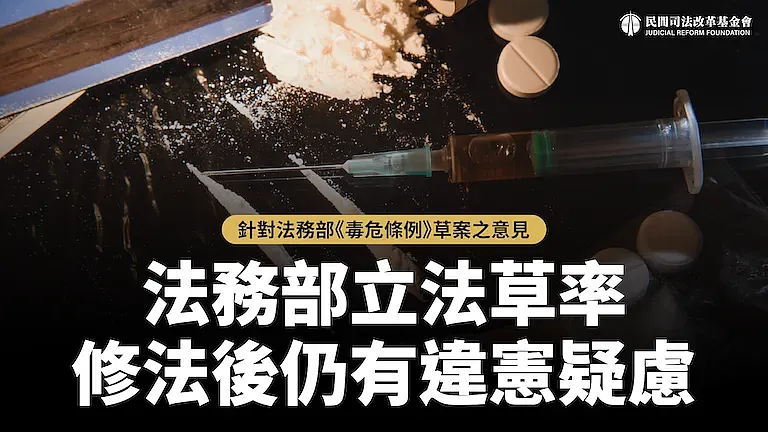
Statement | The Ministry of Justice's Legislative Draft is Hasty and Remains Unconstitutional—Opinions on the Ministry of Justice's Draft Amendment to the Narcotics Hazard Prevention Act
Last edited: 2026-07-27
In response to Constitutional Court Judgment No. 13 of 2023, the Ministry of Justice announced a draft amendment to the Narcotics Hazard Prevention Act (hereinafter the "Narcotics Hazard Prevention Act") last week. As this is merely a draft announcement, civil society organizations would typically submit differing opinions prior to the deadline. However, looking at the content of the Ministry's draft, we believe that this legislative amendment is "stingy with words," clearly lacking the willingness to solve problems, and unable to serve as a basis for dialogue with society. Once passed and implemented in its current form, it is highly likely to be declared unconstitutional by the Grand Justices yet again! In light of this, we call upon the Ministry of Justice to voluntarily withdraw the draft and deliberate on it anew.
Current Status of Issues Declared Unconstitutional by the Grand Justices
Constitutional Court Judgment No. 13 of 2023 pointed out that Article 4, Paragraph 1 of the Narcotics Hazard Prevention Act, which uniformly imposes life imprisonment as the minimum statutory penalty for the "crime of trafficking Category 1 narcotics," fails to comply with the constitutional principle of proportionality between crime and punishment, thereby conflicting with the proportionality principle under Article 23 of the Constitution. It further requires relevant authorities to amend the law within two years from the date of the judgment's announcement in accordance with the intent of the judgment.
In practice, the imbalance between the severity of offenses and punishments under this provision is illustrated by the following cases:
| Case Number | Criminal Record | Circumstances of Trafficking Category 1 Narcotics | Quantity | Consideration (Price) | Sentence Imposed |
|---|---|---|---|---|---|
| Taiwan High Court Tainan Branch Court, Criminal Division 2 (Not Yet Finalized) | Narcotics Use | Personally trafficked 1 time | Unknown | NTD 800 | 16 years |
| Taiwan High Court Kaohsiung Branch Court, 2016 Shang-Su Character No. 396 Criminal Judgment | None | Answered the phone for her cohabiting boyfriend and successively trafficked narcotics 3 times upon his instructions | Unknown | NTD 1000 NTD 2000 NTD 2000 |
15 years and 3 months |
| Taiwan High Court, 2013 Chung-Shang-Keng-(I) Character No. 51 Criminal Judgment | None | Jointly trafficked with her older brother 1 time | 0.45 grams | NTD 500 | 15 years and 2 months |
| Taiwan High Court Taichung Branch Court, 2008 Shang-Chung-Keng-(I) Character No. 34 Criminal Judgment | None | Answered a phone call for a friend and negotiated a transaction to traffic narcotics 1 time | 0.4 grams | NTD 1500 | 15 years and 4 months |
| Taiwan High Court Taichung Branch Court, 2013 Shang-Su Character No. 1984 Criminal Judgment | None | Personally trafficked 1 time | Unknown | NTD 3000 | 15 years and 2 months |
| Taiwan High Court, 2016 Shang-Su Character No. 2290 Criminal Judgment | None | Successively trafficked to the same buyer 2 times on the same day | Unknown | NTD 500 NTD 1200 |
15 years and 8 months |
| Taiwan High Court, 2021 Shang-Su Character No. 1851 Criminal Judgment | None | Had an unidentified person mail narcotics from the Netherlands to Taiwan (via online purchasing) | 3 grams | None | 15 years and 6 months |
The judgment of the Constitutional Court has finally opened a window of opportunity for amending the Narcotics Hazard Prevention Act, which is fraught with problems and has long been criticized by scholars. For instance, problems within this Act include at least: Why do both "micro-trafficking" and "major drug lords" fall under the exact same super-severe felony? Why is the starting statutory penalty for purchasing trace amounts of Category 1 narcotics online from abroad heavier than that for the "crime of homicide"? Since acts such as "manufacturing," "transporting," and "trafficking" are inherently distinct, should they be legislated separately? What practical benefits does the narcotics grading system actually offer for narcotics prevention?
The Ministry of Justice's Draft Raises Concerns of Unconstitutionality
Taking nearly a year, the Ministry of Justice ignored the aforementioned issues and announced a draft amendment on July 11 that merely added "a single article," with the statutory text simply copying and pasting the Constitutional Court's judgment. The amendment draft announced by the Ministry of Justice is as follows:
Draft Article 17-1 of the Narcotics Hazard Prevention Act: "For those who commit the crime of trafficking Category 1 narcotics under Article 4, Paragraph 1, whose circumstances—such as behavioral patterns, quantity, and consideration—are minor and deserving of profound sympathy, and who are deemed to still face excessively heavy punishment even after sentence reduction pursuant to Article 59 of the Criminal Code, their sentences may be discretionally reduced. However, this shall not apply to those who have a past final conviction for a crime." (Announcement Link)
Aside from repeating the words of the Grand Justices, the only addition made by the Ministry of Justice is the proviso stating: "However, this shall not apply to those who have a past final conviction for a crime." In other words, as long as an individual has a criminal record, regardless of the severity of the act or whether it has any connection to narcotics (e.g., offenses against reputation, forgery, negligent injury), they will be entirely barred from sentence reduction even if the individual case clearly exhibits circumstances where "the punishment is heavy relative to the lightness of the offense." If passed through three readings in this version, based on the Grand Justices' past interpretations and the intent of their judgments, one cannot help but worry that it will once again be declared unconstitutional by the Grand Justices.
Please Withdraw the Notice and Seriously Amend the Law
Regarding the amendment to the Narcotics Hazard Prevention Act, we believe that the "absolute minimum" legislative amendment should at least amend Article 4, Paragraph 1 of the Narcotics Hazard Prevention Act, establish different statutory penalties for acts posing varying degrees of harm, and concurrently review other provisions where statutory penalties are manifestly excessive.
As for the direction of the amendment currently being deliberated within our association, it comprehensively reviews the problems of excessively crude behavioral distinctions and insufficiently granular statutory penalty classifications within the Narcotics Hazard Prevention Act, while introducing a new legislative framework through comparative law in an effort to achieve the objectives of "punishing minor offenses lightly and serious offenses severely."
However, neither of the above two directions appears to be included in the Ministry of Justice's legislative agenda. Given that the draft of the Narcotics Hazard Prevention Act currently announced by the Ministry of Justice is hasty and crude, we call upon the Ministry of Justice to proactively withdraw the draft, seriously deliberate on it anew, and subsequently propose an amendment version with genuine substance ("meat").
Press Contact
Lü Cheng-yen, Attorney-at-Law, Director of the Department of Legal Policy, Judicial Reform Foundation
Email: elvin@jrf.org.tw
This article is an AI-generated translation of the original Chinese text. In the event of any discrepancy, the Chinese version shall prevail.