
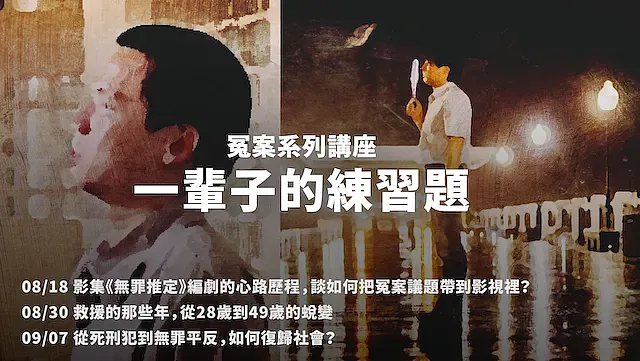
A Lifelong Exercise | Wrongful Conviction Lecture Series
Last edited: 2026-07-27
In July 1995, Hsu Tzu-chiang took over his mother-in-law's small betel nut stand. He thought that with his child about to start elementary school, he would no longer need to pull all-nighters driving trucks and could spend more time with his family.
Little did he know that two months later, he would be wrongfully dragged into a kidnapping and murder case, shattering his ordinary life and destroying his family.
With only co-defendants who "pointed the finger at him," an innocent Hsu—who still believed in the justice system—decided to face it head-on. To his dismay, what awaited him was an endless road of injustice.
"For those ten-plus years, all I wanted was to hug my mother," Hsu recalled of his life "inside."
Sixteen years on death row, twenty years of litigation, and an accompanying shadow of injustice—what once awaited Hsu Tzu-chiang was boundless despair. We still do not understand how or when the judicial system will be willing to admit its mistakes.
Yet, on the road of justice, having one more person might mean sparing someone else an extra mile of wrongful suffering.
➤ Learn more about the "Hsu Tzu-chiang Case"
Lecture Series
08/18 The Creative Journey of the Screenwriter of the Series "The Accidental Influencer" (Presumed Innocent): How to Bring Wrongful Conviction Issues into Film and Television?
In recent years, law-related film and television works have become a trend in Taiwan, many of which are adapted from real social cases. These stories often involve decades-long legal battles, complex case details, and thought-provoking social issues. For screenwriters, how exactly does one draw inspiration from real society and transform these social cases and issues into audiovisual works?
Recently premiered, Taiwan's first Taiwanese-language legal drama, "Presumed Innocent," is adapted from a real Taiwanese social case, recounting the exoneration process of a wrongful conviction. For this lecture, we are honored to invite Lin Pei-yu, screenwriter of "Presumed Innocent" and "The Good Bad Mother" (Best Interest), and Lin Chia-hsuan, screenwriter of "Presumed Innocent," to share their mental journey of bringing social cases and issues into film and television. They will discuss how they brainstormed, gathered materials, and conducted field research during the scriptwriting process, as well as how screenwriters cope with and handle social controversies when the chosen cases or plots touch upon them.
Furthermore, both guest speakers have legal backgrounds, with Lin Chia-hsuan also practicing as an attorney. We have invited them to share how and why they embarked on the path of taking off their judicial robes to tell stories, and how—as both legal professionals and audiovisual creators—they translate dry, complex legal concepts and case details into popular, easily digestible content for the general public.
Moderator
Liu Lo-i (Roy) Community Director, The Law & Taiwan
Speaker
Lin Chia-hsuan Screenwriter of "Presumed Innocent"
Speaker
Lin Pei-yu Screenwriter of "Presumed Innocent" and "Best Interest"
- Time: 08/18 (Sun) 14:00-16:00
-
Venue: Cold Cases Office (8F, No. 300, Minsheng W. Rd., Datong Dist., Taipei City)
Online/In-person participation available. In-person seating is limited to 25 attendees. Live streaming links will be sent out after registration for online participants.
This session has ended. Click to watch the recorded live stream.
08/30 The Years of Rescuing the Hsu Tzu-chiang Case: Transformation from Age 26 to 47
Justice is an impartial scale, but when the scale begins to tilt, social news stories scatter like fallen petals. These fallen petals resemble defendants of wrongful convictions who have tumbled into the abyss of the judiciary, their fates held in the palms of judicial organs, unable to escape.
"Leaving the abyss of wrongful conviction, returning soon to innocence and happiness."
"70, 20, 16, 9, 7, 4, 2"—this sequence of numbers is not random, but the key figures of the Hsu Tzu-chiang case. The case was tried by over 70 judges, with legal proceedings lasting more than 20 years. He spent 16 years behind bars, including 4 years on death row where he could have been executed at any moment. Sentenced to death 7 times and given life imprisonment twice, he was finally acquitted upon his 9th retrial. For 21 years, his family relentlessly fought to clear Hsu Tzu-chiang's name. The Hsu Tzu-chiang case catalyzed Judicial Yuan Interpretation No. 582, ensuring that the public would no longer face the possibility of being convicted solely based on someone else's arbitrary confession, and his acquittal represents the realization of the presumption of innocence.
"Behind every defendant of a wrongful conviction stand family members and relatives who firmly believe in them." Apart from the wrongfully accused defendant being a victim, their family members and relatives are victims as well. While the wrongfully accused struggles in the abyss of injustice, their relatives are likewise exposed to the judgmental gazes of the public, striving to maintain their daily lives.
Every wronged person eventually receives a compensation figure, but these numbers cannot buy back a lost life. Having spent 16 years in prison, Hsu was isolated from society for over a decade upon regaining his freedom. Beyond the drastic changes in the macro-environment, familiar friends and relatives were not necessarily still around. How can a wrongfully accused person's fractured social connections be repaired? How his family had to face others' judgmental stares every single day for the past 20 years—none of this can be compensated for by money.
Today's lecture is deeply honored to invite attorney Lin Tsou-ma, who served as a pro bono lawyer for the Hsu Tzu-chiang case, Lin Hsin-yi, Executive Director of the Taiwan Alliance to End the Death Penalty, and Wu Tung-mu, who participated in the production of the documentary "Hsu Tzu-chiang's Exercise," to join us in person. They will discuss Hsu Tzu-chiang's mental journey, the support of his family, and how he reintegrated into society.
Moderator
Li Hsuan-yi Standing Executive Committee Member, JRF
Speaker
Attorney Lin Tsou-ma Pro Bono Lawyer for the "Hsu Tzu-chiang Case"
Speaker
Lin Hsin-yi Executive Director, Taiwan Alliance to End the Death Penalty
Speaker
Wu Tung-mu Acting Manager, Marketing and Planning Department, PTS Taigi
- Time: 08/30 (Fri) 19:00-21:30
-
Venue: Taichung Office, Judicial Reform Foundation (No. 845, Sec. 2, Taiwan Blvd., Xitun Dist., Taichung City)
Online/In-person participation available. In-person seating is limited to 40 attendees. Live streaming links will be sent out after registration for online participants.
This session has ended. Click to watch the recorded live stream.
09/07 From Death Row to Exoneration: How to Reintegrate into Society?
"When you turned yourself in, did you ever imagine you might face decades of fighting for exoneration?"
"No. Back then, I thought the justice system would return my innocence."
7 death sentences, 2 life imprisonment sentences, 1 Judicial Yuan Interpretation, 9 retrials, 5 extraordinary appeals, 16 years in prison, and 21 years of litigation—this is the life of Hsu Tzu-chiang, a defendant exonerated from a wrongful death-penalty case, spanning ages 26 to 43. In 1995, Hsu Tzu-chiang was falsely accused of involvement in a kidnapping and murder case. Even without any direct evidence proving his involvement, and despite having an alibi, the court sentenced him to death based solely on the confessions of two other co-defendants.
For 16 years—precisely 5,624 days and nights—Hsu transitioned from holding onto hope to complete despair. Friends, family, pro bono legal teams, and civil groups campaigned outside, until he was finally acquitted in 2015 and the case concluded in 2016. However, the impact of this miscarriage of justice did not stop there; the stripped-away lives and days forced into societal absence left indelible marks on both the wrongfully accused individual and those around him.
For this lecture, we are honored to invite Hsu Tzu-chiang, a wrongfully convicted individual exonerated from death row, to chat with us about the twists, turns, and mental journey of walking this long road to exoneration. At the same time, we have also invited counseling psychologist Hao Po-wei to speak with us about the psychological trauma caused by wrongful convictions.
Moderator
Lin Pei-ying Volunteer for the "Hsu Tzu-chiang Case"
Speaker
Hsu Tzu-chiang Former Death Row Inmate, Exonerated Individual
Speaker
Hao Po-wei Counseling Psychologist, Director of Rainbow Tree Counseling Center
- Time: 09/07 (Sat) 14:00-16:00
-
Venue: Cold Cases Office (8F, No. 300, Minsheng W. Rd., Datong Dist., Taipei City)
Online/In-person participation available. In-person seating is limited to 25 attendees. Live streaming links will be sent out after registration for online participants.
This session has ended. Click to watch the recorded live stream.
Organizer
Judicial Reform Foundation
Co-organizer
Cold Cases Office
Donate to Support JRF
Become the Strength for the Innocent (JRF does not accept any government subsidies, which is why we have been able to fearlessly challenge authority and courageously monitor the judiciary for 30 years! We invite you to set up a regular monthly donation to help build a fair, just judiciary worthy of the people's trust. Become the strength for the innocent, and become the strength for JRF.)
Event Contacts
Design Advocacy Specialist Mi-tou (02)25231178 #29
Advocacy Specialist Hsieh Chia-chen (04)2329-2372#11
This article is an AI-generated translation of the original Chinese text. In the event of any discrepancy, the Chinese version shall prevail.