

Self-Help Manual | Exposed for #MeToo and Sued for Defamation: What Should I Do?
Last edited: 2026-07-27
Introduction:
In June 2023, celebrity Ta-Ya (Chou I-pei) posted on Facebook accusing her former boss Blackie (Ch'en Chien-chou) of sexual harassment while she was working in Hong Kong in 2012, which attracted widespread media attention.
In response, Ch'en Chien-chou and his wife Fan Wei-chi filed a massive civil lawsuit against Ta-Ya for NT$10 million in damages, and further demanded that Ta-Ya publish a "letter of apology" on Facebook. However, Ch'en Chien-chou soon withdrew the civil lawsuit and instead filed a criminal complaint for aggravated defamation.
Following an investigation by the Taipei District Prosecutors Office, the criminal case resulted in a non-prosecution disposition in December 2023. According to news reports, Ch'en Chien-chou did not apply for a motion for re-appeal, and the non-prosecution disposition became final.
Although the defamation case has come to an end, Ta-Ya stated in an interview:
This is the first time in my life I have stepped into the Taipei District Prosecutors Office. To be honest, the pressure is really immense. I never thought that by speaking out about my past experience, I would become the first defendant in Taiwan's MeToo movement. This has also caused the entire MeToo movement to stall right here, and no other victims dare to stand up and bravely speak out.
In fact, not only Ta-Ya, but when many #MeToo victims muster the courage to expose sexual harassment (or sexual violence such as sexual assault), they face not only public opinion but also the pressure of being sued by the perpetrators, making their situations even more difficult. Below is a compilation of frequently asked questions during this process, aiming to alleviate the distress experienced by #MeToo victims (hereinafter referred to as the parties involved).
Q: After exposing #MeToo, what charges might the sexual harassment perpetrator (hereinafter referred to as the opposing party) file? Can they succeed in their lawsuit?
This can be discussed from two aspects: "criminal" and "civil":
1. Criminal Defamation:
(1) Elements of Defamation:
According to the Criminal Code, if a person, with intent to distribute to the public, points out or recounts a matter that is sufficient to damage the reputation of another, they may constitute the crime of defamation; if the method of "distributing writing or drawings" is used, it constitutes an aggravated offense, punishable by up to two years of imprisonment 1. Therefore, accusing the opposing party of sexual harassment in a public space (such as Facebook) using written words and causing damage to their reputation does carry the risk of being accused of defamation.
(2) Grounds for Exemption from Punishment:
However, not all cases involving damaged reputation are necessarily punishable; if they meet the "grounds for exemption from punishment" for defamation, one can plead not guilty!
There is a non-punishable provision for defamation: "A person who can prove that the defamed matter is true shall not be punished. However, this shall not apply to matters involving private conduct and unrelated to public interest." 2 This means that if one can prove the accused content is "true" and that the matter is related to the "public interest" rather than merely private morality, even if the spoken content causes damage to the opposing party's reputation, it will not be punished!
Therefore, in a #MeToo incident, if one can provide information proving that the opposing party engaged in sexual harassment, and argue that exposing the opposing party's wrongdoing serves the public interest, it is very likely to be exempted from punishment!
In addition, even if the content of the speech cannot be completely proven to be true, the Justices of the Judicial Yuan hold that as long as the speaker "truly underwent a reasonable verification procedure prior to publishing the speech" 3 and "had reasonable grounds to firmly believe it to be true" 4, publishing speech related to the public interest under such circumstances can also be claimed as exempt from punishment!
That is to say, if the party involved has already verified the information before publishing their speech, lacking actual malice or gross negligence, and had reasonable and proper grounds to believe the matter was true, expressing speech related to the public interest at this time can be claimed as exempt from punishment!
Furthermore, if it can be proven that the speech was made in good faith for reasons such as "self-defense, self-justification, or protection of legal interests" or "appropriate commentary on a matter subject to public comment," exemption from punishment may also be claimed. 5
(3) What information can be prepared to protect oneself?
Many parties involved worry that because no one else was present when the sexual harassment occurred, they might be unable to prove it is true. However, if the party involved subsequently confided in friends and family, or sought psychological counseling or psychiatric treatment as a result, these can also serve as corroborating evidence, and prosecutors or judges will reference these materials as the basis for their judgment.
Nevertheless, the final decision must still be made by the prosecutor or the court through a comprehensive assessment after a trial. Because every individual's case circumstances are different, if you are unsure whether the evidence you hold is sufficient to protect yourself, it is recommended to discuss it with a lawyer.
2. Civil Claim for Damages:
(1) Elements of Damages:
According to the Civil Code, if a person intentionally or negligently unlawfully infringes upon another person's right to reputation, they shall bear liability for damages. 6 If the opposing party suffers property losses as a result (such as claiming an impact on personal income loss) or mental distress (such as claiming mental suffering), they may also request appropriate dispositions to restore their reputation. 7
However, it is worth noting that according to the interpretations of the Grand Justices, it is no longer permissible to use forced apologies to require others to restore their reputation 8!
(2) Grounds to Claim No Infringement of Reputation Rights:
Although the Civil Code does not explicitly list non-punishable grounds like the Criminal Code, courts will in principle also review whether the party's speech is "true," supported by "reasonable grounds to firmly believe it to be true," or constitutes "appropriate commentary on a matter subject to public comment." 9 Therefore, you can similarly provide relevant evidence to prove that the sexual harassment incident did indeed occur, that it is related to the public interest, and claim that exposing sexual harassment incidents is protected by freedom of speech. After reviewing the case, the court may rule that the party involved does not need to bear liability for damages.
However, the final decision must still be made by the court through a comprehensive assessment after a trial. Because every individual's case circumstances are different, if you are unsure whether the evidence you hold is sufficient to protect yourself, it is recommended to discuss it with a lawyer.
Q: After being sued, what procedures will the party face? Must I attend court in person?
This must also be discussed from two aspects: "criminal" and "civil":
1. Criminal Cases:
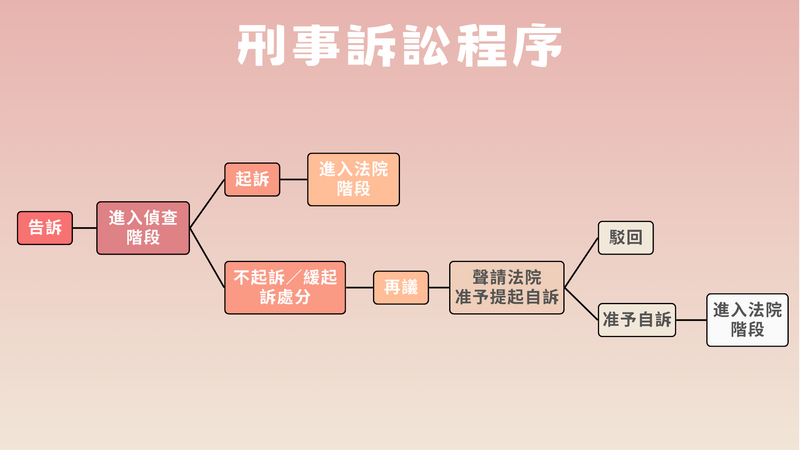
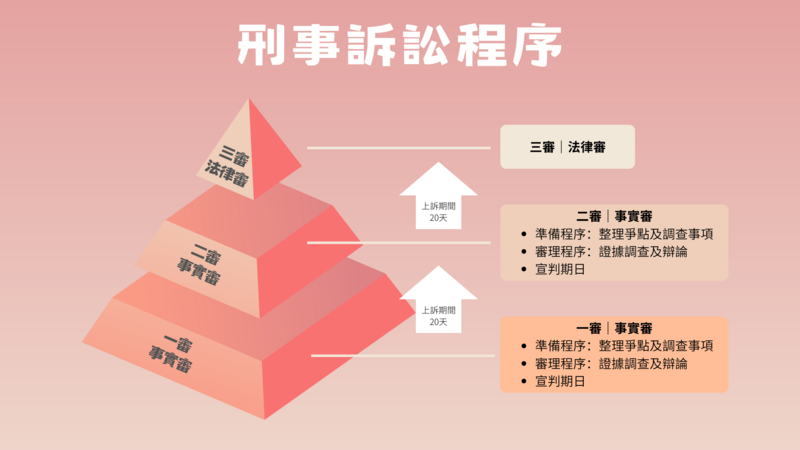
(1) Criminal Procedures:
You must attend in person!
After the opposing party files a complaint, it will enter the investigation procedure. Usually, the police will first notify the party by telephone or written notice to go to the police station to make a statement (record a transcript). Afterwards, the case will be transferred to the local district prosecutors office (hereinafter referred to as the prosecutors office) for the prosecutor to continue the investigation. The prosecutor may summon the party again to make a statement and decide whether to indict after conducting the investigation.
At this stage, if the prosecutor believes no crime has been committed, they will directly issue a "non-prosecution disposition." If the opposing party does not file a motion for re-appeal, the case will come to an end. 10
However, after receiving the non-prosecution disposition, the opposing party may "apply for a motion for re-appeal." Under normal circumstances, if the Taiwan High Prosecutors Office (hereinafter referred to as the High Prosecutors Office) believes there are doubts, it will remand the case back to the district prosecutors office for reinvestigation. In this case, you will need to continue waiting for the results of the reinvestigation by the district prosecutors office.
If the High Prosecutors Office believes there are no issues with the non-prosecution disposition, it will dismiss the re-appeal. At this point, if the opposing party still insists on suing, they may retain a lawyer to apply to the court for "permission to file a private prosecution." You will then have to wait for the court's outcome. If the court ultimately dismisses the application and denies private prosecution, the matter will truly come to an end.
(2) If indicted, what are the subsequent procedures?
After the prosecutor files an indictment, the case will be transferred to the court for trial. Upon receiving the court's summons, you must attend court at the designated time. This is usually divided into two stages:
- "Preparation procedure": Primarily deals with sorting out disputed points and investigation matters, including whether you plead guilty, what opinions you have regarding the indictment or the prosecutor's evidence, what evidence you wish to investigate, which witnesses you wish to summon to testify, or applying for expert appraisals and requesting the court to obtain documents from other agencies. All of these can be raised at this stage. 11
- "Trial procedure": Involves conducting evidence investigation and oral arguments. After arguments are concluded, the court will schedule a date to pronounce the judgment, at which point the court's verdict will be known (acquittal, or guilty verdict along with the sentence). About two to three weeks after the pronouncement, you will receive the written judgment mailed by the court, which will set forth the reasoning behind the judgment.
If you are dissatisfied with the court's guilty verdict, you may file an appeal within 20 days of receiving the judgment; similarly, if the opposing party is dissatisfied with the judgment (such as an acquittal, or a guilty verdict where the sentence is deemed too light), they may also ask the prosecutor to file an appeal. Once appealed, the case is not yet final and will be transferred to a second-instance court for review, until a final judgment is rendered.
(3) How should I submit supplementary information or arguments?
If you have evidence you wish to submit, or if you wish to more fully express your thoughts in writing, during the investigation procedure, you can submit a "written brief" to the district prosecutors office; during the court trial procedure, you submit it to the court. It is recommended to keep a "copy for your own records" so that you will know what materials you have actually provided.
(4) How can I find out what documents or statements by other witnesses the opposing party has submitted?
To know these materials and transcript contents, you need to apply for "file review (copying transcripts/records)." However, if the case is still in the investigation stage (police and prosecutor stages), file review is generally not permitted due to the principle of non-disclosure of investigations. If you are indicted, you may apply to the court for "file review", at which point you can view the transcripts of statements made by both parties and witnesses, the evidence provided, and so on. After reviewing the materials, you can also respond more thoroughly in court. Before applying for file review, you can first contact the court clerk to confirm the available time for file review, remember to submit a "File Review Application Form" to the court, and obtain the judge's approval before reviewing the files. For details, please refer to the Regulations Governing Criminal Procedure File Review.
2. Civil Cases:
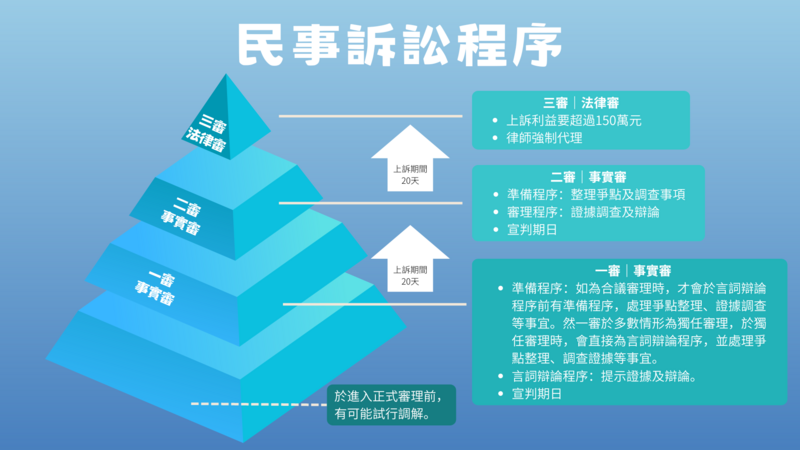
(1) Civil Procedures:
In principle, you may appoint a litigation agent (usually a lawyer) to attend on your behalf!
Upon receiving civil notices from the court, in addition to the court summons, you will also receive a duplicate copy of the opposing party's civil complaint, which will show the grounds for the lawsuit and the attached evidence. If you do not see the evidence attached to the opposing party's complaint, you can apply to the court for file review (detailed below). Civil procedures consist of two stages:
- "Preparation procedure": Primarily deals with sorting out disputed points and investigation matters, including what opinions you have regarding the evidence, what evidence you wish to investigate, which witnesses you wish to summon to testify, or applying for expert appraisals and requesting the court to obtain documents from other agencies. All of these can be raised at this stage.
- "Oral argument procedure": Involves presenting evidence and oral arguments. After arguments are concluded, the court will schedule a date to pronounce the judgment, at which point the court's verdict will be known (dismissal of the plaintiff's action, or judgment ordering a compensation amount). About two to three weeks after pronouncement, you will receive the written judgment mailed by the court, which will set forth the reasoning behind the judgment.
If you are dissatisfied with the court's judgment, you may file an appeal within 20 days of receiving the judgment; similarly, if the opposing party is dissatisfied, they may also file an appeal. Once appealed, the case is not yet final and will be transferred to a second-instance court for review, until a final judgment is rendered.
(2) How should I submit supplementary information or arguments?
If you have evidence you wish to submit, or if you wish to more fully express your thoughts in writing, you can submit a "written brief" to the court.
In addition to keeping your own copy, parties in a civil case must personally send a "duplicate copy" (an identical copy made from the brief submitted to the court) to the opposing party. If the opposing party has retained a lawyer, send it to their lawyer; if the opposing party has no lawyer, send it to their residential address.
(3) How can I find out what documents or statements by other witnesses the opposing party has submitted?
In civil cases, you can directly apply to the court for "file review." The procedure is in principle the same as in criminal cases; for details, please refer to the Regulations Governing Civil Procedure File Review.
Q: What matters should I pay attention to during the statement-taking (transcript recording) or court hearing process?
1. You may have a lawyer accompany you: If you feel stressed about navigating the procedures on your own, you can consider having a lawyer accompany you to make a statement or attend court, and discuss with the lawyer beforehand to alleviate feelings of anxiety.
2. You can organize your notes in advance or provide helpful evidence (such as screenshots of chat logs, surveillance footage, letters, or call logs). If there are witnesses you wish to have summoned, you can also apply to the prosecutor or the court.
3. Read the transcript clearly before signing: Whether in a criminal or civil case, during a court hearing, the court clerk will record the spoken statements in the transcript and display them simultaneously on the computer screen in front of your seat. At this time, you must ensure that the contents of the transcript accurately reflect your intent. If there are any inaccuracies, they must be corrected immediately, and you must verify the transcript before finally signing it, so as to avoid incorrect or incomplete records that could affect your rights.
4. The criminal investigation stage (police and prosecutor stages) requires compliance with the principle of "non-disclosure of investigations," and case details or transcript contents must not be casually disclosed to others.
Q: If the opposing party comes to negotiate a settlement, should I accept?
1. The Meaning of Settlement:
A settlement is an agreement reached between both parties based on mutual consent and mutual concessions. Once the written settlement agreement is signed, both parties must fulfill its terms. In both criminal and civil cases, you may be asked whether you have an "intent to settle.">
2. What is the Settlement Procedure?
A settlement arranged by the prosecutors office or the court may involve scheduling a date to go to a mediation room, assisted by a neutral mediation commissioner. If both parties reach a consensus on terms, a "mediation record" can be signed. Alternatively, a private settlement can be conducted independently or through a lawyer, resulting in a signed "settlement agreement" upon reaching a consensus. However, if a settlement is not established, the original investigation or litigation procedures will continue.
3. What are the Benefits of a Settlement?
If you are accused of criminal defamation, because it is an "offense prosecutable only upon complaint," if a settlement is reached during the investigation stage or before the conclusion of oral arguments in the first instance of the court trial, and the opposing party withdraws the complaint, the case will end. If you are a defendant in a civil case, upon reaching a settlement where the opposing party withdraws the complaint and waives their claims, the case will also end. 12
Concluding a case through settlement spares the party involved from the stress brought by the litigation process, eliminating the need to continue spending time, effort, or money on the case, and removing the worry that the final outcome might fall short of expectations. At the same time, the court will not detail the case facts and judgments in a judgment document, thereby preventing private case details from being made public.
4. What Settlement Conditions Might the Opposing Party Propose?
The opposing party may use the opportunity of a settlement to propose certain conditions to the party involved, such as: deleting the original accusing post, posting an apology or clarification on social media, paying financial compensation, or agreeing not to mention the contents of the sexual harassment incident outwardly in the future (confidentiality clause), etc. These conditions are not necessarily reasonable, so before signing a settlement, you must make sure whether you can accept the opposing party's demands. If you truly cannot accept them, you do not have to agree, and you can let the court continue its trial.
5. Summary:
Mediation is a non-public procedure. Therefore, if mediation fails, the conditions proposed and the conversation contents during the mediation procedure cannot be directly brought out and used as evidence in court in the future.
Hence, whether to reach a settlement with the opposing party requires weighing your own circumstances, the progress of the case, and legal evaluations. Since the settlement process may require continuous communication and negotiation with the opposing party, you need to consider before entering settlement negotiations whether this aligns with your current needs. If the opposing party's proposal is clearly unreasonable, you can also directly express your lack of intent to settle and do not need to force yourself to undergo this procedure.
Conclusion:
In #MeToo incidents, after their wrongdoings are exposed, many perpetrators not only fail to reflect and apologize, but instead use litigation as a tool to try to suppress victims, silence them from speaking out, and create a chilling effect on the public—issues that our society urgently needs to confront.
Many parties involved feel pain and struggle during this process, and experience anxiety over the unfamiliar judicial procedures. In fact, whatever choice is made is a consideration by the party involved, and they should not be blamed, let alone retaliated against.
We sincerely hope that our manual can provide parties involved with a preliminary direction, an understanding of basic legal elements and judicial processes, and slightly alleviate the anxiety brought by this process. We also hope to let the parties involved know that along the way forward, there will be many forces of support, and they do not need to face it alone!
Manual Compilation Credits
Compilation Team: Gender Judicial Reform Group, Judicial Reform Foundation
Special Thanks:
- Wang Ch'en, Attorney at Law
- Hu P'ei-ch'i, Attorney at Law
- Liu Ching-yun, Attorney at Law
- Ch'en Hsun-mei, Attorney at Law
- Chou Meng-ju, Attorney at Law
- Lai Ch'iu-hui, Attorney at Law
- Lin Yen-chun, Attorney at Law
- Sung I-hsin, Attorney at Law
- Li Ming-ju, Deputy Executive Director, JRF
- Lu Cheng-yen, Director of Policy and Legislation Dept., JRF
- Lin Cheng-ching, Legal Policy Researcher, JRF
- Hsieh Chia-chen, Advocacy Specialist, JRF
1 See Article 310, Paragraph 1 of the Criminal Code: "A person who, with intent to distribute to the public, points out or recounts a matter that is sufficient to damage the reputation of another commits the crime of defamation, punishable by up to one year of imprisonment, detention, or a fine of up to 15,000 NTD." Paragraph 2 of the same Article: "A person who commits the crime of the preceding paragraph by distributing writings or drawings shall be sentenced to up to two years of imprisonment, detention, or a fine of up to 30,000 NTD."
2 See Article 310, Paragraph 3 of the Criminal Code.
3 See Constitutional Interpretation Judgment No. 8 of 2023: "Although the speaker cannot prove that their speech is true, if they genuinely underwent a reasonable verification procedure prior to publishing the speech, and based on the evidence obtained, could objectively and reasonably believe the content of their speech to be true, it meets the requirement for exemption from punishment stipulated in the aforementioned provision. Even if the evidence obtained by the speaker through the reasonable verification procedure is not truly authentic, if the speaker did not act with actual malice or gross negligence in citing such unauthentic evidence, it shall still fall under the circumstances exempt from punishment."
4 See Grand Justices Interpretation No. 509: "... The crime of defamation under Article 310, Paragraph 1 and Paragraph 2 of the Criminal Code is established to protect individual legal interests, necessary for preventing the infringement upon the freedom rights of others, and complies with the intent of the provisions of Article 23 of the Constitution. As for the former part of Paragraph 3 of the same article of the Criminal Code, which states that a person who can prove the defamed matter is true shall not be punished, it is a safeguard targeting speech whose content matches the facts, thereby limiting the scope of the penal power; it does not mean that the actor who points out or recounts defamatory matters must personally prove that the content of their speech is indeed true in order to be exempt from criminal liability. However, even if the actor cannot prove the content of the speech to be true, based on the evidence materials they submit, if it is deemed that the actor had reasonable grounds to firmly believe it to be true, they cannot be held criminally liable for defamation..."
5 See Article 311 of the Criminal Code: "A person who in good faith publishes speech and falls under any of the following circumstances shall not be punished: 1. Due to self-defense, self-justification, or protection of legal interests. 2. A public official reporting in the line of duty. 3. Appropriate commentary on a matter subject to public comment. 4. Appropriate recording of reports on central and local government meetings, court proceedings, or public assemblies."
6 See Article 184, Paragraph 1 of the Civil Code: "A person who intentionally or negligently unlawfully infringes upon the rights of another shall bear liability for damages. The same shall apply to one who intentionally inflicts injury upon another through methods contrary to good morals."
7 See Article 195, Paragraph 1 of the Civil Code: "If a person unlawfully infringes upon another's body, health, reputation, freedom, credit, privacy, chastity, or severely infringes upon other personality legal interests, the victim may claim a corresponding amount of compensation even if it is a non-property loss. If their reputation is infringed upon, they may also request appropriate dispositions to restore their reputation."
8 See Constitutional Interpretation Judgment No. 2 of 2022: "... The latter part of Article 195, Paragraph 1 of the Civil Code which provides: 'If their reputation is infringed upon, they may also request appropriate dispositions to restore their reputation.' The 'appropriate disposition' referred to shall not include cases where the court orders the tortfeasor to apologize by judgment, so as to comply with the intent of the Constitution to protect people's freedom of speech and freedom of thought..."
9 See the viewpoints of Supreme Court Judgments 97-Tai-Shang-970 and 96-Tai-Shang-928: "Although an actor's speech damages another's reputation, if the speech constitutes a statement of facts and can be proven true, or even if the actor cannot prove the content of the speech to be true, based on the evidence submitted, it is sufficient to deem that the actor had reasonable grounds to firmly believe it to be true; or if the speech constitutes an expression of opinion, is published in good faith as appropriate commentary on matters subject to public comment, or is made for self-defense, self-justification, or protection of legal interests, regardless of the truth or falsity of the matter, it can hardly be said to be an unlawful infringement of another's rights, and it is difficult to hold them liable for damages arising from a tort." See also Supreme Court Civil Judgment 113-Tai-Shang-57: "Speech published in good faith based on self-defense, self-justification, or the protection of legal interests constitutes the proper exercise of freedom of speech and lacks the illegality of an infringing act."
10 If the court permits the filing of a private prosecution, it will enter the first-instance procedure.
11 For cases handled by a single judge, since the same judge presides over the entire trial, a separate preparation procedure is generally not scheduled; instead, it is consolidated into the oral argument procedure. However, requests for the court to investigate evidence can still be made during court hearings.
12 In offenses prosecutable only upon complaint, if the complainant withdraws the complaint, a non-prosecution disposition is issued by the prosecutor during the investigation, and a judgment of dismissal without prejudice is rendered by the court during trial.
To request a physical copy of the manual, please contact:
- Specialist Hsieh
- Phone: (04)2329-2372 #11
- E-mail: jane@jrf.org.tw
This article is an AI-generated translation of the original Chinese text. In the event of any discrepancy, the Chinese version shall prevail.