
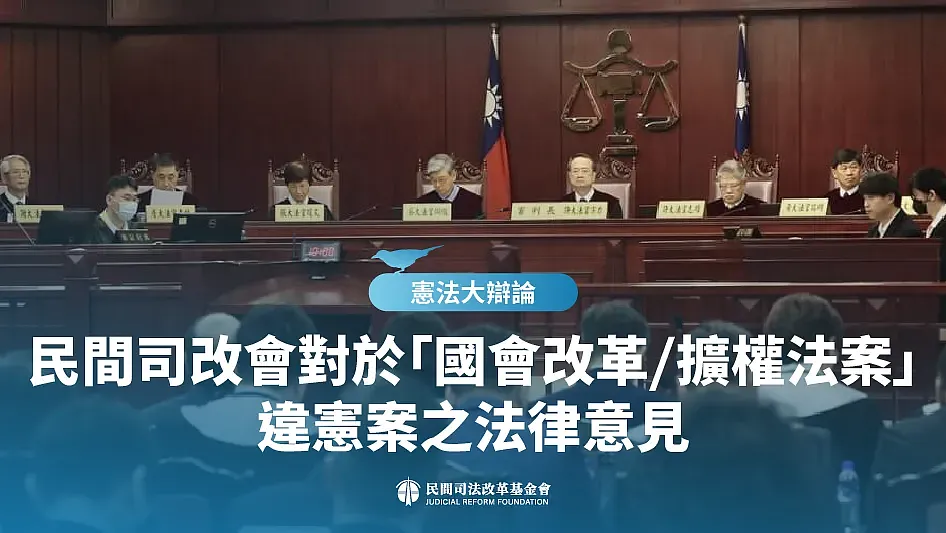
Constitutional Grand Debate | JRF's Legal Opinions on the Unconstitutionality of the "Congressional Reform / Power Expansion Bills"
Last edited: 2026-07-27
Regarding the Constitutional Court's August 6 review of the case concerning the unconstitutionality of the "Congressional Reform / Power Expansion Bills," the Judicial Reform Foundation (JRF) already submitted a 40-page amicus curiae brief (full text link), which the Citizen Congress Watch also joined as a co-petitioner.
The core of this brief is to clarify the concept of the "principle of the separation of powers." According to this principle, different constitutional organs bear different responsibilities; arbitrarily disrupting this division of labor without amending the Constitution could impair Taiwan's constitutional order of free democracy.
From this perspective, the legislative power is a power directed at prior and abstract rules. Therefore, in principle, the parliamentary investigative power must not interfere with retrospective individual cases and substitute or influence the operations of the judicial and control powers. While "exposure of malpractice" is indeed an important public interest value, the pursuit of relevant legal liabilities should be carried out by independent judicial organs; conversely, if political parties handle this through political means, not only will it fail to help clarify the facts, but it may also exacerbate political chaos. In this regard, certain provisions in the recent legislative amendments concerning the exercise of investigative powers and the holding of hearings raise concerns of unconstitutionality.
In addition, regarding the strengthening of the supervision of the executive power, placing the Legislative Yuan in a dominant position and coercively requiring the executive power to simply obey in a top-down manner fails to promote responsible government or strengthen policy debate; it may even exacerbate negative consequences such as talking past each other and institutional confrontation, which is also inconsistent with the "principle of the separation of powers." In this regard, although the operation of the past interpellation system warrants review, the direction of the recent legislative amendments indeed raises concerns of unconstitutionality.
To promote social communication and the exchange of legal opinions, we summarize the conclusions of the amicus curiae brief as follows:
1. The legislation in this case failed to adhere to due process and is in need of review and improvement.
2. Certain amendments to the Act Governing the Legislative Yuan's Power concerning the exercise of the interpellation power raise constitutional concerns.
3. Certain amendments to the Act Governing the Legislative Yuan's Power concerning the exercise of congressional investigative powers raise constitutional concerns.
4. Certain amendments to the Act Governing the Legislative Yuan's Power concerning the holding of hearings raise constitutional concerns.
(For the old-versus-new comparison regarding the passed provisions, please refer to the comparison table.)
I. The legislation in this case failed to adhere to due process and is in need of review and improvement
Comparing the review procedures for "counter-motions" by parliaments in the United States, Germany, and our country, it can be found that they merely serve as tools for majority parties to vie for precedence in voting, lacking a "close connection" or "substantial connection" with the original bill, thus violating due process. The Constitutional Court has not accepted a case involving legislative procedural defects for as long as 24 years, and has not had the opportunity to express its views on the abuse of "counter-motions" in legislative practice. Now, with the development of our country's democratic politics and significant changes in the social environment, the legislative procedural defects in this case and the resulting physical clashes have been broadcast live in audio and video throughout the process, witnessed and heard by the general public, and widely disseminated through social networking sites, audiovisual platforms, traditional media, and other channels.
Considering the deepening of democracy and further demands from our country's civil society regarding the quality and output of democracy, and foreseeing the future development of congressional reform, if we self-impose restrictions and refuse to specify the standards of due legislative process that the Legislative Yuan must follow, allowing ruling and opposition parties to suppress each other after winning a majority of seats in elections (whether past ruling parties or current opposition parties), such an eye-for-an-eye cycle will inevitably cause our country's parliamentary democracy to continuously spiral downward. In this regard, we believe that the legislative process of this case failed to undergo due deliberation procedures and is in need of review and improvement.
II. Certain amendments to the Act Governing the Legislative Yuan's Power concerning the exercise of the interpellation power raise constitutional concerns
(1) According to the intent of past constitutional interpretations, for the Legislative Yuan to exercise the file-requesting power, it must do so in the name of the organ through specific procedures. However, the recent amendments allow individual legislators to use the name of interpellation to achieve the acquisition of reference materials and the request of files, while evading various procedural and conditional restrictions.
In this regard, Article 25, Paragraph 2 of the Act Governing the Legislative Yuan's Power raises concerns of unconstitutionality.
(2) The recent amendments authorize the Legislative Yuan to impose administrative fines, refer for impeachment and disciplinary action, and pursue criminal liability against the interpellated Premier of the Executive Yuan or heads of various ministries and commissions. Such legal accountability mechanisms exceed the institutional purpose of interpellations—which is to implement political accountability—and lead to difficulties in clarifying political responsibility, which is inconsistent with the constitutional principle of responsible government and further undermines the equal status of the executive and legislative branches, violating the principle of the separation of powers.
Regarding the Legislative Yuan's supervision of the Executive Yuan, legal responsibilities arising from illegality, dereliction of duty, or corruption are naturally investigated and prosecuted by independent prosecution and investigative organs. When exercising its powers, if the Legislative Yuan discovers that administrative officials are involved in illegalities, it may of course report crimes; however, as the maker of laws and rules, it is inappropriate for the Legislative Yuan to directly pursue them itself. The pursuit of political responsibility requires a high degree of political nature, value judgment, and the demand for dialogue within a democratic mechanism; therefore, our country's Constitution resorts to the principle of responsible government rather than imposing legal liabilities through legal instruments. Nevertheless, the recent partial amendments regarding the interpellation power are tantamount to admitting that legislators can use legal instruments to attack one another regarding the attribution and confirmation of political responsibility, aggravating political chaos and polarization, which is clearly detrimental to the maintenance and development of democratic politics.
In this regard, Article 25, Paragraphs 5, 6, 8, and 9 of the Act Governing the Legislative Yuan's Power and Article 141-1 of the Criminal Code raise concerns of unconstitutionality.
(3) The recent amendments confer upon the Legislative Yuan the power to refer interpellated persons for disciplinary action, which in nature is similar to the power of impeachment exclusive to the Control Yuan, infringing upon the core power domain of the Control Yuan and conflicting with the principle of the separation of powers; the same provision conferring upon the Legislative Yuan the power to refer for impeachment lacks binding force upon the Control Yuan—which is in charge of impeachment—because it exceeds its constitutional powers.
In this regard, Article 25, Paragraph 8 of the Act Governing the Legislative Yuan's Power raises concerns of unconstitutionality. Based on similar reasoning, Article 48, Paragraph 1 and Article 59-5, Paragraph 4 of the Act Governing the Legislative Yuan's Power are also improper.
(4) Regarding the part in the recent amendments concerning "no counter-interpellation," the regulated persons cannot foresee which words and deeds will be punished. It is basically judged based on the meeting chairperson's attitude toward the interpellated person combined with their subjective perception, leaving room for arbitrary law enforcement, which should violate the principle of clarity of laws.
At the same time, based on the reasoning in (2) above, this provision also violates the principle of the separation of powers.
In this regard, Article 25, Paragraph 1 of the Act Governing the Legislative Yuan's Power raises concerns of unconstitutionality.
III. Certain amendments to the Act Governing the Legislative Yuan's Power concerning the exercise of congressional investigative powers raise constitutional concerns
(1) Regarding the exercise of congressional investigative powers, the recent amendments allow the Legislative Yuan to continue investigations into cases already underway in other independent organs; regarding the effect of investigative reports, they do not rule out the possibility of binding the Control Yuan; the objects of exercise may cover the Presidents of the Judicial, Examination, and Control Yuan as well as independent organs, which violates the principle of the separation of powers.
In this regard, Article 46-2, Paragraph 3, Article 47, and Article 53-1, Paragraph 2 of the Act Governing the Legislative Yuan's Power raise concerns of unconstitutionality.
(2) The initiation of congressional investigative powers is not limited to matters "having a major connection with the powers" of the Legislative Yuan, which is also inconsistent with past constitutional interpretations.
(3) The provision forcing ordinary citizens to participate in investigations under penalty of a fine exceeds the intent of Article 67, Paragraph 2 of the Constitution. In this regard, Article 48, Paragraph 2 of the Act Governing the Legislative Yuan's Power raises concerns of unconstitutionality. Based on the same reasoning, Article 59-5, Paragraph 2 of the Act Governing the Legislative Yuan's Power also raises concerns of unconstitutionality.
Furthermore, current laws largely lack procedural protections for people under investigation, and place improper restrictions on the rights to refuse testimony, be accompanied by a lawyer, and receive assistance. In this regard, Article 50-1, Paragraph 5, Article 50-1, and Article 59-4 of the Act Governing the Legislative Yuan's Power raise concerns of unconstitutionality.
(4) The concerns regarding the unconstitutionality of Article 48, Paragraph 1 of the Act Governing the Legislative Yuan's Power are as stated above.
IV. Certain amendments to the Act Governing the Legislative Yuan's Power concerning the holding of hearings raise constitutional concerns
(1) Regarding the compulsion of officials to attend hearings under penalty of a fine, because it does not exclude application to personnel of the Judicial Yuan, Control Yuan, Examination Yuan, and independent organs, it raises concerns of infringing upon the independence of their exercise of powers, which is inconsistent with past constitutional interpretations and the principle of the separation of powers. In this regard, Article 59-5, Paragraph 2 of the Act Governing the Legislative Yuan's Power raises concerns of unconstitutionality.
(2) The concerns regarding the unconstitutionality of Article 59-4 and Article 59-5, Paragraph 4 of the Act Governing the Legislative Yuan's Power are as stated above.
Press Contact
Lü Cheng-yen, Attorney-at-Law, Director of the Legal Policy Department, Judicial Reform Foundation
Phone: 02-2523-1178 #37
Email: elvin@jrf.org.tw
This article is an AI-generated translation of the original Chinese text. In the event of any discrepancy, the Chinese version shall prevail.