
JRF Newsletter
July E-Paper | Wrongful Convictions? State Compensation? Who Is Writing a Lifelong Practice Exercise...
Last edited: 2026-07-27
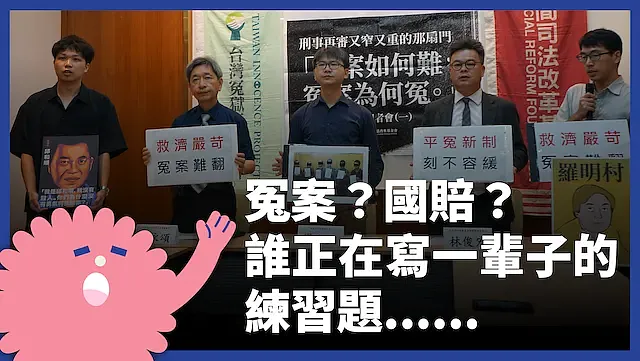
How Difficult Are Difficult Cases, and Why Are Wrongful Convictions Wrongful?—CCRC Press Conference Series (I)
Thank you for your continuous support of our wrongful conviction work. One of JRF's focal points for wrongful conviction advocacy in the second half of the year is holding the press conference series on the "Criminal Finalized Case Review Mechanism."
The redress of wrongful convictions is a belated yet essential justice that can be granted to innocent victims of the judicial system. However, Taiwan's criminal procedure offers limited safeguards for wrongful conviction relief, making it difficult for innocent individuals to effectively seek redress through judicial channels. Nonetheless, wrongful conviction rescue is not without solutions.
Through a series of three press conferences, we will explain the respective systemic problems existing in Taiwan's "criminal retrial," "extraordinary appeal," and "review committee for finalized guilty verdicts." The solution to these issues was in fact already pointed out in the 5-4 resolution of the 2017 National Congress on Judicial Reform: The government should study foreign systems and deliberate on establishing a "Criminal Finalized Case Review Mechanism" that exercises its powers independently. Examples include independent bodies such as the Criminal Cases Review Commission (CCRC) in countries like the United Kingdom.
The theme of the first press conference in this series was the flaws in Taiwan's "criminal retrial" system. The conditions for criminal retrial in Taiwan are extremely stringent; even after requirements were relaxed in the 2015 legal amendments, the approval rate for retrials remains exceptionally low, and the function of retrials remains a drop in the bucket. The primary reason still lies within the judicial trial system and court culture, where it is often difficult to alter established perceptions of the facts of the original case once a judgment has been finalized. The press conference specifically cited JRF's rescue cases of Lo Ming-ts'un (羅明村) and Chiou Ho-shun (邱和順), whose cases have been highlighted with doubts in Control Yuan investigation reports. These innocent individuals remain imprisoned, are growing old, and are racing against failing health, thereby conveying the urgency of systemic reform.
Please refer to the link below for the complete contents of this press conference. There will subsequently be two more press conferences focusing on "extraordinary appeals" and the "review committee for finalized guilty verdicts." Please continue to follow JRF's official website, social media, and e-paper!
Further Reading:
▍The Narrow and Heavy Door of Criminal Retrials—"How Difficult Are Difficult Cases, and Why Are Wrongful Convictions Wrongful?" Press Conference Series (I)
▍Understanding the CCRC System—Excerpt from *The Reason for Doubt: The Case for a Criminal Cases Review Commission*

Hit by a Falling Tree or Rock: Who Can Actually Claim State Compensation? It Turns Out Foreigners Can Request State Compensation Too!
Since its enactment in 1980, aside from minor amendments in 2019, the State Compensation Act has not undergone comprehensive adjustments in response to changing times and practical interpretations.
In September 2021, the Executive Yuan proposed an amendment draft expanding the articles from 17 to 43, specifically reviewing the stringent conditions for state compensation liabilities of courts and prosecutors' offices, but did so without holding public hearings to build consensus.
Many legal professionals and organizations considered the progress of the draft limited and in need of further review. For this reason, the Judicial Reform Foundation initiated legislative deliberations on the State Compensation Act in October 2021, ultimately formulating a civil society version of the amendment draft by the end of 2022. In August 2023, JRF invited groups and legal professionals interested in this legislative issue to jointly host and participate in an academic seminar based on the contents of both the civil society version and the Executive Yuan version.
Waiting until the next Legislative Yuan session this year, JRF will officially issue an official document to the Executive Yuan, hoping that the Executive Yuan will incorporate the civil society version of the State Compensation Act draft as a reference for future system implementation.
This episode of JRF Legal Forum (filmed in September 2023) features Attorney Chiang Jung-hsiang (江榮祥), JRF Executive Director and one of the moderators of the State Compensation Act seminar, providing a brief introduction to the State Compensation Act.
▍Video Highlights:
📍What is state compensation? Under what circumstances can one apply for state compensation?
📍Are foreigners coming to Taiwan eligible for state compensation? Are Chinese nationals excluded from compensation?
📍What are the controversies surrounding the State Compensation Act?
📍Progress of the legal amendments
Further Reading:
▍Comprehensive Review of 40 Years of the Implementation of the State Compensation Act—Principles of Attribution, Judicial Accountability, and Proposed Civil Society Provisions
▍Op-Ed | Does the Amendment to the State Compensation Act Harm Judicial Independence? Judge Immunity ≠ State Immunity
▍Op-Ed | Citizens' Claims for State Compensation and Judicial Independence Are Not a Zero-Sum Game
This article is an AI-generated translation of the original Chinese text. In the event of any discrepancy, the Chinese version shall prevail.