
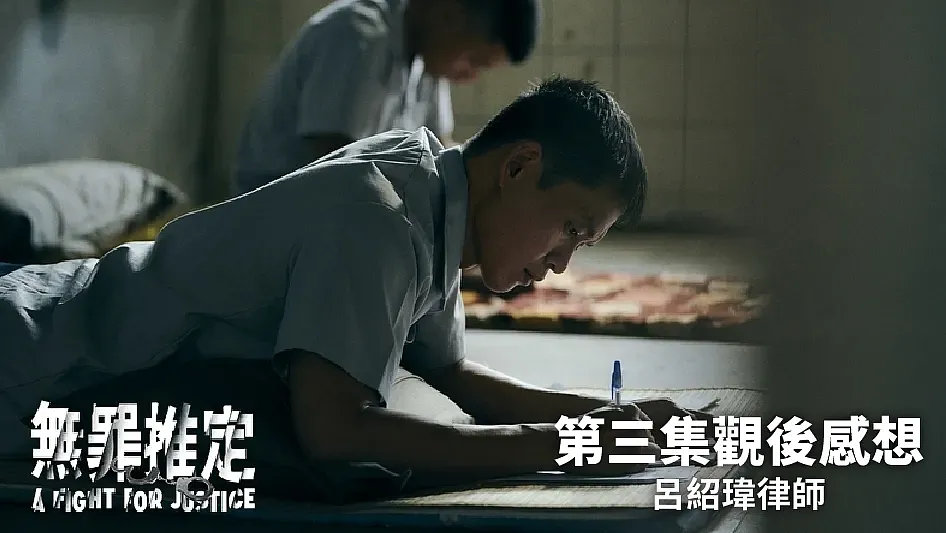
Review | "Innocence" Episode 3
Last edited: 2026-11-03
The following review contains spoilers for practical purposes. It is recommended to watch Episode 3 before reading this article.
(一)Prisoners Outside the Walls
This episode begins with Yang Ming-te (alluding to the real-life figure Hsu Tzu-chiang) writing a suicide note, having completely given up on clearing his name, and cuts to Yang's mother rushing around for her son's innocence, taking care of her grandson, and serving her alcoholic father. The director focuses the lens on Yang Ming-te's family, offering viewers a different perspective. Based on the author's practical experience, the situation is largely similar: when someone is imprisoned or detained, the suffering is often not borne solely by the person locked away. Their family members outside the bars, while enjoying physical freedom, have their souls deeply confined. General inmates' families must face such immense physical and mental torment, let alone the wrongfully accused Yang Ming-te (Hsu Tzu-chiang) in this drama. The author cannot help but think of Taiwan's famous miscarriage of justice—the Chiang Kuo-ching case. Aside from Chiang Kuo-ching himself dying an unjust death, his father spent the second half of his life running about to clear his son's name, unable to see vindication even in death. The words "Heaven has no justice" written by Chiang's father when claiming his son's body should be constantly remembered by all legal professionals. Adjudication is humans engaging in God's work, and especially when facing a death sentence, one should tread as if facing an abyss or walking on thin ice.
(二)Where There Is a Will, There Are All Means
During student days, a teacher once shared this: "Where there is a will, success does not necessarily follow, for after all, many factors determining success or failure are beyond one's control. But where there is a will, one must find all means!" How true these words are. Since practicing as an attorney, the author's sentiment toward this remark has grown day by day. A good attorney cannot rely solely on litigation strategy; they must also possess out-of-court strategies, comprehensive thinking, and strategic planning. In the drama, the two attorneys, Li Cheng-shuo (played by Chuang K'ai-hsun) and Ch'en Chih-ch'en (played by Chung Ch'eng-han), upon discovering that Yang Ming-te might be sent for execution, thought of the Control Yuan's supervisory power and thus intercepted the execution dossier; then, after multiple failures in extraordinary appeals, they opened up the path of constitutional interpretation. They can be said to be exemplars of "where there is a will, there are all means." The only slight flaw is that the plot here should have given a feeling of a sudden turn of events and a glimmer of hope, but in its presentation, it failed to make the author feel this dramatic tension; moreover, after the Grand Justices' interpretation was released, only a few lines of dialogue mentioned Interpretation No. 582 before hastily moving on, ignoring that the audience are not legal industry professionals and should find Interpretation No. 582 even more unfamiliar than the Eighteen Dragon Subduing Palms. If it could have been appropriately explained, it would have helped the audience resonate more.
(三) The JRF That Judicial Officers Dislike?
A very interesting part of this episode is the segment depicting judges launching attacks on the Judicial Reform Foundation (JRF). Indeed, the JRF has never enjoyed a stellar reputation within the judicial circles; judicial officers even frequently joked that the JRF is not trying to reform the judiciary, but rather to reform the judicial officers. Given the time and space background of this drama, a profound confrontation did indeed exist between the JRF and the judicial circles. However, this was simply the inevitable direction of things, as the JRF aims for judicial reform and inevitably offends many people in the process, much like Wang Anshi's reforms—one can hardly seek to reform while simultaneously currying favor with the conservative faction. As time marches forward, judicial officers with new eras and new mindsets have successively joined the legal profession, and the JRF and judicial circles are no longer so strictly demarcated. Beyond monitoring the judiciary, the JRF has also taken note of the problem of judicial officers being overburdened, spending a great deal of effort on this in recent years. When presenting ideas to communicate with the judicial circles, it has also greatly surprised attending representatives. The transition from early antagonism to the current establishment of mutual communication channels is probably something the judges of the drama's era could hardly have imagined.
(四)Trivia Supplement
Because attorney Li Cheng-shuo (Chuang K'ai-hsun) in the drama once scolded another attorney, asking if he had even forgotten the attorney's oath, this article supplements the oath that every attorney must take upon completing training: "I, ○○○, do solemnly and sincerely swear: From the moment I become an attorney, my mission shall be to safeguard human rights, realize social justice, and promote democracy and the rule of law. To fulfill the aforementioned mission: 1. I shall bear in mind that being an attorney is a public office rather than merely a livelihood, and while seeking the best interests of clients, I shall concurrently account for the public interest. 2. I shall abide by the Attorney Regulation Act, attorney ethics norms, and related regulations. 3. I shall defend human rights and exercise my profession with conscience and professional standards. 4. I shall devote myself to public service to help justice manifest. 5. I shall continuously improve my learning and keep pace with the times. 6. Icarry out my practice honestly and shall not obstruct the realization of fair justice in pursuit of victory. 7. I shall strictly guard client confidentiality to make myself trustworthy. 8. I shall abide by the law and strive to make the law conform to social justice. 9. I shall uphold the spirit of the independent bar and supervise the government in safeguarding democracy and the rule of law. 10. I shall fully respect the people I encounter in the course of my practice and treat my fellow attorneys with mutual respect. Throughout my legal career, in speech, thought, action, and conduct, I shall strive to make the legal profession a respected one." Among these, the portion Attorney Li Cheng-shuo referred to is believed by the author to be "3. I shall defend human rights and exercise my profession with conscience and professional standards," reflecting the view that the counterpart did not defend the innocent with professional standards.
This article is an AI-generated translation of the original Chinese text. In the event of any discrepancy, the Chinese version shall prevail.